
Last Updated: September 18, 2026
Honey bee symbolism shows up in more places than most people realize — on wedding invitations, in tattoo shops, stitched onto quilts, and carved into old churches. Part of the reason is simple: bees are one of the few insects that most people actually like. They build, they cooperate, and they produce something sweet and useful, which makes them easy to turn into a symbol for hard work, community, and reward.
People look into what a symbol like this means for a few different reasons. Some are choosing a tattoo and want it to carry real meaning instead of just looking nice. Others are picking a motif for a wedding, a nursery, or a piece of home decor and want to know if it fits the occasion. Still others are simply curious why bees keep turning up in flags, coats of arms, and old folklore.
In American culture specifically, the honey bee has picked up a distinct set of associations tied to industriousness, teamwork, and self-reliance — themes that run through everything from early American state seals to modern small-business branding. That gives honey bee symbolism a slightly different flavor in the U.S. than it has in, say, ancient Egyptian or Celtic tradition, even though the roots overlap.
This article walks through where these meanings came from, how they evolved, and how they’re actually used today — separating the historical record from the more romanticized claims that tend to circulate online.
Quick Answer
Honey bee symbolism in modern American culture most commonly represents hard work, teamwork, and productivity, which is why bees appear on business logos, graduation gifts, and “busy bee” sayings. Historically, bees have also symbolized royalty, immortality, and community order, tracing back to ancient Egyptian, Greek, and Christian traditions that viewed the hive as a model of disciplined, cooperative society.
TL;DR
- Bees symbolize industriousness, teamwork, and order in most modern contexts
- Ancient Egypt linked bees to royalty and the tears of the sun god Ra
- Christian tradition used the hive as a model of a well-run community
- Napoleon adopted the bee as a personal emblem tied to immortality and rebirth
- American culture leans on “busy bee” imagery for effort and self-reliance
- Today bees appear widely in tattoos, wedding themes, and environmental messaging
What a Honey Bee Actually Looks Like as a Symbol
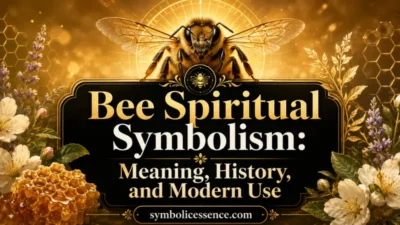
Before getting into meaning, it helps to know what people are actually picturing. The honey bee symbol is almost always a rounded, fuzzy-bodied insect with striped abdomen, four wings, and sometimes a visible stinger — distinct from wasps, which are usually drawn as sleeker and smoother. Artists and designers tend to soften the image: rounder bodies, gentler expressions, and warm yellow-and-black coloring that reads as friendly rather than threatening.
You’ll encounter this imagery on honey jar labels, garden signage, children’s books, wedding stationery, and increasingly on skin as tattoo art. The visual softness matters, because it’s part of why bees carry mostly positive symbolism compared to insects like wasps or hornets, which are visually similar but symbolically read as aggressive or dangerous.
Core Meaning: What Honey Bees Represent Today
At its core, the honey bee stands for three linked ideas: work, cooperation, and productivity. A hive only functions because thousands of individual bees perform specific roles without confusion or conflict, which is why the bee became shorthand for a well-organized effort — a “hive of activity,” a company running like “a well-oiled hive.”
There’s also a secondary meaning tied to sweetness and reward. Honey itself carries connotations of something earned through effort, which is part of why bee imagery often appears alongside messages about patience paying off, or love being “worth the sting.”
A smaller but consistent thread ties bees to resurrection and renewal, largely inherited from older traditions where the yearly disappearance and return of bee colonies was read as a small seasonal death and rebirth.
Historical Origins of Bee Symbolism
Bee imagery is one of the oldest continuously used animal symbols in human history, appearing in art and religious contexts thousands of years before written language systematized their meaning. Early societies noticed something unusual about bees: unlike most insects, they built permanent, highly organized homes, produced a valuable substance, and appeared to operate under some kind of internal order — all of which made them stand out as worth interpreting symbolically rather than just observing as pests.
In ancient Egypt, the bee became connected to kingship. Lower Egypt used the bee as one of its royal emblems, and some traditions held that bees were born from the tears of the sun god Ra as they touched the ground — linking the insect to both divine origin and royal authority.
Greek and Roman writers, including Virgil, described beehives as small, orderly societies worth studying for lessons on governance and cooperation, treating the hive almost like a miniature well-run city-state.
Bees in Religious and Mythological Traditions
Christian tradition picked up much of the classical fascination with hive order and reworked it into moral teaching. Medieval writers frequently used the beehive as a metaphor for a properly functioning church or community — every member contributing, no one idle, the whole working toward a shared, sweet outcome. Bees also appear in some Christian art as symbols of eloquence and diligence, occasionally tied to specific saints associated with preaching or teaching.
In Greek mythology, the Melissae were priestesses associated with bees and honey, particularly connected to the goddess Demeter and, in some tellings, to the nurture of the infant Zeus. Norse and Celtic folklore treated bees as messengers able to carry news between the human world and the realm of the dead, which is part of where the old custom of “telling the bees” about a death in the family comes from — a practice some rural communities kept alive well into the 20th century.
What Does a Honey Bee Symbolize in the Bible?
The honey bee has a more complicated biblical connection than many modern symbolism articles suggest. Bees and honey appear in the biblical world, but the Bible does not establish one universal symbolic meaning for the honey bee.
Honey itself often carries positive associations because it represents sweetness, nourishment, abundance, and something desirable. One of the best-known biblical descriptions of the Promised Land calls it a land “flowing with milk and honey,” making honey an image of abundance and provision.
Bees also appear in biblical passages in a more threatening context. In Psalm 118:12, enemies are compared to bees surrounding a person. Deuteronomy 1:44 similarly compares hostile attackers to bees. These passages show why bee imagery cannot simply be labeled as a symbol of good luck or positivity in every biblical context.
Christian writers later developed broader symbolic uses for bees. The organized hive could serve as an illustration of diligence, cooperation, discipline, and communal responsibility. Honey could suggest spiritual sweetness, while the bee’s work could illustrate the value of persistent effort.
So, when people ask for the honey bee symbolism in the Bible, the most accurate answer is that bees do not have one fixed biblical meaning. Depending on the passage or later Christian interpretation, bee imagery can suggest danger, persistence, community, or the relationship between labor and sweetness.
What Does a Honey Bee Symbolize Spiritually?
Honey bee symbolism can carry a spiritual meaning centered on purpose, cooperation, patience, and renewal. Unlike symbols that depend on one specific religious tradition, bees have appeared in many cultures, so their spiritual interpretation changes with context.
A bee can represent purposeful work because every trip from flower to flower contributes to the life of the colony. In a spiritual reading, this can suggest that small actions matter, even when their results are not immediately visible.
Bees can also symbolize community and service. A hive depends on cooperation, which makes the bee a natural image for the idea that individual effort can support something larger than the self. This meaning often resonates with people who value family, community, teaching, caregiving, or service.
Another spiritual association is transformation and renewal. Honey bees turn nectar into honey, creating something valuable through a process of gathering, patience, and change. Because of this, bee imagery can represent turning experience into wisdom or effort into something meaningful.
There is also a spiritual connection to sweetness and reward. Honey has long carried positive associations in religious and cultural traditions, so the honey bee can suggest the relationship between patience and the good things that eventually come from sustained effort.
These meanings should be understood as symbolic interpretations rather than universal spiritual rules. A bee in a religious painting, a personal dream, a tattoo, or a family emblem may carry a very different meaning depending on the surrounding imagery and the person’s beliefs.
Symbolism in the United States
In the U.S., honey bee symbolism has developed a fairly practical, less mystical flavor than in older European or Egyptian traditions. Americans tend to read the bee less as a royal or spiritual emblem and more as a symbol of individual effort inside a larger cooperative system — a good fit for a culture that prizes both hard work and community-mindedness at the same time.
This shows up concretely in state symbolism: Utah’s state emblem is the beehive, chosen by early Mormon settlers to represent industry, self-reliance, and cooperative labor, and it still appears on the state flag and seal today. “Beehive” was even briefly considered as a name for the Utah territory itself.
The bee also shows up heavily in American education culture through spelling bees, a phrase that has nothing to do with insects linguistically but has folded bee imagery into the branding of academic effort and competition anyway — trophies, mascots, and decor all lean on the insect even though the word’s origin is separate.
Cross-Cultural Meaning Beyond the U.S.
Outside the U.S., bee symbolism carries some meanings Americans don’t typically emphasize. In French imperial history, Napoleon Bonaparte adopted the bee as his personal emblem, partly to link his new dynasty to older French royal tradition and partly because the bee’s associations with immortality and rebirth suited his self-image as a builder of a new order.
In parts of West Africa and the African diaspora, bees and honey appear in folklore tied to prosperity and hidden knowledge, sometimes as messengers or protective spirits, though specifics vary widely by region and shouldn’t be flattened into a single tradition.
Chinese symbolism has also used the bee, though far less prominently than in Western tradition, sometimes pairing it with flowers in art as a general symbol of hard work and seasonal abundance rather than anything spiritual.
Table: Honey Bee Symbolism at a Glance
| Context | Meaning in the USA | Common Associations | Notes |
|---|---|---|---|
| State symbolism (Utah) | Industry and self-reliance | Beehive on flag and seal | Rooted in 19th-century settler values |
| Tattoos | Personal resilience, hard work | Sting balanced with sweetness | Popular in minimalist and botanical styles |
| Weddings | Partnership and sweetness of union | “Meant to bee” phrasing | Plays on wordplay more than deep tradition |
| Business branding | Productivity and teamwork | Logos, mascots, “busy bee” language | Common in startups and small businesses |
| Environmental messaging | Fragility of ecosystems | Pollinator decline awareness | A newer, 21st-century layer of meaning |
Honey Bee vs. Beehive Symbolism: What Is the Difference?
Honey bee symbolism and beehive symbolism overlap, but they are not exactly the same.
The individual honey bee tends to emphasize action. It can represent hard work, persistence, productivity, resilience, or personal contribution. The bee moves from place to place, gathers resources, and performs a useful role within the colony.
The beehive places more emphasis on the group. It can symbolize community, organization, cooperation, shared responsibility, and a society built through collective effort.
The honeycomb adds another layer. Its repeating hexagonal cells often suggest structure, order, efficiency, connection, and the way individual parts fit together into a larger system.
Utah provides a clear American example of the distinction. The state’s official symbolism connects the beehive with “Industry,” community, cooperation, and Utah’s history. The beehive remains a central symbol of Utah’s identity.
So, if a person chooses a bee, the emphasis may fall on personal effort or resilience. If they choose a hive, the emphasis may shift toward family, community, teamwork, or shared purpose. A honeycomb often highlights structure and connection.
Emotional and Psychological Meaning
Psychologically, bee imagery tends to communicate a specific kind of identity: someone who values effort over shortcuts, and who sees their contribution as part of something larger than themselves. That’s different from a symbol like the lone wolf, which signals independence at the expense of group belonging — the bee’s meaning depends on the group even while celebrating individual effort within it.
There’s also a gentler emotional layer tied to sweetness and reward. People drawn to bee symbolism often connect it to the idea that good things take sustained, sometimes uncomfortable effort — the sting is part of the deal, not a flaw in it.
Honey Bee Symbolism in Dreams: What Can It Mean?
Honey bee dreams can take many forms, so the meaning depends heavily on what the bee was doing and how you felt during the dream. There is no single scientific or universal interpretation of dreaming about bees.
A calm bee may fit a personal association with productivity, cooperation, nature, or something rewarding that requires patience. If the bee is gathering nectar or moving peacefully among flowers, the imagery may remind you of steady progress or work that has a meaningful purpose.
A swarm of bees can suggest a very different emotional experience. If the dream feels overwhelming, the swarm may reflect feelings of pressure, social demands, or too many responsibilities. If the swarm feels peaceful, it might instead emphasize community, activity, or belonging.
Being stung by a bee may draw attention to a painful experience, conflict, warning, or situation where something positive also carries a risk. The familiar idea of getting “the sweetness with the sting” can make bee imagery especially useful for representing mixed emotions.
A hive can point toward family, teamwork, organization, or a structured community. For someone who feels supported by a group, the hive may feel comforting. For someone who feels controlled or overworked, the same image may feel restrictive.
The most useful way to interpret a bee dream is to consider the emotional tone first. Ask what the bee represented to you personally, what happened immediately before the dream, and whether the imagery connects with work, relationships, family, responsibility, or change in your waking life.
Why Honey Bees Appear in Tattoos and Personal Style
Bee tattoos have grown steadily in popularity, especially in fine-line and botanical tattoo styles. Common reasons people choose one include marking a period of hard-won personal growth, honoring a family member associated with beekeeping, or simply liking the visual balance of something soft-looking that can still sting.
Placement and styling often shift the meaning slightly. A bee paired with a skull tends to reference mortality and the fragility of effort, while a bee paired with flowers usually leans toward growth, femininity, or nurturing. A solitary bee, drawn without a hive in sight, is sometimes chosen specifically to represent resilience or independence despite having grown up in a highly structured or demanding environment.
Honey Bee Symbolism for Tattoos: Meaning Behind Popular Designs
Honey bee tattoos can represent several ideas at once, which makes them especially flexible as personal symbols. The most common themes include hard work, resilience, community, loyalty, sweetness, and personal growth.
A single honey bee tattoo often emphasizes individual effort. It can represent someone who works steadily toward a goal while still recognizing the importance of connection with others.
A bee and flower tattoo usually creates a stronger connection with nature, growth, beauty, and renewal. The flower also emphasizes the bee’s role as a pollinator, giving the design a natural rather than purely decorative meaning.
A bee and honeycomb tattoo can highlight structure, family, teamwork, and community. Because the honeycomb consists of connected cells, it works particularly well for people who want a symbol of belonging and shared effort.
A queen bee tattoo can suggest leadership, confidence, authority, or a strong feminine identity. However, the phrase “queen bee” also has social meanings in modern English, so the surrounding design can affect how viewers interpret it.
A bee with a skull introduces mortality and impermanence. The contrast between a productive, life-giving insect and a symbol of death can represent the idea that life is temporary and meaningful work should not be taken for granted.
A bee with a heart often emphasizes love, loyalty, family, or devotion. In contrast, a bee paired with a crown can bring back older associations with royalty, authority, and status.
Ultimately, a bee tattoo does not have one fixed meaning. The design, accompanying symbols, personal experience, and reason for choosing it all shape what the tattoo communicates.
Honey Bees in Weddings and Relationships
Bee imagery has become a recognizable, if lighthearted, wedding motif in the U.S., largely through phrases like “meant to bee” and “the bee’s knees.” Couples use it on invitations, favors, and cake toppers, usually leaning on the wordplay more than any historical tradition of bees representing marriage.
There is a slightly older thread worth noting, though: because beehives function through constant cooperation between individuals with different roles, some couples use bee symbolism more sincerely, as a way of representing partnership built on teamwork rather than romance alone.
Modern Everyday Use of Bee Symbolism
Outside tattoos and weddings, bees show up constantly in everyday American visual culture. Children’s educational materials use bees to teach lessons about teamwork and effort. Home decor leans on bee motifs in kitchens specifically because of the honey connection, often paired with sunflower or gingham patterns in a distinctly rustic-Americana style. Small businesses, especially in food, wellness, and handmade goods, frequently choose bee logos to signal both sweetness and hard work without saying either word directly.
Social media has added a newer layer: bee emojis and imagery are now commonly used to signal environmental awareness, tied to public concern over declining pollinator populations.
Honey Bee Symbolism and Pollinator Conservation
The modern honey bee has gained another important layer of symbolism: pollinator conservation.
For many Americans, a bee now represents more than hard work or teamwork. It can also represent healthy ecosystems, food production, biodiversity, and the need to protect pollinators. This meaning grew alongside greater public awareness of the role bees play in agriculture.
The USDA notes that the United States has more than 4,000 native bee species, while the European honey bee (Apis mellifera) remains a major managed pollinator in American agriculture. Honey bees are not native to the United States, which is an important distinction when discussing bee conservation.
This distinction matters because “save the bees” does not refer only to honey bees. Native bees, including bumble bees, mason bees, leafcutter bees, and many other species, also contribute to pollination and face challenges such as habitat loss, disease, parasites, and environmental contaminants.
As a result, contemporary bee imagery can symbolize environmental responsibility. A bee printed on a reusable product, garden sign, conservation campaign, or wildflower package may communicate support for pollinators rather than the older ideas of industry and productivity.
This environmental meaning adds an interesting modern layer to honey bee symbolism. Historically, people often looked at bees as a model for human society. Today, people also look at bees as reminders of the relationship between human communities and the natural systems that support them.
Controversies and Misunderstandings
Most bee symbolism is genuinely positive, but a few misunderstandings persist. One common mix-up is conflating bees with wasps or hornets in fear-based contexts — the aggressive, stinging insect people are usually afraid of is a wasp, not a honey bee, which is far less aggressive and dies after stinging.
There’s also a modern tension between bee-as-symbol and bee-as-species. Environmental groups have used the honey bee heavily in awareness campaigns about pollinator decline, which is well-intentioned but sometimes oversimplifies a more complicated ecological picture, since native wild bees are often more at risk than managed honey bee colonies.
Historically, some monarchist and nationalist movements borrowed bee imagery specifically for its royal and hierarchical associations, which is worth noting only because it shows the same symbol can be read very differently depending on who’s using it and why — a reminder to separate the older political use from the mostly personal, positive meaning it carries today.
How the Meaning of the Bee Symbol Has Evolved
The throughline across centuries is a shift from top-down to bottom-up meaning. Ancient and medieval uses of the bee tended to emphasize hierarchy — a queen, an ordered society, a model for kings and churches to imitate. Modern American use has largely flipped that emphasis toward the individual worker: effort, contribution, and personal resilience rather than obedience to a larger structure.
The newest layer, environmental symbolism, is barely a generation old but has already become one of the most common associations people make with bees, alongside the older industriousness theme rather than replacing it.
FAQs
What does a bee tattoo symbolize?
A bee tattoo typically represents hard work, resilience, and community, though the exact meaning often shifts based on what it’s paired with. A bee next to flowers usually signals growth or nurturing, while a solitary bee often represents personal independence or grit.
Is the honey bee a symbol of good luck?
Bees aren’t traditionally a primary good-luck symbol in American culture, but they carry a closely related meaning around reward for effort. In some older European folk traditions, a bee landing on you or entering your home was considered a sign of good fortune or an important visitor.
Why is the beehive Utah’s state symbol?
Early settlers in Utah adopted the beehive to represent industry, self-reliance, and cooperative community effort, values central to building the territory. It remains on the state flag and seal today as one of the most recognizable American uses of bee symbolism.
Do bees symbolize death in any tradition?
Not death exactly, but some older European and Celtic customs involved “telling the bees” about a death in the family, treating bees as messengers between the living and the dead. This reflects a broader folk belief in bees as spiritual go-betweens rather than a symbol of death itself.
What’s the difference between bee and wasp symbolism?
Bees are almost universally read as industrious and community-minded, while wasps are more often associated with aggression or danger, partly because wasps can sting repeatedly and are visually sleeker. The two are frequently confused in casual conversation, even though their symbolic meanings diverge sharply.
Why do bees appear in wedding themes?
Mostly through wordplay like “meant to bee,” though some couples use the imagery more intentionally to represent partnership built on teamwork. It’s a modern, lighthearted use rather than one rooted in older bridal tradition.
What does it mean when bees are used in business logos?
Business use of bee imagery almost always signals productivity, teamwork, and a hardworking, no-shortcuts identity. It’s especially common among small and handmade-goods businesses looking to pair “sweetness” with a work-ethic message.
What does a honey bee tattoo symbolize?
A honey bee tattoo commonly represents hard work, resilience, community, loyalty, growth, or the idea that meaningful rewards require effort. Flowers, honeycombs, skulls, hearts, and crowns can add different layers to the design.
What does a queen bee symbolize?
A queen bee can symbolize leadership, authority, confidence, influence, and feminine power. In personal symbolism, it may represent someone who takes a central role within a family, community, or organization.
Conclusion
Honey bee symbolism has stayed remarkably consistent in its core themes — work, cooperation, and reward — even as the specific context around it has shifted from royal courts and religious sermons to tattoo parlors and wedding invitations. What changes most isn’t the meaning itself but who’s allowed to claim it: once a symbol tied to kings and church order, it’s now used mainly to represent individual effort and personal resilience.
In American culture, that shift lines up neatly with values the country already prizes — self-reliance built through cooperation rather than isolation. Whether it’s stitched into a state flag, inked onto skin, or printed on a jar of local honey, the bee keeps doing the same quiet work it always has: standing in for the idea that something sweet is usually earned.
That consistency, more than any single legend behind it, is probably why the symbol has held up so well across so many centuries and settings.