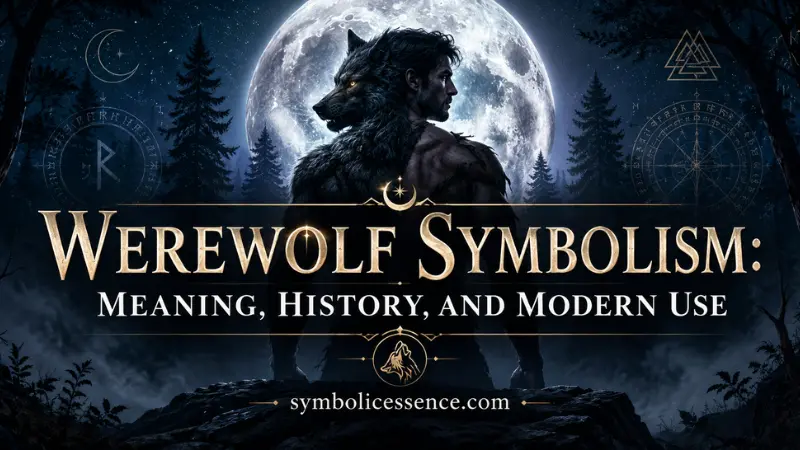
Few figures in folklore have stayed as consistently popular as the werewolf, a creature that manages to be terrifying and sympathetic at the same time. Werewolf symbolism has survived for centuries specifically because it captures something people recognize in themselves: the sense of a controlled, civilized self existing alongside something wilder and harder to manage.
People search out the meaning behind werewolves for a range of reasons. Some are fans of horror and fantasy media who want to understand the roots of a character type they keep encountering. Others are drawn to werewolf imagery for tattoos or personal symbolism, often connecting it to anger, transformation, or a part of themselves they feel they have to keep in check. Still others are simply curious why a European peasant fear from centuries ago turned into one of modern pop culture’s most reliable archetypes.
In the United States, the werewolf has shifted from a figure of real, documented fear into something closer to a cultural shorthand for inner conflict and repressed instinct. That shift says as much about changing American attitudes toward nature, self-control, and mental health as it does about the original folklore. This article traces where the meaning came from, how it evolved, and how it’s used today, separating older documented belief from more modern, symbolic use.
Quick Answer
Werewolf symbolism in modern American culture commonly represents the struggle between civilized self-control and primal instinct, often used to explore themes of repressed anger, hidden identity, or loss of control. Historically, werewolves were tied to real folk beliefs about curses, punishment, and the blurred boundary between human and animal nature in medieval and early modern Europe.
TL;DR
- Werewolves symbolize the tension between control and primal instinct
- Medieval Europe treated werewolf belief as a real, documented fear
- Early folklore linked transformation to curses or divine punishment
- American pop culture reframed werewolves as tragic, sympathetic figures
- Full moon imagery ties werewolves to cycles beyond personal control
- Modern tattoos often use wolves to represent hidden or suppressed rage
What a Werewolf Represents as a Symbol
At its most basic, the werewolf represents the idea that civilization is a thin layer over something more animal underneath. Unlike vampires, who tend to symbolize seduction or aristocratic decay, werewolves are almost always about loss of control — a person transformed against their will into something governed by instinct rather than reason.
This makes the werewolf a flexible symbol for anything involving suppressed impulses: rage, sexuality, addiction, or trauma that surfaces unpredictably. The specific trigger changes depending on the story or context, but the underlying structure stays remarkably consistent — an ordinary person who becomes dangerous the moment their control slips.
Historical Origins of the Werewolf Figure
Werewolf belief has a long, well-documented history in Europe, distinct from most folklore in that it produced actual criminal trials. In the 16th and 17th centuries, several European regions, particularly parts of France and Germany, saw formal legal proceedings against individuals accused of being werewolves, often tied to unsolved attacks on livestock or people. These cases were taken seriously enough to be recorded alongside witch trials of the same era, reflecting genuine belief rather than simple storytelling.
Earlier references appear in ancient Greek mythology, most notably the story of King Lycaon, who was transformed into a wolf by Zeus as punishment for serving human flesh at a banquet — a myth that gave the condition its name, lycanthropy, and set an early pattern linking wolf transformation to violation of basic human decency.
Folklore Traditions Behind the Curse
Across different European folk traditions, becoming a werewolf was explained in several competing ways: an inherited family curse, punishment for a specific sin, the result of a pact with dark forces, or simply being born on a particular date or under specific circumstances. Some regional folklore held that the transformation could be triggered by wearing a wolf pelt or belt, while other traditions treated it as an affliction that could be passed on through a bite or scratch, an idea later folded heavily into modern fiction.
Notably, older European folklore rarely treated werewolves as sympathetic. Unlike the tragic, unwilling figure common in modern stories, many folk accounts describe werewolves as willing participants in a dark bargain, making the shift toward a more pitiable werewolf a distinctly modern development.
Religious and Moral Readings of the Werewolf
Medieval Christian communities frequently interpreted werewolf transformation as evidence of a soul that had opened itself to sin or demonic influence, treating the physical change as an outward sign of inward moral corruption. This framing positioned the werewolf less as a monster to fear physically and more as a warning about what happens when a person surrenders self-discipline entirely.
Some folk-Catholic traditions in parts of Europe also connected werewolf affliction to failure to observe religious obligations properly, treating the curse almost as a consequence for spiritual negligence rather than random misfortune.
Werewolf Symbolism in the United States
American engagement with werewolf symbolism has been shaped far more by film and literature than by any inherited folk tradition, since werewolf belief was never part of indigenous North American folklore in the way it was in parts of Europe. As a result, the American werewolf is largely a media invention layered onto older European source material, reworked to fit modern anxieties.
This shows up clearly in how American horror media uses the werewolf as a stand-in for adolescence and puberty specifically, with transformation often triggered around a character’s coming-of-age, tying werewolf symbolism to loss of innocence and struggling to control a suddenly unfamiliar body. It also appears heavily around Halloween, where the werewolf functions less as a genuine object of fear and more as a costume archetype representing wildness people get to try on for one night.
American storytelling has also leaned into the werewolf as a metaphor for hidden trauma or untreated anger, particularly in fiction where a character’s transformations are triggered by stress, provocation, or an inability to process difficult emotion safely.
Cross-Cultural Meaning Beyond Europe
Shapeshifting predator figures appear well outside the European werewolf tradition, though the specifics vary. Central and South American folklore includes stories of humans transforming into jaguars or other predators, often tied to shamanic practice rather than curse or punishment, representing spiritual power rather than loss of control. Some African folklore traditions include were-hyena or were-leopard figures, generally functioning as warnings about dangerous or untrustworthy individuals within a community rather than sympathetic tragic figures.
These traditions share the core idea of a human capable of becoming a dangerous animal, but they diverge sharply from the European werewolf in tone — many treat the transformation as a source of power or spiritual authority rather than pure affliction.
Table: Werewolf Symbolism at a Glance
| Context | Meaning in the USA | Common Associations | Notes |
|---|---|---|---|
| Halloween costumes | Adventurous wildness, harmless thrill | Full moon, claws, torn clothing | Reads as fun rather than disturbing |
| Tattoos | Internal struggle for self-control | Half-transformed face, moon imagery | Popular for marking anger or recovery work |
| Coming-of-age fiction | Puberty and loss of bodily control | Sudden transformation, hiding a secret | Common trigger tied to adolescence |
| Horror and fantasy media | Repressed instinct, tragic affliction | Curses, bites, pack loyalty | Modern stories favor sympathy over blame |
| Historical folklore | Real, feared threat to a community | Trials, curses, pacts with dark forces | Distinct from modern, more forgiving portrayals |
Emotional and Psychological Meaning
Psychologically, werewolf symbolism resonates because it externalizes something people already sense internally: the fear of losing composure and doing something they can’t take back. That’s different from a purely villainous monster, because the werewolf typically remembers, on some level, being the person who caused harm — making guilt and self-blame part of the symbol in a way that’s less present in other classic monsters.
The full moon detail adds another psychological layer, tying the transformation to something cyclical and outside personal control, which is part of why werewolf imagery resonates with people processing conditions or emotional patterns that feel recurring and difficult to predict, even though the moon itself has no scientifically established effect on human behavior.
Why Werewolves Appear in Tattoos and Personal Style
Werewolf and wolf-transformation tattoos are common choices for people who want to represent an internal struggle rather than a purely external identity. A half-transformed wolf face, in particular, is a popular design specifically because it visually captures the idea of two natures existing in the same body, rather than committing to either a fully human or fully animal image.
Some people choose werewolf imagery to mark recovery from anger issues or a period of feeling out of control, using the design as a personal reminder rather than a horror reference. Others use it more playfully, tied to genre fandom rather than any deeper personal symbolism, which is worth distinguishing since not every werewolf tattoo carries psychological weight.
Werewolves in American Holidays and Seasonal Culture
Halloween is by far the biggest driver of werewolf imagery in everyday American life, where the figure functions as one of the handful of “classic monster” archetypes alongside vampires and mummies. Unlike more overtly gory Halloween imagery, werewolves tend to read as adventurous rather than disturbing, making them a common costume choice for people who want a dramatic look without crossing into genuinely disturbing territory.
Outside Halloween, werewolves rarely appear in mainstream American holiday or ritual life, which sets them apart from symbols like the bee or the wolf itself, both of which carry meaning across a wider range of everyday contexts.
Modern Usage in Pop Culture and Media
Werewolf symbolism has been reshaped heavily by 20th and 21st century film and television, moving the figure from a feared folk belief toward a recognizable genre archetype used to explore identity and belonging. Popular franchises have used werewolf characters to represent everything from teenage transformation to found-family loyalty within a pack structure, often softening the original folklore’s darker, punitive tone.
Video games and tabletop role-playing have also adopted werewolf mythology extensively, frequently reframing the curse as a source of power rather than pure affliction, which mirrors the more favorable view found in some non-European shapeshifter traditions.
Controversies and Misunderstandings
One common misunderstanding is treating all historical werewolf belief as harmless folklore, when in reality werewolf accusations contributed to real trials and executions in early modern Europe, sometimes overlapping with the same social panic that fueled witch trials. This history is worth taking seriously rather than treating purely as entertainment backstory.
There’s also a modern tension between werewolf symbolism used to explore mental health themes, such as anger or trauma, and cases where that connection is made carelessly, implying that people experiencing emotional dysregulation are inherently dangerous or monstrous. Responsible use of the symbol tends to focus on the difficulty of managing intense emotion rather than suggesting that struggling with control makes someone a threat by nature.
Finally, some modern reinterpretations romanticize the werewolf curse as purely empowering, which glosses over the older folklore’s emphasis on loss, punishment, and the werewolf’s frequent inability to control the harm they cause.
How Werewolf Symbolism Has Evolved
The clearest shift in werewolf symbolism is the move from feared, often willing monster to sympathetic, unwilling victim of circumstance. Early folklore and legal history treated the werewolf as someone who had made a choice, however coerced, to embrace a dark power. Modern storytelling almost always removes that agency, making the curse something that happens to a person rather than something they sought.
A second shift is the move from communal fear to personal metaphor. Where older belief was about protecting a village from an actual predator, modern use is almost entirely about understanding an individual’s internal experience of losing control.
FAQs
What does a werewolf tattoo symbolize?
A werewolf tattoo often represents an internal struggle between control and instinct, frequently chosen to mark personal work around anger or emotional regulation. A half-transformed design specifically is popular because it visually holds both a human and animal identity at once.
Are werewolves based on a real historical belief?
Yes, werewolf belief was a genuine part of folk fear in medieval and early modern Europe, serious enough to produce documented criminal trials in the 16th and 17th centuries. This sets werewolves apart from purely fictional monsters, since real people were accused and prosecuted under this belief.
Why are werewolves connected to the full moon?
The full moon connection is largely a later addition to werewolf folklore, popularized heavily by 20th-century film rather than older source material, which had more varied triggers for transformation. It has since become one of the most recognizable parts of the symbol, tying the curse to something cyclical and outside personal control.
Is werewolf symbolism always negative?
Not necessarily. While older folklore treated the curse as punishment, some modern stories and shapeshifter traditions outside Europe frame transformation as a source of power or spiritual connection rather than pure affliction. The tone depends heavily on the specific tradition or story being referenced.
What’s the difference between werewolf and vampire symbolism?
Werewolves typically symbolize loss of control and repressed instinct, while vampires more often represent seduction, temptation, or a kind of aristocratic decay. The two are frequently paired in fiction specifically because they represent contrasting types of monstrous transformation.
Do werewolves have religious meaning?
In medieval Christian tradition, werewolf transformation was often interpreted as outward evidence of inward sin or demonic influence rather than random misfortune. This religious framing treated the physical curse as a consequence of moral failing rather than simple bad luck.
Why do werewolves appear so often in coming-of-age stories?
American media frequently uses werewolf transformation as a metaphor for puberty and the disorienting experience of a suddenly unfamiliar body. This use ties the older folklore’s theme of losing control to a specifically adolescent experience of change.
Conclusion
Werewolf symbolism has held up for centuries because it names something people recognize without needing much explanation: the fear of losing control over yourself and hurting someone in the process. What’s changed most is sympathy — a figure once treated as a willing danger to a community is now more often portrayed as an unwilling victim of forces beyond their control.
In American culture, that shift has turned the werewolf into a flexible tool for talking about anger, trauma, and the parts of ourselves we work hardest to manage, far removed from the documented fear that once put real people on trial.
Whatever form it takes next, the werewolf’s staying power seems to come from that same honest discomfort it’s always represented — the sense that self-control is something maintained, not guaranteed.


