
The red panda is a strange case in the world of animal symbolism: an animal most Americans didn’t know much about until fairly recently, now surrounded by a growing set of meanings borrowed from Himalayan tradition and reshaped by internet culture. Red panda symbolism centers on gentleness, quiet independence, and balance, but understanding why requires looking at both where the animal actually lives and how it became a fixture of American pop culture almost overnight.
Unlike animals with centuries of layered Western mythology behind them, the red panda’s symbolic meaning in the U.S. is largely a recent import, arriving through zoos, nature documentaries, and social media rather than through any long domestic folklore tradition. That makes it a useful case study in how a symbol can take shape quickly once an animal captures public attention.
This piece looks at where red panda symbolism actually comes from in the mountain communities that have lived alongside the animal for generations, and how that meaning has been adapted, simplified, and sometimes flattened as it moved into American culture.
Quick Answer
Red panda symbolism often represents gentleness, uniqueness, curiosity, and quiet strength. In modern American culture, the animal is admired through zoos, art, and pop culture as a symbol of kindness and individuality. Across its Himalayan homeland, red pandas have also been connected with harmony, nature, and positive spiritual meanings.
TL;DR
- Red panda symbolism in the U.S. is mostly recent, not historically rooted
- Himalayan traditions treat the animal as a bringer of luck and protection
- Buddhist symbolism connects it to non-violence and peaceful coexistence
- Nepalese legend claims the animal inspired the country’s original name
- American meaning skews toward cuteness, quirkiness, and gentle resilience
- Conservation status has added urgency to how the symbol gets used
What a Red Panda Actually Looks Like and Where People Encounter It
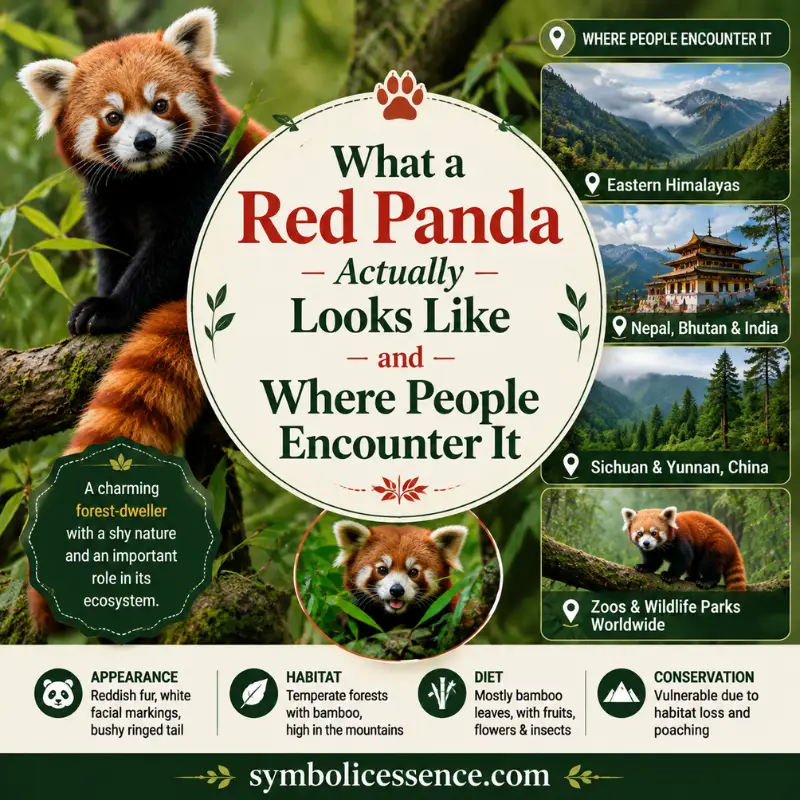
Red pandas are roughly cat-sized, with rust-colored fur, a ringed tail, and a masked white face that gives them an expressive, almost cartoonish look. Despite the name, they aren’t closely related to giant pandas — their closest relatives are actually raccoons and weasels, and their reddish coloring functions as camouflage against the red moss and lichen common in their high-altitude forest habitat.
Most Americans encounter red pandas through zoos, where they’re consistently among the most popular exhibits, or through short videos and photos that circulate widely online. Very few people in the U.S. have ever seen one in the wild, since the species is confined to a narrow band of forest across the Eastern Himalayas and parts of southwestern China — which is part of why its symbolism here has developed so differently from its symbolism in the regions it actually inhabits.
The Core Meaning: Gentleness, Balance, and Quiet Strength
Red panda symbolism consistently centers on a few related ideas: gentleness, balance, and a kind of understated resilience. <cite index=”31-1″>At its core, the red panda symbolizes a blend of softness and strength, embodying the quiet power of a creature that doesn’t need to dominate in order to thrive.</cite> That combination — visibly delicate but genuinely tough enough to survive harsh mountain winters — is the foundation almost every other layer of meaning builds on.
Balance shows up as a recurring theme specifically because of the animal’s behavior and habitat. <cite index=”31-1″>The red panda is often read as representing the importance of maintaining equilibrium in life, reflecting the need to live in alignment with the natural world around oneself.</cite> Unlike louder or more aggressive animal symbols, the red panda’s meaning tends to be built around stillness and observation rather than dramatic action.
Where the Symbolism Originates: Himalayan Tradition
Red panda symbolism has real roots in the mountain communities that share its habitat, long before the animal had any presence in American culture at all. <cite index=”27-1″>In many Himalayan communities, red panda images or figurines are placed at the entrances of homes, based on the belief that doing so invites good luck and protection into the household.</cite> <cite index=”29-1″>Local legends describe red pandas as magical creatures capable of bringing good fortune to those who encounter them, sometimes appearing in folk stories as guides that help lost travelers find their way home.</cite>
Nepal carries a particularly striking piece of red panda folklore tied directly to national identity. <cite index=”27-1″>According to one Nepalese legend, a medieval king named Langduray spotted a red panda and mistook it for a creature called a “nigalya pony,” a name later connected to the origin of the country’s own name.</cite> Whether or not the etymology holds up to modern scrutiny, the story itself shows how deeply the animal is woven into local cultural memory in a way that has no real American equivalent.
Red Panda Symbolism in the United States
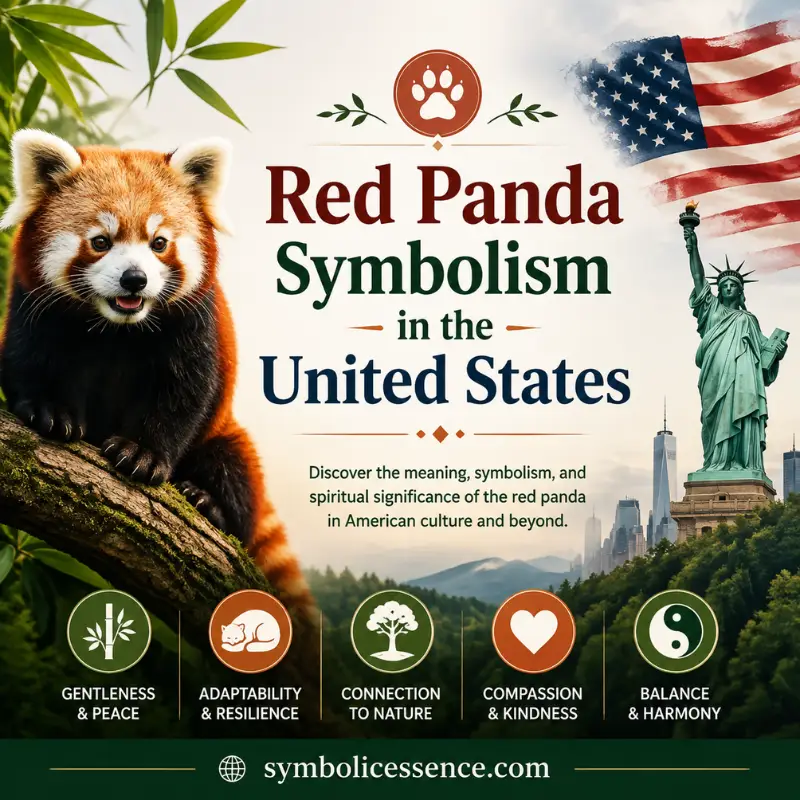
American red panda symbolism looks almost nothing like its Himalayan counterpart, largely because the U.S. relationship with the animal developed through very different channels: zoos, documentaries, and internet culture rather than centuries of shared geography.
In American pop culture, the red panda has become shorthand for a specific kind of appeal — small, expressive, a little clumsy, and instantly endearing without being conventionally cute in the same way as, say, a puppy or a rabbit. That reputation was cemented by online virality: red panda videos and photos have circulated widely for over a decade, turning the species into one of the most recognizable “internet animals” despite most viewers never having encountered one outside a screen or a zoo enclosure.
That online popularity has translated into real merchandising and fandom. Red panda plush toys, enamel pins, and illustrated character designs are common in gift shops and online stores aimed at a young adult audience, often marketed around personality traits like quirkiness, introversion, or “chaotic but lovable” energy — associations that have little to do with the animal’s actual Himalayan symbolism and much more to do with how it’s been packaged for American consumers.
Conservation status has added a more serious note to the American version of the symbol in recent years. As red pandas have become better known as an endangered species, zoos and wildlife organizations have leaned on the animal’s existing popularity to support fundraising and awareness campaigns, adding a layer of environmental urgency on top of the purely aesthetic appeal that first drove its popularity.
| Context | Meaning in the USA | Common Associations | Notes |
|---|---|---|---|
| Zoos and wildlife media | Cuteness, curiosity, gentle charm | Zoo mascots, nature documentaries | Primary way most Americans encounter the species |
| Internet and pop culture | Quirky individuality, introversion | Memes, plush toys, character merchandise | Meaning shaped largely by online virality |
| Conservation campaigns | Vulnerability, environmental urgency | Fundraising drives, endangered species lists | Reflects the animal’s real conservation status |
| Himalayan folk tradition | Good luck, protection | Home entrance figurines, folk stories | Rarely referenced directly in American use |
| Buddhist symbolism | Non-violence, harmony with nature | Monastic art, forest spirit imagery | Tied to the animal’s largely vegetarian diet |
Cross-Cultural Meaning Beyond the U.S.
In parts of Nepal and China where Buddhism has shaped local culture for centuries, the red panda carries meaning tied directly to religious values. <cite index=”25-1″>In certain Buddhist monasteries across the Himalayan region, red pandas are seen as symbols of harmony with nature and peaceful existence, since their largely vegetarian diet aligns closely with Buddhist principles of non-violence.</cite> <cite index=”25-1″>Some Buddhist artwork from these regions includes stylized depictions of red pandas as forest spirits or companions to enlightened beings.</cite>
That religious framing has had practical consequences as well. <cite index=”25-1″>In remote monasteries near red panda habitat, monks have historically acted as unofficial guardians of the animal, discouraging hunting and encouraging respect for it within the surrounding community.</cite> Separately, some shamanic traditions in western Nepal have used red panda fur in ritual dress, treating the animal as a protective presence against harmful spirits during healing ceremonies — a use of the symbol that’s considerably more specific and localized than anything found in American culture.
Red Panda Spiritual Meaning and Spirit Animal Interpretations
In modern spiritual interpretation, the red panda represents gentle strength, emotional balance, independence, and respect for personal boundaries. Its solitary habits make it a fitting personal symbol for people who need quiet time but still value meaningful relationships.
Someone who connects with the red panda may see it as a reminder to protect their energy without shutting others out. Its calm behavior suggests patience, while its ability to move through steep forest canopies represents flexibility and careful progress. Together, these qualities create a message of moving at your own pace instead of competing for attention.
As a personal animal symbol, the red panda can encourage several practices:
- Stay kind without allowing others to take advantage of you.
- Make room for rest, privacy, and emotional recovery.
- Approach change with patience rather than panic.
- Let individuality become a source of confidence.
- Balance private reflection with supportive relationships.
Terms such as “spirit animal” and “totem” require care. They hold specific meanings within some Indigenous religions and communities, while most online red panda interpretations come from modern personal spirituality. Therefore, these readings should not be presented as universal Himalayan or Indigenous beliefs.
Seeing a red panda repeatedly in art, media, or dreams does not prove that a supernatural message has arrived. However, a person can still use the encounter as a prompt for reflection. It may raise useful questions about balance, emotional boundaries, self-acceptance, and the quiet strengths that often go unnoticed.
What Does Dreaming About a Red Panda Mean?
A red panda in a dream may represent individuality, privacy, playfulness, or the need for a healthier balance between activity and rest. Dream meanings remain personal rather than predictive, so the animal’s behavior and the dreamer’s emotions provide more insight than any fixed definition.
A peaceful red panda resting in a tree may reflect a desire for safety, solitude, or relief from pressure. If the animal appears playful, the dream could point toward creativity or a part of life that has become too serious. A frightened or injured red panda may express concern about vulnerability, neglect, or something valuable that needs protection.
Common dream situations can suggest different themes:
- A red panda climbing: Patient progress, adaptability, or a careful approach to a challenge.
- A sleeping red panda: A need for rest, privacy, or emotional recovery.
- A playful red panda: Curiosity, joy, creativity, or renewed confidence.
- A red panda hiding: Social discomfort, avoidance, or a need to establish boundaries.
- An injured red panda: Concern for something vulnerable, including a relationship, personal goal, or natural environment.
- Several red pandas together: A search for community that still respects individuality.
Personal associations also matter. Someone who recently watched a red panda video, visited a zoo, or saw the animal in a movie may simply carry that image into a dream. Instead of treating the dream as a prophecy, consider what the animal was doing, how you felt, and whether those emotions resemble a current situation.
Emotional and Psychological Meaning
Part of the red panda’s emotional appeal comes from a mismatch between its appearance and its actual behavior. It looks soft and approachable, but it’s a solitary, largely nocturnal animal that spends most of its life avoiding contact rather than seeking it out. That contrast between a warm, expressive face and genuinely reserved, independent behavior is a big part of why the red panda resonates particularly strongly with people who identify with a similar mix of traits — approachable on the surface but deeply private underneath.
<cite index=”30-1″>Red panda symbolism is also tied to the idea of quietly pursuing ambitious goals rather than announcing them loudly, encouraging the kind of persistence that doesn’t rely on external validation to keep going.</cite> That reading fits naturally with the animal’s actual survival strategy: camouflage and avoidance rather than confrontation, a subtler form of resilience than more commonly symbolized predator or migratory species.
Why Red Pandas Show Up in Fashion and Personal Style

Red panda imagery in tattoos and fashion tends to skew toward playfulness and individuality rather than anything overtly symbolic or spiritual. Because the animal lacks a long Western mythological tradition, most people choosing red panda-themed tattoos or accessories are responding to its distinct look and personality-driven appeal rather than referencing any specific folklore, which sets it apart from more symbolically loaded animals like the wolf or the owl.
Where cultural meaning does appear in American fashion contexts, it usually shows up indirectly, through brands or designers referencing the animal’s Himalayan origins or conservation status as part of a broader environmental or ethical framing, rather than drawing on the specific luck and protection folklore found in Nepal and China.
Red Panda Symbolism in Decor and Everyday Design
Red panda motifs are common in children’s decor and gift items, chosen largely for the animal’s expressive, approachable face rather than any deeper meaning. Nursery items, stationery, and plush toys make up the bulk of red panda-themed decor in the U.S., paralleling how other visually appealing but symbolically thin animals get used in design.
Conservation organizations occasionally use red panda imagery in more purpose-driven decor and merchandise — posters, tote bags, educational materials — where the goal is less about symbolic meaning and more about building an emotional connection that supports habitat protection efforts.
Modern Usage: Pop Culture and Digital Life
The red panda’s biggest cultural moment in the U.S. came through animation and online media rather than through any organic folklore. Character designs based on red pandas have appeared in major animated films and shows, reinforcing many of the same personality traits — awkward but endearing, small but scrappy — that had already taken hold through years of viral internet content.
On social media specifically, red pandas occupy a niche similar to other “internet famous” animals: recurring meme formats, dedicated fan accounts, and zoo social media feeds that treat individual red pandas as recognizable personalities with names and followings of their own. This kind of organically built, personality-driven fame is a distinctly modern form of symbolism, shaped more by algorithmic virality than by any inherited cultural tradition.
What the Red Panda Symbolizes in Turning Red
Pixar’s Turning Red gave the red panda a new and highly visible symbolic role. In the movie, 13-year-old Mei Lee transforms into a giant red panda whenever strong emotions overwhelm her. The transformation represents adolescence, emotional change, family expectations, and the parts of herself she initially struggles to control.
The red panda also reflects Mei’s emerging independence. At first, she treats it as an embarrassing problem that she must hide. Gradually, she learns that this emotional and unconventional side belongs to her identity. Keeping the panda becomes an act of self-acceptance rather than rebellion for its own sake.
Family inheritance adds another layer. Women in Mei’s family share the transformation, connecting the panda with traits, expectations, and emotional patterns passed between generations. Mei respects her family while deciding that she does not have to make the same choices as her mother and other relatives.
Pixar describes Red Panda Mei as her most “emotional, messy, and true” self. Director Domee Shi has also described the story as a coming-of-age journey involving changes in Mei’s body and relationships. Therefore, the panda works as a broad metaphor for puberty, intense emotions, identity, and growing autonomy. Pixar’s official film page provides additional background on the character and story.
The movie’s ancestral red panda legend belongs to its fictional world. Viewers should not treat it as an established story from Chinese religion or mythology. Instead, Turning Red uses an original legend to explore a Chinese Canadian family and the universal challenge of growing into one’s identity.
Common Misunderstandings and Controversies
The most persistent misunderstanding is assuming red pandas are closely related to giant pandas simply because of the shared name. Biologically, they’re not — the naming overlap is a historical accident based on some superficial similarities, like a diet that includes bamboo, and it has led to a fair amount of confused symbolism, with some giant panda associations occasionally getting mistakenly applied to red pandas.
There’s also a gap worth naming between the animal’s rich, specific folklore in its native range and its comparatively shallow symbolic meaning in the U.S. American use of the red panda leans almost entirely on aesthetics and personality rather than the luck, protection, and spiritual symbolism found in Himalayan tradition, and that gap is worth being aware of rather than assuming American “cute animal” branding reflects the same meaning found in Nepal or China.
Finally, some of the folk claims around red pandas, including traditional medicine beliefs tied to consuming parts of the animal, are not supported by scientific evidence and have contributed to real conservation pressure on wild populations. It’s worth separating cultural symbolism from these unsupported practical claims, which are a genuine threat to the species rather than a harmless part of its folklore.
How the Meaning Has Evolved Over Time
Red panda symbolism in its native range developed slowly, shaped by centuries of shared geography, Buddhist religious values, and specific local legends tied to individual communities and even national origin stories. That kind of symbolism typically takes generations to build, since it’s rooted in direct, sustained contact between people and the animal.
American red panda symbolism, by contrast, developed remarkably quickly, almost entirely within the last two decades, driven by zoo popularity and internet culture rather than lived proximity to the species. That compressed timeline is unusual compared to most animal symbolism, which tends to accumulate meaning over centuries rather than years. The most recent layer, tied to conservation and endangered status, is newer still, and it’s likely to keep shaping how the symbol is used going forward as awareness of the species’ vulnerability continues to grow.
FAQs
What does a red panda tattoo typically represent?
Red panda tattoos most often represent individuality, gentle resilience, or a personal fondness for the animal’s distinctive look, since it doesn’t carry a long Western mythological tradition the way some other animals do. Some people choose the design specifically to reference conservation awareness or the animal’s Himalayan origins.
Is the red panda a spiritual or religious symbol?
Within its native Himalayan range, yes — Buddhist tradition ties the red panda to non-violence and harmony with nature, and some local folk traditions treat it as a protective or lucky presence. In the U.S., that spiritual framing is rarely referenced directly, with the symbolism leaning more toward cuteness and personality.
Why is the red panda associated with good luck in parts of Asia?
The association comes from folk traditions in Himalayan communities, where red panda images have historically been placed near home entrances to invite protection and good fortune. Local legends also describe the animal as a guide or helper figure in stories involving lost travelers.
Are red pandas closely related to giant pandas?
No, despite the shared name. Red pandas are more closely related to raccoons and weasels, and the naming overlap comes from superficial similarities like a partial bamboo diet rather than any close biological relationship.
Does red panda symbolism have anything to do with conservation?
Increasingly, yes. As public awareness of the species’ endangered status has grown, conservation organizations have used the red panda’s existing popularity to support awareness and fundraising efforts, adding urgency to a symbol that was previously built mostly around cuteness.
Why did red pandas become so popular in American pop culture?
Their rise in American culture is largely tied to zoo popularity and internet virality rather than any long-standing tradition, with short videos and photos helping the animal build a recognizable, personality-driven reputation over the past couple of decades.
Is there a difference between how red pandas are viewed in Asia versus the U.S.?
Yes, and it’s a fairly significant one. In Nepal and parts of China, red pandas carry specific spiritual and folkloric meaning tied to luck, protection, and Buddhist values, while American symbolism is largely shaped by aesthetics, online popularity, and more recently, conservation concern.
What does a baby red panda symbolize?
A baby red panda may symbolize innocence, curiosity, vulnerability, and gradual growth. It can also represent something new that needs patience and protection, such as a relationship, creative project, or personal goal.
What does seeing a red panda symbolize?
Seeing a red panda may personally suggest gentleness, individuality, patience, or the need for stronger boundaries. This interpretation is reflective rather than predictive; an encounter does not guarantee luck or announce a supernatural event.
Conclusion
Red panda symbolism sits at an interesting crossroads between old and new. In the Himalayan communities that have lived alongside the animal for generations, it carries genuine spiritual and folkloric weight tied to protection, luck, and Buddhist values. In the United States, that same animal has taken on an almost entirely different meaning, built quickly and largely through zoos and internet culture rather than any inherited tradition.
Both versions of the symbol are legitimate, but they’re not interchangeable, and it’s worth knowing which one is actually being referenced in a given context. The Himalayan meaning is old, specific, and tied to place; the American meaning is new, broad, and tied to personality and popularity.
Whether encountered through a folk story in Nepal or a viral video on a phone screen, the red panda seems to inspire the same basic response wherever it shows up — a sense that something this quietly resilient deserves more attention than its size would suggest.