Last Updated: September 15, 2026
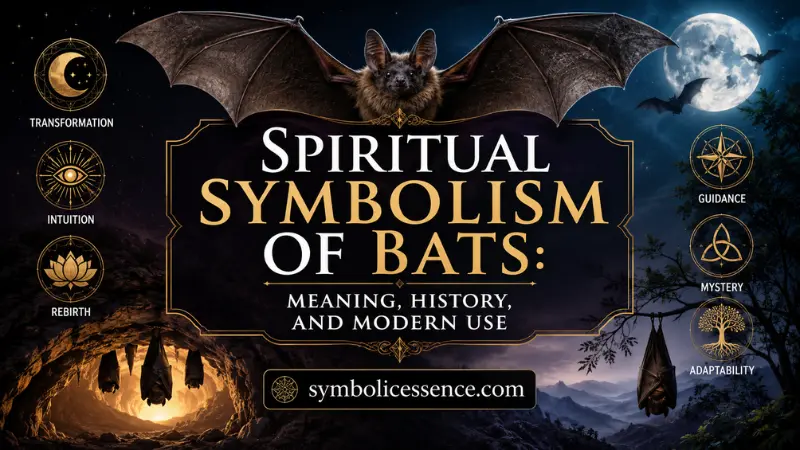
The spiritual symbolism of bats commonly centers on transformation, intuition, adaptability, and the ability to move through uncertain periods. Because bats emerge at dusk, navigate darkness, and live in caves and hidden roosts, people often associate them with life transitions, unseen knowledge, and the boundary between one stage of life and another.
Yet bats have never carried one universal meaning. Chinese decorative traditions present them as signs of happiness and good fortune, while some Mesoamerican narratives connect them with caves, death, sacrifice, and the underworld. Western folklore later tied bats to witches, vampires, Halloween, and fear.
In the United States today, these older interpretations overlap with newer ones. A bat may represent personal reinvention in a tattoo, a playful fright on a Halloween decoration, a vigilant nighttime hero in popular culture, or an important animal deserving protection.
Quick Answer
The spiritual symbolism of bats most often represents transformation, intuition, resilience, and confidently facing the unknown in modern American culture. Historically, bats have also symbolized good fortune, the underworld, death, rebirth, fear, and supernatural power in different cultural traditions.
TL;DR
- Bats often represent transformation, intuition, and adaptability.
- Their nighttime behavior links them with hidden knowledge.
- Chinese traditions associate bats with happiness and good fortune.
- Western folklore emphasizes fear, witchcraft, vampires, and death.
- Modern Americans also connect bats with courage and conservation.
- Bat meanings depend heavily on culture, context, and personal intention.
What Bats Commonly Symbolize Today
Modern symbolic interpretations usually focus on how bats survive and move. They fly after sunset, rest in concealed places, and locate their surroundings through highly developed senses. These traits make them natural metaphors for functioning well when the path ahead is unclear.
The most common meanings include:
| Context | Common Meaning in the United States | Typical Association | Important Note |
|---|---|---|---|
| Personal growth | Transformation | Leaving an old identity behind | Usually a modern interpretation |
| Spiritual practice | Intuition | Trusting subtle information | Not a fixed religious teaching |
| Tattoo culture | Resilience | Surviving a difficult period | Meaning depends on the wearer |
| Halloween imagery | Fear and the supernatural | Haunted places, witches, vampires | Strongly shaped by Western folklore |
| Conservation | Ecological balance | Pollination and insect control | Reflects growing public awareness |
| Chinese-inspired art | Happiness and good fortune | Blessings, longevity, prosperity | Comes from a distinct cultural tradition |
A bat symbol can therefore feel hopeful, unsettling, protective, rebellious, or playful. Its meaning depends less on the animal alone than on the surrounding design, cultural setting, and reason it was chosen.
Why Bat Biology Shapes Its Symbolic Meaning
Bats are the only mammals capable of true sustained flight. Many species are active at night, and numerous insect-eating bats use echolocation by producing high-frequency sounds and interpreting the returning echoes. Contrary to the familiar expression, bats are not blind; they combine hearing, vision, smell, and other senses according to their species and environment.
These physical characteristics have encouraged several symbolic interpretations:
- Flight suggests freedom, movement, and release.
- Nocturnal activity suggests comfort with uncertainty.
- Echolocation suggests perception beyond ordinary appearances.
- Cave roosts suggest withdrawal, incubation, or inner reflection.
- Emergence at dusk suggests transition between opposing states.
Such meanings are metaphors rather than scientific facts about spirituality. A bat does not literally represent intuition or transformation in nature. People create those associations by interpreting its behavior through human experiences.
Intuition and Navigating the Unknown
One of the most popular modern meanings of a bat is intuitive awareness. Since many bats can locate small objects and moving prey in darkness, they are often used as symbols of finding direction without having every detail clearly visible.
In personal spirituality, this meaning may apply to a period when evidence is incomplete but a decision still must be made. The bat can represent careful listening, attention to subtle changes, and a willingness to adjust course.
This does not necessarily mean following every impulse. The better comparison is active perception: a bat continually sends out information, receives feedback, and responds. Symbolically, it encourages a person to observe, test, listen, and adapt rather than move blindly.
Transformation and the End of an Old Identity
Bats are frequently interpreted as symbols of transformation because they occupy unusual boundaries. They are mammals that fly, daytime sleepers that become active after sunset, and familiar animals that often remain unseen.
This boundary-crossing quality is sometimes called liminality—the condition of existing between established categories or stages. In modern spiritual language, a bat can therefore mark the uncomfortable middle of a change: the old situation has ended, but the new one is not yet stable.
Someone might choose a bat image after leaving a difficult relationship, changing careers, recovering from grief, or abandoning habits that no longer fit. The animal represents the process of becoming different, not simply the final result.
Unlike a butterfly, which often conveys visible and graceful transformation, a bat usually suggests change that happens privately. It is suited to experiences involving solitude, uncertainty, emotional honesty, or rebuilding away from public attention.
Darkness as Reflection Rather Than Evil
Darkness has several symbolic meanings. It can represent fear, danger, secrecy, grief, or the unknown. It can also represent rest, privacy, imagination, and the unseen stages of growth.
Because bats are associated with night and caves, Western imagery often treats them as sinister. A more balanced spiritual interpretation sees darkness as a condition that requires different forms of awareness. The bat does not wait for daylight before acting; it uses the abilities suited to its environment.
For a person, that can symbolize functioning during an emotionally confusing period. The lesson is not that suffering is desirable. It is that uncertainty does not eliminate the possibility of movement, perception, or purpose.
This interpretation is especially common in modern wellness, tattoo, and self-development communities. It should not be mistaken for a single ancient doctrine shared by all cultures.
Death, Rebirth, and Spiritual Renewal
Bats sometimes represent death, but symbolic death does not always refer to physical dying. It may describe the end of a role, belief, attachment, reputation, or former version of oneself.
Caves strengthen this interpretation. A bat disappears into a dark enclosed space and later emerges into the open air. Modern readers may view this pattern as a symbolic descent followed by renewal—a period of retreat, confrontation, and return.
This is why bat imagery appears in discussions of grief, recovery, shadow work, and radical personal change. The bat can stand for accepting that renewal often requires an ending.
However, the death-and-rebirth meaning should be presented carefully. It is partly a modern synthesis built from the animal’s habitat and from selected mythological traditions. It is not an identical belief found everywhere bats appear.
Protection, Awareness, and Personal Boundaries
A bat’s symbolic connection with protection comes from alertness rather than physical strength. Its survival depends on detecting obstacles, locating food, recognizing threats, and responding quickly.
In personal symbolism, this can represent stronger boundaries and greater awareness of one’s environment. A bat tattoo or pendant may remind someone to notice warning signs, protect private space, or stop ignoring information that feels uncomfortable.
Popular culture has strengthened this association. Batman transformed the bat from a background creature of horror into an emblem of vigilance, discipline, secrecy, and nighttime protection. The character still carries darkness and fear, but directs those qualities toward defending others.
This modern heroic interpretation is especially influential in the United States, where the bat silhouette can suggest both danger and guardianship.
What Does a Bat Symbolize in Love and Relationships?
In love and relationships, bat symbolism can represent deep change, emotional awareness, independence, and the courage to face what remains unspoken. Because bats are associated with darkness and hidden spaces, they can serve as a metaphor for the parts of a relationship that require honesty rather than avoidance.
A bat may symbolize the end of an unhealthy relationship pattern and the beginning of a healthier one. It can also represent learning to trust your perception while still communicating openly with another person.
For someone beginning a new relationship, the bat may suggest moving carefully through unfamiliar emotional territory. For someone leaving a relationship, it can represent releasing an old identity and rebuilding independently.
A pair of bats may also be interpreted as partnership, shared movement, or mutual support. However, there is no universal tradition that gives every bat image a fixed romantic meaning.
The strongest interpretation usually comes from the design and personal context. A romantic bat tattoo, matching bat jewelry, or artwork featuring two bats may communicate intimacy, loyalty, shared resilience, or simply a mutual interest in Gothic and nocturnal imagery.
Community, Cooperation, and Hidden Support
Although bats are often portrayed as solitary creatures, many species live in colonies, and some gather in extremely large numbers. Mothers of certain species form maternity colonies where they give birth and care for their pups.
This behavior gives bats a less familiar symbolic meaning: community that operates quietly. A colony may represent belonging, coordinated movement, family protection, and strength created through shared shelter.
The symbolism is particularly relevant to people who value private support systems. Not every meaningful community is highly visible. Friends, relatives, neighbors, recovery groups, or online communities may provide stability without public recognition.
A group of bats in art can therefore communicate something different from a single bat. One bat often emphasizes independence or personal change. Several bats may suggest family bonds, collective survival, or movement toward a shared purpose.
What Does the Bat Spirit Animal Symbolize?
In modern spiritual and symbolic practices, the bat spirit animal is often associated with transformation, perception, adaptability, independence, and navigating the unknown. These interpretations come from the bat’s unusual biology and from the meanings people have developed around nocturnal animals.
The bat can serve as a metaphor for someone who is comfortable questioning appearances and looking more closely at situations. Its ability to navigate through darkness also makes it a natural symbol of adapting when the future is not completely visible.
Another important theme is transformation. Bat symbolism often fits people who are leaving behind an old identity, changing direction, or learning to live differently after a difficult experience.
The bat can also represent a healthy relationship with solitude. Spending time alone does not always mean isolation. Sometimes it provides the space needed to reflect, recover, and decide what comes next.
At the same time, the phrase “spirit animal” should be used carefully. Indigenous traditions differ widely, and there is no single Native American system that assigns one universal spiritual meaning to bats. For general modern spirituality, it is more accurate to describe the bat as a personal symbolic or spiritual archetype rather than claim that every Indigenous tradition shares the same interpretation.
Bat Meaning in Ancient Mesoamerican Traditions
Some of the strongest historical associations between bats, caves, death, and the underworld come from Mesoamerican traditions. In the K’iche’ Maya narrative commonly known as the Popol Vuh, the Hero Twins encounter dangerous bat beings in the House of Bats during their trials in Xibalba, the underworld. The figure often called Camazotz is associated with the violent episode in which one twin is decapitated.
This narrative helps explain why bat imagery may represent death, sacrifice, nighttime danger, or passage into an underworld realm. Caves were not merely frightening locations; they could also function as entrances to sacred or other-than-human spaces.
It would be inaccurate, however, to reduce all Maya bat imagery to one “bat god” or one negative meaning. Mesoamerican civilizations covered large areas and long periods, and their imagery changed across communities and contexts.
Modern tattoos and entertainment sometimes remove Camazotz from this cultural setting and present the figure as a generic horror monster. A respectful interpretation recognizes its connection to specific Indigenous stories rather than treating it as interchangeable with European demons or vampires.
Bats as Good Fortune in Chinese Culture
Chinese bat symbolism offers a striking contrast to Western fear-based imagery. The Chinese word for bat is pronounced similarly to a word meaning good fortune or blessing. Because of this linguistic connection, bats became auspicious motifs in clothing, porcelain, furniture, ceremonial objects, and gifts.
A design containing five bats may refer to the Five Blessings, commonly associated with longevity, health, wealth, virtue, and a peaceful or natural death. These motifs were not intended to look frightening. They communicated wishes for a fortunate and well-ordered life.
Red bats can intensify the positive meaning because red itself is widely associated with happiness and good fortune in Chinese visual culture. Bats may also appear with peaches, longevity characters, clouds, or other auspicious motifs.
In American decor or tattoos, a person may intentionally draw from this positive tradition. The design should retain enough context to avoid confusion with Halloween imagery. Chinese-style clouds, red coloring, circular arrangements, and blessing motifs can make the intended meaning clearer.
Biblical and Christian Interpretations
Bats appear only briefly in the Bible. In Leviticus and Deuteronomy, they are included among animals prohibited as food under ancient Israelite dietary law. In Isaiah, bats appear in a passage describing people casting away the idols they had made.
These passages do not establish a detailed biblical doctrine in which bats universally symbolize Satan, demons, or spiritual corruption. The dietary classification concerns ritual and communal rules, while the passage in Isaiah uses the bats’ dark habitat as part of an image of abandoned idols.
Later European Christian art contributed more strongly to negative imagery. Demons and dragons were frequently given leathery, bat-like wings, visually separating them from angels with feathered wings. Medieval and later religious art helped turn the bat’s physical appearance into a visual shorthand for hell, temptation, and disorder.
Modern Christian interpretations vary. Some believers continue to see bats as warnings against spiritual darkness, while others treat them simply as part of creation and reject superstitious meanings. A bat sighting has no fixed biblical message.
Bat Symbolism in Native American Traditions
There is no single Native American meaning of bats. Tribal nations have distinct languages, environments, religious systems, stories, and artistic traditions. Assigning one universal “Native American bat symbol” erases those differences.
In some recorded stories from eastern tribes, the bat appears in narratives about a contest between birds and four-legged animals. Although initially rejected because of its small size or uncertain identity, the bat helps its side succeed. The story may communicate that unusual abilities, intelligence, and adaptability matter more than conventional status. Other traditions contain different, sometimes darker, bat associations.
Care is also needed with the phrase “spirit animal.” Indigenous relationships with animals are specific to communities, clans, ceremonies, and personal histories. Using generalized animal meanings as though they represent all Native peoples can trivialize living traditions.
A respectful article, tattoo, or artistic design should name a specific tradition when reliable information is available and avoid copying sacred or clan imagery without cultural understanding.
European Folklore, Vampires, and Halloween
The bat’s frightening reputation in the United States largely developed from European folklore and later popular entertainment. Nocturnal activity, cave dwelling, erratic-looking flight, and an unfamiliar body shape made bats easy subjects for supernatural stories.
European settlers brought beliefs to North America in which a bat entering a house could predict illness, bad luck, or death. Such superstitions were preserved in regional folklore even though they had no scientific basis.
The association with vampires became especially influential through Gothic literature and theater. Blood-feeding bats live in the Americas rather than Europe, and the literary vampire existed before it became firmly linked with bat transformation. Bram Stoker’s Dracula helped popularize the image of a vampire taking bat form, which film and television later made nearly inseparable from the genre.
Halloween reinforced the connection. Bat silhouettes now appear beside witches, haunted houses, graveyards, full moons, and jack-o’-lanterns. In this setting, bats represent controlled fear: they make a scene feel spooky without necessarily conveying a serious spiritual belief.
What Bats Mean in Modern American Culture
American bat symbolism combines several meanings that do not always agree. During October, bats are playful emblems of darkness, horror, and supernatural entertainment. In comics and movies, they represent fear turned into strength. In tattoos, they can express survival, independence, grief, or unconventional identity.
Cities with major bat colonies have also helped reshape the animal’s image. Public bat emergences can become community events and tourist attractions rather than scenes of terror. Conservation education emphasizes that bats support ecosystems through insect consumption, pollination, seed dispersal, and nutrient movement.
As a result, the modern American meaning is gradually becoming more balanced. The bat still belongs to horror imagery, but it can also symbolize ecological responsibility, coexistence, and correcting unfair assumptions.
This shift matters because symbols influence behavior. When an animal is portrayed only as filthy, evil, or aggressive, people may be less willing to protect its habitat. Replacing superstition with accurate knowledge does not remove the bat’s cultural intrigue; it gives the symbol greater range.
Bat Tattoos, Jewelry, Fashion, and Decor
A bat tattoo can communicate very different ideas depending on its style. A realistic bat may express appreciation for wildlife. A Gothic design may represent mortality, rebellion, or attraction to horror culture. A bat emerging from a cave may suggest release from isolation, while an upward-flying bat can mark progress after hardship.
Common tattoo interpretations include:
- Surviving a period of grief or depression
- Trusting one’s perception
- Rejecting social expectations
- Feeling comfortable outside the mainstream
- Beginning a new phase of life
- Honoring a love of Halloween or Gothic art
Bat jewelry often carries a subtler version of the same meanings. A small pendant may suggest independence or nighttime awareness without the permanence of a tattoo. In fashion, bat wings can create an alternative, dramatic, or protective identity.
Home decor changes with context. Black paper bats on a wall usually signal Halloween. A Chinese-inspired bat motif may express good fortune. Naturalistic bat artwork can reflect conservation, regional wildlife, or admiration for nocturnal animals.
Dreams, Encounters, and Personal Interpretation
Dreaming about a bat does not have one reliable universal meaning. Dreams are influenced by memory, emotion, recent experiences, personal beliefs, and cultural imagery.
A frightening bat dream may reflect anxiety about something hidden or difficult to understand. A bat flying freely may represent release, adaptation, or increased confidence. A bat trapped inside a room could suggest an unwanted problem entering one’s private life.
The dreamer’s emotional response is usually more useful than a fixed symbol dictionary. Consider whether the bat felt threatening, injured, calm, protective, or simply present. Then connect that feeling with current circumstances.
A real-life bat encounter should also be interpreted realistically before it is treated symbolically. Bats may enter buildings accidentally or appear near places where insects gather. Practical safety and humane removal matter more than superstition.
What Does Seeing a Bat Mean Spiritually?
Seeing a bat can feel meaningful, especially when the encounter happens unexpectedly. In modern spiritual interpretation, a bat is often associated with change, intuition, awareness, and navigating uncertainty. Because bats move through darkness and rely on highly developed senses, people may view an encounter as a reminder to pay closer attention to what they already sense but may not fully understand.
The meaning can depend on the circumstances. A bat flying calmly overhead may suggest adaptability and movement through an uncertain period. A bat appearing during a major life transition may feel like a symbol of leaving an old phase behind. If the encounter creates fear, that reaction may also point toward something unfamiliar that deserves closer examination.
However, seeing a bat does not prove that a supernatural message has been sent. Bats follow normal patterns of feeding, roosting, migration, and movement. The spiritual meaning comes from the interpretation a person gives the encounter.
A useful way to reflect on a bat sighting is to ask:
- What was happening in my life when I saw the bat?
- Did I feel calm, curious, frightened, or protected?
- Am I facing a change that requires adaptability?
- Is there something I have been avoiding or failing to notice?
- What does the bat represent to me personally?
This approach keeps the symbolism personal without presenting folklore or spirituality as scientific fact.
Is Seeing a Bat Good Luck or a Bad Omen?
A bat is not universally a sign of good luck or bad luck. Its meaning changes across cultures and personal belief systems. In Chinese decorative tradition, bats can represent happiness, blessings, longevity, and good fortune. By contrast, parts of European and American folklore connected bats with death, darkness, illness, or supernatural danger.
Modern spiritual interpretations often take a middle position. A bat can symbolize a period of change, the need for greater awareness, or the ability to move forward when circumstances are unclear. In that sense, the encounter does not have to be either positive or negative.
The emotional response also matters. If seeing a bat creates a feeling of curiosity or calm, you may naturally interpret it as a symbol of adaptation or renewal. If it produces fear, the encounter may become a prompt to examine what the unknown represents in your own life.
Most importantly, a bat sighting should not be treated as a prediction of death or misfortune. There is no reliable evidence that seeing a bat predicts future events. Symbolism can provide a useful framework for reflection, but it should not replace practical judgment or factual understandin
Common Misunderstandings and Misuse
The most persistent misconception is that bats are blind. Most species can see, and many combine vision with echolocation or other senses. Another mistaken idea is that bats routinely attack people or become tangled in human hair. Their flight may seem unpredictable to an observer, but they are generally skilled navigators.
Symbolic misunderstandings are equally common. Bats are not universally evil, and they are not universally lucky. Neither claim works outside its cultural context.
Three forms of misuse are especially important:
First, modern writers sometimes present newly invented meanings as ancient spiritual facts. Transformation and intuition are reasonable contemporary metaphors, but they should not be falsely attributed to every historical culture.
Second, commercial designs may combine Maya, Chinese, European, and Native imagery without explaining the differences. This produces an attractive image but a misleading cultural story.
Third, fear-based depictions can encourage hostility toward real bats. Symbolic horror is part of art and entertainment, but it should not be confused with the behavior or ecological role of actual animals.
How Bat Meaning Has Evolved
Bat symbolism has changed as cultures have encountered the animal under different conditions. In parts of Asia, language and decorative tradition made the bat a blessing. In Mesoamerican narratives, caves and underworld journeys supported associations with death and sacred danger. European folklore emphasized nighttime fear, while Gothic fiction connected bats to vampires.
American culture inherited much of the European imagery but added new layers. Halloween turned the bat into a seasonal icon. Batman made it a sign of vigilance and intimidating protection. Wildlife education later promoted the bat as a misunderstood ecological ally.
The result is not one replacement meaning but a wider symbolic range. A bat can now communicate fear, humor, courage, change, fortune, environmental concern, or an attraction to the unconventional.
Its evolution also demonstrates how symbols work. Meaning does not come only from an animal’s physical traits. It develops through language, stories, art, religion, entertainment, and repeated public use.
FAQs
Are bats a positive or negative spiritual symbol?
Bats can be either positive or negative depending on the cultural setting. Modern personal symbolism often emphasizes transformation and intuition, while some Western folklore associates them with fear, death, and supernatural danger.
What does a bat symbolize in a tattoo?
A bat tattoo commonly represents reinvention, resilience, independence, heightened awareness, or comfort with the darker side of life. It may also simply express an interest in Gothic fashion, horror movies, Halloween, or wildlife.
Do bats symbolize death?
Bats sometimes symbolize death because of their connection with caves, night, underworld stories, and Gothic imagery. In personal spiritual use, however, death often means the ending of an identity or life stage rather than physical death.
Are bats considered lucky?
Bats are strongly associated with happiness, blessings, and good fortune in Chinese decorative tradition. This meaning comes partly from a linguistic connection between the Chinese words for bat and fortune, so it should not be treated as a universal belief.
What do bats mean in the Bible?
The Bible lists bats among animals prohibited as food under ancient Israelite law and mentions them in an image of discarded idols. It does not give a complete symbolic teaching that makes every bat a sign of demons, Satan, or approaching misfortune.
What does seeing a bat at night mean spiritually?
Some people interpret the encounter as a reminder to trust perception, accept change, or examine something they have avoided. In practical terms, the bat is probably feeding, traveling, or returning to a roost, so no supernatural conclusion is required.
Why are bats associated with transformation?
Bats cross several symbolic boundaries: they are mammals that fly, rest during the day, emerge at twilight, and move effectively through darkness. These traits make them useful modern metaphors for changing identity and adapting during uncertain periods.
What does a bat symbolize in a house?
Spiritually, some people interpret a bat entering or appearing around a house as a symbol of change, awareness, protection, or something previously unnoticed. In practical terms, bats may enter buildings while searching for food, shelter, or an exit.
Is a bat a symbol of protection?
Yes, modern symbolism can use the bat as a symbol of protection, vigilance, and awareness. Its ability to detect obstacles and move through darkness makes it a useful metaphor for staying alert and protecting personal boundaries.
Conclusion
Bats carry contrasting meanings because people have interpreted them through different languages, landscapes, religions, stories, and emotional experiences. They can represent intuition and adaptation, but also fear, mortality, good fortune, community, and the supernatural.
The spiritual symbolism of bats is most useful when its cultural context remains visible. A Chinese blessing motif, a Maya underworld figure, a Halloween silhouette, and a personal transformation tattoo may feature the same animal, yet they do not communicate the same idea.
Perhaps the bat’s clearest modern lesson is not that darkness should be feared or romanticized, but that unfamiliar conditions often require closer attention, flexible movement, and a different way of seeing.
[…] Bismuth symbolism commonly represents transformation, creativity, patience, and structured personal growth in modern American crystal culture. Its rainbow colors suggest individuality and changing perspectives, while its staircase-like crystals represent progress through small, deliberate steps. Historically, bismuth was valued mainly for its practical uses in metalworking rather than for established spiritual meanings. […]