
Last Updated: September 10, 2026
The donkey is one of the most misunderstood animals in American culture. Most people know it as stubborn, slow, or simply the butt of a joke, but donkey symbolism actually carries a much longer and more respectful history than its modern reputation suggests. For thousands of years, donkeys were essential working animals, and the meanings attached to them grew out of that daily, practical relationship rather than distant myth.
People look into donkey symbolism for a range of reasons — some because of its role in religious stories, some because of its place in American politics, and others simply because they’ve met a donkey in person and were surprised by how intelligent and personable it seemed. That gap between the stereotype and the real animal is exactly why the symbolism is worth unpacking.
This article covers where donkey symbolism began, how it evolved, and why it still shows up in places as different as church pageants, political cartoons, and forearm tattoos.
Quick Answer
Donkey symbolism in modern American culture most commonly represents humility, patience, and stubborn determination, along with a strong political association with the Democratic Party. Historically, donkeys were also linked to hard work, service, and — in religious traditions — humble strength, since they carried both burdens and important figures without complaint.
TL;DR
- Donkey symbolism centers on humility, patience, and quiet endurance.
- Ancient cultures valued donkeys as reliable, hardworking companions.
- Religious traditions link donkeys to humility and unassuming strength.
- American politics uses the donkey as the Democratic Party’s mascot.
- Stubborn” is a modern stereotype, not the animal’s original meaning.
- Donkey imagery appears in folk art, tattoos, and children’s stories.
What a Donkey Looks Like and Where People Encounter One
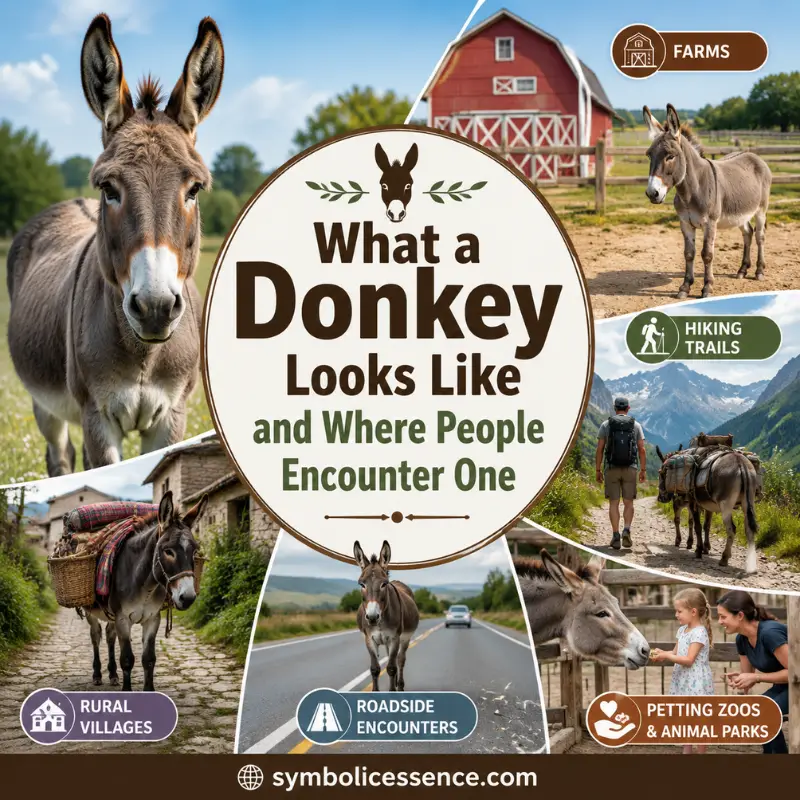
Donkeys are compact, sturdy animals related to horses, typically gray, brown, or black, with long ears and a distinctive bray that’s hard to mistake for anything else. In the United States, most people encounter donkeys on farms, at petting zoos, or in rural areas where they’re still used as working animals or companions for livestock. Wild donkeys, often called burros, also roam parts of the American Southwest, descended from animals brought over centuries ago.
Because donkeys aren’t as commonly kept as horses, many Americans form their impression of the animal secondhand — through cartoons, nativity scenes, or political imagery — rather than direct experience. That distance has shaped a symbolism built more on cultural shorthand than firsthand familiarity.
The Core Meaning Behind Donkey Symbolism
At its center, donkey symbolism is about steady, uncomplaining effort. Unlike animals symbolized for speed or power, the donkey earned its meaning through reliability — showing up, carrying the load, and doing the work without needing recognition. That’s where its associations with humility and patience come from.
The “stubborn” reputation, while common, actually comes from a related trait: donkeys are known for stopping and assessing a situation rather than reacting immediately, especially when they sense danger or exhaustion. Handlers have long recognized this as caution rather than defiance, but it’s the trait that stuck in popular language.
Historical Origins of Donkey Symbolism
Donkeys were domesticated in Northeast Africa several thousand years ago, making them one of the oldest working animals in human history. Long before the horse became widely used for transport and labor, the donkey filled that role across the ancient Mediterranean, Middle East, and North Africa, which is why so much of its early symbolism ties to service, endurance, and practical value rather than status or glamour.
In many ancient economies, owning a donkey was a marker of modest, working-class stability rather than wealth — a detail that shaped the animal’s long association with humility rather than pride or power.
Donkey Symbolism in Religious Tradition
Donkey symbolism holds a distinct place in religious storytelling, most notably in the Christian tradition, where a donkey carries a pregnant Mary to Bethlehem and later carries Jesus into Jerusalem. In both cases, the donkey is chosen specifically for its humility rather than in spite of it — a deliberate contrast to the war horses and status animals of the era. This is a major reason donkey symbolism is so closely tied to humble service rather than weakness.
Other religious and folk traditions across the Middle East and Mediterranean similarly treat the donkey as a hardworking, unglamorous companion animal, respected for consistency rather than celebrated for strength or beauty.
Donkey Symbolism in the Bible
The donkey has a particularly important symbolic role in the Bible, where it often appears in moments that emphasize humility, service, peace, and ordinary life. Rather than presenting the donkey as a symbol of weakness, biblical stories place it in situations where quiet usefulness carries more meaning than outward status.
One of the best-known examples appears in the Gospel accounts of Jesus entering Jerusalem. Jesus rides a donkey, an image Christians commonly understand as contrasting with the warhorse associated with military power and conquest. The scene emphasizes a different kind of kingship: peaceful, humble, and accessible rather than built around force.
The donkey also appears in the Old Testament in the story of Balaam. In Numbers 22, Balaam’s donkey sees an angel blocking the road before Balaam does. The story gives the animal an unusual role as the one that perceives the danger first, adding a theme of awareness and caution to its broader symbolism.
Donkeys also appear throughout biblical descriptions of everyday work, travel, agriculture, and transportation. Because they were familiar working animals, their presence helped connect religious stories to ordinary life.
For Christians, donkey symbolism can therefore suggest humility, faithful service, peace, patience, awareness, and strength without display. These meanings come from the biblical stories themselves rather than from a single official biblical definition of the donkey as a symbol.
Donkey Symbolism in the United States
In American culture, donkey symbolism has taken on a life of its own, shaped heavily by politics, folklore, and rural life. The animal’s American identity is inseparable from its role as the mascot of the Democratic Party, an association that began in the 1820s and was later cemented by political cartoons in the 1800s.
Outside of politics, donkeys carry a warm, folksy symbolism in American rural culture — associated with self-sufficiency, no-nonsense character, and a certain plainspoken honesty. Regional folklore, especially in the South and Southwest, often treats donkeys as steady, dependable companions rather than comic relief, even though popular culture frequently leans on the stubborn stereotype for humor.
Donkey Symbolism in American Politics and Public Life
The donkey’s political meaning is one of the most recognizable pieces of American visual symbolism. Its association with the Democratic Party grew out of a nickname used against Andrew Jackson during his 1828 presidential campaign, which his supporters embraced rather than rejected. Political cartoonist Thomas Nast later popularized the image widely in the late 1800s, cementing the donkey as shorthand for the party in newspapers and public discourse.
Today, the donkey appears on campaign material, editorial cartoons, and party branding, functioning almost entirely separately from its older meanings around humility or hard work. In this context, it’s a political identifier first and an animal symbol second.
Cross-Cultural Meaning Beyond the United States
Outside the United States, donkey symbolism carries similarly grounded meanings, often tied to rural labor and patience. In parts of the Mediterranean and Middle East, donkeys remain working animals in daily life, and folk stories from these regions frequently cast the donkey as a wise, if underestimated, character — clever enough to outlast louder, flashier animals in the story.
In some African folklore traditions, the donkey appears as a figure of quiet persistence, valued for consistency over cleverness or speed. Across most of these traditions, the throughline is the same one found in American culture: an animal defined by reliability rather than glamour.
Emotional and Psychological Symbolism
Psychologically, donkey symbolism tends to resonate with people who value steady effort over flashy achievement. It appeals to a mindset built around showing up consistently, handling burdens without complaint, and trusting that quiet persistence eventually gets the job done.
There’s also a self-protective undertone tied to the animal’s cautious streak. The donkey’s tendency to pause and assess before acting resonates with people who see careful, deliberate decision-making as a strength rather than a weakness — a useful contrast to symbols built purely around speed or aggression.
Donkey Spiritual Meaning and Symbolism
Spiritually, donkey symbolism often centers on humility, patience, service, resilience, and grounded strength. The donkey does not represent power through dominance. Instead, its symbolism comes from endurance, usefulness, and the ability to keep moving through difficult circumstances.
A donkey can also represent the value of doing meaningful work without seeking attention. That idea appears especially strongly in Christian interpretations, where the animal’s humble role contrasts with symbols of wealth, military power, and social status.
Another spiritual theme is discernment. Donkeys are cautious animals, and their tendency to stop when they perceive something unsafe has often been interpreted symbolically as a reminder to pause before moving forward. In that sense, donkey symbolism can represent knowing when persistence is appropriate and when caution deserves attention.
For some people, the donkey becomes a useful personal symbol during periods when life demands patience rather than dramatic action. Its message can be simple: you do not have to move quickly to make progress, and quiet strength still counts as strength.
These spiritual interpretations are symbolic rather than universal rules. A person’s religious background, culture, personal experiences, and the circumstances surrounding the donkey can all influence what the animal means to them.
What Does a Donkey Mean in a Dream?
A donkey in a dream can symbolize patience, responsibility, persistence, humility, or a burden you are carrying. However, dream symbolism does not have one fixed meaning. The animal’s behavior and the emotions you experienced in the dream matter just as much as the donkey itself.
If the donkey is calmly carrying a load, the dream may reflect responsibility, endurance, or the feeling that you are steadily handling demanding tasks. A healthy, peaceful donkey can suggest groundedness and dependable progress.
If the donkey refuses to move, the dream may point to resistance, caution, or a situation where you feel pressured to act before you are ready. Rather than automatically representing stubbornness, the image can encourage you to consider whether something deserves closer examination.
Riding a donkey may symbolize humility, service, or moving forward without relying on status or appearances. Because of the donkey’s importance in Christian stories, a religious dream may also connect the image with faith, peace, or spiritual purpose.
A frightened, injured, or neglected donkey can carry a different emotional meaning. It may reflect exhaustion, vulnerability, neglected responsibilities, or concern about someone who has been carrying too much.
The most useful way to interpret a donkey dream is to consider the setting, the animal’s behavior, your emotions, and what was happening in your waking life. Dream symbolism works best as a tool for reflection rather than as a prediction of future events.
Donkey Symbolism in Dreams, Art, and Personal Meaning
Donkey imagery can take on a deeply personal meaning when it appears in art, gifts, jewelry, tattoos, dreams, or everyday encounters. Because the animal carries such a mixture of positive and negative associations, its meaning often depends on which qualities a person wants to emphasize.
Someone may choose a donkey to represent resilience after a difficult period, especially when they identify with the idea of continuing despite heavy responsibilities. Another person may see it as a symbol of humility and prefer its quiet character to more aggressive animal imagery.
The donkey can also represent a healthy form of resistance. Its reputation for stopping and assessing danger creates a useful metaphor for setting boundaries and refusing to move forward simply because someone else demands it.
In family or rural settings, the symbol may carry an even more personal meaning. A donkey can recall farming, ranching, childhood memories, a particular animal, or a connection to a place and way of life.
This flexibility explains why donkey symbolism continues to work in modern visual culture. It can communicate humor, hard work, humility, independence, loyalty, or resilience without requiring the dramatic imagery associated with predators or mythical creatures.
Why Donkeys Appear in Tattoos and Personal Style
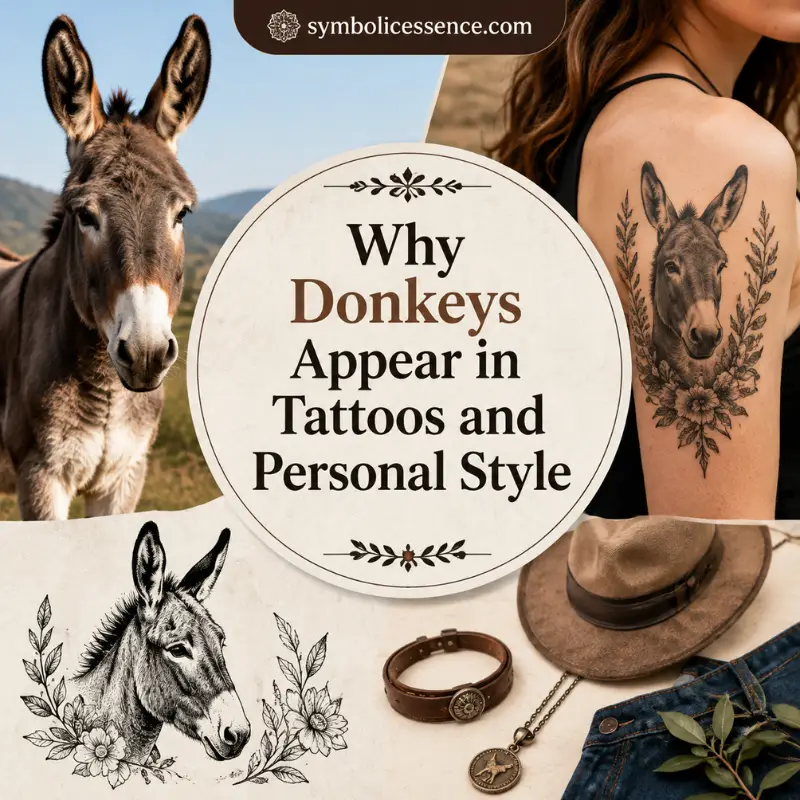
Donkey tattoos are a niche but meaningful choice, often selected by people connected to farming, ranching, or rural heritage, or by those who simply relate to the animal’s reputation for stubborn resilience. Unlike more common tattoo animals chosen for beauty or ferocity, donkey tattoos tend to carry a personal, story-based meaning — frequently tied to family history, a specific working animal, or a self-identified trait like persistence.
Because the animal’s shape and features are simple and graphic, donkey tattoos also work well in folk-art or Southwestern-inspired styles, which has helped keep the design present in regional tattoo culture even as broader animal tattoo trends shift.
Donkey Symbolism in Pop Culture
Modern pop culture has leaned heavily into the donkey’s comedic reputation, most famously through the wisecracking Donkey character in the “Shrek” film franchise, which reinforced the animal’s image as talkative, loyal, and a little exasperating. Children’s books and shows frequently use donkeys in a similar way — lovable, a bit clumsy, and endearing rather than impressive.
This softer, humor-driven portrayal has slightly overshadowed the animal’s older symbolism around humility and hard work, though the two aren’t necessarily in conflict. Even in comedic roles, donkey characters are almost always loyal and dependable underneath the jokes.
Donkey Symbolism in Decor and Everyday Objects
Donkey imagery shows up frequently in Southwestern and rustic home decor, particularly in Mexican and American Southwest-inspired design, where painted or carved donkey figures are common folk art motifs. These pieces usually lean warm and nostalgic rather than serious, evoking rural life and craftsmanship instead of formal symbolism.
The image also appears seasonally around Christmas, where donkey figures are a near-permanent fixture in American nativity scene decorations, tying back directly to the animal’s religious symbolism of humble service.
Common Misunderstandings About Donkey Symbolism
The most persistent misunderstanding is treating “stubborn” as the animal’s defining trait rather than a byproduct of caution and self-preservation. Handlers and animal behaviorists have long noted that donkeys are highly intelligent and cautious, not defiant — they simply won’t be rushed into something that seems unsafe, which looks like stubbornness from the outside.
Another common mix-up is assuming the donkey’s political symbolism reflects its cultural meaning everywhere. In reality, the party association is a distinctly American development from the 1800s and has little to do with the animal’s older, more universal symbolism around humility and labor.
Donkey Symbolism, Controversies, and Misuse
Donkey symbolism has occasionally been used dismissively, with the word “donkey” applied as an insult implying stupidity or clumsiness — a usage that runs counter to what is actually a well-documented intelligent and perceptive animal. This slang use is disconnected from the animal’s historical and cultural symbolism and says more about the insult’s target than the donkey itself.
Politically, the donkey has also been the subject of caricature and exaggeration in editorial cartoons for nearly two centuries, sometimes used to mock rather than simply represent. That satirical use is a separate tradition from the animal’s broader cultural symbolism and is generally understood as commentary on politics rather than on donkeys themselves.
How Donkey Symbolism Has Evolved Over Time
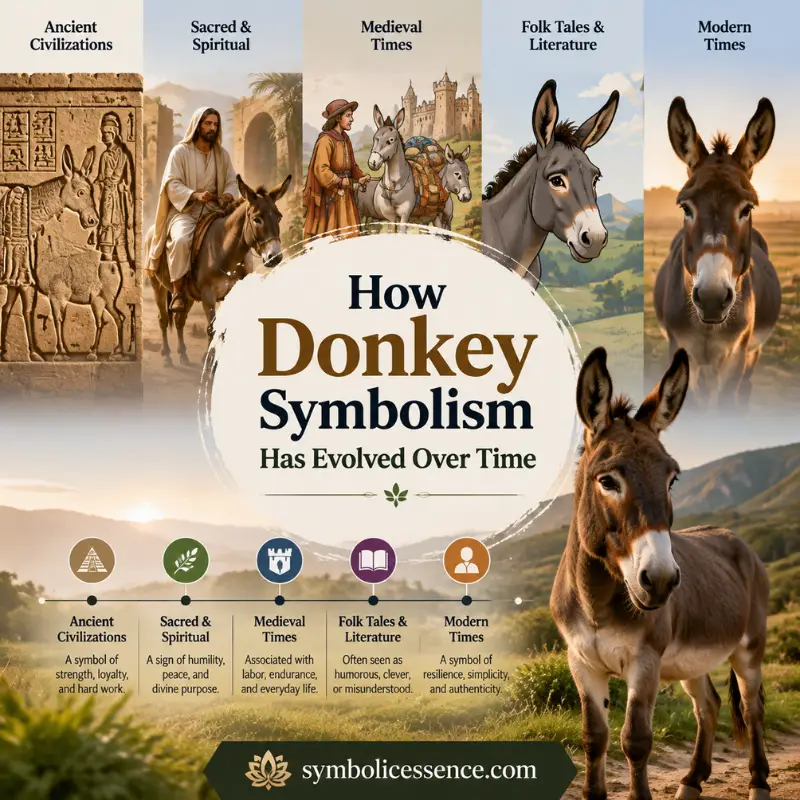
Early donkey symbolism centered almost entirely on practical value — a working animal essential to trade, agriculture, and travel across ancient civilizations. Religious traditions later added a layer of moral meaning, framing the donkey’s humility as a virtue rather than a limitation.
In the United States, that meaning split further once the animal became tied to a political party, adding a modern layer of symbolism largely disconnected from its older associations. More recently, pop culture has softened the donkey’s image again, turning old stereotypes about stubbornness into something more affectionate and comedic than critical.
Donkey Symbolism at a Glance
| Context | Meaning in the USA | Common Associations | Notes |
|---|---|---|---|
| Religious tradition | Humble service | Christmas, nativity scenes | Tied to biblical stories of quiet strength |
| American politics | Democratic Party identity | Campaigns, editorial cartoons | Traces back to Andrew Jackson’s 1828 campaign |
| Rural folklore | Reliability, hard work | Farm life, self-sufficiency | Predates and differs from political symbolism |
| Tattoos | Resilience, personal history | Southwestern and folk-art styles | Often tied to family or ranching heritage |
| Pop culture | Loyal but talkative | Humor, comic relief | Shaped strongly by characters like Shrek’s Donkey |
FAQs
What does a donkey symbolize spiritually?
In religious tradition, the donkey is often linked to humility and quiet, unglamorous strength, most notably through its role in biblical stories. Spiritually, it’s frequently read as a reminder that steady, humble service carries real value, even without recognition.
What does a donkey tattoo mean?
A donkey tattoo generally represents resilience, stubborn determination, and a connection to hard work or rural heritage. Many people choose it as a personal symbol tied to family history or a specific trait they identify with, rather than a purely decorative choice.
Why is the donkey associated with the Democratic Party?
The association began during Andrew Jackson’s 1828 presidential campaign, when opponents mocked him as a “jackass” and his supporters embraced the image instead. The symbol was later popularized nationwide through political cartoons, becoming permanently linked to the party.
Is donkey symbolism positive or negative?
Traditionally and culturally, it’s overwhelmingly positive, centered on humility, reliability, and quiet strength rather than weakness. Negative readings mostly come from modern slang use of “stubborn” or “dumb,” which don’t reflect the animal’s actual intelligence or historical meaning.
Are donkeys and mules symbolized the same way?
No — while related, mules carry their own separate symbolism, often tied more specifically to hybrid strength and practical usefulness, whereas donkeys carry the older, more established meanings around humility and service. The two are frequently confused, but their cultural histories developed somewhat differently.
Why do donkeys have such a mixed reputation?
The gap comes from two very different sources shaping the animal’s image: centuries of respected, practical symbolism versus a much newer, casual stereotype about stubbornness and slowness. Once that stereotype took hold in everyday language, it became more visible than the older, more respectful meaning.
What does seeing a donkey symbolize spiritually?
Seeing a donkey can be interpreted spiritually as a reminder of humility, patience, service, resilience, and grounded strength. In a Christian context, the image may also recall biblical themes of peace and humble service. The personal meaning depends on the circumstances and the viewer’s beliefs.
Why is the donkey considered a symbol of humility?
The donkey became associated with humility because it was a practical working animal rather than an elite status symbol. Christian tradition strengthened this meaning through biblical stories in which donkeys serve important roles, including Jesus’ entry into Jerusalem.
Conclusion
Donkey symbolism ultimately reflects an animal defined by quiet reliability rather than the stubborn stereotype most people default to. From ancient working animals to religious symbols of humility to a modern American political mascot, the meaning behind the donkey has always come back to steady, uncomplaining effort rather than flash or force.
What makes this symbolism worth understanding is the contrast it offers to louder, more dramatic animal meanings. The donkey doesn’t need myth-making to earn its place in culture — its history of showing up, carrying the load, and doing the work speaks for itself.