
Few insects carry as much symbolic weight in American life as the monarch butterfly. With its bold orange-and-black wings and a migration that spans thousands of miles, it shows up on memorial tattoos, in classroom science lessons, at funerals, and increasingly in conversations about conservation. Monarch butterfly symbolism didn’t develop in one place or one tradition — it’s a blend of biology, Indigenous belief, and modern American culture that all point toward roughly the same idea: change, and what survives it.
Part of why the monarch resonates so strongly is that its life story does the symbolic work on its own. A caterpillar entirely dissolves and rebuilds itself inside a chrysalis before emerging as something that looks nothing like where it started. That’s not metaphor added after the fact — it’s literally what happens, which is part of why the transformation symbolism feels earned rather than imposed.
This piece walks through where that meaning comes from, how the monarch specifically differs from general butterfly symbolism, and how Americans use its imagery today, from tattoos to grief rituals to garden design.
Quick Answer
Monarch butterfly symbolism represents transformation, resilience, hope, and renewal. Its life cycle reflects personal growth and change, while its long migration symbolizes strength and perseverance. In Mexican culture, monarchs are also connected with ancestors and remembrance during Día de los Muertos. Today, many Americans view this butterfly as a symbol of beauty, survival, and positive change.
TL;DR
- Metamorphosis makes transformation the monarch’s most literal meaning
- Long migration adds themes of endurance and perseverance
- Mexican tradition links monarchs to returning ancestral spirits
- Endangered status has made the monarch a conservation symbol
- Americans use it heavily in memorial tattoos and grief symbolism
- Orange and black coloring adds warning and warmth associations
What the Monarch Looks Like and Where People See It
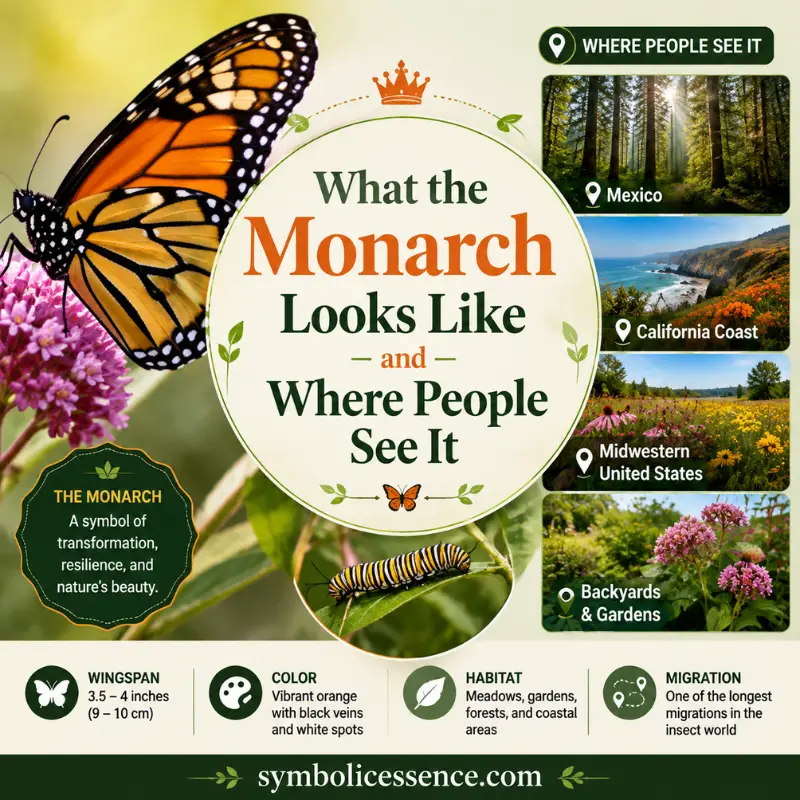
The monarch (Danaus plexippus) is instantly recognizable by its bright orange wings crossed with black veins and a black border dotted with white spots. That coloring isn’t just decorative — it signals toxicity to predators, since monarch caterpillars feed exclusively on milkweed and retain the plant’s toxins into adulthood. People most commonly encounter monarchs in gardens planted specifically to attract them, along migration routes in the fall, and in classrooms, where raising a monarch from caterpillar to butterfly is a common science project across the country.
Because the life cycle is so visually dramatic — egg, striped caterpillar, jade-green chrysalis, then the fully formed butterfly — the monarch has become one of the most commonly referenced examples of metamorphosis in American culture, used in everything from sermons to therapy metaphors to elementary school posters.
The Core Meaning: Transformation, Resilience, and Hope
Strip away the regional variation and three ideas dominate: transformation, resilience, and hope. The transformation piece comes directly from metamorphosis itself — the idea that real change often requires a period of apparent stillness or even collapse before something new emerges. Resilience comes from the monarch’s migration, an up to 3,000-mile journey between the northern United States and Canada and the mountains of central Mexico, made even more remarkable by the fact that no single butterfly completes the full round trip. It takes multiple generations to finish the cycle, which has made the monarch a popular symbol for effort that outlasts any one individual’s lifetime.
Hope tends to attach to both of those ideas at once: a creature that survives a total physical rebuilding and then travels farther than most people ever will becomes an easy stand-in for the belief that difficult periods are survivable and often lead somewhere better.
What Do the Monarch’s Orange, Black, and White Colors Symbolize?
A monarch’s colors add another layer to its symbolic meaning. Orange often represents energy, warmth, courage, and enthusiasm in modern American color symbolism. Because orange also resembles sunlight and autumn leaves, it can suggest vitality during a season of change.
Black usually adds themes of mystery, strength, seriousness, and protection. On a real monarch, however, the dark pattern serves a biological purpose. Its bold orange-and-black appearance warns predators that the butterfly may taste unpleasant because of toxins gained from milkweed.
The small white spots along the wing edges soften this strong contrast. Some people interpret them as signs of clarity, peace, guidance, or light during a difficult transition. These color meanings offer personal ways to read the monarch’s appearance, but they do not form one universal spiritual tradition.
Together, the colors create a balanced message. Orange suggests life and movement, black reflects hardship and endurance, and white offers a sense of hope. This combination makes the monarch especially meaningful to people rebuilding their lives after loss, illness, or a major change.
Ancient and Indigenous Roots of the Symbol
Long before the monarch became a familiar tattoo motif, Indigenous peoples in central Mexico had already built a rich tradition around it. The Purépecha people of Michoacán, whose territory includes the monarch’s primary overwintering grounds, held beliefs connecting butterflies to the spirit world well before European contact. <cite index=”30-1″>According to pre-Hispanic folklore, migrating butterflies were understood to carry the souls of ancestors visiting from the afterlife, and for centuries monarchs have served Mexico as a cultural symbol linking the living to the dead.</cite> Local legend also gave monarchs a connection to warriorhood, framing their arrival as the return of fallen fighters rather than ordinary ancestors alone.
Separately, in ancient Greek tradition, butterflies in general were associated with Psyche, the personification of the soul, and with the idea of the soul’s release from the body — a belief system that predates any specific connection to monarchs but helped establish butterflies broadly as symbols tied to the spirit rather than just to nature.
How the Monarch Became Linked to Día de los Muertos
The most culturally significant thread in monarch symbolism is its tie to Mexico’s Day of the Dead. <cite index=”26-1″>Roughly 300 million monarchs arrive each year in the forests of Michoacán after traveling more than 2,000 miles from the northeastern United States and southeastern Canada, and as Catholic tradition blended with older Indigenous belief, the butterflies came to be regarded as the souls of departed ancestors returning to Earth for their annual visit.</cite> The timing is almost exact: <cite index=”27-1″>the arrival of millions of monarchs to their Michoacán overwintering sites lines up with the same time of year Mexican communities set aside to honor their dead, a pattern likely shaped by generations of close observation of the natural world.</cite>
That timing has made the monarch one of the central visual symbols of Día de los Muertos, appearing on altars, in face paint, and throughout the artwork associated with the holiday, standing alongside marigolds as a recognizable emblem of the season. <cite index=”28-1″>To this day, many families in the region continue to describe the monarchs as the spirits of loved ones and ancestors, returning every year at the same time as the holiday.</cite>
Monarch Butterfly Symbolism in the United States
American use of monarch symbolism draws on both threads — the transformation meaning rooted in biology and the ancestral meaning rooted in Mexican tradition — and blends them into a broader, largely secular idea of change, memory, and hope. In U.S. Latino communities, especially those with ties to Mexico, the connection to Día de los Muertos remains direct and is often observed with real cultural weight, including at altars built for family members who have passed.
Outside that specific tradition, American culture has adopted the monarch more loosely as a general symbol of grief and remembrance. It’s common at funerals and memorial services, including releases at gravesides, and shows up frequently in sympathy cards and memorial jewelry, usually without direct reference to the Mexican origin of that meaning. Alongside grief, the monarch has become one of the most visible faces of American conservation messaging, since population declines tied to habitat loss and pesticide use have made “save the monarchs” a familiar phrase in gardening and environmental circles.
| Context | Meaning in the USA | Common Associations | Notes |
|---|---|---|---|
| Memorial and grief | Remembrance, souls of loved ones | Funerals, sympathy cards, memorial jewelry | Draws on Mexican Día de los Muertos tradition |
| Personal transformation | Growth, change, new chapters | Tattoos, therapy and recovery symbolism | Based directly on metamorphosis |
| Conservation | Environmental fragility, action | Milkweed gardens, pollinator campaigns | Tied to the species’ endangered status |
| Día de los Muertos | Returning ancestral spirits | Altars, marigolds, face paint | Strongest and most specific meaning, rooted in Michoacán |
| Weddings and milestones | New beginnings, hope | Butterfly releases, decor | Leans on transformation without the grief association |
| Children’s education | Growth, patience, natural cycles | Classroom life-cycle projects | Popular teaching tool for metamorphosis |
Cross-Cultural Meaning Beyond Mexico and the U.S.
While the monarch’s most specific cultural meaning belongs to Mexico, the broader idea of butterflies as soul symbols shows up widely elsewhere. In ancient Greece, the word psyche meant both “butterfly” and “soul,” a linguistic overlap that reflected a genuine belief that the soul could take butterfly form after death. Some Native American traditions outside the Purépecha and Mazahua also associate butterflies generally with joy, change, and messages carried on the wind, though these beliefs vary significantly by nation and aren’t uniform across Indigenous North America.
In parts of East Asian tradition, butterflies are linked to romantic love and long life rather than death, a meaning most famously expressed in the Chinese folktale of the Butterfly Lovers. That contrast is worth noting because it shows how differently a physically similar symbol can be read depending on the surrounding belief system — the same insect signals death and remembrance in one tradition and romance in another.
Monarch Butterfly Meaning in Christianity and the Bible
The Bible does not assign a specific meaning to monarch butterflies. In fact, it does not present the butterfly as a formal biblical symbol. Therefore, claims that a monarch carries one fixed message from Scripture go beyond what the text actually says.
Still, many Christians use the monarch’s life cycle as a visual metaphor for spiritual renewal. The caterpillar may represent an old way of life, while the chrysalis suggests surrender, waiting, or inner change. The emerging butterfly can then symbolize rebirth, resurrection, and a life transformed by faith.
This interpretation often appears in Christian memorial services. A monarch may represent the hope that death does not have the final word or that a person’s spirit has entered a new state of existence. Others connect its long migration with trust, perseverance, and continuing forward without seeing the entire path.
These are modern devotional interpretations rather than established biblical teachings. For that reason, the most accurate approach treats the monarch as a faith-inspired metaphor—not as a coded biblical sign or guaranteed message from God.
Emotional and Psychological Meaning
Psychologically, the monarch’s appeal comes from how directly it maps onto lived experience of change. Most people don’t experience personal growth as a single clean moment — it tends to feel more like the chrysalis stage, a period where nothing visible seems to be happening even though real change is underway. That’s a big part of why the monarch resonates with people going through recovery, grief, career transitions, or any major life change: it offers a visual for the idea that transformation can look like standing still from the outside.
The migration piece adds a second emotional layer, one built around endurance rather than sudden change. A creature that travels thousands of miles across multiple generations reads less like inspiration and more like proof — evidence that sustained effort, spread out over time and even beyond a single lifetime, can still reach its destination.
What Does It Mean When a Monarch Butterfly Visits You?
A monarch encounter often feels meaningful because the butterfly already carries strong associations with transformation, endurance, and remembrance. However, the setting and the observer’s circumstances shape the interpretation more than the encounter itself.
If a monarch crosses your path, you might view it as a reminder to accept change or continue through an uncertain period. Its migration makes it an especially fitting symbol for progress, even when the destination still feels far away.
When a monarch lands on you, the moment may suggest trust, stillness, or a need to slow down. Butterflies sometimes land on people because they seek warmth, moisture, or salts from perspiration. The natural explanation does not prevent someone from finding personal comfort in the experience.
A monarch near the home may represent welcome, family memory, or a new chapter. If it appears during grief, some people connect it with a loved one who died. Mexican traditions linking monarchs with returning ancestors also influence this interpretation, although people should recognize and respect that cultural origin.
Repeated sightings may feel like encouragement during recovery or major change. Yet they can also result from seasonal migration, nearby milkweed, or favorable weather. A grounded interpretation can make room for both facts and personal meaning without claiming that every visit predicts an event.
Why Monarchs Show Up in Tattoos and Personal Style
Monarch tattoos are among the most common butterfly designs in American tattoo culture, and the meaning attached to them usually depends on context the wearer brings to it rather than the design alone. A monarch chosen after a major life change — recovery, a divorce, surviving an illness — typically signals personal transformation. A monarch paired with a name, date, or portrait typically signals memorial symbolism, often drawing consciously or unconsciously on the Día de los Muertos association even among people with no direct connection to Mexican culture.
Multiple monarchs, or a monarch shown mid-migration alongside other butterflies, tends to lean into the endurance and generational-effort meaning rather than transformation or grief specifically. The specific orange-and-black coloring also matters to a lot of people getting the tattoo, since it distinguishes a monarch from a generic butterfly design and signals that the more specific meaning — not just “butterfly,” but monarch specifically — was intentional.
Monarch Symbolism in Decor, Weddings, and Everyday Design
Monarch imagery is a common choice in wedding decor, usually tied to themes of new beginnings and transformation rather than grief. Butterfly releases at weddings, while less common than they once were due to ecological concerns about releasing non-local butterflies, drew directly on the idea of witnessing a visible, symbolic transformation at a major life milestone.
In home and garden design, the monarch functions a little differently: it’s less about abstract symbolism and more about a very literal invitation. Milkweed gardens planted specifically to support monarch populations have become a recognizable form of small-scale environmental action, and monarch imagery on garden flags, planters, and signage usually signals that intent directly rather than referencing deeper mythology.
Modern Usage: Conservation, Pop Culture, and Digital Life
The monarch’s endangered status has reshaped a significant part of its modern symbolism. Population declines linked to milkweed habitat loss, pesticide use, and climate disruption along the migration route have turned the monarch into one of the most recognizable symbols of pollinator conservation in the United States, alongside honeybees. Environmental campaigns, school programs, and gardening organizations regularly use monarch imagery specifically to make an abstract conservation message feel personal and immediate.
Online and in broader pop culture, the monarch shows up frequently in content about grief, recovery, and personal growth, often accompanied by a version of the same core idea: that visible change follows a period of quiet, internal reorganization. That framing has made monarch imagery a recurring visual shorthand in mental health and recovery spaces specifically, distinct from butterfly imagery in general.
Is the Monarch Butterfly Endangered?
As of 2026, the monarch butterfly does not have a final federal listing as an endangered or threatened species in the United States. The U.S. Fish and Wildlife Service proposed listing it as threatened in December 2024, but the agency has not issued a final ruling. Therefore, describing the monarch as already federally endangered is inaccurate. The U.S. Fish and Wildlife Service confirms that the proposal remains unfinished.
A proposed threatened classification means experts believe the species may become endangered in the foreseeable future. Habitat loss, declining milkweed supplies, pesticide exposure, drought, climate change, and damage to overwintering areas all place pressure on monarch populations.
The distinction matters, but it does not reduce the need for conservation. Monarch numbers can rise in one season and fall sharply in another because weather conditions strongly affect migration and breeding. One better year does not erase the longer pattern of risk.
This uncertain future has changed the monarch’s modern symbolism. It now represents not only resilience but also the limits of resilience. Milkweed gardens, pollinator projects, and habitat campaigns turn admiration into practical action. In that sense, protecting the monarch means protecting the living source of the symbol rather than appreciating only its image.
Common Misunderstandings and Controversies
The most common misunderstanding is treating “butterfly symbolism” and “monarch butterfly symbolism” as identical. They overlap, but the monarch carries specific meanings — particularly the Día de los Muertos association and the endangered-species conservation meaning — that don’t apply to butterflies generally and shouldn’t be assumed to apply to, say, a swallowtail or a painted lady.
There’s also a real tension around cultural borrowing. Monarch imagery tied to Día de los Muertos carries deep, specific meaning within Mexican and Mexican American communities, and its casual use in unrelated American contexts — divorced from any connection to that tradition or to Mexican culture at all — has drawn some criticism as a flattening of a meaningful cultural and religious practice into generic aesthetic decoration. That doesn’t mean the monarch’s broader grief symbolism in the U.S. is inauthentic, but the specific ancestral-spirit meaning belongs most directly to the communities where the tradition originated, and it’s worth keeping that distinction in mind rather than treating the two meanings as interchangeable.
How the Meaning Has Evolved Over Time
Monarch symbolism has moved from a specific, place-based Indigenous belief system toward a broader, more general American symbol over the course of roughly a century. The Purépecha and Mazahua traditions connecting monarchs to ancestral spirits developed long before European contact and remain actively practiced today, particularly in Michoacán. As American awareness of the migration grew through nature documentaries, school curricula, and conservation reporting in the 20th century, the symbolism broadened considerably — retaining transformation and, more loosely, remembrance, while gradually detaching from the specific religious and cultural context it came from.
The more recent shift toward conservation symbolism is the newest layer, driven directly by population decline rather than folklore. It’s added a note of urgency to monarch imagery that wasn’t really present a few decades ago, turning a symbol that was mostly about personal or spiritual change into one that’s also, increasingly, about environmental responsibility.
FAQs
Meaning and Interpretation
What does a monarch butterfly symbolize spiritually? Most spiritual interpretations center on transformation and the presence of a departed loved one’s spirit, drawing partly on Mexican Día de los Muertos tradition. Many people also read a monarch sighting during a period of personal change as an encouraging sign that difficult transitions lead somewhere new.
Is seeing a monarch butterfly considered a sign? For some people, yes, particularly around grief or major life transitions, though this is a personal or cultural belief rather than a universally recognized meaning. The interpretation usually depends on context — a monarch appearing during a hard time is more likely to be read as meaningful than one seen on an ordinary day.
Tattoos and Personal Symbolism
What does a monarch butterfly tattoo usually represent? It most often represents personal transformation or grief and remembrance, depending on what the wearer associates with the design. A monarch tattoo paired with a name or date typically signals a memorial, while a solo monarch chosen after a major life change usually points toward growth.
Cultural and Religious Meaning
Why are monarch butterflies connected to Día de los Muertos? The connection comes from the timing of the monarch’s migration, which arrives in Michoacán, Mexico almost exactly when Día de los Muertos is celebrated each year. Indigenous Purépecha belief, later blended with Catholic tradition, holds that the butterflies carry the souls of ancestors home for their annual visit.
Is monarch symbolism tied to any specific religion? Not to one formal religion, though it draws on Indigenous Mexican spiritual tradition and later Catholic influence in the context of Día de los Muertos. In the U.S., its use is largely secular, centered more on personal meaning than any specific religious framework.
Positive vs. Historical Meaning
Does the monarch ever symbolize something negative? Rarely in modern usage — the meaning is overwhelmingly hopeful, centered on transformation, resilience, and remembrance rather than fear or misfortune. The one exception is its growing association with environmental loss, since population decline has made the monarch a symbol of ecological fragility as much as hope.
How is monarch symbolism different from general butterfly symbolism?
General butterfly symbolism tends to be broader and more universal, covering ideas like change and the soul across many cultures. Monarch symbolism carries more specific weight, especially through its direct tie to Día de los Muertos and its current status as an endangered species tied to active conservation efforts.
What does monarch butterfly jewelry mean as a gift?
Monarch jewelry can express encouragement, remembrance, or support during a major transition. It makes a thoughtful gift for someone facing recovery, graduation, relocation, grief, or a fresh beginning.
Is a monarch butterfly a sign of good luck?
Many people consider a monarch a positive sign because it represents hope, renewal, and successful change. However, no universal tradition guarantees that seeing one predicts good fortune.
Conclusion
Monarch butterfly symbolism holds together an unusually wide range of ideas — personal transformation, generational endurance, the return of ancestral spirits, and now, increasingly, the fragility of a species under real environmental pressure. What ties all of it together is the same basic fact of the monarch’s life: something that looks like an ending, whether a chrysalis or a migration route millions of individual butterflies will never see the end of, keeps turning out to be the middle of something else.
That’s ultimately why the symbol has traveled so far past its original Indigenous Mexican context without losing its emotional core. The specific tradition behind it deserves to be remembered and credited rather than flattened into generic decoration, but the underlying idea — that visible transformation often follows an invisible period of real change — clearly speaks to something people recognize in their own lives, regardless of where they first encountered it.
The next time monarchs pass through on their fall migration, it’s worth remembering that the sight carries more than seasonal beauty. For millions of people, it’s still a genuine, specific act of remembrance — not just a metaphor borrowed for the occasion.