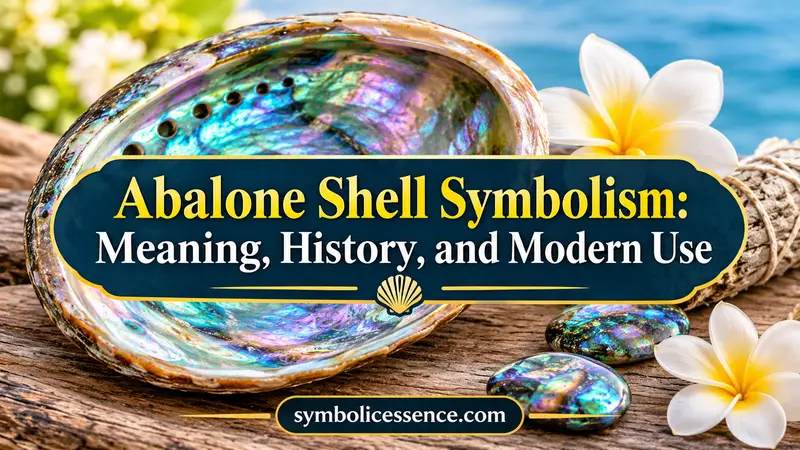
An abalone shell is easy to recognize by its colorful inner surface. Shades of blue, green, purple, pink, and silver appear to shift when the shell catches the light. This natural pattern has made it popular in jewelry, decorative objects, artwork, and coastal-inspired home designs.
People often search for abalone shell symbolism when they receive a piece of jewelry, find a shell near the ocean, or want to understand why its unusual colors appear in spiritual and cultural traditions. In the United States, it is commonly associated with the ocean, emotional balance, natural beauty, protection, and personal renewal.
However, its meaning is not the same in every setting. Some associations come from its physical connection to the sea, while others developed through cultural traditions, personal experiences, and modern decorative use.
Quick Answer
Abalone shell symbolism commonly represents ocean connection, emotional balance, protection, natural beauty, and personal transformation in modern American culture. Its associations developed partly from its coastal origins and long-standing use in Indigenous Pacific coastal communities, where shells served practical, artistic, and ceremonial purposes.
TL;DR
- Abalone shells commonly represent the ocean, balance, and natural beauty.
- Their colorful inner surfaces come from layers of nacre.
- Coastal Indigenous communities have used abalone shells for generations.
- Modern Americans often choose them for jewelry and home decoration.
- Their colors are associated with individuality and personal expression.
- Harvesting concerns have added environmental meaning to the shell.
What Does an Abalone Shell Look Like?
An abalone is a marine sea snail that lives in coastal waters. Its shell has a rounded, ear-like shape with a row of small holes along one side. These openings help the animal move water through its shell.
The outside is usually rough, dark, and uneven. Depending on the species and its environment, it may appear brown, gray, green, or reddish. The inside is what makes the shell especially recognizable.
Its inner surface contains nacre, also called mother-of-pearl. This material forms thin layers that reflect light in different ways. As a result, the shell can display several colors at once.
Common colors include:
- Blue: Often associated with water, openness, and calm.
- Green: Commonly connected with nature, growth, and renewal.
- Purple: Often used to suggest creativity and individuality.
- Pink: Associated in modern decorative settings with gentleness and affection.
- Silver: Can suggest clarity, elegance, and simplicity.
Not every shell displays the same combination. Species, age, growing conditions, and natural variation influence its appearance.
Abalone shells are found in coastal regions around the world, including parts of California, Mexico, Australia, New Zealand, South Africa, and Japan.
Their appearance is an important starting point for understanding why people have attached different meanings to them.
What Does an Abalone Shell Symbolize Today?
In contemporary American culture, the shell is most often associated with five ideas.
Connection with the ocean: Its natural home gives it a direct connection to coastal environments, marine life, and the movement of water. People who enjoy beach communities or ocean activities may choose it as a reminder of their relationship with the sea.
Emotional balance: Its changing colors and smooth inner surface are often used as visual reminders of calmness. Some people associate it with taking a break, slowing down, and making space for their feelings.
Protection: Shells protect the animals that grow inside them. This natural function has helped make shells general symbols of shelter and safety. When people use abalone jewelry as a personal keepsake, they may connect it with feeling protected.
Personal transformation: The shell develops through natural growth over time. Its layered structure and changing appearance make it a useful image for personal development, changing circumstances, and learning from experience.
Natural beauty: No two shells have exactly the same pattern. Their unusual colors represent individuality and the appeal of things that are not perfectly uniform.
These are common modern interpretations rather than universal meanings. Someone who grew up near the Pacific Ocean may connect the shell with family memories, while another person may simply appreciate its appearance.
Where Did Its Symbolic Meaning Begin?
The history of this shell is closely connected to the communities that lived near the coastlines where abalone grew.
For many generations, Indigenous peoples along the Pacific Coast of North America collected and used marine shells. Abalone was valued for its material, appearance, and usefulness.
Its shell could be shaped into decorative objects, ornaments, and other items. In some communities, shell materials also had connections to exchange, cultural identity, and ceremonial practices.
It is important not to treat all Indigenous traditions as one shared belief system. Different coastal nations have their own histories, customs, and meanings. The role of abalone also varied depending on location and availability.
The shell’s natural appearance contributed to its appeal. Its reflective interior offered a material that could be worked into objects with distinctive colors and patterns.
Over time, trade and contact between communities helped move marine materials beyond the places where they were collected.
European settlers and later commercial markets also developed an interest in abalone, particularly for food, buttons, ornaments, and decorative products.
The exact beginning of every symbolic association is difficult to establish. What can be said is that its cultural importance developed through a combination of practical use, coastal traditions, artistic work, and personal meaning.
Why Is Abalone Shell Connected With the Ocean?
The connection is straightforward: abalone is a marine animal that lives attached to rocks in coastal waters.
Unlike an object that only represents the sea through artwork, this shell comes directly from a marine environment. Its natural origin makes it a recognizable reminder of ocean life.
Several features contribute to this association.
First, its colors resemble parts of the underwater world. Blue and green shades can remind people of shallow coastal water, while purple and silver reflections may bring to mind sunlight moving across the surface of the sea.
Second, the shell is associated with coastal habitats. Abalone typically lives in rocky marine areas, where waves, tides, kelp, and other sea life shape its environment.
Third, its growth reflects the passage of time in nature. The shell develops as the animal grows, creating layers rather than appearing fully formed.
For Americans living near the Pacific Coast, these details can make the shell especially meaningful. It may remind someone of a childhood beach, a family vacation, a fishing community, or a favorite coastal landscape.
For others, it represents an appreciation of marine environments without a direct personal connection.
How Is It Used in Native American and Indigenous Coastal Traditions?
Abalone has a documented place in the material cultures of several Indigenous communities along the Pacific Coast.
Historically, marine shells were important resources. They could be used for ornamentation, trade, artistic objects, and, in some cultural settings, ceremonial purposes.
The exact use depended on the community and historical period.
In parts of California and the Pacific Northwest, shell materials were worked into personal decorations and other crafted objects. Their appearance, durability, and availability made them useful for different forms of artistic expression.
Some Indigenous coastal traditions also connect shell materials with social relationships, cultural practices, and the natural resources of ancestral lands.
However, it would be inaccurate to claim that every Native American community considers abalone a universal symbol of healing, protection, or spirituality.
These meanings should be understood within their specific cultural settings rather than assigned to all Indigenous peoples.
There is also an important distinction between learning about traditional practices and copying ceremonial objects or presenting them as generic decorations. Respectful interpretation recognizes the communities behind these traditions and avoids treating their cultural materials as interchangeable symbols.
What Does Its Color Mean in Symbolic Interpretations?
One reason people find this shell appealing is its changing color. Unlike a painted object, its reflective surface produces natural variations that shift with the viewing angle.
Different colors have their own common associations in modern American design and personal expression.
| Context | Meaning in USA | Common Associations | Notes |
| Blue and green patterns | Connection with nature | Ocean, relaxation, coastal living | Popular in beach-inspired interiors |
| Purple reflections | Individuality | Creativity, imagination | Often appreciated in artistic jewelry |
| Pink and silver tones | Softness and elegance | Affection, beauty, refinement | Common in decorative accessories |
| Multicolored surfaces | Personal expression | Uniqueness, change, diversity | Each natural pattern is different |
| Dark outer shell | Natural protection | Shelter, resilience | Reflects the shell’s physical structure |
These associations are cultural interpretations, not scientific properties of the colors.
For example, blue does not automatically make someone feel calm, and purple does not guarantee creativity. Color meanings depend on personal experience, design choices, and cultural background.
Still, these associations help explain why the shell appears in so many decorative and personal objects.
What Does an Abalone Shell Mean Emotionally?
People often connect physical objects with memories, feelings, and experiences. A shell can become meaningful because of what it reminds someone of rather than because it has one fixed definition.
Its ocean connection may remind a person of a peaceful afternoon at the beach. Someone who grew up near the California coast might associate it with family trips, summer holidays, or time spent exploring tide pools.
Its changing colors can also provide a visual comparison for human experience. Life does not always look the same from one day to the next. A person may see the different shades as a reminder that circumstances and feelings can change.
There are several emotional associations people may find in it:
Comfort: A coastal object may remind someone of a familiar place where they feel at ease.
Acceptance: Its irregular patterns can represent an appreciation of natural differences and imperfections.
Resilience: The shell’s protective function can serve as a personal reminder to establish boundaries and care for oneself.
Hope: Its colorful interior may represent finding something beautiful after a difficult period.
Belonging: For someone with family or cultural ties to coastal communities, it may represent a connection to a particular place and its traditions.
These interpretations are personal. They do not mean that owning a shell changes someone’s emotional condition or guarantees a particular outcome.
Why Do People Wear Abalone Shell Jewelry?
Jewelry is one of the most recognizable modern uses of this material.
In the United States, abalone appears in necklaces, earrings, bracelets, rings, pendants, and decorative inlays. It is especially popular in coastal-inspired fashion because its colors work well with natural materials.
A pendant may display one large section of the shell, allowing its natural pattern to become the main feature. Earrings often use smaller pieces, while rings may combine the material with silver, gold, or other metals.
People choose this jewelry for different reasons.
Some appreciate its unusual appearance. Others associate it with ocean memories or a love of coastal living. A person who enjoys nature-inspired accessories may prefer it because every piece has a slightly different pattern.
It can also carry personal meaning as a gift.
For example, someone might give an abalone necklace to a friend who loves the ocean or include a shell pendant in a birthday present for someone who enjoys handmade jewelry.
In these situations, the meaning comes partly from the relationship between the people exchanging the gift.
The material does not need a spiritual explanation to be meaningful. Its appearance and personal history may be enough.
Why Is It Used in Home Decoration?
Abalone shell is also used in home accessories and decorative design.
Its reflective interior works particularly well in spaces inspired by beaches, water, and natural materials. It may appear in small bowls, picture frames, decorative boxes, wall art, furniture inlays, and ornamental objects.
In American homes, it is often associated with a relaxed coastal style.
A small decorative dish on a bedroom dresser, for example, can bring a subtle reminder of the ocean into an everyday space. A shell-inlaid box may become a display item or a place to store jewelry.
Its visual effect also makes it suitable for rooms that use neutral colors. White walls, light wood, beige fabrics, and blue accents can complement its changing surface.
Some people choose it because it looks different from manufactured decorations. Natural variations give each piece its own appearance.
There is also a personal side to its use. A shell collected during a legal and responsible beach visit, or purchased during a vacation, can become a keepsake associated with a particular experience.
That connection often matters more than any traditional interpretation.
Does It Have a Spiritual Meaning in Modern America?
Some Americans include abalone in personal spiritual practices, meditation spaces, or collections of nature-inspired objects.
In these settings, it may be used as a reminder of calmness, protection, reflection, and a connection with the natural world.
Its shell-like shape and ocean origin also make it suitable for personal rituals involving water or coastal themes.
However, there is no single religious meaning shared by all Americans.
Abalone is not a required object in Christianity, Judaism, Islam, Buddhism, or other major religious traditions. Particular communities and individuals may use shells in their own practices, but those choices should not be confused with universal religious rules.
It is also worth separating traditional cultural practices from modern spiritual interpretations.
For example, a person may associate the shell with emotional balance because of its appearance and personal experience. That does not establish that the shell has a scientifically proven effect on emotions.
A respectful interpretation leaves room for personal belief without presenting it as an established fact.
How Has Its Meaning Changed Over Time?
The meaning of abalone has developed alongside changes in how people use and value marine materials.
In earlier coastal communities, the shell was first and foremost a natural resource. It had practical value and could also become part of artistic, social, and ceremonial life.
As trade expanded, shell materials reached people who did not live near abalone habitats. Their appeal increasingly included appearance and craftsmanship.
During the twentieth century, decorative products and jewelry helped introduce iridescent shell materials to wider consumer markets. Abalone became recognizable as an attractive material for accessories, ornaments, and gifts.
Later, coastal fashion and home design gave it another role. It became associated with beach-inspired interiors and personal connections to the ocean.
More recently, environmental awareness has influenced how people think about marine products.
Concerns about overharvesting, habitat damage, and declining wild abalone populations have encouraged greater attention to responsible sourcing and conservation.
This has added another possible interpretation: appreciation of nature also involves protecting the living environments that produce beautiful materials.
The shell’s meaning has therefore expanded from practical and cultural use to include personal identity, design, environmental awareness, and individual expression.
What Are Common Misunderstandings About Abalone Shell?
Several popular claims about this shell need a little clarification.
Every abalone shell has the same meaning.
It does not. Its interpretation varies between individuals, communities, and cultural settings. A jewelry buyer and someone from an Indigenous coastal community may have very different relationships with the material.
It is naturally a spiritual object.
A shell can have spiritual importance within a particular tradition or personal practice, but it is not automatically sacred to everyone.
Its colors prove that it has special emotional properties.
The colors result from the structure of nacre and the way light interacts with its layers. Their emotional associations are cultural and personal, not proven physical effects.
All shiny mother-of-pearl comes from abalone.
This is another common mistake. Mother-of-pearl occurs in the shells of several mollusks. A shiny white or iridescent surface does not necessarily mean an object is made from abalone.
Collecting any shell from the beach is harmless.
Not always. Local rules may restrict collecting, and taking living marine animals or protected species can harm coastal ecosystems. Responsible sourcing matters, especially when purchasing shell products.
Understanding these differences helps people appreciate the material without confusing natural facts, cultural traditions, and modern beliefs.
Why Is Abalone Conservation Part of Its Modern Meaning?
Abalone is not only a decorative material. It comes from living marine animals that depend on healthy coastal habitats.
In several regions, wild populations have faced serious challenges from overharvesting, disease, environmental changes, and habitat loss.
California provides an important example. Some wild abalone populations have declined significantly, and restrictions on harvesting have been introduced to support conservation.
The situation varies by species and location, so it is not accurate to assume that every abalone population faces identical conditions.
For modern consumers, this creates a practical question: Where did a particular shell product come from?
Responsible buyers can look for clear information about the species, origin, and sourcing method. They can also consider reclaimed, recycled, or previously used shell materials instead of automatically choosing newly harvested products.
This environmental connection adds a different layer to its modern interpretation.
Rather than seeing the shell only as a beautiful object, some people see it as a reminder that coastal resources need protection.
Its value is connected to the living marine environment, not just the finished product.
FAQs
Is abalone shell symbolism positive or negative?
It is generally interpreted positively in modern American decorative and personal settings. Common associations include beauty, protection, ocean connection, and renewal. However, its meaning can vary depending on cultural background and personal experience.
Is an abalone shell considered good luck?
Some people keep shells as personal keepsakes or objects they associate with good fortune. However, there is no universal cultural rule that an abalone shell guarantees luck or prevents bad events. Its meaning depends on the owner’s beliefs.
Can you give someone an abalone shell as a gift?
Yes. It can make a thoughtful gift for someone who enjoys the ocean, nature-inspired jewelry, or coastal design. A shell pendant or decorative piece can be especially meaningful when it represents a shared vacation, family memory, or personal milestone.
Is abalone shell the same as mother-of-pearl?
Not exactly. Mother-of-pearl is the iridescent inner material found in several mollusk shells, including abalone. Abalone shell is one particular source of this material, and its color patterns are often more varied than those of other types.
Can abalone shell be used in weddings?
Yes. Some couples use it in coastal wedding decorations, jewelry, table accessories, or small gifts for guests. Its blue and green reflections can complement oceanfront ceremonies and beach-inspired wedding themes.
Is an abalone shell the same as a nautilus shell?
No. Both come from marine mollusks, but they belong to different groups and have different structures. Abalone has a flattened shell with a colorful inner surface, while a nautilus has a distinctive spiral-shaped shell.
How can you tell whether an abalone shell is genuine?
A genuine shell generally has natural variations in color, an uneven outer surface, and a recognizable row of small respiratory holes along one side. Artificial imitations may have unusually uniform patterns or painted surfaces, although professional identification may be needed for valuable pieces.
Conclusion
Abalone shell symbolism is closely connected with the ocean, natural beauty, protection, emotional balance, and personal change. Its associations developed through its coastal origins, traditional material uses, artistic value, and modern popularity in jewelry and home decoration.
For Americans today, the shell can represent a personal connection to the sea, a reminder of a meaningful experience, or simply an appreciation of nature’s unusual patterns. Its interpretation does not need to be spiritual or religious to have value.
The next time you see an iridescent shell in a jewelry shop or coastal home, look closely at its changing colors. Each pattern is a natural result of the animal’s growth, making the finished object a small reminder of the living environment from which it came.