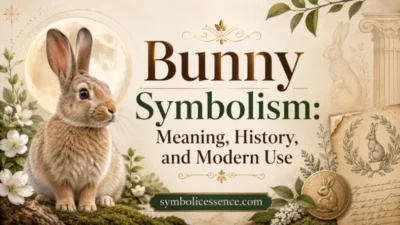

Rabbits show up everywhere in American life — on greeting cards, in nursery decor, tattooed on forearms, and hopping across lawns every spring. Most people never stop to ask why a small, twitchy-nosed animal carries so much cultural weight. Rabbit symbolism has accumulated meaning over thousands of years, pulled from religion, folklore, farming life, and pop culture, and a lot of that history still shapes how we read a rabbit image today without anyone quite realizing it.
Part of the reason rabbits carry so much symbolic freight is biological: they reproduce fast, they’re prey animals with sharp instincts for danger, and they’re active around dawn and dusk, times humans have long associated with transition and mystery. Those traits gave early cultures plenty of raw material to build stories and beliefs around.
This piece walks through what the rabbit has meant historically, how that meaning shifted once it crossed into American culture, and why the image still gets used the way it does — in tattoos, on Easter cards, and in the phrase “down the rabbit hole.”
Quick Answer
Rabbit symbolism in modern American culture most commonly represents fertility, new beginnings, and good luck, largely thanks to its association with spring and Easter. Historically, rabbits and hares were tied to lunar mythology, fertility goddesses in Greek and European traditions, and trickster folklore across Native American and African storytelling. Today the meaning ranges from wholesome renewal to cleverness and even vulnerability, depending on the context.
TL;DR
- Fertility is the oldest and most consistent meaning across cultures
- Easter Bunny traces back to European spring goddess traditions
- Many Native American stories cast the rabbit as a clever trickster
- Chinese and Japanese traditions link rabbits to the moon and longevity
- American tattoo culture often reads rabbits as luck or transformation
- Rabbit-foot charms come from old European folk magic, not Easter
What a Rabbit Actually Looks Like in Symbolic Use
When people say “rabbit symbolism,” they’re usually picturing one of a few recurring images: a soft, upright bunny with long ears (the Easter Bunny type), a running hare stretched mid-leap (common in Celtic and heraldic art), or a stylized rabbit paired with the moon (common in Chinese and Japanese design). Real biological differences exist between rabbits and hares — hares are larger, faster, and don’t burrow — but folklore rarely bothers to separate them. Most symbolic traditions use the words interchangeably, which is why hare mythology and rabbit mythology tend to blend together in modern retellings.
You’ll encounter rabbit imagery on everything from spring greeting cards to company logos to fine jewelry, and the visual style usually signals which meaning is intended. A cartoonish, round bunny leans toward innocence and childhood. A running hare or a rabbit paired with celestial imagery leans toward something older and more mythic.
The Core Meaning: Fertility, Renewal, and Luck
Strip away the regional variation and three meanings show up almost everywhere: fertility, renewal, and luck. <cite index=”6-1″>Rabbits have been associated with fertility and abundance for centuries, and in many traditions the animal is treated as a sign of prosperity and renewal.</cite> This isn’t an accident of folklore — it’s a direct read on rabbit biology. Female rabbits can produce several litters a year, and that reproductive speed made them an obvious stand-in for abundance long before anyone wrote it down as a formal symbol.
Luck is the other major thread, and it comes from a slightly different source: old European folk belief that carrying part of a rabbit, especially a hind foot, warded off misfortune. That practice is centuries old and has nothing to do with Easter; it developed independently and later merged into the broader cultural sense that rabbits are “lucky” animals in general.
Ancient Roots: How the Symbol First Took Shape
The earliest layers of rabbit symbolism come from the ancient Mediterranean and from early Buddhist art in Asia. <cite index=”3-1″>In Greek mythology, rabbits were associated with Aphrodite, the goddess of love, marriage, and beauty, and their reputation for producing many offspring made them symbols of fertility and abundance.</cite> Rabbits were also connected to Artemis, goddess of the hunt, who was said to protect young hares rather than allow them to be killed. Gift-giving customs grew out of this: young men reportedly gave rabbits as courtship gifts, a gesture tied directly to the fertility association.
In Egypt, the rabbit’s seasonal appearance lined up with spring rites connected to renewal and rebirth, themes that later folded into how Europe would come to understand Easter itself. Meanwhile, in Buddhist art from Central Asia, a very different rabbit motif was taking shape. <cite index=”5-1″>One of the oldest known versions of a recurring rabbit symbol has been traced to the sixth century, found in the sacred Buddhist Mogao caves near Dunhuang, a hub along the Silk Road that helped spread the design across trade routes into surrounding artistic traditions.</cite> That geographic spread is a big part of why rabbit imagery looks so similar across cultures that otherwise had little direct contact.
The Moon Connection Across Cultures
One of the most consistent and least American-specific pieces of rabbit symbolism is its tie to the moon. Look at the moon’s surface and, depending on the culture, you’re told to see a rabbit rather than a “man in the moon.” <cite index=”7-1″>In Chinese tradition, the Jade Rabbit lives on the moon and is linked to longevity, purity, and the elixir of life within a broader Daoist framework, while in Japan a rabbit is pictured pounding mochi, tied to themes of prosperity and self-sacrifice.</cite> Hindu tradition carries a related image, with lunar rabbit stories connected to ideas of well-being and transformation.
This lunar link also shows up in Aztec, Mesoamerican, and some Norse traditions, which is notable because these cultures had no meaningful contact with each other. The likeliest explanation isn’t shared influence — it’s that the actual shadow pattern on the moon’s surface resembles a crouching rabbit closely enough that multiple, unconnected cultures arrived at the same visual interpretation independently.
Rabbit Symbolism in the United States
American rabbit symbolism is really a layered import: European fertility and spring folklore arrived with settlers, Native American trickster storytelling was already deeply rooted on the continent, and both got filtered through commercial holiday culture and 20th-century media.
The clearest example is the Easter Bunny, which didn’t originate in the United States. It traveled here with German immigrants in the 1700s, carrying older associations with spring fertility goddesses from pre-Christian Europe. Once in America, the folk figure was gradually softened into a family-friendly character tied to egg hunts and chocolate, stripped of most of its older mythic weight. Most Americans today encounter the rabbit almost entirely through this Easter lens, with little awareness of the older material underneath it.
Separately, Native storytelling traditions gave American culture its own homegrown rabbit archetype: the clever trickster. <cite index=”2-1″>In Native American folklore, the rabbit often appears as a trickster figure that relies on cleverness and deceit rather than strength to get what it wants, a pattern that suggests intelligence and strategy can outmatch brute force.</cite> <cite index=”4-1″>The Pawnee associated rabbits with the ability to communicate with the spirit world, while the Navajo linked rabbits to rain and abundance.</cite> That trickster lineage runs in a straight line to Br’er Rabbit stories, which were adapted from African and African American oral traditions in the American South, and eventually to Bugs Bunny, a distinctly American pop-culture descendant of the same clever-underdog archetype.
| Context | Meaning in the USA | Common Associations | Notes |
|---|---|---|---|
| Easter and spring | Renewal, new life | Eggs, pastel colors, chocolate bunnies | Rooted in older European spring-goddess folklore |
| Tattoos | Luck, transformation, femininity | Moon, flowers, running hare | Meaning shifts heavily with art style |
| Folklore characters | Cleverness, wit | Br’er Rabbit, Bugs Bunny | Traces back to Native American and African trickster tales |
| Nursery and baby items | Innocence, gentleness | Soft colors, storybook bunnies | Draws on the animal’s gentle, timid nature |
| Rabbit’s foot charm | Luck, protection | Keychains, pocket charms | Separate tradition from Easter, older European origin |
| Year of the Rabbit | Longevity, prosperity | Chinese zodiac, moon imagery | Increasingly visible in U.S. Lunar New Year celebrations |
Cross-Cultural Meaning Beyond the U.S.
Outside American borders, rabbit symbolism keeps some threads consistent and adds others. In Chinese culture, the rabbit is the fourth animal in the zodiac cycle. <cite index=”8-1″>According to the zodiac story, the Jade Emperor invited animals to race, and the order they finished in determined their place in the cycle — the rat came first, the rabbit fourth — and the rabbit came to be seen as a gentle, sensitive creature representing abundance and prosperity.</cite>
In parts of European folk belief, rabbits and hares carried a darker undertone alongside the positive fertility associations. Hares in particular were sometimes linked to witchcraft in medieval European folklore, since a running hare crossing someone’s path was considered an omen, and folk tales occasionally described witches shape-shifting into hares. That superstition never really took hold in the United States, which is part of why American rabbit symbolism reads almost entirely positive by comparison.
Emotional and Psychological Meaning
Beyond mythology, there’s a psychological layer to why rabbits resonate the way they do. Their physical vulnerability — small size, prey status, constant alertness — makes them easy stand-ins for innocence, gentleness, and fragility. That’s the emotional register at work when a rabbit shows up in children’s books like Peter Rabbit or Watership Down, where the animal’s vulnerability is the point.
At the same time, the trickster tradition pulls in the opposite direction, associating rabbits with quick thinking, adaptability, and the ability to outmaneuver bigger threats. So a rabbit can signal either “delicate and needs protecting” or “sharp and resourceful,” and which one a given piece of media is going for usually comes down to tone: soft pastel illustration versus a sly, grinning cartoon rabbit send very different signals despite depicting the same animal.
Why Rabbits Show Up in Tattoos and Personal Style
Rabbit tattoos have become common enough in the U.S. that they carry a fairly specific set of associated meanings. A simple, realistic rabbit often signals gentleness, femininity, or a personal connection to spring and renewal — sometimes tied to a specific life change like a pregnancy, a recovery, or a fresh start. A running hare, especially rendered in a bold linework or geometric style, tends to lean into the older folklore meanings of luck, speed, and transformation.
Moon-and-rabbit combination tattoos pull directly from the East Asian lunar tradition and usually signal an interest in that specific mythology rather than the Western Easter association. White rabbits carry their own subset of meaning, partly from Alice in Wonderland’s role as a guide into a strange new world, which has made “white rabbit” tattoo imagery associated with curiosity, transition, or a turning point.
Rabbit Symbolism in Decor, Design, and Everyday Objects
Rabbit motifs are a staple in home decor, especially around spring, but they show up year-round in nursery design, ceramics, and textile patterns. The appeal is largely about softness and approachability — a rabbit reads as gentle and non-threatening in a way that few other animals do, which makes it a natural choice for spaces meant to feel calm or welcoming, like children’s rooms.
In jewelry, rabbit charms and pendants are frequently marketed around the luck association, often paired directly with rabbit’s-foot imagery, though modern versions almost always use stylized or faux materials rather than anything literal.
Modern Usage: Pop Culture and Digital Life
Rabbits occupy a strange dual role in American pop culture. On one hand, there’s the wholesome lineage — Peter Rabbit, the Velveteen Rabbit, the Easter Bunny — built around gentleness and childhood comfort. On the other, there’s a stranger, more unsettling rabbit tradition running through American media, from the unnerving rabbit in Donnie Darko to the disorienting White Rabbit in Alice in Wonderland, both of which use the animal as a signal that something is about to shift into unfamiliar territory.
That duality is baked into common phrases too. “Down the rabbit hole” now describes falling into a confusing or obsessive research spiral, borrowed directly from Lewis Carroll but stripped of its original whimsy. Online, rabbit imagery gets used in both registers: soft, aesthetic bunny content on social media platforms, and edgier “white rabbit” or “follow the rabbit” references in internet subcultures that lean into the stranger, Alice-in-Wonderland side of the symbol.
Common Misunderstandings and Controversies
The biggest misunderstanding is treating rabbit symbolism as one consistent thing. It isn’t. A rabbit in a Chinese zodiac context is signaling something almost entirely different from a rabbit tattoo referencing Alice in Wonderland, even though both use the same animal.
There’s also a persistent conflation between rabbits and hares in popular writing, which occasionally garbles historical claims — a piece of European hare folklore gets attributed to “rabbits” generally, even though the two animals had somewhat distinct symbolic roles in older traditions. It’s a minor point, but it explains why sources sometimes seem to contradict each other on specific historical details.
Separately, the rabbit’s-foot charm tradition sometimes gets criticized today on animal-welfare grounds, since the charms were historically made from real feet. That’s a modern ethical reassessment of an old practice rather than a shift in what the symbol itself means, and most commercial versions sold today use synthetic materials specifically to sidestep the issue.
How the Meaning Has Evolved Over Time
The throughline from ancient fertility goddess to Easter Bunny to Bugs Bunny is really a story of gradual secularization. Rabbit symbolism started in religious and mythological contexts — tied to specific gods, specific rituals, specific beliefs about the afterlife or the harvest. Over centuries, especially as it moved through Christianized Europe and then into American consumer culture, the religious backbone got quietly removed while the surface imagery stayed intact.
That’s why most Americans today can recognize the Easter Bunny instantly but would have no idea it descends from a fertility goddess named Eostre. The visual symbol survived; the theology underneath it mostly didn’t. A similar pattern shows up with the trickster rabbit, which started as a specific spiritual and moral figure in Native storytelling and gradually became a general-purpose comic archetype in mainstream American cartoons, with much of its original cultural context left behind in the transition.
FAQs
What’s the significance behind a rabbit tattoo?
Rabbit tattoos usually point to luck, fertility, gentleness, or a personal sense of renewal, and the exact reading depends heavily on style. A rabbit paired with the moon typically borrows from East Asian lunar mythology, while a white rabbit design usually nods to Alice in Wonderland and the idea of stepping into something unfamiliar.
Does the rabbit hold any religious weight today?
Not within mainstream American religion, though its roots run through several older traditions. Ancient Greek and Germanic paganism tied it to specific goddesses, and it still appears in Buddhist lunar folklore and parts of Chinese Daoist tradition as a marker of longevity.
How did rabbits end up connected to Easter?
The link goes back to pre-Christian European spring festivals built around fertility goddesses, which later merged into Christian Easter traditions and were carried to America by German immigrants in the 1700s. The candy-and-egg-hunt version familiar today is a much later, thoroughly Americanized simplification of that older folklore.
Can rabbit symbolism carry a negative meaning?
Within modern American culture, rarely — the associations skew heavily positive, built around luck, gentleness, and renewal. Some older European folk traditions linked hares to witchcraft or ill omens, but that darker thread never really took root in the U.S.
Is there a real difference between rabbit symbolism and hare symbolism?
There is historically, even though the two get used interchangeably now. Hares carried a wilder, more mystical reputation tied to moon lore and folk magic, while rabbits were more closely tied to domestic fertility symbolism.
Why does a rabbit appear in the moon for so many different cultures?
It’s less about shared belief and more about shared observation — the moon’s natural shadow pattern resembles a crouching rabbit closely enough that unconnected cultures, including Chinese, Aztec, and Japanese traditions, independently arrived at the same image.
What does it mean to dream about a rabbit?
Interpretations usually track the rabbit’s behavior in the dream, with themes of fertility, fresh starts, or anxiety showing up most often. A calm or playful rabbit tends to read as a positive sign, while one that’s fleeing or frightened is more often tied to a feeling of wanting to escape a situation.
Conclusion
Rabbit symbolism isn’t a single, tidy idea — it’s a layered mix of fertility folklore, lunar mythology, trickster storytelling, and modern commercial holiday tradition, all riding on the same small, twitchy-eared animal. What makes it interesting is how much of that history is invisible in daily use: most people reaching for a chocolate bunny at Easter or getting a rabbit tattoo aren’t thinking about Eostre or the Jade Rabbit, yet those older meanings are still quietly baked into the image.
That’s really the pattern with most enduring symbols. The specific beliefs fade, but the image sticks around and keeps absorbing new meaning from whatever culture picks it up next. The rabbit’s particular mix of softness, speed, and reproductive abundance gave it unusually broad appeal, which is part of why it managed to survive the trip from ancient goddess worship to Saturday morning cartoons without losing its foothold in the culture.
Next time a rabbit shows up on a greeting card or in a tattoo shop’s flash sheet, it’s worth remembering there’s a lot more sitting underneath that image than “cute Easter animal” — even if that’s the only part most people ever notice.