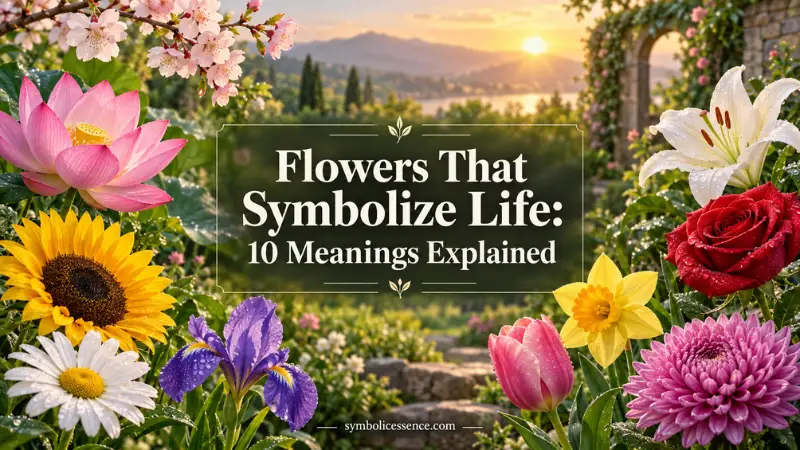
Flowers grow, open, fade, and return with the seasons. That natural cycle explains why people often use them to represent birth, growth, survival, renewal, and the shortness of life. However, flowers that symbolize life do not all deliver the same message.
A daffodil signals a fresh start, while a chrysanthemum can express longevity. Cherry blossoms emphasize life’s brief beauty. The lotus carries religious associations with purity and rebirth in several Asian traditions.
For modern American readers, the right flower depends on the occasion. A birth, recovery, memorial, graduation, and new home may each call for a different version of “life.”
Quick Answer
Flowers that symbolize life most commonly represent growth, renewal, vitality, endurance, or the cycle of birth and death. The lotus, daffodil, sunflower, cherry blossom, chrysanthemum, amaranth, daisy, lily, marigold, and iris each express a different part of that broad idea.
TL;DR
- Lotus flowers represent rebirth, purity, and life rising through hardship.
- Daffodils signal spring, recovery, and hopeful new beginnings.
- Sunflowers express warmth, vitality, growth, and an active life.
- Cherry blossoms highlight life’s beauty and brief duration.
- Chrysanthemums and amaranths can represent longevity or life beyond death.
- Occasion and cultural background determine the most suitable flower.
Why Flowers Represent Life
A flower is the reproductive structure of a flowering plant. It helps produce seeds, which allow another generation to grow. Flowers therefore have a direct biological connection to fertility, continuation, and new life.
Their seasonal patterns add another symbolic layer. Many plants appear dormant in winter, grow again in spring, bloom, form seeds, and fade. People have long read that visible sequence as an image of birth, maturity, death, and renewal.
Yet a flower’s symbolism does not come from nature alone. Religion, art, literature, local customs, and the 19th-century language of flowers all shaped modern interpretations. The same bloom may represent celebration in one setting and remembrance in another.
What “Life” Can Mean in Flower Symbolism
Life is not one narrow concept. Before choosing a flower, consider which part of life you want it to express:
- Birth: the arrival of a child or beginning of a family
- Renewal: recovery after illness, grief, or hardship
- Growth: education, maturity, or personal development
- Vitality: health, energy, warmth, and joy
- Longevity: a long life, marriage, or family line
- Life’s brevity: appreciation for beauty that does not last
- Continuation: remembrance, legacy, or life beyond death
This distinction prevents a common mistake. A flower connected with rebirth may suit a recovery gift but feel less natural for an anniversary. A bloom associated with life’s brief duration can be thoughtful in art or memorials, yet too somber for a newborn celebration.
10 Flowers That Symbolize Life
1. Lotus: Rebirth and Life Rising Through Difficulty
The lotus is one of the clearest floral images of rebirth. Its roots develop in mud beneath shallow water, while the leaves and flowers rise toward the surface. That contrast has made the plant a fitting image of purity, regeneration, resilience, and spiritual development.
Lotus symbolism has distinct cultural histories. In ancient Egyptian art, water lilies commonly called lotuses were associated with creation, the rising sun, and daily renewal because certain species opened in daylight and closed at night.
In Hindu art and worship, the lotus appears with deities including Lakshmi and commonly represents fertility, divine beauty, abundance, and spiritual purity. Buddhist art uses lotus seats and blossoms to express purity and awakening. These traditions overlap in places, but they should not be treated as one universal “Eastern” meaning.
In modern American use, lotus tattoos and artwork often stand for recovery, personal change, or emerging from a difficult period. That interpretation draws from older religious imagery but is usually more individual than doctrinal.
2. Daffodil: New Life and the Return of Spring
Daffodils bloom near the end of winter or in early spring across much of the United States. Their timing makes them natural signs of renewal, hope, and life returning after dormancy.
The flower works especially well for a fresh beginning. People may give daffodils after a move, career change, successful treatment, or emotionally difficult season. Yellow varieties add a cheerful sense of warmth, although the renewal meaning comes mainly from the plant’s spring appearance.
Daffodils also belong to the genus Narcissus, a name connected with the Greek myth of Narcissus. That story adds associations with self-absorption and beauty, but it does not erase the flower’s widely recognized spring meaning.
Choose daffodils when “life” means beginning again rather than living forever.
3. Sunflower: Vitality, Warmth, and Active Growth
Sunflowers communicate life through size, color, and visible growth. Their tall stalks and broad yellow flower heads resemble the sun, a basic source of warmth and energy for life on Earth.
Young sunflower buds display solar tracking, known as heliotropism. They generally follow the sun from east to west during the day and turn back overnight. Mature flower heads usually face east rather than continuing to track the sun. This real plant behavior helps explain modern associations with optimism, direction, energy, and growth.
American culture also gives the sunflower a strong connection to farms, late summer, open landscapes, and abundant seeds. It can therefore suggest nourishment and productive life as well as happiness.
A sunflower is a good choice for graduations, recovery gifts, birthdays, and encouragement. It creates a brighter, more energetic message than the quiet spiritual renewal of a lotus.
4. Cherry Blossom: Beautiful but Brief Life
Cherry blossoms symbolize life by drawing attention to its short duration. Their flowers appear in large numbers but remain for only a limited time, especially when wind or rain carries the petals away.
In Japan, cherry-blossom viewing, or hanami, encourages seasonal appreciation of the blooms. Japanese art and literature have connected sakura with spring, beauty, change, and impermanence. The symbolism is complex and developed across many periods rather than coming from one simple ancient rule.
American audiences often encounter this meaning through Japanese cultural influence and the flowering cherry trees in Washington, D.C. Those trees also carry a specific history of friendship between Japan and the United States.
Cherry blossoms suit art, tattoos, memorial pieces, and gifts that honor a meaningful stage of life. Their message is not merely “new beginnings.” They can also remind viewers to value beauty because it passes.
5. Chrysanthemum: Longevity and a Full Life
Chrysanthemums can represent longevity, good fortune, and a life that continues into old age. In East Asian art, the flower has developed important links with autumn, endurance, and long life.
Japanese culture gives the chrysanthemum a prominent imperial association. In Chinese artistic and literary traditions, it can suggest autumn, resilience, longevity, or the integrity of a person who remains true to personal principles. These meanings are culturally specific and should not be reduced to a single pan-Asian definition.
Context matters greatly. In several European countries, chrysanthemums are strongly connected with graves and mourning. In the United States, people also use colorful “mums” as cheerful fall decorations, especially on porches and in seasonal displays.
For an American birthday or anniversary, a warm-colored chrysanthemum can express long life and endurance. Before giving one across cultures, check whether the recipient associates it mainly with funerals.
6. Amaranth: Unfading Life and Immortality
Amaranth offers one of the most direct links between a flower’s name and its symbolic meaning. Its name comes through Greek from a word commonly understood as “unfading.” Some varieties also retain their form and color after drying.
Those qualities helped amaranth become an image of immortality, lasting affection, and something that refuses to disappear. In poetry and later flower symbolism, an unfading flower could stand for a memory, reputation, or love that survives physical change.
Amaranth differs from flowers that represent a new start. Its central message is continuation. It suits lasting memorials, major anniversaries, heirloom gardens, or art about legacy.
The plant also has practical importance. Several amaranth species produce edible leaves or nutritious grain-like seeds. This connection with food gives the plant an additional, concrete relationship to sustaining life.
7. Daisy: Fresh Life, Innocence, and Simplicity
Daisies commonly represent innocence, freshness, and uncomplicated joy. Their white petals, yellow centers, and familiar appearance create a light message suited to childhood and new beginnings.
The English name “daisy” developed from “day’s eye,” referring to the flower’s habit of opening with daylight and closing at night. This daily movement supports associations with awakening and a fresh start.
In modern American use, daisies appear in casual bouquets, spring decorations, children’s designs, and relaxed outdoor celebrations. They feel friendly rather than formal, making them suitable for a new baby, younger recipient, or everyday encouragement.
For a closer look at the flower’s historical and modern associations, explore this guide to daisy symbolism.
8. Lily: Renewal, Resurrection, and the Life Cycle
Lilies carry several meanings, so the variety and occasion matter. White lilies often represent purity, peace, and spiritual renewal. Easter lilies have a strong Christian association with Christ’s resurrection and the promise of new life.
Lilies also appear frequently at American funerals. In that setting, they may express peace, restored innocence, remembrance, or hope beyond death. Their funeral use does not make them negative, but it gives them a more solemn tone than daisies or sunflowers.
Other flowers called lilies may not belong to the true lily genus, Lilium. The calla lily, for example, belongs to a different botanical family. Floral symbolism follows common names and visual traditions more often than strict plant classification.
Choose lilies when the intended message includes faith, remembrance, resurrection, or a major transition. For a simple celebration of health and energy, a sunflower may communicate more clearly.
9. Marigold: Life, Death, and Continuing Bonds
Marigolds often represent life as part of a cycle that includes death and remembrance. Their orange and yellow flowers evoke sunlight, warmth, and vitality, but cultural settings can add more solemn meanings.
In Mexico, the Mexican marigold, or cempasúchil, has an important place in Día de Muertos observances. Families may use its flowers and petals on altars and graves while remembering people who have died. This is not simply a “flower of death.” Within the observance, it belongs to an active relationship among memory, family, life, and mortality.
Marigolds also appear in Hindu religious and festive settings in South Asia, including garlands and decorations. Meanings and uses vary by region, community, and ceremony, so no single definition covers every practice.
In an American garden, marigolds may simply signal summer and fall color. In cultural artwork or a memorial, however, they can express remembrance and the continuing presence of family ties.
10. Iris: Hope, Purpose, and a New Stage of Life
Irises often carry modern associations with hope, wisdom, courage, and meaningful communication. Their upright form and striking color make them suitable for transitions that require confidence.
The flower’s name connects it with Iris, the rainbow messenger in Greek mythology. Later Western flower traditions expanded that link into ideas of messages, faith, and hope. These meanings were not perfectly standardized, especially in 19th-century flower dictionaries.
An iris bouquet can mark graduation, a new career, retirement, or recovery. It works best when “life” means moving into a new stage with purpose rather than returning from symbolic death.
Purple irises often feel dignified or reflective. Blue varieties can suggest calm and trust, while yellow flowers create a warmer message. These color meanings are modern associations, not fixed historical laws.
Comparing the Meanings at a Glance
| Flower | Life-Related Meaning | Best-Suited Occasion | Important Qualification |
|---|---|---|---|
| Lotus | Rebirth and resilience | Recovery or personal change | Meaning differs across religious traditions |
| Daffodil | Renewal and fresh beginnings | New job, move, or spring event | Narcissus myths add another symbolic layer |
| Sunflower | Vitality and active growth | Birthday, graduation, encouragement | Usually bright rather than solemn |
| Cherry blossom | Brief beauty and change | Art, reflection, or memorial | Rooted strongly in Japanese culture |
| Chrysanthemum | Longevity and endurance | Birthday or anniversary | May signify mourning in parts of Europe |
| Amaranth | Unfading life and legacy | Memorial or lasting commitment | Emphasizes continuation, not a new start |
Flowers for Birth, Recovery, and Memorials
The event should guide the choice more than a general flower-meaning list.
For a new baby, daisies, daffodils, or light-colored irises express freshness and beginning. White lilies may suit a religious celebration, but some American recipients associate them closely with funerals.
For recovery after illness or hardship, sunflowers offer energy and encouragement. A lotus emphasizes resilience, while daffodils communicate the start of a better season.
Memorial flowers require a more thoughtful tone. Lilies express peace and resurrection in many Christian settings. Marigolds may honor continuing family bonds in a Día de Muertos context, while amaranth suggests an unfading legacy. Cherry blossoms can recognize that a life was beautiful even if it was brief.
How Color Changes a Flower’s Message
Color can shift the emotional tone without completely replacing the flower’s main meaning.
- White often suggests peace, innocence, simplicity, or spiritual renewal.
- Yellow tends to convey sunlight, vitality, friendship, and optimism.
- Orange adds warmth, movement, celebration, or creative energy.
- Pink can express affection, tenderness, youth, or gentle joy.
- Red often introduces love, sacrifice, strength, or intense life.
- Purple can suggest dignity, reflection, spirituality, or achievement.
- Blue commonly creates a sense of calm, trust, or contemplation.
These associations depend on setting and culture. A white lily at a baptism does not communicate exactly the same thing as a white lily beside a casket. Likewise, a yellow chrysanthemum may look cheerful in an American fall display but carry another meaning in a different cultural setting.
Color-specific traditions can also be explored through individual flowers, such as the emotional differences described in pink rose symbolism.
Life, New Life, and Eternal Life Are Different Messages
Many flower guides combine renewal, vitality, longevity, and immortality as though they mean the same thing. They do not.
A daffodil represents life returning after winter. It is ideal for a fresh beginning, but it does not strongly communicate immortality. Amaranth conveys what endures or refuses to fade, making it more suitable for legacy and remembrance.
Sunflowers embody life as energy and visible growth. Cherry blossoms offer almost the opposite lesson: life matters partly because it passes quickly. The lotus introduces another distinction by showing new life or purity emerging from difficult conditions.
Matching the flower to the exact idea creates a clearer message than selecting any bloom described as a “symbol of life.”
How Americans Use Life-Symbol Flowers Today
Most Americans do not follow one official flower dictionary. They use floral meanings flexibly in bouquets, gardens, tattoos, wedding designs, memorials, greeting cards, home décor, and digital art.
Spring flowers often mark births, Easter gatherings, housewarmings, and fresh starts. Sunflowers appear in cheerful gifts and motivational designs. Lilies remain common at religious services and funerals, while lotus imagery has become popular in wellness spaces and personal tattoos.
Garden plants can also represent life through years of care. A long-lived vine, flowering shrub, or perennial passed between family members may carry more meaning than a traditional list assigns to it. Wisteria symbolism, for example, often centers on enduring connection, devotion, and growth over time.
Personal use does not erase cultural history. A lotus or cherry blossom may have an individual meaning while still carrying established religious or cultural associations that deserve recognition.
How to Choose the Right Flower
Use five clues to judge which bloom fits your intended message:
- Define the kind of life being honored. Decide whether you mean birth, recovery, energy, longevity, mortality, or legacy.
- Consider the setting. A hospital gift, tattoo, wedding, and memorial require different emotional tones.
- Check the cultural source. Learn whether the meaning comes from religion, local custom, mythology, art, or modern floral marketing.
- Study the color and condition. A fresh yellow bloom sends a different signal from a dried red flower.
- Look at accompanying symbols. Butterflies may add transformation, while seeds, suns, names, or dates can make the meaning more specific.
When giving flowers, the recipient’s associations matter too. Someone may connect chrysanthemums with an autumn garden, while another person reads them mainly as cemetery flowers. A short note explaining your intention can prevent confusion.
Common Misunderstandings About Floral Meanings
No flower has one meaning shared by every culture. Symbolism develops within particular communities, texts, ceremonies, art forms, and historical periods.
Victorian floriography is also less fixed than modern charts suggest. Flower dictionaries from the 1800s did not always agree. Publishers assigned different sentiments to the same plants, and present-day websites often combine those entries with later interpretations.
Botanical behavior sometimes gets simplified as well. Mature sunflowers do not constantly follow the sun, and the flowers called “Egyptian lotuses” in popular writing are often water lilies rather than true lotuses.
Finally, a personal interpretation is not automatically an ancient tradition. People can give flowers new meanings in tattoos and memorials, but those choices should be described as modern or individual when historical evidence is absent.
FAQs
What flower represents life most clearly?
The lotus is one of the clearest symbols of life through rebirth, purity, and emergence from difficult conditions. For a less religious and more energetic message, the sunflower is a strong alternative.
Which flower symbolizes new life?
The daffodil commonly symbolizes new life because it blooms around the arrival of spring. Daisies and irises can also suit births, moves, graduations, and other fresh beginnings.
What flower represents eternal life?
Amaranth most directly represents unfading or continuing life because its name and long-lasting dried form support that association. White lilies may represent eternal life in Christian funeral and resurrection contexts.
Which flower represents both life and death?
The marigold can represent both life and death, especially within Mexican Día de Muertos traditions centered on remembrance and continuing family bonds. Cherry blossoms also connect beauty with mortality because their flowering period is brief.
What flower symbolizes growth and strength?
The sunflower symbolizes visible growth, warmth, strength, and vitality. The lotus is better suited to growth achieved through hardship, while wisteria can represent patient growth and enduring connection.
What is the best life-symbol flower for a tattoo?
A lotus works well for a tattoo about recovery or rebirth, while a cherry blossom can represent life’s fleeting beauty. Choose according to the intended meaning and research any cultural or religious imagery included in the design.
Are flowers that represent life appropriate for memorials?
Yes, lilies, amaranth, cherry blossoms, chrysanthemums, and culturally appropriate marigolds can honor life in memorial settings. Consider the person’s faith, heritage, favorite flowers, and the tone of the service before choosing.
Conclusion
Flowers that symbolize life express several related but distinct ideas. Lotus flowers represent rebirth, daffodils announce renewal, sunflowers embody vitality, cherry blossoms recognize impermanence, and amaranths suggest that memory or legacy can endure.
The most meaningful choice depends on what “life” means in the situation. Botanical traits provide part of the message, while religion, history, local customs, color, and personal experience complete it. A carefully chosen flower can honor not just life in general, but a particular beginning, struggle, season, or legacy.


