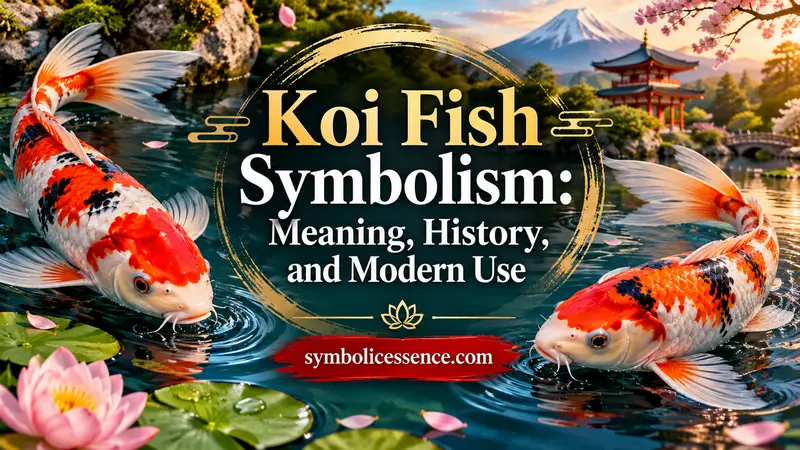
Koi fish symbolism is closely connected to perseverance, courage, prosperity, and personal growth. These colorful freshwater fish are admired for their appearance, but their cultural importance comes from stories about overcoming obstacles, achieving success, and adapting to life’s challenges.
In Japan, koi are associated with strength and hopes for a successful future. In Chinese folklore, the image of a carp swimming against a powerful current represents determination and the possibility of transformation. These ideas have influenced art, family traditions, and decorative designs for generations.
Today, Americans encounter koi in garden ponds, tattoos, jewelry, paintings, and home decor. Some people choose them to celebrate personal achievements, while others appreciate their peaceful movement and striking colors. Understanding their background helps explain why one fish can represent both steady ambition and a quiet sense of balance.
Quick Answer
Koi fish symbolism commonly represents perseverance, strength, good fortune, and personal transformation in modern American culture, especially in tattoos, gardens, and decorative art. Its historical meanings come from Chinese legends about overcoming challenges and Japanese traditions that associate carp with courage, success, and healthy growth.
TL;DR
- Core meaning: Koi represent perseverance, courage, personal growth, and success.
- Historical roots: Chinese folklore connects carp with transformation and achievement.
- Japanese traditions: Carp symbolize strength, determination, and hopes for children’s futures.
- American interpretation: Koi often represent resilience, recovery, and peaceful living.
- Modern uses: Koi appear in tattoos, garden ponds, jewelry, and artwork.
- Color meanings: Popular interpretations vary by color, design, and personal experience.
What Makes Koi Fish Recognizable?
Koi are ornamental varieties of common carp, a freshwater fish known for its strong body and ability to survive in different environments.
The Japanese word koi means carp, while nishikigoi refers more specifically to the colorful ornamental varieties. These specially bred fish display combinations of white, red, orange, yellow, black, blue-gray, and metallic colors.
Their appearance makes them easy to recognize. A koi has an elongated body, visible scales in many varieties, flowing fins, and small whisker-like structures called barbels near its mouth.
Unlike ordinary aquarium fish, koi can become quite large. They are often kept in spacious outdoor ponds where their patterns are visible from above.
Several well-known varieties include:
- Kohaku: White koi with red markings.
- Taisho Sanshoku: White koi with red and black patterns.
- Showa Sanshoku: Koi featuring black, red, and white.
- Ogon: Metallic koi, often gold or platinum-colored.
- Asagi: Koi with blue-gray scales and reddish markings.
These colors and patterns contribute to the fish’s decorative appeal. Their symbolic associations, however, come mainly from cultural traditions rather than their physical appearance alone.
The Main Symbolic Meanings of Koi Fish
The most common meanings of koi are connected to how people understand determination, change, and success.
Perseverance and Determination
Koi are frequently shown swimming against strong currents. This image suggests a willingness to keep moving despite resistance.
For someone facing a demanding goal, the fish can represent steady effort rather than immediate success.
A student preparing for an important examination, for example, might identify with the idea of continued progress despite setbacks.
Courage and Inner Strength
Courage does not always mean taking dramatic action. Sometimes, it means continuing with a difficult responsibility when giving up would feel easier.
Koi imagery often expresses this quieter form of strength.
Prosperity and Good Fortune
Koi are also associated with favorable opportunities and material success, especially in decorative traditions influenced by East Asian beliefs.
Golden varieties are particularly popular in designs intended to suggest abundance.
This interpretation expresses a wish for prosperity rather than a promise that keeping koi will create wealth.
Transformation and Personal Growth
The journey of a carp becoming a dragon in folklore provides a memorable example of transformation.
People may connect this story with finishing an education, building a career, recovering from hardship, or beginning a new stage of life.
Peace and Harmony
A different meaning appears when koi swim gently through a still pond.
Their movement can suggest patience, emotional balance, and an appreciation for nature.
This peaceful association is especially familiar in American garden design.
How Ornamental Koi Developed in Japan
The history of koi symbolism includes two related but different stories: the older cultural symbolism of carp and the much later development of colorful ornamental koi.
Carp have been raised in Asia for centuries. Chinese traditions involving carp existed long before the brightly patterned Japanese fish familiar today.
Modern ornamental koi breeding developed in Japan during the early nineteenth century, particularly in the mountainous Niigata region.
Farmers in areas now associated with Ojiya and Nagaoka raised ordinary carp, partly as a food source. When unusually colored fish appeared, some were kept and selectively bred for their appearance.
Over time, breeders developed increasingly distinct colors and patterns.
An important moment came in 1914, when ornamental carp were displayed at the Tokyo Taisho Exposition. The exhibition helped introduce these unusual fish to a wider Japanese audience.
Their popularity later expanded internationally.
Today, ornamental koi are valued as living examples of careful breeding and traditional craftsmanship. In the United States, collectors and hobbyists admire them for their beauty, movement, and individual markings.
The distinction matters because modern koi did not create the ancient legends. Instead, the older meanings associated with carp became attached to the colorful ornamental fish that developed much later.
The Chinese Dragon Gate Legend and Its Meaning
One of the strongest historical connections between carp and perseverance comes from the Chinese Dragon Gate legend.
In a familiar version of the story, a carp struggles upstream through dangerous waters and reaches a challenging waterfall known as the Dragon Gate.
After successfully passing the obstacle, the carp transforms into a dragon.
The story is not simply about becoming stronger. It describes advancement earned through extraordinary effort.
Why the Dragon Matters
In Chinese tradition, dragons often represent authority, strength, and favorable natural forces.
A carp transforming into a dragon therefore represents a major change in status.
The fish begins as an ordinary creature and becomes something extraordinary after overcoming a difficult challenge.
Historically, the Dragon Gate image was also connected with success in China’s imperial civil service examinations.
Passing those demanding examinations could open a path toward prestigious government employment.
The carp’s transformation offered a fitting comparison for scholars who hoped their studies would change their futures.
How the Legend Influenced Japan
The story later became familiar in Japanese art and cultural traditions.
Images of carp climbing waterfalls appeared in paintings, prints, and decorative objects.
The ascending fish became associated with bravery, ambition, and the determination needed to achieve an important goal.
Modern American interpretations often focus on the same central lesson: meaningful change usually requires patience and continued effort.
Koi Symbolism in Japanese Family Traditions
In Japan, carp imagery has an important connection with children’s growth and future success.
One of the most recognizable examples is the koinobori, a colorful windsock shaped like a carp.
These decorations are displayed around May 5, which is celebrated as Children’s Day in Japan.
The custom developed during the Edo period and was historically associated with Boys’ Day before the modern holiday came to celebrate children more broadly.
Families display carp streamers as expressions of hope that their children will grow healthy, courageous, and capable of overcoming life’s difficulties.
The streamers move in the wind, creating the appearance of fish swimming through the sky.
This visual connects the celebration to the traditional image of a carp struggling against a current.
Family Connection and Generational Hope
Many koinobori displays include several carp of different sizes.
These may represent members of the family, with larger streamers commonly associated with parents and smaller ones representing children.
Their arrangement celebrates both family relationships and hopes for the next generation.
This custom explains why carp can symbolize more than individual ambition. They can also express parental care, encouragement, and responsibility.
For Americans learning about Japanese traditions, this family-centered meaning provides a useful contrast to the more individual interpretations found in contemporary tattoo culture.
What Koi Fish Symbolize in American Culture
In the United States, koi are often interpreted through personal experience rather than a single shared religious or cultural tradition.
Their meanings appear across several settings, including private gardens, public landscapes, tattoos, and decorative art.
Personal Achievement
Many Americans choose koi imagery to mark an important achievement.
A koi tattoo might commemorate completing a degree, surviving a difficult period, or reaching a long-term goal.
The fish represents effort and the satisfaction of continuing when progress seemed uncertain.
Resilience and Recovery
Koi can also become symbols of recovery after emotional or physical hardship.
Someone who has worked through a painful experience may connect with the idea of moving forward against resistance.
This is a modern personal interpretation, not a fixed ancient meaning assigned to every koi.
Cultural Appreciation
Japanese gardens, cultural festivals, and art exhibitions have introduced many Americans to koi and related artistic traditions.
These experiences may encourage interest in Japanese craftsmanship, landscape design, and the historical relationship between people and nature.
Individual Identity
For some people, koi symbolize a personal belief: difficulties do not have to determine the direction of one’s life.
Others simply enjoy their beauty.
Both approaches are valid, although understanding the fish’s cultural background gives the image greater context.
Why Koi Ponds Represent Peace and Patience
Koi ponds offer a different symbolic experience from images of carp struggling upstream.
Instead of dramatic movement, a garden pond emphasizes calm water, gentle motion, and repeated observation.
Watching koi move slowly beneath the surface can encourage a person to pay attention to the present moment.
In American homes and public gardens, ponds are often designed as places for relaxation, reflection, and quiet conversation.
Rocks, plants, bridges, and flowing water may surround the fish, creating a landscape intended to feel balanced.
The Meaning of Water
Water often represents movement, renewal, and changing circumstances in art and literature.
When koi appear in water, the surrounding environment can influence their interpretation.
A fish in a rushing river suggests struggle or determination. A fish beneath a still surface may suggest composure.
Neither meaning cancels the other.
Together, they show how the same animal can represent action in one setting and patience in another.
Responsibility Behind the Symbol
Keeping living koi also involves practical responsibility.
They need adequate space, good water quality, filtration, suitable feeding, and protection from environmental hazards.
Because koi may live for decades, caring for them can become a long-term commitment.
That experience may give owners a personal association with patience and stewardship, beyond any traditional symbolic meaning.
What Different Koi Fish Colors May Represent
Color adds another layer to koi imagery, especially in tattoos, illustrations, and decorative objects.
However, there is an important distinction between traditional koi varieties and modern color symbolism.
Japanese breeders use established names to identify fish by physical patterns. Claims that every color has one ancient spiritual meaning are often modern interpretations.
The following table summarizes common contemporary associations.
| Koi Color | Common Symbolic Meaning | Modern Interpretation |
| Red | Love, courage, vitality | Passion and emotional commitment |
| Black | Strength, endurance | Overcoming adversity |
| Gold | Prosperity, success | Wealth and achievement |
| White | Clarity, peace | Renewal and fresh beginnings |
| Blue | Calmness, stability | Emotional balance |
| Orange | Optimism, enthusiasm | Hope and positive change |
These meanings can be useful when choosing artwork, but they are not universal cultural rules.
Black Koi and Overcoming Hardship
Black koi are frequently associated with resilience in modern tattoo culture.
A person may select one to mark surviving a difficult chapter.
The interpretation usually comes from the individual’s story rather than an established rule of Japanese fish breeding.
Golden Koi and Prosperity
Gold naturally suggests valuable metals and material wealth.
Golden koi therefore appear in designs intended to communicate success, opportunity, or abundance.
The association works especially well in jewelry and decorative art.
White Koi and Renewal
White is commonly connected with simplicity and new beginnings in contemporary American design.
A white koi may represent a fresh start, although white has different cultural associations in different societies.
Understanding these variations helps prevent a single color interpretation from being treated as universal.
Two Koi Fish: Love, Partnership, and Balance
Two koi swimming together are a popular design in tattoos, jewelry, paintings, and home decoration.
In contemporary American interpretations, the pairing may represent companionship, cooperation, or a lasting relationship.
The direction and arrangement of the fish often shape the intended meaning.
Two Koi Swimming Together
When two fish travel in the same direction, viewers may interpret them as partners pursuing shared goals.
This design can represent a marriage, friendship, or close family connection.
It may also express the idea that progress becomes easier when people support each other.
Koi Swimming in a Circle
Two koi arranged in a circular pattern are sometimes compared with the yin-yang symbol.
In Chinese philosophy, yin and yang describe complementary forces that exist in an interconnected relationship.
A pair of koi can be used as a modern artistic expression of this idea, particularly when the fish are positioned to suggest a flowing circle.
However, two koi are not automatically an ancient yin-yang symbol.
Their association with balance depends on the design and the intention behind it.
Relationship Symbolism
Some couples choose matching koi artwork to represent commitment without suggesting that both partners must be identical.
The fish may differ in color or size while still forming one connected image.
That contrast can communicate individuality within a shared relationship.
Why Koi Fish Tattoos Represent Personal Transformation
Koi tattoos are among the most recognizable fish designs in Japanese-inspired body art.
Their popularity comes from their flowing shapes, strong visual patterns, and association with perseverance.
A tattoo may show one koi, a pair of fish, or a carp approaching a waterfall.
Some designs incorporate waves, flowers, or a dragon.
Koi Swimming Upstream
An upward-moving koi is commonly interpreted as determination in the face of an unfinished challenge.
It can represent someone working toward a difficult goal or rebuilding life after a setback.
This meaning connects closely with the Dragon Gate legend.
Koi Swimming Downstream
In some modern tattoo interpretations, a downstream fish represents a challenge already overcome.
Others see it as a sign of moving peacefully with life’s changes.
These interpretations are not universal rules within Japanese tattoo traditions. The artwork’s overall composition and the wearer’s intention matter more than direction alone.
Koi and Dragon Tattoos
A design combining a koi and a dragon emphasizes transformation.
The fish represents the effort required to reach a goal, while the dragon represents the change that follows.
Such artwork may commemorate a major personal milestone.
Choosing a Meaningful Design
Traditional Japanese tattooing has its own artistic history, conventions, and techniques.
Someone choosing a Japanese-inspired koi tattoo can benefit from understanding those traditions and discussing the design with an artist experienced in the style.
The strongest personal interpretation usually comes from connecting the image to a specific experience rather than relying on an oversimplified color chart.
Spiritual and Emotional Meanings of Koi Fish
Koi are sometimes described as spiritual symbols, but their meanings depend heavily on cultural and personal context.
They are not universally sacred animals, and there is no single religious interpretation shared across East Asia.
Koi in Chinese-Inspired Feng Shui
Some feng shui traditions and modern decorative practices use fish imagery to express hopes for abundance and favorable circumstances.
Koi may appear in paintings, ponds, or ornaments associated with prosperity.
The number and arrangement of fish can carry meaning in certain practices.
These associations belong to specific Chinese cultural and decorative traditions and should not be confused with Japanese koi breeding or the Children’s Day custom.
Nor is there scientific evidence that a koi image directly changes a person’s financial fortune.
Koi and Mindfulness
For many people, watching koi swim provides an opportunity for quiet observation.
Their measured movement may help someone shift attention away from everyday distractions.
This experience can feel meaningful without requiring a supernatural explanation.
Emotional Resilience
The strongest emotional association often comes from the contrast between struggle and progress.
A koi swimming against a current offers an image of persistence, while a koi resting in calmer water suggests the value of peace after difficulty.
Together, these ideas can express a balanced view of resilience.
Working hard matters, but so does recognizing when to rest.
Koi as a Personal Reminder
A koi drawing on a desk or a small pendant may serve as a reminder of a commitment.
For one person, it might represent patience during recovery. For another, it may symbolize dedication to a family or career.
The meaning develops through repeated personal association rather than through any special property of the object.
Koi Fish in Modern Art, Jewelry, and Home Decor
By 2025–2026, koi imagery remains visible across many forms of American design.
Its appeal comes partly from its flexibility. The same fish can appear in traditional Japanese-inspired artwork or in a simple modern illustration.
Home Decoration
Koi appear on wall prints, ceramic ornaments, decorative bowls, garden sculptures, and textiles.
Designers often combine their curved shapes with water patterns to create a sense of movement.
In a living room or garden, the image may suggest calmness without becoming the center of a religious display.
Jewelry and Fashion
Koi pendants, earrings, embroidered clothing, and accessories may communicate individuality or personal ambition.
A gold-colored koi pendant might symbolize success, while a pair of fish could represent a relationship.
These are usually personal or contemporary decorative choices.
Wedding and Anniversary Gifts
Some couples choose paired koi designs for anniversary gifts or shared artwork.
The meaning centers on partnership and continued growth together.
Unlike established wedding customs, however, koi do not carry one universal marriage meaning across all cultures.
Digital Art and Social Media
Koi also appear in digital illustrations, phone wallpapers, and tattoo inspiration collections.
Artists often use bold color contrasts and circular compositions because they are visually memorable.
Online descriptions sometimes give these images very specific meanings. Such explanations should be treated as interpretations unless they have a clear cultural or historical basis.
Common Misunderstandings and How Koi Symbolism Has Evolved
The meanings attached to koi have changed as their imagery has traveled between cultures.
Originally, the best-known stories concerned ordinary carp. In Chinese folklore, the fish represented advancement through effort.
Japanese traditions later developed their own uses of ascending carp imagery, including connections with children’s growth and courage.
The breeding of colorful ornamental koi introduced another dimension: the appreciation of fish as living decorative art.
As koi became familiar internationally, personal interpretations expanded.
Several misunderstandings are worth correcting.
All Koi Colors Have Fixed Ancient Meanings
Modern websites and tattoo guides sometimes present color interpretations as if they were strict historical rules.
In reality, many popular meanings reflect contemporary symbolism and personal preference.
Traditional koi classification focuses on the fish’s appearance rather than an official spiritual code.
Koi Are Always Symbols of Wealth
Prosperity is one recognized association, but it is not the only one.
Koi may also represent endurance, family hopes, decorative beauty, or personal achievement.
A peaceful garden pond does not necessarily communicate the same idea as a carp climbing a waterfall.
Koi Are Sacred in Every Asian Religion
Koi do not have identical significance in Buddhism, Shinto, Daoism, or other religious traditions.
Carp imagery can appear in cultural settings influenced by these traditions, but that does not make every ornamental koi a sacred religious symbol.
Any Koi Design Is Automatically Traditional Japanese Art
Modern American designs frequently combine elements from different artistic traditions.
Some use Japanese tattoo conventions, while others borrow from Chinese philosophy or contemporary illustration.
Distinguishing these influences helps preserve their individual histories.
The Meaning Cannot Change
Symbols gain additional meanings as people encounter them in new settings.
The historical image of a carp overcoming a waterfall remains important, but a modern koi illustration may also express recovery, friendship, or a personal commitment.
Recognizing this evolution allows people to appreciate both traditional cultural meanings and modern individual interpretations without confusing them.
FAQs
Are koi fish considered good luck?
Koi are associated with good fortune and prosperity in some East Asian cultural and decorative traditions. In American homes, koi artwork may express a wish for success, although the fish itself does not guarantee favorable outcomes.
What does a koi fish tattoo mean for a woman or man?
A koi tattoo can represent courage, perseverance, ambition, or personal transformation regardless of gender. Although some historical Japanese carp imagery was connected with ideals of masculine courage, modern tattoo meanings are usually shaped by the individual wearer.
What does a koi fish symbolize in Christianity?
Koi do not have a specific established meaning in traditional Christian symbolism. Christians may personally associate them with perseverance or hope, but these interpretations should not be confused with the early Christian fish symbol, known as the ichthys.
What does a koi fish swimming upstream mean?
An upstream koi often represents continued effort toward a difficult goal. In traditional East Asian imagery, the ascending carp recalls the Dragon Gate legend, while modern designs may connect it with education, recovery, or career achievement.
Do koi fish symbolize love and loyalty?
Paired koi can represent love, companionship, and shared commitment in contemporary artwork. However, koi are not universally recognized as biological examples of lifelong romantic pairing, so these meanings are symbolic rather than claims about their natural behavior.
What does a black koi fish symbolize?
In many contemporary tattoo interpretations, a black koi represents endurance or overcoming serious hardship. This meaning is not an official historical definition of black koi varieties, and different artists or owners may assign other personal associations.
Is there a difference between koi fish and goldfish symbolism?
Both can be associated with beauty and good fortune, but koi are especially connected with the Dragon Gate story of perseverance and transformation. Goldfish have their own decorative and cultural histories and should not be treated as identical to koi simply because both are colorful ornamental fish.
Conclusion
Koi fish symbolism brings together several distinct ideas: perseverance, courage, success, transformation, and peaceful balance. Its best-known historical foundation comes from Chinese carp legends and Japanese cultural traditions, while modern American interpretations frequently emphasize resilience, personal achievement, and emotional well-being.
The meaning of a koi also depends on its setting. A fish climbing a waterfall suggests determination, two fish swimming together may express partnership, and koi moving quietly through a garden pond can encourage patience and reflection.
What makes the koi meaningful is not a promise of luck or an unchanging set of rules. It is the way a familiar living creature can remind people of effort, change, and the possibility of moving forward through life’s challenges.

[…] Animal symbols: Lambs, lions, doves, serpents, and eagles. […]