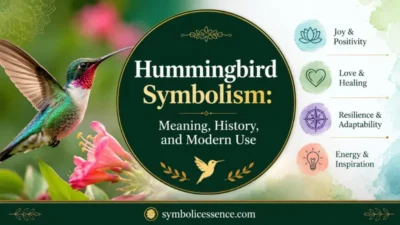

Hummingbirds are tiny birds with remarkable flying abilities, bright feathers, and an unusual way of moving through the air. Hummingbird symbolism often centers on joy, resilience, love, hope, and the ability to find happiness during difficult times. Their quick movements and delicate appearance help explain why people attach so many positive meanings to them.
Watching a hummingbird hover beside a flower can feel special. Its wings move almost too quickly to see, yet the bird remains remarkably steady. For many people, that contrast between speed and control represents determination, adaptability, and finding balance in life.
Hummingbirds also hold important places in Indigenous traditions across the Americas. Some historical meanings involve courage, warfare, survival, or relationships with the natural world. These traditions deserve attention because they differ from the gentle interpretations common in modern decorative art.
In the United States, hummingbirds frequently appear in jewelry, tattoos, gardens, memorial artwork, and inspirational designs. Understanding their symbolism means looking at both the bird’s natural behavior and the cultural setting in which its image appears.
Quick Answer
Hummingbird symbolism most commonly represents joy, resilience, love, hope, and appreciation for life’s small pleasures. In modern American culture, these birds often symbolize happiness during hardship, emotional strength, and renewal. Some Indigenous traditions give hummingbirds different meanings connected with courage, sacred stories, or the natural world.
TL;DR
- Joy: Hummingbirds represent happiness and appreciation for small pleasures.
- Resilience: Their remarkable endurance suggests strength despite physical limitations.
- Love: Their connection with flowers inspires romantic and affectionate imagery.
- Cultural history: Some Indigenous traditions associate hummingbirds with courage and sacred stories.
- Spiritual interpretation: Some people view sightings as comforting personal signs.
- Modern use: Hummingbirds appear in tattoos, memorials, jewelry, and garden art.
What Do Hummingbirds Symbolize in American Culture?
In modern American culture, hummingbirds usually carry positive meanings. Their colorful appearance, energetic behavior, and close relationship with flowers make them familiar images of happiness and renewal.
Several meanings appear especially often.
Joy and Happiness
Hummingbirds are closely associated with joy because of their lively movements and colorful feathers.
Their brief visits to flowering gardens often create moments of surprise and delight. This experience helps explain why hummingbird images appear on greeting cards, cheerful home decorations, and gifts.
A hummingbird surrounded by blossoms may express gratitude for life’s ordinary pleasures rather than a major life event.
Strength and Resilience
Although hummingbirds are small, they can travel impressive distances during migration. Their ability to endure demanding journeys has made them popular symbols of perseverance.
In personal artwork, a hummingbird may represent someone who continues moving forward through illness, loss, or other challenges.
This meaning comes from the contrast between the bird’s fragile appearance and its remarkable physical abilities.
Love and Affection
Hummingbirds often appear beside flowers, creating a natural visual connection with beauty and romance.
In modern jewelry and illustrations, this pairing can represent affection, emotional warmth, or a treasured relationship.
However, hummingbirds are not universal symbols of romantic partnership. Their real mating behavior differs from the human ideals often expressed through romantic artwork.
Hope and Renewal
The return of migratory hummingbirds during warmer months makes them appealing symbols of seasonal renewal.
For someone beginning a new chapter, the bird can suggest fresh opportunities or the possibility of happiness after hardship.
This interpretation is especially common in modern inspirational designs.
Why Does a Hummingbird’s Behavior Shape Its Symbolism?
Many hummingbird meanings come directly from the bird’s unusual physical abilities.
Hummingbirds belong to a family of birds found naturally in the Americas. Their rapid wing movements, specialized feeding habits, and remarkable control in flight distinguish them from most other birds.
Hovering Represents Balance and Focus
Hummingbirds can remain almost motionless in the air while feeding.
Their wings continue moving rapidly, but their bodies stay positioned beside a flower. This creates an image of control amid constant activity.
In modern symbolism, hovering may suggest concentration, patience, or maintaining balance while life changes around you.
Backward Flight Represents Adaptability
Hummingbirds can fly backward during normal controlled flight.
This ability makes them unusual among birds and provides a memorable metaphor for flexibility.
A backward-flying hummingbird in artwork might represent reconsidering a decision, changing direction, or adjusting to difficult circumstances.
It does not mean the bird literally understands reflection or personal growth. The meaning comes from human interpretation.
Migration Represents Determination
Several hummingbird species undertake seasonal migrations between breeding and wintering areas.
Ruby-throated hummingbirds, familiar across much of eastern North America, include populations that cross the Gulf of Mexico during migration.
Such journeys are demanding for birds of their size.
This natural endurance explains why hummingbirds commonly represent persistence and the ability to overcome obstacles.
Nectar Feeding Represents Life’s Pleasures
Hummingbirds visit flowers to obtain energy-rich nectar. Many also consume insects and other small arthropods.
Their close association with blossoms has inspired imagery of sweetness, beauty, and enjoyment.
The symbolism is poetic rather than scientific: the bird feeds to survive, while people interpret its visits to flowers as reminders of enjoyable moments.
Historical Origins of Hummingbird Symbolism
Hummingbird meanings developed in different societies across the Americas. There is no single historical origin that explains every modern interpretation.
Because hummingbirds are native to the Americas, they held particular importance in Indigenous cultures long before European colonization.
Their feathers, movement, and behavior appeared in stories, religious imagery, and artistic traditions.
Some societies emphasized courage or supernatural relationships. Others included hummingbirds in stories about survival, natural forces, or the responsibilities connecting living beings.
The modern association with happiness and positivity is only part of this wider history.
An important distinction is that historical religious symbolism cannot always be translated into a simple modern idea such as good luck or positive energy.
Hummingbirds in Aztec Culture and Mythology
In Aztec tradition, hummingbirds had important connections with warfare, courage, and religious belief.
One of the most important Aztec deities was Huitzilopochtli, whose name includes a Nahuatl word associated with hummingbirds.
Huitzilopochtli was closely linked with warfare and the sun. He also played a central role in Mexica accounts of migration and the founding of their capital, Tenochtitlan.
The hummingbird association carried meanings that differed from the peaceful images commonly found on modern greeting cards.
Courage and Warrior Identity
The Aztecs admired qualities such as endurance, fearlessness, and strength.
Hummingbirds could appear delicate, yet they defended territories aggressively and displayed remarkable speed.
These characteristics helped make them meaningful images of warrior-like determination.
In this context, the bird’s small size did not make it a symbol of weakness.
Hummingbirds and the Afterlife
Some Aztec religious accounts describe warriors who died in battle and certain other honored dead as accompanying the sun before returning in the form of hummingbirds or butterflies.
These ideas belonged to a specific religious understanding of death, sacrifice, and the cosmos.
They should not be presented as proof that every hummingbird represents a deceased person.
Modern memorial interpretations may resemble these historical beliefs, but their cultural meanings are not identical.
Hummingbird Meaning in Native American Traditions
Hummingbirds appear in the cultural traditions of several Native American communities. Their meanings depend on the specific nation, story, and ceremonial setting.
There is no single Native American interpretation shared by all tribes.
Hummingbirds in Hopi Stories
A documented Hopi tale tells of children facing drought and hunger in the village of Oraibi.
A magical hummingbird helps them and approaches Muy’ingwa, a figure associated with fertility, seeking the return of rainfall.
Within this particular story, the bird has a meaningful role in survival and the relationship between people and natural forces.
It would be misleading to reduce the entire tradition to the claim that all hummingbirds symbolize rain.
Hummingbird figures also appear in Hopi katsina art. Katsinam have specific religious and cultural significance, so these figures are more than decorative bird images.
Hummingbirds in Indigenous Art
Hummingbirds appear in artistic traditions from different parts of the Americas.
The forms, materials, and meanings change according to the community and artist.
For example, a hummingbird represented in Pueblo artwork may carry cultural associations different from those in Aztec religious imagery.
When interpreting Indigenous artwork, identifying the artist, nation, and intended meaning offers a more reliable understanding than using a general symbolism chart.
Spiritual Meaning of Seeing a Hummingbird
In contemporary spiritual interpretations, seeing a hummingbird is often associated with joy, encouragement, emotional renewal, or hope.
Some people interpret a close encounter as a reminder to appreciate their lives or remain hopeful during a challenging period.
Others associate hummingbirds with comforting memories of loved ones.
These meanings reflect personal belief rather than scientifically established messages.
Is Seeing a Hummingbird Good Luck?
Many modern spiritual interpretations treat hummingbird sightings as positive signs.
A hummingbird visiting a garden may feel especially encouraging during a period of change.
However, there is no scientific evidence that seeing one predicts good fortune or future events.
A more grounded interpretation is that the encounter offers a meaningful moment of attention, beauty, or reflection.
Does a Hummingbird Represent a Message From Heaven?
Some people associate hummingbirds with deceased loved ones and interpret unexpected sightings as comforting reminders of them.
This belief appears in contemporary memorial language and personal spiritual practices.
It can provide emotional comfort, but there is no reliable evidence that hummingbirds carry messages from the dead.
A person can value the memory or emotion connected with a sighting without treating the bird’s appearance as proof of supernatural communication.
Hummingbird Symbolism in Love and Relationships
Hummingbirds often represent affection, happiness, and emotional connection in modern romantic imagery.
Their association with flowers makes them suitable for artwork celebrating relationships, anniversaries, and expressions of gratitude.
However, different visual arrangements can communicate different ideas.
Romantic Love
A hummingbird approaching a flower may suggest romantic attraction or the excitement of new affection.
The image often emphasizes beauty, tenderness, and enjoyment rather than lifelong commitment.
A hummingbird paired with a heart communicates romance more directly.
Self-Love and Emotional Healing
In modern inspirational artwork, hummingbirds may represent taking pleasure in everyday experiences while recovering from emotional challenges.
Someone might choose a hummingbird necklace after a difficult year as a personal reminder of resilience.
This meaning comes from the wearer’s intention, not a historically fixed interpretation.
Friendship and Family Love
Hummingbird imagery also works outside romantic relationships.
A decorative piece featuring several birds may symbolize loved ones, shared memories, or family connections.
For example, a parent might choose three hummingbirds to represent three children.
The number has meaning because the individual assigns it, not because three hummingbirds have a universal traditional meaning.
What Does a Hummingbird Symbolize After Someone Dies?
Hummingbirds are increasingly used in modern American memorial art to express remembrance, love, and hope after a loss.
Their small size, delicate appearance, and sudden visits can make them emotionally meaningful to people who are grieving.
A hummingbird in a remembrance card may suggest that a person’s influence or memory remains important.
Hummingbirds as Memorial Symbols
Memorial jewelry, garden ornaments, and tattoos sometimes feature a hummingbird alongside a name, date, or meaningful flower.
These designs can express affection without using traditional religious symbols.
For instance, a hummingbird beside a forget-me-not flower may combine the ideas of remembrance and enduring emotional connection.
Do Hummingbirds Symbolize Rebirth?
In some modern artwork, hummingbirds represent renewal after a painful experience.
This does not necessarily mean literal reincarnation.
The bird may instead represent a new beginning, continued emotional growth, or the ability to appreciate life after loss.
Historical beliefs about returning as hummingbirds should be discussed within their original cultural settings rather than applied to all modern memorial imagery.
Hummingbird Symbolism in Tattoos and Jewelry
Hummingbird tattoos are popular because they combine graceful shapes with meanings such as joy, independence, resilience, and affection.
Their compact bodies and long, narrow beaks also make them recognizable in small designs.
Common hummingbird tattoo interpretations
| Tattoo design | Common modern meaning | Additional context |
|---|---|---|
| Flying hummingbird | Freedom and adaptability | Often represents personal growth |
| Hummingbird with flowers | Joy, affection, beauty | Flower choice adds meaning |
| Two hummingbirds | Love or companionship | Meaning depends on the design |
| Hummingbird with a name | Remembrance | Often a personal memorial |
| Watercolor hummingbird | Creativity and individuality | Color choices are usually artistic |
| Hummingbird with a heart | Romance and affection | A modern decorative interpretation |
Hummingbird Tattoos for Strength
A hummingbird with outstretched wings may represent overcoming adversity.
Some people choose this design after a major personal challenge because the bird’s physical endurance offers a memorable image of persistence.
A simple black outline can express this idea just as effectively as a colorful design.
Hummingbird Jewelry Meaning
Hummingbird necklaces, bracelets, and earrings often communicate affection, hope, or appreciation.
Someone may give a hummingbird pendant to celebrate a graduation, recovery, birthday, or new beginning.
The meaning usually comes from the gift’s occasion and the relationship between the people involved.
Hummingbird Color Symbolism: Does Color Change the Meaning?
Hummingbird colors can influence the emotional tone of artwork, but there is no universal color code that determines what every hummingbird means.
Real hummingbird feathers are often iridescent. Their appearance changes with the angle of light because microscopic feather structures reflect light in particular ways.
This scientific feature helps explain why the birds appear especially vivid and attractive.
In modern designs, people sometimes attach additional meanings to different colors.
| Color | Common modern interpretation | Important qualification |
|---|---|---|
| Green | Growth, renewal, nature | Often based on garden imagery |
| Red | Passion, energy, affection | Not a universal historical meaning |
| Blue | Calmness, trust, peace | Usually a modern artistic association |
| Purple | Creativity, imagination | Depends on the artwork |
| Gold | Celebration, success, warmth | Often used in decorative designs |
| White | Peace, remembrance, innocence | Frequently symbolic rather than naturalistic |
Green Hummingbird Meaning
Green hummingbirds often inspire interpretations of growth, renewal, and connection with nature.
These meanings are especially common when the bird appears among leaves or flowers.
However, green is a natural color in many hummingbird species, not a supernatural sign.
Red Hummingbird Meaning
Red hummingbird designs can suggest romantic affection, excitement, or determination.
The bright throat feathers of male ruby-throated hummingbirds may also contribute to the visual association with energy.
In real birds, feather colors play biological roles, including communication and courtship.
White Hummingbird Meaning
White hummingbirds sometimes appear in memorial artwork as symbols of peace or remembrance.
A genuinely white hummingbird may have unusual pigmentation, such as leucism, which reduces pigment in some or all feathers.
The bird’s biological condition does not create a spiritual meaning. Any symbolic interpretation comes from the observer or artist.
Hummingbirds in Literature, Art, and Modern Media
Hummingbirds provide writers and artists with a recognizable image of movement, energy, and delicacy.
A writer might describe a hummingbird visiting an abandoned garden to create a contrast between living activity and a quiet setting.
In another story, the bird’s restless movement could represent anxiety, urgency, or the difficulty of remaining still.
This illustrates an important point: hummingbirds do not always symbolize happiness.
Their meaning depends on the way an artist presents them.
Hummingbirds in Visual Art
In paintings and illustrations, hummingbirds commonly appear alongside flowers, bright colors, and natural scenery.
These details help create impressions of growth, beauty, and seasonal change.
An artist may also use the bird’s rapid movement to express energy or instability.
Historical cultural imagery can carry very different meanings from contemporary garden paintings.
Hummingbirds in Digital Culture
Hummingbird images are also common in social media artwork, inspirational graphics, and digital greeting cards.
Short sayings about appreciating the present often accompany these illustrations.
Such designs generally reflect contemporary attitudes toward happiness and emotional well-being rather than a single inherited religious tradition.
Positive and Negative Meanings of Hummingbirds
Hummingbirds usually carry positive associations in modern American culture, but their symbolism can also express difficult or demanding experiences.
Their natural behavior includes energetic competition and territorial defense.
Some hummingbirds aggressively chase other birds away from feeding areas. This behavior contrasts with the gentle image used in romantic illustrations.
Possible contrasting interpretations include:
- Joy versus restlessness: Rapid movement can suggest excitement or constant activity.
- Strength versus vulnerability: Small bodies appear fragile despite impressive endurance.
- Independence versus isolation: Solitary behavior may inspire different emotional readings.
- Determination versus aggression: Territorial defense can represent either persistence or conflict.
These are interpretive possibilities, not fixed meanings.
Aztec warrior symbolism also demonstrates why hummingbirds cannot accurately be described as universally peaceful.
Their historical associations include courage and warfare as well as survival.
Hummingbird vs. Butterfly Symbolism: What’s the Difference?
Hummingbirds and butterflies often appear together in gardens, artwork, and memorial decorations.
Both can represent beauty, hope, and renewal. However, their most familiar modern meanings emphasize different natural qualities.
| Symbol | Common modern meaning | Natural basis |
|---|---|---|
| Hummingbird | Joy and resilience | Energetic flight and endurance |
| Butterfly | Transformation and change | Metamorphosis |
| Dove | Peace and reconciliation | Long-standing religious and artistic associations |
| Dragonfly | Adaptability and change | Agile flight and life cycle |
A butterfly is especially recognizable as a symbol of transformation because it undergoes metamorphosis.
A hummingbird more often emphasizes endurance, lively movement, or enjoyment within the present moment.
For example, someone celebrating recovery from a difficult experience might choose a hummingbird for resilience or a butterfly for transformation.
Neither interpretation is required. Both symbols can carry meanings chosen by the person using them.
How to Interpret a Hummingbird Symbol in Context
The most reliable way to understand a hummingbird image is to examine where it appears and why someone chose it.
Instead of assuming that every hummingbird carries the same message, consider these questions.
- Where does it appear? A memorial, garden decoration, religious artwork, and romantic card may communicate different ideas.
- What accompanies the bird? Flowers, hearts, names, dates, and other symbols can clarify its purpose.
- Who created it? An Indigenous artist may use hummingbird imagery within a specific cultural tradition.
- How is the bird shown? A hovering bird may suggest balance, while a bird in rapid flight may emphasize motion.
- What does the creator say? A stated meaning provides stronger evidence than a general online interpretation.
For example, a hummingbird tattoo beside a relative’s birth date likely communicates remembrance. The same bird on a spring greeting card probably suggests happiness or renewal.
This approach respects both cultural history and individual expression.
Common Misunderstandings About Hummingbird Symbolism
Several popular explanations oversimplify the bird’s cultural meaning.
All Native American Tribes Share the Same Hummingbird Beliefs
This is incorrect.
Different Indigenous nations have distinct languages, histories, stories, and artistic practices.
A tradition documented among the Hopi should not automatically be applied to every Native American community.
Hummingbirds Always Represent Peace
This is also inaccurate.
Contemporary illustrations often present hummingbirds as gentle or joyful. However, their natural territorial behavior can be aggressive, and some historical traditions connect them with warfare.
Peace is one possible modern interpretation, not their universal meaning.
Seeing a Hummingbird Predicts a Specific Event
No scientific evidence supports claims that a hummingbird sighting guarantees money, romance, healing, or good fortune.
People may find such encounters meaningful, but the experience does not establish a prediction.
Every Hummingbird Tattoo Has a Spiritual Meaning
Many hummingbird tattoos are purely artistic.
Someone might choose the bird because they enjoy watching wildlife, appreciate its colors, or simply like its shape.
The person’s stated intention matters more than an assumed symbolic meaning.
FAQs
What does it mean when a hummingbird visits you?
A hummingbird visiting you can symbolize joy, hope, or encouragement in modern personal interpretations. In nature, the bird may simply be searching for nectar, insects, or a suitable place to rest.
Is a hummingbird a symbol of good luck?
Hummingbirds are often considered positive symbols in contemporary spiritual artwork and personal belief. However, there is no scientific evidence that encountering one changes your luck or predicts future events.
What does a hummingbird symbolize in love?
A hummingbird commonly symbolizes affection, happiness, attraction, and appreciation in modern romantic designs. When paired with hearts or flowers, it may express tenderness or the excitement of a relationship.
What does a hummingbird mean spiritually?
In contemporary spiritual interpretations, hummingbirds often represent joy, resilience, hope, and emotional renewal. These meanings are personal or tradition-specific interpretations rather than scientifically verified spiritual messages.
What does a hummingbird tattoo symbolize?
A hummingbird tattoo often represents freedom, endurance, happiness, or a meaningful personal memory. Its specific meaning depends on the design, accompanying symbols, and the person wearing it.
Does the Bible mention hummingbirds?
Hummingbirds are not specifically mentioned in the Bible’s standard texts. Some Christians use hummingbirds as personal symbols of gratitude or appreciation for creation, but these are modern interpretations rather than established biblical meanings.
What does it mean to dream about a hummingbird?
A hummingbird dream may be interpreted as representing excitement, freedom, hope, or a desire for greater balance. Dream symbolism has no scientifically proven universal interpretation, so recent experiences and personal feelings provide useful context.
Conclusion
Hummingbird symbolism most commonly represents joy, resilience, hope, love, and the ability to appreciate life’s smaller pleasures. These meanings reflect the bird’s remarkable flight, bright appearance, and endurance despite its tiny size.
Yet hummingbirds also have cultural histories that reach beyond modern positive imagery. Aztec traditions connect them with warfare and courage, while specific Hopi stories give them important roles in survival and relationships with the natural world.
Understanding a hummingbird symbol means paying attention to its setting, cultural background, and the intention behind its use. A bird in a memorial tattoo, an Indigenous artwork, and a garden illustration may look similar while expressing very different ideas.