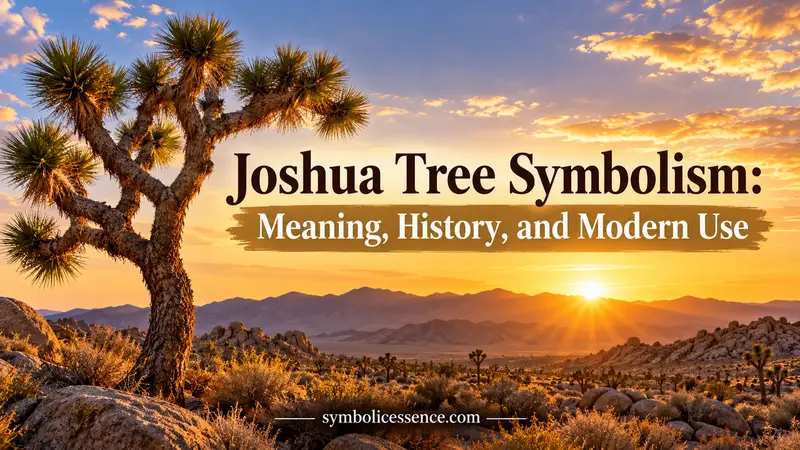
A Joshua tree stands in the desert with twisted branches reaching toward the sky. Its unusual shape makes it easy to recognize, but its meaning goes beyond its appearance. Joshua tree symbolism often connects with resilience, faith, survival, hope, and the ability to find direction during difficult times.
For many Americans, this desert plant represents strength in challenging surroundings. Its branches can suggest determination, while its ability to survive in dry landscapes makes it a natural image of endurance.
The Joshua tree also carries cultural and historical meaning. Its English name recalls a biblical figure, its homeland holds generations of Indigenous history, and its striking silhouette appears in music, photography, tattoos, and Southwestern design.
Understanding these different connections reveals why one desert plant can represent both personal determination and a larger relationship with the natural world.
Quick Answer
Joshua tree symbolism commonly represents resilience, perseverance, faith, hope, and finding direction through life’s challenges. In modern American culture, it also symbolizes desert beauty, individuality, and connection to nature, while its English name carries a historical association with the biblical Joshua and spiritual guidance.
TL;DR
- Resilience: Surviving difficult conditions without losing the ability to grow.
- Faith: The tree’s name connects with the biblical Joshua.
- Guidance: Its reaching branches can suggest direction and hope.
- Individuality: Its unusual shape represents independence and personal identity.
- Cultural heritage: Indigenous communities have long-standing relationships with the desert landscape.
- Modern meaning: Joshua trees appear in tattoos, photography, music, and conservation imagery.
What Is a Joshua Tree, and Why Does It Look So Unusual?
The Joshua tree is a distinctive desert plant known scientifically as Yucca brevifolia. Despite its name, it is not a conventional tree like an oak or maple. Instead, it belongs to the asparagus family and is closely related to other yuccas.
Joshua trees grow mainly in the Mojave Desert, across parts of California, Nevada, Arizona, and Utah. Their ability to live in dry environments makes them one of the most recognizable plants of the American Southwest.
Several physical features contribute to their unusual appearance:
- Twisted branches: Mature plants often develop irregular limbs that stretch in different directions.
- Sharp leaves: Dense clusters of pointed, green leaves grow at the ends of branches.
- Thick trunks: Rough, fibrous trunks help support the plant’s height and weight.
- Cream-colored flowers: Large clusters of pale flowers can appear in spring when conditions are favorable.
- Distinctive silhouettes: Their shapes stand out clearly against mountains, open skies, and desert sunsets.
The branching patterns differ from plant to plant. Some Joshua trees remain mostly upright, while others develop several arms that bend outward.
This variety helps explain their association with individuality. No two mature plants look exactly alike.
Their appearance also creates a striking contrast. Although the desert seems open and exposed, Joshua trees often look firmly established in their surroundings.
That contrast has helped people connect them with endurance, stability, and the ability to flourish in unexpected places.
What Does the Joshua Tree Commonly Symbolize in America?
In the United States, the Joshua tree has several widely recognized symbolic associations. Most arise from the plant’s appearance, its desert environment, or the cultural stories connected to its name.
Rather than carrying one universal meaning, the Joshua tree changes meaning depending on where and how people encounter it.
| Symbolic meaning | Common American interpretation | Typical context |
| Resilience | Continuing through difficult circumstances | Tattoos and personal artwork |
| Faith | Trust, spiritual guidance, and determination | Christian-inspired imagery |
| Hope | Looking toward a better future | Inspirational photography |
| Individuality | Being comfortable with one’s differences | Fashion and personal identity |
| Freedom | Open spaces and independent living | Southwestern art and decor |
| Conservation | Protecting fragile desert ecosystems | Environmental campaigns |
Resilience and perseverance
Resilience is among the strongest modern associations.
Joshua trees grow in places with limited rainfall, strong sunlight, and significant temperature changes. Their survival provides an easy visual comparison to people facing difficult circumstances.
Someone recovering from a setback may see the tree as a reminder that unfavorable conditions do not prevent all forms of growth.
Hope and determination
A Joshua tree’s branches often point upward or outward.
Some viewers interpret this shape as reaching toward new possibilities. Others see it as a reminder to remain hopeful when circumstances are uncertain.
These are personal interpretations rather than fixed historical meanings.
Independence and individuality
Unlike trees with predictable branching patterns, Joshua trees often grow into unusual shapes.
Their irregular appearance has become part of their appeal in contemporary art and design.
For people who value independence, the tree can represent the confidence to follow an unconventional path.
Why Is the Joshua Tree a Symbol of Strength and Resilience?
The Joshua tree’s connection with resilience comes partly from its biological adaptations.
Growing in the Mojave Desert requires specialized ways of conserving water, surviving heat, and using limited resources.
Joshua trees have root systems suited to their environment. Their narrow, tough leaves also help reduce water loss.
These adaptations allow mature plants to survive conditions that many other species could not tolerate.
However, resilience does not mean invincibility.
Joshua trees remain vulnerable to prolonged drought, rising temperatures, wildfire, and damage to their habitats. Young plants are especially sensitive to unfavorable conditions.
This distinction adds meaning to the symbolism.
Strength is not the same as being unaffected by hardship. Sometimes resilience means adapting to circumstances while remaining vulnerable.
Strength through adaptation
A Joshua tree does not survive by changing the desert into a more comfortable environment.
Instead, its physical structure allows it to live within the conditions around it.
As a personal metaphor, this can represent flexibility, patience, and practical problem-solving.
For example, someone moving to a new city may connect with the Joshua tree because they are learning to adjust to unfamiliar surroundings.
Perseverance without perfection
Joshua trees rarely have perfectly balanced branches.
Their shapes can appear uneven, bent, or weathered.
In contemporary symbolic interpretations, those irregular features may represent the idea that a difficult experience does not remove someone’s value.
The plant becomes an image of imperfect but continuing growth.
The Biblical Meaning Behind the Joshua Tree’s Name
The Joshua tree’s English name has long been linked to the biblical Joshua, who succeeded Moses as a leader of the Israelites.
According to a commonly repeated account, Mormon pioneers traveling westward during the nineteenth century saw the tree’s raised branches and associated them with Joshua.
One version suggests the branches resembled arms pointing toward the Promised Land. Another connects the plant’s appearance with Joshua’s military leadership.
However, the precise origin of the name remains uncertain. The familiar story about pioneers seeing Joshua’s outstretched arms is not firmly established by surviving historical records.
Although the naming story is uncertain, it has influenced later interpretations of the plant.
Joshua as a biblical figure
In the Bible, Joshua is closely associated with leadership, courage, obedience to God, and the journey into Canaan.
His story appears most prominently in the Book of Joshua.
Because of this connection, Christians sometimes interpret images of the Joshua tree through themes such as:
- Courage when facing an unfamiliar future.
- Trust in divine guidance.
- Leadership during challenging transitions.
- Determination to complete a difficult journey.
- Hope while moving toward a promised destination.
These ideas come from the biblical Joshua’s story, not from a biblical passage about the plant.
Is the Joshua tree mentioned in the Bible?
No. The plant called the Joshua tree does not appear by that name in the Bible.
Its common English name developed much later in North America.
The tree’s connection with Christianity is therefore based on a later naming tradition and modern interpretation.
It should not be confused with a direct biblical symbol established in scripture.
Indigenous History and the Joshua Tree’s Cultural Importance
The Joshua tree’s cultural history began long before English-speaking settlers arrived in the American Southwest.
The region now associated with Joshua Tree National Park includes ancestral homelands and traditional-use areas connected to the Cahuilla, Serrano, Chemehuevi, and Mohave peoples.
These communities developed extensive knowledge of desert plants, water sources, seasonal changes, and local ecosystems.
For them, the desert was not simply a harsh landscape waiting to be explored. It was home.
Traditional relationships with the plant
Indigenous communities used Joshua trees and other desert plants for practical purposes.
Among the Cahuilla, Joshua tree leaves could be used to make woven objects, including baskets and sandals. Flower buds and seeds also served as food resources.
Such uses demonstrate an understanding of the plant’s materials and seasonal growth.
They also reflect broader relationships between communities and their environment.
However, it would be inaccurate to assign one spiritual meaning to every Indigenous culture connected with the Joshua tree.
Different communities have their own languages, traditions, histories, and ways of understanding the landscape.
A history older than the English name
The name “Joshua tree” reflects a nineteenth-century English-language interpretation.
Indigenous names and knowledge existed long before that label became widely used.
This matters when discussing symbolism because the familiar Christian association is only one part of the plant’s cultural story.
Recognizing earlier relationships creates a more accurate picture of its importance.
It also helps distinguish documented cultural history from modern spiritual ideas that may have no established connection to Indigenous traditions.
Joshua Tree Symbolism in Spirituality and Personal Faith
Beyond its biblical name, the Joshua tree has become a personal spiritual image for some people.
Its shape, environment, and long life can encourage reflection on patience, belief, and finding direction.
However, these interpretations are not part of one universal religious tradition.
They are often individual responses to the plant.
Trust during uncertain times
The desert can look empty or unforgiving, especially to someone unfamiliar with its ecosystems.
Yet Joshua trees survive and reproduce there.
A person of faith may interpret this contrast as a reminder to remain hopeful when progress is difficult to see.
In Christian settings, the image may also evoke courage and trust during an uncertain journey.
The meaning of upward-reaching branches
Some observers associate the tree’s raised branches with prayer.
This connection is understandable because the silhouette can resemble arms reaching toward the sky.
Still, the shape does not establish a specific spiritual teaching.
The interpretation depends on the viewer’s beliefs and experiences.
Spiritual growth and patience
Joshua trees grow slowly, and their development depends on environmental conditions.
As a metaphor, that process can suggest patience and the value of gradual change.
Not every meaningful personal transformation happens quickly.
For someone beginning a new stage of life, the tree may become a visual reminder that progress takes time.
Why Joshua Trees Represent Hope and New Beginnings
A Joshua tree standing against a wide desert sky can create a sense of possibility.
The surrounding landscape often appears quiet, with long stretches of open ground and distant mountains.
In photography and personal writing, this setting can represent a fresh beginning.
The symbolism becomes especially meaningful during periods of transition.
Starting over after hardship
People sometimes choose Joshua tree images to mark a significant personal change.
Examples include:
- Moving away from a familiar hometown.
- Beginning a new career.
- Recovering after a difficult relationship.
- Rebuilding confidence following disappointment.
- Adjusting to a major change in family life.
The plant offers an image of continuing growth rather than instant transformation.
Hope in unexpected surroundings
Many people associate flowers, forests, and gardens with renewal.
The Joshua tree presents a different picture.
Its beauty comes from an environment that may appear severe or unwelcoming.
This contrast supports the interpretation that hope can exist even when circumstances are far from ideal.
However, this meaning is metaphorical. The desert itself is a living ecosystem, not an empty or failed landscape.
That difference matters because desert plants and animals are well adapted to conditions that may seem difficult from a human perspective.
What Does a Joshua Tree Symbolize Emotionally?
The Joshua tree can communicate different emotions depending on its setting and the viewer’s personal experiences.
Its unfamiliar shape may create wonder, while its isolated appearance can suggest solitude.
A photograph taken at sunrise may feel hopeful. The same tree photographed beneath a dark sky may appear reflective or lonely.
Neither interpretation is automatically correct.
Solitude and self-reflection
The wide spaces of the Mojave Desert encourage some visitors to think about quietness and separation from everyday routines.
A solitary Joshua tree can become an image of independence.
For one person, that independence may feel peaceful. For another, it may suggest loneliness.
This emotional flexibility helps explain the plant’s popularity in visual art.
Confidence in being different
The Joshua tree’s irregular branches make it visually distinctive.
In personal symbolism, this unusual appearance may represent accepting one’s differences rather than hiding them.
For example, an artist might use a Joshua tree to communicate a willingness to develop an individual style.
Peace through connection with nature
Desert landscapes often provide a strong contrast to crowded urban settings.
Their open views, changing light, and relative quiet can encourage reflection.
For people who associate Joshua trees with meaningful outdoor experiences, the plant may symbolize calmness and a desire to reconnect with nature.
These responses are personal rather than universal psychological effects.
Joshua Tree Meaning in American Art, Music, and Popular Culture
The Joshua tree became especially recognizable in modern American visual culture through desert photography, tourism, design, and popular music.
Its shape is easy to identify even when presented as a simple black silhouette.
That makes it useful for album artwork, posters, logos, and illustrations.
U2 and The Joshua Tree
One of the plant’s most famous appearances in popular culture is connected with The Joshua Tree.
Released in 1987, the album used American desert imagery as part of its visual identity.
The band’s photography in the American Southwest helped establish an association between the Joshua tree and themes of American landscapes, spiritual searching, and cultural reflection.
The album also explored conflicting ideas about America, including admiration, criticism, ambition, and disappointment.
As a result, the tree became connected with more than natural beauty.
For some music fans, it also recalls emotional searching, artistic identity, and the complicated promise of the American dream.
Joshua trees in desert photography
Photographers often use Joshua trees as foreground subjects against wide skies.
Their unusual branches create recognizable shapes, particularly at sunset or during nighttime photography.
Different compositions suggest different moods.
A single tree beneath the stars may communicate quiet reflection, while a group of trees in morning light may suggest community or renewal.
Southwestern design
Joshua tree silhouettes also appear in illustrations, wall prints, clothing, and local branding.
These designs often use muted earth tones, simple lines, and open desert backgrounds.
In this context, the plant typically represents the visual identity of the American Southwest rather than a specific religious belief.
Why Is the Joshua Tree Important in American Desert Identity?
For many Americans, the Joshua tree is closely associated with the Mojave Desert and Southern California.
Its distinctive appearance helps identify the landscape in much the same way that saguaros are associated with parts of the Sonoran Desert.
The tree has also become a familiar image of outdoor exploration.
Joshua Tree National Park
Joshua Tree National Park is a major reason the plant is widely recognized.
The area became a national monument in 1936 and was designated a national park in 1994.
Today, it is known for rock formations, desert ecosystems, hiking, climbing, camping, and dark night skies.
For visitors, Joshua trees can become symbols of memorable outdoor experiences.
Someone who first encountered them during a family trip may associate the trees with childhood, adventure, or time spent together.
Others may connect them with personal reflection during a solo journey.
Freedom and open spaces
American desert imagery often emphasizes long roads, distant mountains, and open horizons.
Within this visual tradition, Joshua trees can suggest exploration and independence.
They may also represent the desire to escape routines and experience a different pace of life.
However, these meanings come mainly from modern American storytelling and visual culture.
They should not be treated as ancient or universal interpretations.
Joshua Tree Tattoo Symbolism and Personal Expression
Joshua tree tattoos have become a recognizable choice for people who enjoy nature-inspired designs and Southwestern imagery.
The plant’s branching shape works well in minimalist outlines, blackwork, and detailed landscape tattoos.
Its meaning often depends on why someone chooses it.
Tattoos representing personal resilience
A person may select a Joshua tree tattoo after overcoming a difficult experience.
The plant can represent adapting to new circumstances while remaining connected to personal values.
In this setting, the tattoo serves as a reminder of individual growth.
Tattoos connected with faith
Some Joshua tree designs include a cross, a biblical phrase, or other Christian imagery.
These combinations may emphasize trust, courage, and guidance.
Without those additional elements, a Joshua tree tattoo should not automatically be assumed to have a religious meaning.
Tattoos honoring a special place
Many people choose Joshua tree tattoos because they love the desert.
They might associate the image with a vacation, a hometown, or an important personal memory.
Common design choices include:
- A single Joshua tree in black ink.
- A desert sunset behind the plant.
- Mountains and stars surrounding the branches.
- A Joshua tree inside a circular landscape design.
- A minimalist silhouette with a meaningful date.
In each example, the tree’s visual identity allows the wearer to communicate something personal without requiring a fixed meaning.
Joshua Tree Symbolism in Jewelry, Home Decor, and Fashion
Joshua tree imagery also appears in everyday objects, particularly products inspired by Southwestern landscapes.
Unlike religious symbols with widely established meanings, the tree usually communicates a general connection with nature, travel, or personal style.
Jewelry and accessories
Necklaces, earrings, and pendants featuring Joshua tree silhouettes often appeal to people who enjoy desert landscapes.
Some wearers associate these pieces with independence or resilience.
Others simply appreciate the plant’s unusual shape.
A Joshua tree pendant may also serve as a reminder of a memorable visit to the Southwest.
Home decor
Joshua tree artwork is common in desert-inspired interior design.
Framed photographs, minimalist prints, and landscape illustrations often feature the plant beside rocks, mountains, or a sunset.
These pieces can create a sense of openness and calm.
In American homes, the imagery is especially associated with Southwestern, rustic, bohemian, and contemporary desert styles.
Fashion and personal identity
Joshua tree graphics appear on T-shirts, hats, sweatshirts, and outdoor accessories.
In many cases, they communicate an interest in hiking, travel, California landscapes, or desert culture.
Some designs emphasize environmental awareness.
Others use the tree simply as a recognizable regional image.
The distinction depends on the words, illustrations, and context surrounding the design.
Is the Joshua Tree a Positive or Negative Symbol?
The Joshua tree is generally interpreted positively in contemporary American culture.
Its strongest associations include endurance, independence, natural beauty, and hope.
However, certain images can carry more serious or melancholy meanings.
A tree standing alone in an empty landscape may suggest isolation.
Broken branches or a burned tree may represent environmental loss, hardship, or change.
These interpretations are shaped by context rather than an established belief that the plant brings misfortune.
When the symbolism feels positive
A healthy Joshua tree surrounded by warm light commonly suggests perseverance and optimism.
In personal artwork, it may represent confidence or a renewed sense of direction.
When the symbolism feels somber
A dead or damaged Joshua tree can draw attention to vulnerability.
Artists may use such imagery to explore environmental destruction, grief, or the consequences of change.
The symbolism can be emotionally serious without being supernatural or threatening.
Does the Joshua tree bring bad luck?
There is no widely established American tradition identifying Joshua trees as omens of bad luck.
Claims that the plant predicts misfortune or carries harmful spiritual forces are not supported by a recognized historical tradition.
People may attach personal meanings to the tree, but those meanings should not be presented as universal beliefs.
Common Misunderstandings About Joshua Tree Symbolism
Several popular interpretations simplify the plant’s history or overlook important distinctions.
Understanding these misunderstandings makes its symbolism more accurate and culturally respectful.
Mistaking a naming legend for proven history
The story about Mormon pioneers naming the tree after Joshua is frequently repeated as a definite historical event.
However, the surviving evidence does not establish the familiar version of the story with certainty.
It is more accurate to describe the connection as a traditional explanation with an uncertain origin.
Assuming the plant is a biblical sacred tree
The Joshua tree is not identified as a sacred plant in the Bible.
Its religious associations developed from its English name and later interpretation.
This does not prevent people from finding personal spiritual meaning in the plant. It simply separates belief from documented history.
Treating Indigenous traditions as one belief system
Native communities connected with the Mojave Desert have distinct histories, languages, and cultural traditions.
Assigning a single Indigenous spiritual meaning to the Joshua tree can erase those differences.
Specific claims about traditional beliefs should be grounded in the relevant community’s knowledge.
Confusing symbolism with scientific reality
Joshua trees often represent endurance, but their ecological survival is not guaranteed.
Their adaptations do not protect them from every threat.
Presenting them as plants that can survive anything overlooks the environmental pressures they currently face.
The Joshua Tree as a Modern Symbol of Environmental Protection
In recent years, the Joshua tree has gained another important association: environmental vulnerability.
This meaning comes from growing concern about climate change, habitat loss, wildfire, and the future of desert ecosystems.
The plant’s survival is closely connected to the conditions of the Mojave Desert.
Rising temperatures and prolonged drought can make it harder for young Joshua trees to establish themselves in some areas.
Wildfires create additional risks, especially where invasive grasses increase available fuel.
From desert survivor to conservation symbol
Historically, many visitors viewed Joshua trees mainly as examples of desert endurance.
Today, environmental discussions increasingly emphasize that even highly adapted species have limits.
This has changed the message conveyed by the plant.
It can still represent resilience, but it also reminds people that natural environments require protection.
The responsibility behind the symbol
Joshua trees have become useful images in discussions about conserving American desert landscapes.
Their recognizable silhouettes help communicate what could be lost through environmental change.
Protecting the plant also means protecting the wider ecosystem, including native animals, other plants, and culturally important landscapes.
For modern audiences, the Joshua tree can therefore represent both the beauty of nature and the responsibility to care for it.
FAQs
What does a Joshua tree symbolize spiritually?
Spiritually, a Joshua tree can represent faith, perseverance, guidance, and patience during difficult periods. These meanings usually reflect personal beliefs and the plant’s association with the biblical Joshua rather than a universal religious teaching.
What does the Joshua tree mean in Christianity?
Some Christians associate the Joshua tree with courage, leadership, and trust in God because of its name. However, the plant is not specifically mentioned in the Bible, so these connections are later interpretations.
What does a Joshua tree tattoo mean?
A Joshua tree tattoo often represents resilience, individuality, personal growth, or a connection with the American Southwest. Its exact meaning depends on the wearer’s experiences and the other elements included in the design.
Why is the Joshua tree associated with the Bible?
Its English name is traditionally linked to nineteenth-century Mormon pioneers who reportedly connected its unusual shape with the biblical Joshua. The exact history of this naming tradition remains uncertain.
Does a Joshua tree symbolize love?
Love is not one of the Joshua tree’s most established symbolic meanings. However, someone may use its image to represent a lasting relationship, shared memories, or the commitment to grow together through difficult circumstances.
What does seeing a Joshua tree mean?
Seeing a Joshua tree does not have a universally recognized supernatural meaning. For someone who values nature or personal reflection, the experience may serve as a reminder of perseverance, independence, or appreciation for the desert.
Why is the Joshua tree considered special?
Joshua trees are special because of their unusual appearance, their ecological relationship with the Mojave Desert, and their cultural importance. They also serve as recognizable symbols of Southwestern landscapes and the need to protect desert habitats.
Conclusion
Joshua tree symbolism brings together resilience, faith, independence, hope, and connection to the American desert. Its meaning comes from several sources, including its distinctive appearance, its environmental adaptations, its English naming tradition, and its place in modern culture.
The plant also has a history that extends far beyond its familiar name. Indigenous relationships with the Mojave Desert, later religious interpretations, popular music, and environmental concerns all contribute to how people understand it today.
Perhaps the most meaningful lesson offered by the Joshua tree is that endurance and vulnerability can exist together. Its unusual branches reflect adaptation, while its uncertain environmental future reminds us that even the most recognizable desert survivors need conditions in which they can continue to grow.