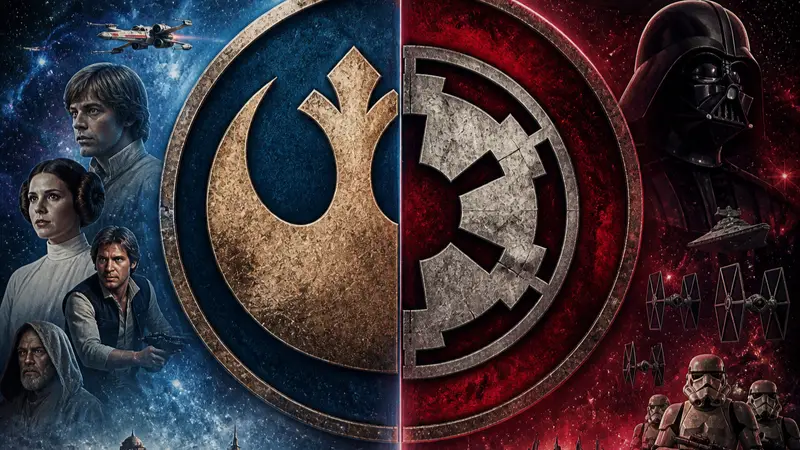
A blue lightsaber, a black helmet, two suns setting over a desert, and a small Rebel Alliance symbol can communicate an entire story without a character saying a word. In Star Wars, objects, colors, characters, and fictional groups often represent ideas that reach beyond the films themselves.
Star Wars symbolism attracts attention because viewers recognize familiar images but may interpret them in different ways. A lightsaber might represent hope to one person and responsibility to another. Darth Vader’s helmet can suggest fear, authority, personal loss, or the danger of giving up one’s freedom.
Since the original film premiered in 1977, these images have become part of American entertainment, fashion, art, celebrations, and everyday conversation. Their meanings have also changed as new films, television series, books, and generations of fans have added their own interpretations.
Quick Answer
Star Wars symbolism commonly represents the struggle between good and evil, freedom and control, hope and fear, and personal choice and responsibility. Its meanings developed through George Lucas’s storytelling, which drew on mythology, science fiction, samurai films, wartime imagery, and familiar moral conflicts.
TL;DR
- Lightsabers represent identity, responsibility, and the struggle between opposing choices.
- The Force connects ideas of balance, self-control, and personal responsibility.
- The Rebel Alliance stands for freedom and resistance to authoritarian rule.
- Darth Vader represents fear, corruption, regret, and the possibility of redemption.
- Jedi imagery reflects discipline, service, and the challenge of controlling emotions.
- American fans use Star Wars imagery in tattoos, clothing, art, and celebrations.
What Does Star Wars Symbolism Look Like?
The visual language of Star Wars combines recognizable objects, strong colors, unusual creatures, costumes, and fictional organizations. Each design helps viewers understand a character or situation before hearing the full story.
Some of its best-known visual elements include:
- Lightsabers: Energy swords with colored blades, associated with Jedi and Sith characters.
- The Force: An invisible connection that living beings can experience and use.
- The Rebel Alliance symbol: A starbird-inspired emblem associated with resistance against the Galactic Empire.
- The Imperial crest: A circular insignia representing the Empire’s centralized authority.
- Darth Vader’s helmet: A black, mechanical mask that hides his face and supports his intimidating appearance.
- The twin suns of Tatooine: Two suns that appear in the desert landscape of Luke Skywalker’s home planet.
These images appear on movie posters, toys, clothing, collectibles, video games, and fan artwork.
Their meanings are not always fixed. A black costume, for example, may suggest danger in one scene but personal struggle or redemption in another.
What Are the Main Meanings Behind Star Wars?
The franchise uses several recurring ideas to explain human choices and conflicts. Although the stories take place in a fictional galaxy, many of their central themes are familiar to American audiences.
Good Versus Evil
The conflict between the Jedi and Sith is one of the clearest examples. Jedi characters generally try to protect life and maintain peace, while Sith characters pursue control through fear, anger, and personal power.
However, the films do not always present every character as entirely good or bad. Anakin Skywalker’s transformation into Darth Vader shows how fear, grief, and poor decisions can lead someone toward cruelty.
Freedom Versus Control
The Rebel Alliance fights against an Empire that uses military power and political pressure to control entire systems. This conflict gives the series a recurring message about freedom, individual rights, and resistance to oppression.
Hope During Difficult Times
Hope appears in small acts as well as major victories. Luke Skywalker begins as a young person living far from the center of galactic events, yet his decisions eventually affect the future of the galaxy.
The idea is simple: someone does not need to begin with great influence to make a difference.
Choice and Responsibility
Star Wars repeatedly shows that a person’s decisions matter more than their background alone. Anakin’s fall and Luke’s refusal to surrender to hatred provide two contrasting examples.
Where Did the Symbolic Ideas in Star Wars Come From?
George Lucas developed the original Star Wars film during the 1970s. Its story did not emerge from a single mythology or historical event. Instead, it combined several storytelling traditions and visual influences.
One important influence was the work of Japanese filmmaker Akira Kurosawa. In particular, The Hidden Fortress (1958) helped inspire aspects of the original film’s storytelling, including the use of characters who experience major events from a less powerful position.
Samurai films also influenced the appearance and behavior of the Jedi. Their robes, disciplined fighting styles, and codes of conduct bring to mind older warrior traditions.
Mythologist Joseph Campbell’s writing about the hero’s journey is another commonly discussed influence. Lucas drew on familiar storytelling patterns involving a young hero, a mentor, a difficult journey, and a final confrontation.
The original trilogy also appeared during a period when American audiences were thinking about war, political authority, public trust, and social change. These circumstances helped shape the way viewers understood the Empire and the Rebel Alliance.
It would be inaccurate to say that every fictional organization represents one specific historical government. The films combine several influences rather than offering a direct historical copy.
What Does the Force Symbolize?
The Force is an invisible power that connects living things throughout the Star Wars galaxy. Jedi characters learn to understand and use it through training, concentration, and self-control.
As a fictional concept, it often represents connection, awareness, balance, and responsibility.
The Force has two commonly discussed sides:
- Light side: Associated with compassion, patience, protection, and self-discipline.
- Dark side: Associated with anger, fear, hatred, domination, and the desire for control.
These sides are not simply two equal teams. The films generally show the dark side as a path that damages both the person using it and the people around them.
The Force also raises questions about personal freedom. Characters may feel that events are connected or guided by something larger than themselves, but they still face choices about how to act.
For American viewers, this idea can work as a fictional reflection on personal values, relationships, and the responsibility people have toward others. It should not be confused with a scientific description of an actual invisible force.
What Do Different Lightsaber Colors Mean?
Lightsaber colors are among the most recognizable visual details in the franchise. They help distinguish characters and groups, although their meanings have developed across films, animated shows, novels, and other official stories.
| Context | Meaning in USA | Common Associations | Notes |
| Blue lightsaber | Courage and protection | Jedi guardians, action, heroism | Commonly associated with characters such as Obi-Wan Kenobi |
| Green lightsaber | Wisdom and understanding | Jedi knowledge, patience, spiritual discipline | Used by Luke Skywalker and Yoda |
| Red lightsaber | Conflict and aggression | Sith, danger, ambition, the dark side | Associated with characters such as Darth Vader |
| Purple lightsaber | Individuality and distinction | Mace Windu, unusual character identity | Its special meaning is not a universal rule |
| Yellow lightsaber | Service and watchfulness | Jedi Temple Guards and other roles | Meaning depends on the story and character |
One important detail is that the color system has changed over time. Older fan explanations sometimes assign strict personality types to every color, but official storytelling does not support every popular interpretation.
For example, a purple lightsaber does not automatically mean that someone is partly good and partly evil. Mace Windu’s weapon is distinctive, but its color should not be treated as a universal personality test.
Fans often choose a favorite blade color because it reflects the character they admire, the visual design they enjoy, or the qualities they personally associate with that character.
Why Does Darth Vader Represent Fear and Redemption?
Darth Vader is one of the most recognizable fictional villains in American popular culture. His black armor, mechanical breathing, covered face, and commanding voice make him visually different from nearly every other character.
His appearance communicates authority and danger. The mask also hides the person underneath, making him seem less human and more like a machine.
However, his story adds another layer to this image.
Before becoming Darth Vader, Anakin Skywalker was a Jedi who struggled with fear, attachment, anger, and the possibility of losing people he loved. His decisions eventually led him to serve the Empire and commit terrible acts.
His later return to the light side gives the character a different meaning. He becomes an example of how a person can recognize wrongdoing and make a final choice to protect someone else.
For many viewers, Vader represents several ideas at once:
- The damage caused by uncontrolled fear.
- The danger of using authority to dominate others.
- The loss of identity through harmful choices.
- The possibility of regret and redemption.
This complexity explains why Darth Vader remains popular even though he is responsible for many cruel actions in the story.
What Does the Rebel Alliance Symbol Represent?
The Rebel Alliance emblem is commonly recognized as a symbol of resistance, courage, and the desire for freedom.
Its design is often described as a starbird. It appears on Rebel uniforms, spacecraft, equipment, and military-style displays throughout the films and television series.
Within the story, the emblem identifies people who oppose the Galactic Empire. These characters do not all come from the same background, but they share an interest in ending Imperial control.
In American culture, the design can communicate ideas such as:
- Standing up to unfair authority.
- Supporting individual freedom.
- Working with others toward a shared goal.
- Refusing to accept oppression as normal.
The symbol is especially popular on T-shirts, patches, stickers, laptop covers, and tattoos.
Its meaning can become more personal when someone uses it to represent an experience of speaking up, challenging an unfair situation, or supporting a cause.
Still, wearing the emblem does not automatically reveal someone’s political beliefs. Many fans simply enjoy the design or identify with the fictional heroes.
What Does the Galactic Empire Symbolize?
The Galactic Empire is presented as a government that uses military strength, fear, and centralized authority to maintain control.
Its insignia, uniforms, large spacecraft, and carefully organized forces create a visual impression of order. But the films gradually show the cost of that order.
The Death Star is perhaps the clearest example. It is a weapon designed to destroy entire planets, demonstrating how far the Empire is willing to go to prevent resistance.
The Imperial symbol therefore carries associations with:
- Authoritarian government.
- Military domination.
- Fear-based leadership.
- The loss of individual freedom.
- The misuse of technology and institutional power.
Its visual style also borrows from recognizable military design traditions, including formal uniforms, strict formations, and large-scale displays of authority.
Some viewers compare the Empire to real-world authoritarian governments. Such comparisons can help explain the fictional themes, but the Empire should not be treated as an exact representation of any single historical country or political system.
How Do American Fans Interpret Star Wars in Everyday Life?
In the United States, Star Wars has moved far beyond movie theaters. Its characters and designs appear in family traditions, entertainment events, clothing, collectibles, and personal artwork.
May 4 is a particularly recognizable example. Fans celebrate Star Wars Day on this date because of the wordplay behind the phrase “May the Fourth be with you,” which resembles the familiar line “May the Force be with you.”
The day is often marked by movie marathons, themed parties, merchandise promotions, costumes, and social media posts.
Families may introduce children to the original trilogy, while longtime fans revisit films they watched when they were younger.
The franchise also provides a shared cultural language. Someone might describe a difficult situation as a battle between the light and dark sides or use a Darth Vader image to make a joke about an intimidating boss.
These expressions work because many Americans already recognize the characters and their basic stories.
Why Do People Choose Star Wars Symbols for Tattoos?
Star Wars tattoos often represent personal experiences rather than simple admiration for a film series.
Someone who chooses a Rebel Alliance tattoo may associate it with independence or overcoming a difficult situation. Another person might choose a lightsaber to remember a favorite character or a meaningful period in life.
Popular tattoo designs include:
- Lightsabers: Personal strength, courage, and responsibility.
- The Rebel Alliance emblem: Freedom, resistance, and independence.
- Darth Vader: Personal struggles, difficult experiences, or an appreciation of the character.
- The Death Star: Science fiction interests, visual design, or a reminder of a favorite film.
- The Millennium Falcon: Adventure, loyalty, and friendship.
- The twin suns: New beginnings, childhood memories, or Luke Skywalker’s journey.
Minimalist designs are also common. A small outline of a lightsaber or an Imperial crest can be meaningful without including an entire character or scene.
People should remember that tattoo meanings are personal. Two individuals can choose the same design for completely different reasons.
How Do Star Wars Symbols Influence Fashion, Art, and Home Decor?
The franchise has a recognizable visual style that works well in everyday products. Its symbols are easy to identify, even when they appear without a character’s name.
Fashion is one of the most visible examples. T-shirts, hoodies, jackets, hats, sneakers, and accessories frequently feature lightsabers, droids, spacecraft, and character artwork.
Home decoration offers another use. Fans may display:
- Framed movie posters.
- Lightsaber replicas.
- LEGO spacecraft models.
- Character figures and helmets.
- Bedding with galaxy-inspired patterns.
- Wall art featuring fictional planets.
Artists also use Star Wars imagery in digital illustrations, paintings, graphic design, and fan-made posters.
These designs can communicate a person’s interests, childhood memories, or connection to a fictional universe. Some people prefer subtle references, such as a small droid illustration, while others enjoy covering an entire room with collectibles.
The visual style has also become part of licensed American merchandise and popular culture, making it familiar to people who may not have watched every film.
Are There Religious or Cultural Meanings Behind Star Wars?
Star Wars includes ideas that resemble themes found in several philosophical and religious traditions. However, the fictional Force is not simply another name for a real religion.
Lucas’s creative influences included ideas associated with Eastern philosophy, mythology, and different approaches to spiritual discipline. The Jedi Order also has visual and storytelling connections to samurai traditions.
Some viewers notice similarities between Jedi practices and Buddhist or Taoist ideas, particularly around self-control, attachment, balance, and awareness.
These connections should be understood carefully. Similar themes do not prove that the Jedi represent one specific religious tradition.
The films also use familiar Western storytelling elements, including the hero’s journey, moral temptation, sacrifice, and redemption.
For American audiences, the Jedi may therefore suggest different things depending on their backgrounds. One viewer may appreciate the discipline, another may focus on the ethical lessons, and someone else may simply enjoy the fictional order.
The franchise leaves room for these personal readings without requiring viewers to accept a particular religious belief.
What Are Common Misunderstandings About Star Wars Symbolism?
Some popular interpretations are based on fan discussions rather than established details from the films or official stories.
Understanding the difference helps prevent fictional details from being presented as universal facts.
Misunderstanding 1: Every lightsaber color has one fixed personality meaning.
Lightsaber colors have associations within the franchise, but their meanings are not always strict. A fan may personally connect green with wisdom or purple with individuality without those interpretations applying to every character.
Misunderstanding 2: The Jedi represent a single real-world religion.
The Jedi combine several fictional and historical influences. Their beliefs and practices should not be described as an exact copy of Buddhism, Taoism, Christianity, or another tradition.
Misunderstanding 3: Darth Vader represents nothing except evil.
His actions are often cruel and destructive, but his character also explores fear, regret, manipulation, and redemption.
Misunderstanding 4: Wearing an Imperial symbol means supporting authoritarian politics.
Many fans use Imperial imagery because they enjoy the costume design, fictional spacecraft, or visual style. A piece of merchandise alone does not establish someone’s political position.
Misunderstanding 5: Star Wars is a direct retelling of one historical conflict.
The franchise contains historical and political influences, but its stories combine multiple sources. It is better understood as fictional storytelling informed by different traditions and events.
How Has the Meaning of Star Wars Changed Across Generations?
The original Star Wars film arrived in 1977, when audiences first encountered Luke Skywalker, Princess Leia, Han Solo, Darth Vader, and the conflict between the Empire and the Rebels.
For many viewers of that generation, the original trilogy became associated with childhood, family movie nights, and the excitement of theatrical science fiction.
The prequel trilogy, released between 1999 and 2005, changed the way audiences understood the Jedi, the Republic, and Anakin Skywalker’s fall. It gave more attention to political corruption, institutional failure, and the dangers of fear.
The sequel trilogy, released between 2015 and 2019, introduced new characters and explored the continuation of older conflicts. Rey, Finn, Poe Dameron, and Kylo Ren brought questions about identity, belonging, and the influence of family history to a new generation.
Television series such as The Mandalorian and Andor added further perspectives. They explored survival, community, resistance, and the experiences of ordinary people living under Imperial rule.
The result is a franchise whose visual language remains familiar while its themes continue to expand.
Older fans may connect a lightsaber with childhood memories, while younger viewers may associate it with newer characters or stories. Both interpretations can exist without replacing the original meaning.
FAQs
Is Star Wars symbolism positive or negative?
It includes both positive and negative meanings. Jedi imagery often suggests responsibility, compassion, and self-control, while Imperial imagery commonly represents fear, domination, and the misuse of authority.
Does Star Wars have a connection to Christianity?
The franchise is not a Christian story, although some viewers notice themes that resemble Christian storytelling, such as sacrifice, temptation, forgiveness, and redemption. These similarities do not make its characters direct representations of biblical figures.
What does the phrase “May the Force be with you” symbolize?
It expresses encouragement, support, and goodwill before someone faces a difficult task. In everyday American conversation, fans sometimes use it humorously before exams, job interviews, competitions, or important decisions.
Why is the color black associated with Darth Vader?
His black armor creates a threatening appearance and separates him visually from many heroic characters. It also hides his damaged body and face, making his identity as a human being less visible.
What does the Millennium Falcon represent?
The Millennium Falcon is commonly associated with adventure, loyalty, independence, and friendship. Its worn appearance also makes it different from the polished spacecraft used by powerful organizations.
Why is May 4 celebrated as Star Wars Day?
The date comes from the playful similarity between “May the Fourth” and “May the Force.” Fans began using the wordplay as a celebration, and it eventually became an internationally recognized fan event.
Can someone use Star Wars symbols without being a major fan?
Yes. A person might choose a lightsaber design because they like its appearance or use the Rebel emblem because they appreciate its association with freedom. Understanding the original story is helpful, but personal expression does not require extensive knowledge of the franchise.
Conclusion
Star Wars symbolism brings together ideas about freedom, responsibility, fear, hope, identity, and personal choice. Its lightsabers, fictional organizations, characters, and spacecraft each contribute to a visual language that audiences can recognize across generations.
The meaning of these images has developed since the original 1977 film, influenced by new stories, changing audiences, and the franchise’s place in American entertainment. Some meanings come directly from the films, while others reflect the personal experiences of fans.
Ultimately, Star Wars symbolism remains relevant because people continue to find familiar ideas in its fictional conflicts. A small Rebel emblem, a green lightsaber, or a pair of desert suns can remind someone of a favorite character, an important memory, or the value of making their own choices.