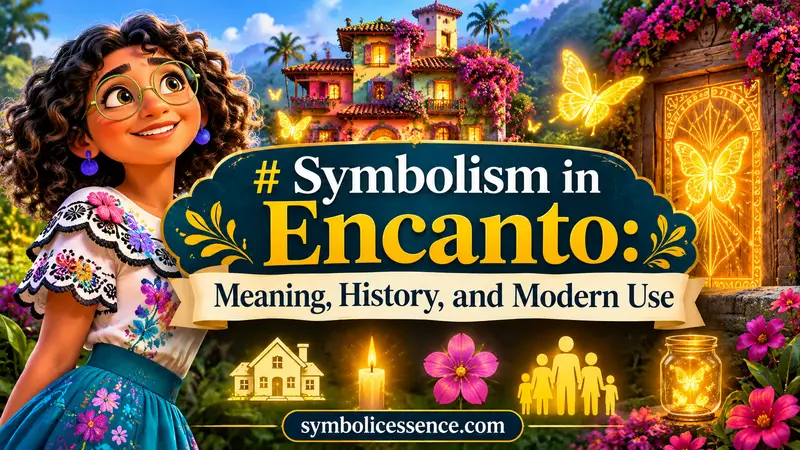
Disney’s Encanto (2021) tells the story of the Madrigal family, whose members receive magical gifts that help their community in a colorful Colombian village. One family member, Mirabel, receives no special ability. As the story unfolds, however, the film reveals that its magic represents something more familiar than supernatural powers: family expectations, personal identity, emotional pressure, and the need to feel accepted.
The symbolism in Encanto comes from several connected ideas. The magical candle represents hope and family protection, the house reflects the condition of family relationships, and each character’s gift reveals a different expectation placed on them.
These ideas have helped the movie connect with American audiences, especially people who recognize the pressure to meet family expectations or hide their struggles behind a cheerful appearance. Its Colombian setting also gives the story a cultural background that matters to its meaning.
Quick Answer
The symbolism in Encanto represents family love, belonging, identity, personal responsibility, and the pressure to meet other people’s expectations. Its central symbols, including the magical candle, Casita, and the Madrigals’ gifts, connect to the family’s fictional origin story and the broader Colombian cultural setting.
TL;DR
- The magical candle represents hope, protection, and family survival.
- Casita symbolizes family relationships and emotional stability.
- Mirabel represents belonging without needing special abilities.
- The magical gifts reflect individual talents and family expectations.
- Cracks in the house reveal hidden family problems.
- Butterflies suggest change, renewal, and the possibility of healing.
What Does Encanto Look Like, and Where Does Its Symbolism Appear?
Encanto is an animated Disney film set in a fictional Colombian village surrounded by green mountains. Its visual style combines colorful architecture, tropical plants, traditional clothing, music, and magical details.
The Madrigal family lives in Casita, a house that responds to their needs. Doors appear for family members when they receive their magical gifts, and the rooms inside the house reflect their abilities.
Several visual details carry meaning throughout the movie:
- The candle: A magical flame connected to the family’s original miracle.
- Casita: A living house that reflects the condition of the family.
- The butterflies: Repeated images associated with change, hope, and renewal.
- The cracks: Physical signs of problems that the family has tried to ignore.
- The magical doors: Representations of identity, responsibility, and personal roles.
- The family clothing: Colorful designs that help communicate each character’s personality and abilities.
These details are not random decorations. Their meanings become clearer as the characters face problems they cannot solve through magic alone.
What Does Encanto Symbolize in Modern American Culture?
For many American viewers, the movie represents the difference between being loved for who you are and being valued for what you can do.
The Madrigal family appears successful because every gifted member contributes something useful. Luisa carries heavy objects, Isabela creates beautiful flowers, and Julieta heals people with her cooking.
However, their abilities also become expectations. Luisa feels she must always be strong, while Isabela believes she must remain perfect. Their gifts help the village, but they also limit how freely the sisters express themselves.
This connects with familiar experiences in American families, schools, and workplaces. A child may feel expected to earn excellent grades, care for younger siblings, or become the person everyone depends on.
The film also represents the importance of recognizing people whose contributions are less visible. Mirabel does not have a supernatural gift, yet she notices problems that other family members overlook.
For modern audiences, one of the central messages is that a person’s value should not depend on achievements, talent, appearance, or usefulness.
Why Does the Magical Candle Represent Hope and Family Protection?
The candle is one of the most important objects in the movie. Its story begins when Alma Madrigal and her husband, Pedro, are forced to flee their home with their young children.
During their escape, Pedro stays behind to protect his family and is killed by pursuing attackers. Alma is left alone with her children. At that moment, the candle becomes magical and creates a protected place for the family.
The event gives the Madrigals their miracle, a magical home, and special abilities for future generations.
The candle can be understood through three connected meanings.
Hope after loss: Its appearance follows a frightening personal tragedy. It represents the possibility of building a future after losing a home and a loved one.
Protection and survival: The miracle creates a safe village where the family can raise children and help others.
Family responsibility: As the generations grow, protecting the miracle becomes Alma’s main responsibility. Eventually, that responsibility turns into pressure.
The candle therefore has two sides. It begins as a sign of hope, but the family’s fear of losing it makes the miracle feel like something they must constantly prove themselves worthy of keeping.
This change is important because the movie does not present protection as an excuse for controlling every family member.
What Does Casita Symbolize About Family Relationships?
Casita is more than the Madrigals’ home. It behaves like a family member, helping people move through rooms, opening doors, and responding to their needs.
Its condition reflects the emotional condition of the household.
When the family is working together, the house appears lively and supportive. When hidden problems grow, cracks begin appearing in its walls and floors.
This creates a connection between the physical building and the family’s relationships.
Casita can represent:
- Family unity: Its rooms and shared spaces bring different generations together.
- Emotional security: It provides shelter and a sense of belonging.
- Family conflict: Its cracks reveal that something is wrong beneath the cheerful surface.
- Rebuilding relationships: Its restoration reflects the family’s willingness to change.
The house also shows that a family can look successful from the outside while struggling privately.
One important detail is that Casita does not simply return to its original appearance at the end. The family rebuilds it together, suggesting that healthy relationships require participation from everyone rather than relying on one person’s sacrifice.
What Do the Madrigal Family’s Magical Gifts Represent?
Each Madrigal receives a special ability, and those abilities reflect different ways people contribute to their families and communities.
However, the gifts also show how easily a useful talent can become an unwanted responsibility.
| Context | Meaning in USA | Common Associations | Notes |
| Luisa’s strength | Pressure to be dependable | Responsibility, exhaustion, caretaking | Strength does not mean someone never needs help. |
| Isabela’s flowers | Expectations of perfection | Beauty, approval, control | Creativity becomes freeing when she grows beyond expectations. |
| Bruno’s visions | Fear of being misunderstood | Rejection, uncertainty, family secrets | His story challenges the habit of blaming uncomfortable messengers. |
| Julieta’s healing food | Care through everyday actions | Nurturing, comfort, family support | Cooking connects affection with practical care. |
| Mirabel’s lack of a gift | Belonging without achievement | Acceptance, individuality, self-worth | Her importance does not depend on receiving magic. |
The gifts are especially interesting because they are not equally easy to carry.
Luisa’s strength makes everyone depend on her. Isabela’s beauty creates pressure to behave perfectly. Bruno’s visions make people uncomfortable because they reveal possible futures they do not want to face.
The movie suggests that a person’s ability should not become the only thing others see about them.
Why Does Mirabel Symbolize Belonging and Self-Acceptance?
Mirabel is different from the other Madrigals because she does not receive a magical gift during her ceremony.
Her experience reflects a common fear: being the only person in a family or social group who seems different.
She watches her sisters receive attention for their abilities and sees other family members praised for their contributions. Meanwhile, she struggles to understand where she belongs.
Yet Mirabel has qualities that the family needs. She observes people’s emotions, recognizes problems, asks difficult questions, and continues trying to bring everyone together.
Her importance becomes especially clear when the miracle begins to fail. While other family members focus on protecting their abilities, Mirabel investigates the cracks and tries to understand their cause.
She represents:
- Self-worth that does not depend on achievements.
- The courage to question unfair expectations.
- Emotional awareness within a family.
- The importance of being included.
- The ability to help without receiving public recognition.
Her character also challenges the idea that the most talented person must be the most valuable person.
Mirabel’s story is a reminder that people can make meaningful contributions through kindness, observation, honesty, and persistence.
What Do the Cracks in Casita Mean?
The cracks appear when the Madrigal family begins experiencing problems that cannot remain hidden.
At first, the family focuses on the possibility that the miracle is disappearing. Alma worries about losing the protection that has supported three generations.
However, the cracks also reflect emotional damage caused by fear, pressure, and unspoken feelings.
Each family member has a different relationship with this problem.
Luisa hides her exhaustion because she believes others need her strength. Isabela hides her desire to make choices outside her family’s expectations. Bruno stays away because he fears being rejected for his visions.
These personal struggles are connected to the larger family conflict.
The cracks can represent:
- Unspoken problems: Issues that grow when nobody feels comfortable discussing them.
- Emotional pressure: The cost of trying to meet unrealistic expectations.
- Fear of change: The family’s belief that everything must remain as it was.
- The need for honesty: Problems become easier to address when people acknowledge them.
An important part of the ending is that the family does not repair its relationships simply by hiding the cracks. They must first recognize what caused them.
What Does Bruno Symbolize in Encanto?
Bruno Madrigal is often misunderstood because his gift allows him to see possible futures.
His visions are not always welcome. Some family members interpret them as bad news, and people become uncomfortable around him.
As a result, Bruno withdraws from the family and secretly lives inside the house.
His character represents the experience of being blamed for information that other people do not want to hear.
His story also raises an important distinction between predicting a possible outcome and causing that outcome. Bruno does not create the problems he sees. His visions reveal situations that may already be developing.
The famous phrase “We Don’t Talk About Bruno” reflects how families sometimes avoid uncomfortable subjects instead of addressing them directly.
Bruno’s eventual return shows the value of allowing people to explain themselves before judging them.
He also represents the possibility of reconnecting after years of distance. His family does not need to pretend that the past never happened. They need to make room for an honest relationship in the present.
What Do Butterflies Symbolize in the Movie?
Butterflies appear as recurring visual details in Encanto. Their connection with the story is especially noticeable through the butterfly imagery associated with the Madrigal family’s miracle and the film’s closing moments.
In many familiar cultural interpretations, butterflies represent transformation because they change from caterpillars into winged insects.
That association makes them suitable for a story about a family learning to change.
Within the movie, butterflies can suggest:
- Personal growth: Characters begin to understand themselves differently.
- Renewal: The family has an opportunity to rebuild its relationships.
- Hope: Difficult experiences do not have to determine the future.
- Change across generations: The next generation can choose a different way of living.
Butterflies also fit the film’s visual style. Their bright colors complement the flowers, plants, and warm landscapes of the Colombian setting.
However, the butterfly should not be treated as having one fixed meaning in every culture. Its interpretation depends on the story and the viewer’s own associations.
How Does Colombian Culture Shape the Film’s Symbolism?
The movie’s setting is important because its story is connected to Colombian landscapes, family life, food, music, clothing, and architecture.
Disney’s creative team worked with Colombian cultural experts and drew inspiration from different parts of the country. The fictional village is not intended to represent one exact Colombian town.
Several cultural details help establish its setting.
Architecture: Casita features colorful walls, patterned tiles, balconies, and open spaces. These details reflect visual elements associated with Colombian homes and traditional architecture.
Food: Arepas, coffee, and other familiar foods appear throughout the movie. Food is not just decoration; it connects to hospitality, care, and everyday family life.
Music: The soundtrack combines different musical influences connected to Colombia, including styles associated with cumbia and vallenato. The music helps express the characters’ emotions while establishing a cultural identity.
Clothing: The characters wear garments inspired by Colombian traditional clothing. Their designs also reflect personality and family roles.
These elements make the setting feel connected to a real place rather than a generic fantasy village.
The cultural background also matters when interpreting the family’s origin story. Alma and her children experience forced displacement after violence destroys their previous life. This connects the fictional story to the broader history of displacement and internal conflict in Colombia.
Still, the movie does not tell the complete history of that conflict. Its family story should not be treated as a full account of every Colombian person’s experience.
What Does the Film Say About Generational Trauma?
One of the movie’s central themes is the way painful experiences can influence children and grandchildren.
Alma loses her husband during the family’s escape. She then spends years protecting the miracle that gives her children and grandchildren a safe place to live.
Her actions come from fear and love, but the experience also shapes how she raises the next generations.
She believes the family’s safety depends on everyone fulfilling their responsibilities.
This creates pressure for her grandchildren. Instead of allowing them to develop freely, she sometimes measures their worth through their gifts and usefulness.
The film shows how one generation’s attempt to prevent future suffering can unintentionally create new emotional problems.
For example:
- Alma’s fear of losing the miracle leads to strict expectations.
- Luisa feels responsible for carrying everyone’s burdens.
- Isabela struggles to express her real preferences.
- Bruno becomes isolated because his visions create discomfort.
- Mirabel feels excluded because she does not have a gift.
The message is not that Alma is a bad person. Her behavior becomes easier to understand when viewers recognize the loss and fear behind it.
The family’s healing begins when she acknowledges how her actions have affected the people she loves.
Why Does Isabela’s Flower Power Represent More Than Beauty?
Isabela’s ability allows her to create beautiful flowers and plants. At first, the family sees her as the perfect Madrigal daughter.
She appears graceful, polite, attractive, and well behaved. Her family expects her to maintain this image, including accepting a marriage arrangement she does not truly want.
Her flowers initially represent beauty, control, and social approval.
However, when Isabela begins expressing herself more freely, her creations become less predictable. She produces unusual plants, including cacti, rather than limiting herself to perfect flowers.
This change reveals another meaning: creativity grows when people are allowed to experiment.
Her character can represent people who feel trapped by expectations connected to appearance, manners, success, or relationships.
The shift in her magical ability also challenges the idea that perfection is the same as happiness.
Isabela does not need to become less talented. She needs the freedom to decide what she wants to create.
How Do American Viewers Use Encanto’s Symbols Today?
Since its release, Encanto has become a recognizable part of American popular culture. Its characters, songs, and visual details appear in conversations about family relationships, personal identity, and cultural representation.
Different symbols have found different uses.
Social media: Viewers use character references and movie songs to describe family roles. Luisa, for example, has become a recognizable reference for people who feel responsible for everything.
Family conversations: Parents and children can use the movie to discuss pressure, favoritism, and the importance of accepting individual differences.
Fashion and merchandise: Butterfly designs, colorful skirts, character costumes, and floral patterns allow fans to express their connection with the film.
Art and decoration: Images of Casita, butterflies, and the Madrigal family appear in posters, room decorations, and fan-created artwork.
Personal expression: Some viewers identify with Mirabel because they have experienced feeling overlooked, while others connect with Luisa’s struggle to meet everyone’s expectations.
The movie also offers a way to discuss Colombian representation in mainstream American entertainment. Its food, music, landscapes, and family traditions introduce viewers to cultural details that are not always represented in major animated films.
These uses show how a fictional story can provide recognizable language for real experiences.
What Are the Most Common Misunderstandings About Encanto’s Symbolism?
Although the film contains several recognizable symbols, some interpretations simplify its message.
Misunderstanding 1: Mirabel is more important because she has no gift.
Mirabel is essential to the family’s story, but the movie does not suggest that gifted people are less valuable. Its message is that every family member deserves respect, regardless of ability.
Misunderstanding 2: Alma is simply the villain.
Alma makes mistakes, but her behavior comes from the trauma of losing her husband and home. Understanding her background does not excuse the pressure she places on others.
Misunderstanding 3: Bruno’s visions cause bad events.
His gift reveals possible futures. The film does not establish that he creates the situations he sees.
Misunderstanding 4: The candle represents only magic.
The candle is connected to hope, survival, protection, and family responsibility. Its meaning changes as the family’s relationship with the miracle changes.
Misunderstanding 5: The movie represents every Colombian family.
The Madrigals are fictional characters. Their experiences draw on cultural and historical elements, but they cannot stand for every Colombian household.
Recognizing these differences makes it easier to understand the film without turning every visual detail into a universal rule.
How Has Encanto’s Meaning Changed Since Its Release?
When Encanto premiered in November 2021, much of the public attention focused on its music, colorful animation, characters, and family-friendly story.
Its popularity expanded through streaming, social media, and the widespread success of songs such as “We Don’t Talk About Bruno.”
Over time, viewers began discussing the characters in more personal ways.
Luisa became a recognizable example of the dependable person who feels unable to ask for help. Mirabel became a familiar character for people who feel overlooked. Bruno became associated with family members who are misunderstood or excluded.
The film also became part of wider conversations about generational expectations and emotional health.
For younger American audiences, its message often connects with self-acceptance and finding an individual identity. Older viewers may focus more on Alma’s experience, the responsibility of caring for a family, and the difficulty of changing beliefs formed through painful experiences.
The movie’s meaning has not completely changed. Rather, different audiences have found new ways to connect its original themes with their own lives.
FAQs
Is Encanto’s symbolism positive or negative?
Most of its central symbols have positive meanings, including hope, belonging, family love, and personal growth. However, the cracks, Bruno’s isolation, and the pressure surrounding magical gifts show the negative effects of fear and unrealistic expectations.
Does Encanto have a religious meaning?
The movie is not primarily a religious story. Its miracle and magical candle are fictional elements connected to the Madrigal family’s survival, protection, and shared history rather than a direct representation of a particular religious teaching.
What does the butterfly represent in Encanto?
The butterfly is commonly interpreted as a sign of transformation, renewal, and hope. Its association with change fits the family’s journey toward understanding one another and rebuilding their relationships.
Why does Mirabel wear glasses?
Mirabel’s green glasses are part of her visual design and help distinguish her appearance from other family members. Their color also connects with the film’s broader use of visual details to identify characters, although the glasses do not have a separately established magical meaning.
What does the ending of Encanto symbolize?
The ending represents reconciliation and a new understanding of family responsibility. The Madrigals rebuild their home together, showing that their relationships matter more than maintaining the appearance of a perfect family.
Is Encanto based on real Colombian history?
The film is fictional, but its setting and family background draw inspiration from Colombian culture and historical experiences. Alma’s displacement reflects the reality of violence and forced migration that has affected many Colombian communities, although the movie does not identify one specific historical event as its exact source.
Why does Encanto have no traditional villain?
The main conflict comes from family expectations, fear, and unresolved emotional pain rather than one clearly evil character. This allows the story to show how people who love one another can still cause harm when they refuse to recognize each other’s needs.
Conclusion
The symbolism in Encanto centers on family, identity, hope, and the freedom to become an individual. The candle represents protection after loss, Casita reflects family relationships, and the magical gifts show how talents can become burdens when others turn them into expectations.
Its Colombian setting adds another layer through music, food, clothing, architecture, and a fictional family history connected to displacement. These details help give the story a cultural identity beyond its fantasy elements.
Ultimately, the Madrigals learn that a home does not become meaningful because every person is gifted or perfect. It becomes meaningful when family members can be honest, support one another, and feel accepted without having to prove their worth.