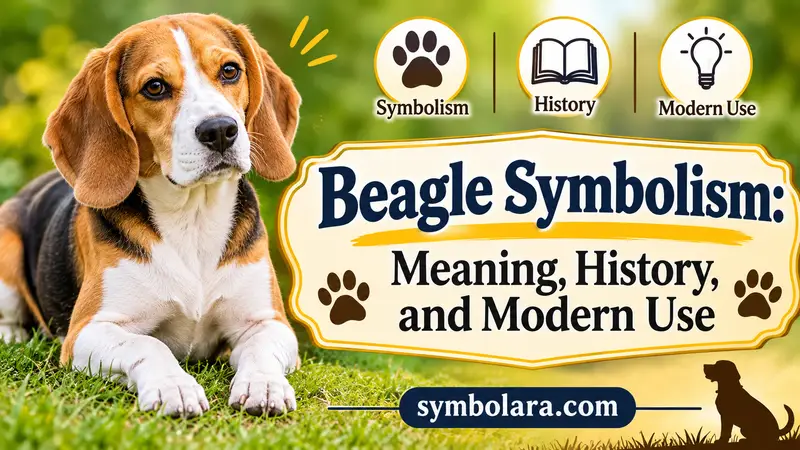
A beagle is easy to recognize by its long, soft ears, short coat, sturdy body, and curious expression. Known for its excellent sense of smell and friendly nature, this small hound has spent generations working alongside hunters and living as a family pet.
When people look up beagle symbolism, they are often interested in what this dog represents beyond its appearance. Its cheerful personality, loyalty, curiosity, and strong connection with people have given it several familiar meanings.
In American culture, the beagle is often associated with friendship, family life, happiness, exploration, and staying curious. Its appearance in children’s stories, cartoons, advertisements, and family homes has also helped shape its public image.
Quick Answer
Beagle symbolism most commonly represents loyalty, friendship, curiosity, happiness, and companionship. These associations developed from the breed’s history as a social hunting hound and its later role as a beloved household pet.
TL;DR
- Beagles commonly represent friendship, loyalty, and companionship.
- Their hunting background connects them with curiosity and determination.
- Their friendly personality makes them familiar symbols of family happiness.
- Snoopy helped establish the beagle as a recognizable American cultural figure.
- Their nose and tracking instincts represent exploration and persistence.
- Modern designs often use beagles to express affection for dogs and family pets.
What Does a Beagle Look Like, and Why Does Its Appearance Matter?
A beagle is a small-to-medium-sized scent hound with a compact body, broad head, floppy ears, and a short, weather-resistant coat. Its eyes often have a gentle, slightly pleading expression, which contributes to its reputation as an approachable and friendly dog.
The breed commonly appears in three colors:
- Tricolor: Black, white, and tan markings.
- Red and white: Warm reddish patches combined with white.
- Lemon and white: Pale yellow or golden markings with white.
Its long ears are more than a recognizable feature. They help direct scents toward its nose when it follows a trail. Its nose is especially important because beagles were developed to track animals by smell.
These physical qualities influence how people interpret the breed. Its soft ears and expressive eyes suggest affection and approachability, while its alert posture and nose-down tracking behavior suggest curiosity and determination.
Unlike dogs often portrayed as intimidating guardians, beagles are commonly shown as approachable companions. Their appearance supports associations with warmth, playfulness, and family life.
What Does a Beagle Represent in Modern American Culture?
In the United States, the breed is most commonly connected with positive ideas about relationships and everyday happiness. However, different people may focus on different qualities depending on their experiences.
Loyalty and friendship
Beagles are social dogs that generally enjoy spending time with people and other dogs. Their friendly nature makes them familiar representations of dependable friendship.
A beagle appearing in a family photograph, for example, may represent years of shared experiences rather than simply a love of animals.
Curiosity and exploration
Their ability to follow scents makes them natural symbols of investigation. A beagle sniffing a trail can represent someone who enjoys discovering new places, asking questions, and following their interests.
Happiness and playfulness
Their energetic behavior, expressive faces, and enthusiasm for outdoor activities connect them with uncomplicated enjoyment.
Family and belonging
Beagles frequently appear in American household settings. For many owners, they represent the comfort of having a familiar companion waiting at home.
Determination
A beagle following a scent can remain focused even when the trail becomes difficult. This behavior gives the breed an association with persistence and commitment.
These meanings are cultural interpretations, not fixed rules. A person who grew up with a beagle may associate the dog with a particular family member or childhood memory instead.
Where Did the Historical Meaning of Beagles Come From?
The breed’s history helps explain why it became associated with companionship, determination, and exploration.
Small scent hounds existed in Britain long before the modern beagle was standardized. Historical accounts describe dogs used to follow rabbits and other small game, although the exact ancestry of today’s breed is not completely settled.
The name beagle is also debated. Some explanations connect it to the French word begueule, referring to an open or noisy mouth. Other possible origins have been suggested, so no single explanation should be treated as certain.
During the Middle Ages and later centuries, small hunting hounds were valued for their ability to track game. Their size made them useful in hunting situations where larger hounds were less practical.
By the 18th and 19th centuries, recognizable beagle types were established in Britain. Breeders gradually developed more consistent traits, including body size, appearance, and scent-tracking ability.
The breed’s hunting role created several associations:
- Persistence: Following a scent over long distances.
- Awareness: Detecting and investigating unfamiliar smells.
- Cooperation: Working with other hounds during hunts.
- Reliability: Performing a specific task alongside human handlers.
These working qualities later became part of the breed’s public identity.
As beagles increasingly entered private homes, their reputation expanded beyond hunting. People began appreciating their companionship, social nature, and suitability for family life.
Why Are Beagles So Recognizable in American Popular Culture?
One of the biggest reasons Americans recognize beagles is Snoopy, the fictional dog from Charles M. Schulz’s Peanuts comic strip.
Snoopy first appeared in the comic strip in October 1950. Although he is not always presented as a realistic example of beagle behavior, he is widely identified as a beagle and has become one of the best-known cartoon dogs in American popular culture.
Snoopy helped connect the breed with several ideas:
- Imagination: His daydreams and fantasy adventures make him a symbol of creativity.
- Individuality: His unusual personality shows that being different can be enjoyable.
- Friendship: His relationship with Woodstock represents companionship across differences.
- Humor: His expressions and playful behavior make him a familiar source of comedy.
The popularity of Peanuts also helped make the beagle recognizable to people who had never owned one.
In American advertising, children’s products, holiday decorations, and illustrated merchandise, beagles often appear as cheerful and approachable characters. Their familiar appearance makes them easy to use in designs that communicate friendliness.
What Does a Beagle Symbolize in Family Life?
For many American households, a beagle represents the everyday experience of having a dog as part of the family.
Its social personality and interest in human company make it a familiar companion in homes with adults, children, and other pets. Individual temperaments differ, but the breed is generally known for enjoying interaction.
A beagle sleeping near the family sofa, waiting beside the kitchen, or following someone around the backyard can become a reminder of ordinary moments that make a household feel like home.
This association is particularly noticeable in family photographs and personalized gifts.
For example, a framed illustration of a beagle wearing a red collar may represent a childhood pet. A Christmas ornament shaped like a beagle may remind someone of a dog that participated in family celebrations for years.
The meaning is often personal rather than universal. For one person, the dog represents childhood security. For another, it represents the responsibility and happiness of caring for a pet.
How Does Beagle Symbolism Connect With Curiosity and Exploration?
A beagle’s nose is central to its identity. Unlike dogs bred mainly for guarding or herding, beagles are scent hounds developed to locate and follow smells.
Their tracking instincts give them a natural connection with curiosity and discovery.
When a beagle encounters an unfamiliar object, it may spend considerable time investigating it. A new smell can become more interesting than whatever activity was happening moments earlier.
This behavior inspires several common interpretations:
Following your own path: A beagle tracking a scent can represent the willingness to investigate personal interests instead of automatically following others.
Learning through discovery: Its habit of examining unfamiliar surroundings can represent curiosity, education, and experience.
Paying attention: The breed’s ability to notice scents that people cannot detect can serve as a reminder that important details are not always immediately visible.
Enjoying the journey: A dog following a trail is not necessarily concerned with reaching a destination quickly. The act of exploring is part of the experience.
A beagle image used on a travel journal, for example, may communicate a love of outdoor adventures. On a notebook or school bag, it may represent curiosity and learning.
What Do Beagles Represent in Tattoos and Personal Jewelry?
Beagle tattoos are often chosen by people who have owned the breed or formed a strong emotional connection with an individual dog.
Unlike general dog tattoos, a beagle portrait can preserve specific details such as ear shape, facial markings, coat colors, and a familiar expression.
Common design choices include:
- Realistic beagle portraits: Represent affection for a particular dog.
- Paw prints: Express the lasting place a pet holds in someone’s life.
- Small beagle outlines: Communicate a personal connection through a simple design.
- Heart and dog combinations: Often represent love, remembrance, or gratitude.
- Beagles with names and dates: Preserve the memory of a family pet.
Jewelry can communicate similar feelings. A small beagle pendant, charm bracelet, or engraved tag may remind its owner of a companion.
Memorial designs sometimes include a dog’s birth and death dates, a paw print, or a short phrase. These details shift the meaning from general friendship toward remembrance.
A beagle tattoo does not automatically mean that someone values loyalty or curiosity. The most accurate interpretation usually comes from the person’s own reason for choosing it.
Why Are Beagles Associated With Loyalty and Friendship?
Beagles have a long history of working in groups. Traditional hunting often involved several hounds following a trail together, with human handlers guiding the activity.
This background contributes to their association with cooperation and social connection.
Modern beagles are also generally social animals. Many enjoy playing with other dogs and spending time with familiar people. They may become uncomfortable when left alone for long periods, although individual behavior varies.
These characteristics help explain why people connect the breed with friendship.
A beagle sitting beside another dog in an illustration can represent companionship. Two beagles playing together may suggest cooperation, shared enjoyment, and belonging.
The association with loyalty is also shaped by personal experience. Owners often remember their dogs greeting them at the door, following them around the house, or resting nearby while they work.
However, loyalty should not be confused with perfect obedience. Beagles can become distracted by interesting smells, and their independent tracking instincts sometimes make training challenging.
Their companionship is often expressed through social behavior rather than constant obedience.
What Does a Beagle Mean in Dreams?
Seeing a beagle in a dream does not have one scientifically established meaning. Dream interpretations depend on personal experiences, emotions, memories, and the events surrounding the dream.
Still, people often use the breed’s familiar characteristics to think about what a dream might represent.
Dreaming of a friendly beagle
A friendly dog may reflect a desire for companionship, affection, or a more comfortable social environment. It may also remind someone of a real pet or a positive childhood experience.
Dreaming of a beagle following a scent
This image may connect with a personal search, unanswered question, or interest that has recently occupied the dreamer’s attention.
Dreaming of a lost beagle
A lost dog may bring up feelings about separation, responsibility, or concern for someone important. The interpretation depends heavily on whether the dream feels frightening or simply confusing.
Dreaming of playing with a beagle
This situation may reflect a wish for relaxation, recreation, or more enjoyable time with friends and family.
Psychologists do not treat a particular dog breed as having a universal dream message. A beagle in a dream may simply reflect a dog the person recently saw, a childhood pet, or an image encountered during the day.
The dreamer’s feelings and personal associations are more useful than a fixed symbolic definition.
How Does a Beagle’s Hunting Background Shape Its Meaning?
The working history of the breed remains an important part of its identity, even though many modern beagles live entirely as companion animals.
Beagles were developed to track small game, especially rabbits and hares. Their strong sense of smell and ability to follow a trail made them useful to hunters.
This history gives the breed a different set of associations from those connected with dogs primarily developed for protection or livestock work.
| Context | Meaning in USA | Common Associations | Notes |
| Hunting imagery | Determination and tracking | Focus, patience, outdoor skills | Reflects the breed’s original working role |
| Family photographs | Love and belonging | Childhood, home, shared memories | Often connected with a particular pet |
| Cartoon characters | Humor and imagination | Snoopy, creativity, friendship | Influenced by American entertainment |
| Memorial jewelry | Remembrance and affection | Paw prints, names, dates | Usually represents an individual dog |
| Outdoor artwork | Curiosity and discovery | Trails, forests, nature | Highlights scent-tracking instincts |
The breed’s ability to work with other hounds also supports its connection with teamwork. A group of beagles following a trail is an example of animals working toward a shared goal.
There is another side to this history. Scent hounds can become so focused on an interesting trail that they pay less attention to nearby distractions. This is why responsible owners often use secure fencing and leashes.
Their independence is part of their working design, not evidence that they cannot form close relationships with people.
Are Beagles Positive or Negative Symbols?
Beagles are generally viewed positively in American culture. Their friendly appearance and familiar role as household pets make them more likely to represent affection, happiness, and companionship than fear or danger.
However, some interpretations focus on less convenient characteristics.
Positive associations include:
- Friendship and social connection.
- Loyalty and emotional companionship.
- Curiosity and willingness to discover.
- Persistence when following a goal.
- Family memories and affection.
Less favorable associations may include:
- Stubbornness during training.
- Distraction by unfamiliar smells.
- Excessive barking or howling.
- Food-seeking behavior.
- Difficulty staying focused around interesting scents.
These less favorable qualities are usually connected with real experiences of owning the breed rather than traditional negative symbolism.
For example, someone who has lived with a beagle may jokingly use its image to represent stubbornness or a dog that always wants a snack.
Such humor does not make the breed a negative symbol. It simply reflects the difference between an idealized image of a pet and the everyday work of caring for one.
How Has Beagle Symbolism Changed Over Time?
The public image of the breed has developed as its role in society has changed.
Before the 19th century: Hunting and practical work
Small hounds were valued for tracking game. Their identity was closely connected with hunting, scent detection, and cooperation with handlers.
19th century: A more recognizable breed
British breeding efforts helped establish more consistent beagle characteristics. The breed’s identity became easier to distinguish from other small hunting hounds.
Late 19th and early 20th centuries: Recognition and wider interest
The American Kennel Club registered its first beagle in 1885. This helped establish the breed within organized American dog culture.
As dog shows, breed clubs, and household pet ownership became more familiar, the beagle developed a public identity beyond its hunting role.
1950s onward: Popular entertainment
The arrival of Snoopy in Peanuts in 1950 introduced a beagle-inspired character to a broad American audience. His imagination, humor, and friendship with Woodstock added new associations to the breed’s public image.
Late 20th century: Family companion
The beagle became increasingly familiar as a household pet. Family photographs, children’s books, television, and pet-related merchandise reinforced its connection with home life.
2025–2026: Personal identity and pet remembrance
Today, beagle imagery appears in customized products, pet portraits, social media accounts, clothing, and memorial keepsakes.
People are increasingly likely to choose a particular breed’s image because it represents their own dog rather than because they follow a traditional symbolic system.
The main change is clear: the beagle moved from being recognized primarily as a working hunting hound to becoming a familiar companion and cultural character.
What Do Beagles Represent in American Holidays and Seasonal Decorations?
Beagles are commonly used in American seasonal merchandise because their appearance works well in friendly, family-oriented designs.
Christmas is one of the clearest examples. Beagle-shaped ornaments, stockings, wrapping paper, and holiday sweaters are popular choices among dog owners.
A beagle wearing a Santa hat may represent the enjoyment of including pets in family celebrations. An ornament featuring a dog’s name can become a yearly reminder of a much-loved companion.
Other seasonal uses include:
- Halloween: Beagles dressed as pumpkins, superheroes, or other characters represent playfulness and humor.
- Valentine’s Day: Heart-shaped beagle illustrations often communicate affection for pets.
- Thanksgiving: Family-themed dog decorations can represent belonging and gratitude.
- National Dog Day: Beagle photographs and illustrations celebrate pet ownership and animal companionship.
These uses do not come from an established historical tradition specific to the breed. They are modern expressions of the close relationship between Americans and their pets.
Common Misunderstandings About Beagle Symbolism
Several assumptions can make the breed’s cultural meaning seem more complicated than it really is.
Misunderstanding 1: Beagles always represent loyalty.
Loyalty is a common interpretation, but not everyone associates the breed with the same qualities. A former hunting-dog owner may think first about tracking ability, while a family may associate it with childhood memories.
Misunderstanding 2: Snoopy represents every real beagle.
Snoopy is a fictional character. His personality was created for entertainment and should not be treated as an accurate description of every dog’s temperament.
Misunderstanding 3: A beagle appearing in a dream predicts something.
There is no scientific evidence that dreaming about this breed predicts future events. Personal memories and emotions offer more reasonable starting points for interpretation.
Misunderstanding 4: Beagles have one universal cultural meaning.
Their associations depend on location, personal experience, and context. The breed’s British hunting background and American entertainment history are important, but neither defines every interpretation.
Misunderstanding 5: A beagle’s independence means it is unfriendly.
Following scents and becoming distracted are natural behaviors for a scent hound. They do not mean that the dog cannot enjoy close relationships with people.
Understanding these differences helps separate documented breed history from modern personal interpretations.
FAQs
Is a beagle a symbol of good luck?
A beagle is not traditionally recognized as a widespread good-luck symbol in American folklore. However, someone may associate the dog with good memories, happy family experiences, or a positive period in life.
What does a beagle symbolize in a relationship?
In a relationship, a beagle can represent friendship, shared responsibility, affection, and enjoying everyday experiences together. Couples who own one may also see the dog as a reminder of their shared home and life.
Does a beagle have a spiritual meaning?
There is no single established spiritual meaning for the breed across religions or spiritual traditions. Some individuals personally connect its curiosity, companionship, and persistence with their own beliefs about life and personal growth.
Why is Snoopy associated with beagle symbolism?
Snoopy is identified as a beagle and became a major cultural figure through Charles M. Schulz’s Peanuts. His imaginative adventures and friendship with Woodstock helped connect the breed with humor, creativity, and individuality.
What does a white beagle symbolize?
A white beagle does not have a widely documented traditional meaning separate from other beagles. In personal artwork, white coloring may be chosen for its visual appearance or because it matches a particular pet.
What does it mean when a beagle follows you?
In everyday life, a beagle following someone may reflect social interest, curiosity, food motivation, or a desire for attention. Symbolically, people may interpret the behavior as companionship or a close personal connection, but the dog’s actual reason depends on the situation.
Conclusion
Beagle symbolism is mainly connected with friendship, loyalty, curiosity, persistence, and family companionship. These associations developed from the breed’s history as a British scent hound and its later popularity as a household pet.
American popular culture also played an important role. Snoopy introduced generations of readers to a fictional beagle whose imagination and humor helped shape the breed’s familiar public image.
Today, beagle symbolism often carries a personal meaning. It may appear in a tattoo honoring a childhood pet, a Christmas ornament displayed every year, or a family photograph that preserves a favorite memory. Sometimes, the most meaningful part of a symbol is simply the individual dog behind it.