
Goat horns symbolism can seem contradictory at first. The same curved horns may suggest strength, independence, fertility, abundance, wilderness, rebellion, or occult imagery depending on where they appear and what other symbols surround them.
That range did not develop from one tradition. Humans have lived closely with goats for roughly 10,000 years, and horned animals appeared in religion, mythology, ritual objects, farming life, and art across many societies. Their horns were noticeable physical features as well as practical tools of defense and competition.
In the United States today, goat horns remain visually striking because they can communicate either rugged natural strength or something deliberately unconventional. A horned goat in a farm logo, for example, carries a very different message from a goat skull inside a pentagram.
Quick Answer
Goat horns symbolism commonly represents strength, determination, independence, resilience, and untamed nature in modern American culture. Historically, goat and wild-goat imagery has also been connected with fertility, abundance, divinity, pastoral life, and, much later, occult or demonic imagery.
TL;DR
- Goat horns commonly suggest strength, toughness, independence, and determination.
- Ancient goat imagery sometimes represented fertility, renewal, and divine status.
- Greek traditions connected a goat’s horn with abundance and plenty.
- Later European art helped associate goatlike features with the Devil.
- Tattoos often use horns for resilience, rebellion, or unconventional identity.
- Context determines whether the symbol feels positive, neutral, or threatening.
What Goat Horns Look Like and Why Their Shape Matters
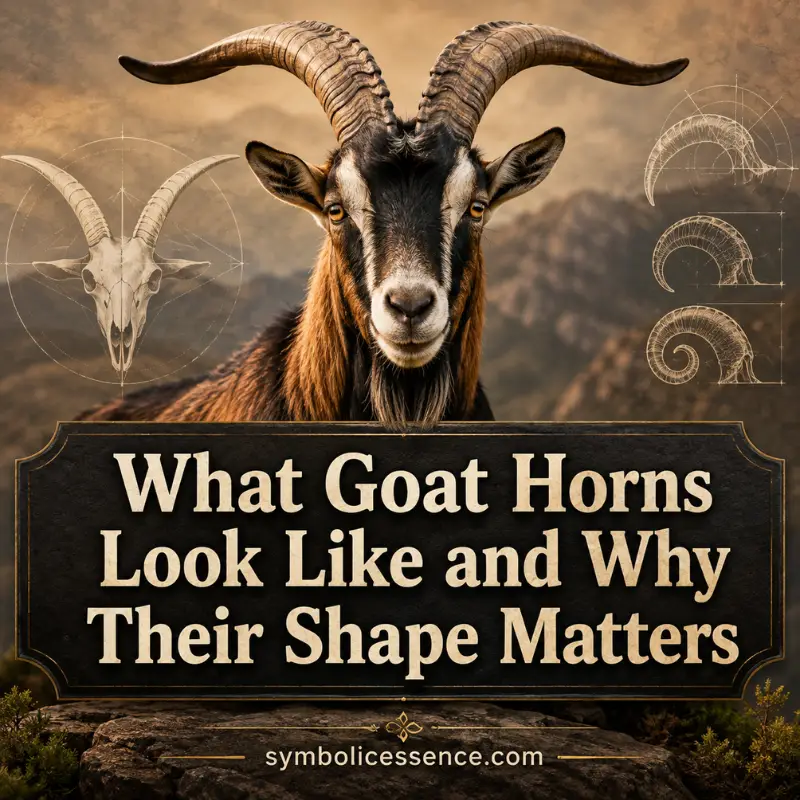
Goat horns are permanent structures rather than annually shed antlers. They grow from the skull and typically have a hard outer covering of keratin around a living bony core.
Their appearance varies considerably. Some sweep backward in smooth curves, while others twist outward or form dramatic spirals. Wild goats such as ibexes can have especially long, ridged horns that make the animal’s profile immediately recognizable.
That physical shape contributes directly to the symbolism.
A pair of horns rising above the head increases an animal’s apparent size. Their pointed form looks defensive, while their symmetry can resemble a natural crown. Large curling horns also visually suggest age and endurance because they grow over time.
As a result, people did not have to invent the connection between horns and strength entirely from imagination. The symbolic meaning developed partly from watching how horned animals actually behaved.
What Goat Horns Commonly Mean in the United States
Modern American interpretations tend to fall into several broad groups.
Strength is one of the clearest. Horns function as natural weapons and visible signs of physical capability.
Determination comes from the goat’s broader reputation for persistence. Mountain goats and wild ibexes navigating steep terrain strengthen the image of an animal that keeps moving where others might struggle.
Independence is another common reading. Goats are often imagined as stubborn, self-directed, and difficult to control. In personal symbolism, that can become a positive statement about refusing to follow expectations.
Wildness appears when horns are paired with forests, mountains, skulls, vines, or other nature imagery.
There is also a darker interpretation. Horned goat heads can evoke Satan, Baphomet, witchcraft, or occult aesthetics for many American viewers. That association is culturally influential, but it represents only one chapter in a much longer history.
Why Horns Became Symbols of Strength and Status
The connection between horns and dominance has a biological foundation.
Goats use head butting, pushing, threatening movements, and horn-to-horn contests when establishing social relationships. Among wild and feral goats, larger horns can be associated with higher social position, particularly among males.
To an early observer, therefore, prominent horns could visibly communicate an animal’s ability to defend itself or challenge a rival.
This helps explain why horns became useful artistic shorthand for authority. A person wearing horns or a horned crown could symbolically borrow the animal’s physical qualities without literally becoming the animal.
The idea extended far beyond goats. Bulls, rams, antelope, and other horned animals also contributed to the ancient symbolic vocabulary of horns.
That distinction matters. Not every historical image of a horned god represents goat horns specifically. Sometimes horns simply indicated supernatural status, power, or a connection with a particular animal.
Ancient Near Eastern Roots: Fertility, Renewal, and Divinity
Goats were among the earliest livestock managed by humans, with domestication beginning in western Asia around 10,000 years ago. Their usefulness made them closely connected with human survival.
They supplied meat, milk, hides, hair, and other materials while being capable of living in terrain unsuitable for some larger livestock. That practical relationship helped goats enter early visual culture.
Goats and wild ibexes appear repeatedly in ancient Near Eastern art. Some images place them near plants or stylized sacred trees, creating associations with fertility, vegetation, and renewal. Their ability to survive in rocky mountain environments also made wild goats recognizable emblems of rugged terrain.
Horns had another important role in Mesopotamian art: horned headdresses could identify gods. Multiple tiers of horns might indicate especially elevated divine status.
These divine crowns should not automatically be interpreted as literal goat horns. They belong to a broader ancient language in which horns signaled supernatural rank.
This is one reason modern claims that horns have always represented evil are historically inaccurate. In some of the world’s earliest complex artistic traditions, horns could communicate precisely the opposite: sacred authority.
Greek Myth Connected Goat Horns With Nature and Abundance
Ancient Greek traditions added two especially influential associations: wilderness and abundance.
Pan, the rustic Greek god associated with shepherds, flocks, rural places, music, and fertility, was represented with goatlike characteristics, including horns. Through Pan and related satyr imagery, goat features became connected with instinct, sexuality, pastoral landscapes, and a world outside orderly city life.
That association eventually became important in later European imagery, although the Greeks themselves were not simply depicting Pan as a Christian Devil. That interpretation developed much later.
A second Greek tradition gave the goat horn a more generous meaning.
Stories about the infant Zeus and his nurse Amalthea developed different versions, but one influential tradition involved the horn of a goat that became a source of inexhaustible provision. From this mythology emerged the cornucopia, or horn of plenty.
Filled with fruit, grain, and flowers, the cornucopia became a durable Western symbol of prosperity and abundance.
Americans still encounter the horn of plenty most often around Thanksgiving. Although modern cornucopias rarely make people think directly about goats, their curved horn form preserves an ancient connection between animal horns and plentiful resources.
Biblical and Jewish Traditions Require an Important Distinction
Goats appear prominently in the Hebrew Bible, but the symbolism of the animal should not automatically be assigned to its horns.
One of the best-known examples comes from the Day of Atonement ritual described in Leviticus. Two goats had different ritual roles, including the goat sent into the wilderness after the community’s wrongdoings were confessed over it.
That tradition eventually contributed to the English concept of a scapegoat: someone made to carry blame.
The central symbol in this ritual is the goat’s role in removal and atonement, not the shape of its horns.
This distinction prevents a common mistake. It is easy to collect every religious meaning involving goats and label all of them “goat horn meanings.” Historically, symbolism is usually more precise than that.
Biblical goat imagery also should not be reduced to “goat equals Satan.” Later Christian art played a much larger role in establishing that visual connection.
How Goat Horns Became Associated With the Devil
The familiar horned Devil of Western popular culture was not created from a single biblical description.
Christian artists gradually developed visual ways of representing demons and Satan. Medieval and early modern images often combined human anatomy with animal characteristics such as horns, tails, claws, wings, fur, or cloven feet.
These features emphasized a creature outside the perceived order of civilized human life.
Goatlike imagery was especially useful because earlier Greco-Roman figures such as Pan and satyrs already combined human and caprine characteristics. Their associations with sexuality, instinct, and uncontrolled nature could be reinterpreted negatively in a Christian cultural environment.
By the early modern period, European art could portray demons with unmistakably goatlike heads or horns.
The result was a major symbolic reversal. Features that had once belonged to pastoral gods, fertility imagery, or animals admired for their toughness became available as visual markers of temptation, disorder, or evil.
That later development strongly influences how Americans still respond to horned goat imagery.
Baphomet Strengthened the Modern Occult Association
Another major shift occurred in the nineteenth century.
The name Baphomet existed centuries earlier in connection with accusations made against the Knights Templar, but the famous goat-headed image people recognize today came much later.
French occult writer Éliphas Lévi created an influential nineteenth-century depiction of Baphomet as a winged, goat-headed humanoid containing deliberately contrasting elements. The figure was intended as a complex esoteric composition rather than merely a portrait of a conventional Christian Devil.
Over time, however, Baphomet became increasingly blended with Satanic imagery in popular culture.
That connection became especially visible in the United States through occult literature, horror entertainment, heavy metal aesthetics, tattoos, political controversies involving religious displays, and modern Satanic iconography.
Consequently, a goat head with dramatic horns may be read as occult even when the artist intended something entirely different.
How Americans Read Goat Horns in Different Contexts
The surrounding image usually tells viewers which meaning matters most.
| Context | Meaning in the USA | Common Associations | Notes |
|---|---|---|---|
| Living goat | Strength and independence | Farming, toughness, personality | Usually neutral or positive |
| Mountain goat or ibex | Resilience and endurance | Mountains, survival, adventure | Strong nature symbolism |
| Horn of plenty | Abundance | Harvest, Thanksgiving, prosperity | Historically positive |
| Goat skull with horns | Mortality or wildness | Gothic art, desert imagery, tattoos | Meaning varies widely |
| Goat head with occult symbols | Rebellion or esotericism | Baphomet, Satanism, heavy metal | Strongly context-dependent |
A symbol therefore cannot be interpreted reliably from the horns alone.
Flowers surrounding goat horns may emphasize nature and renewal. Mountains can shift the meaning toward perseverance. A skull adds mortality. A pentagram can produce an occult reading.
Visual context functions almost like grammar: it tells the viewer how individual symbolic elements relate to one another.
Why Goat Horns Appear in Tattoos
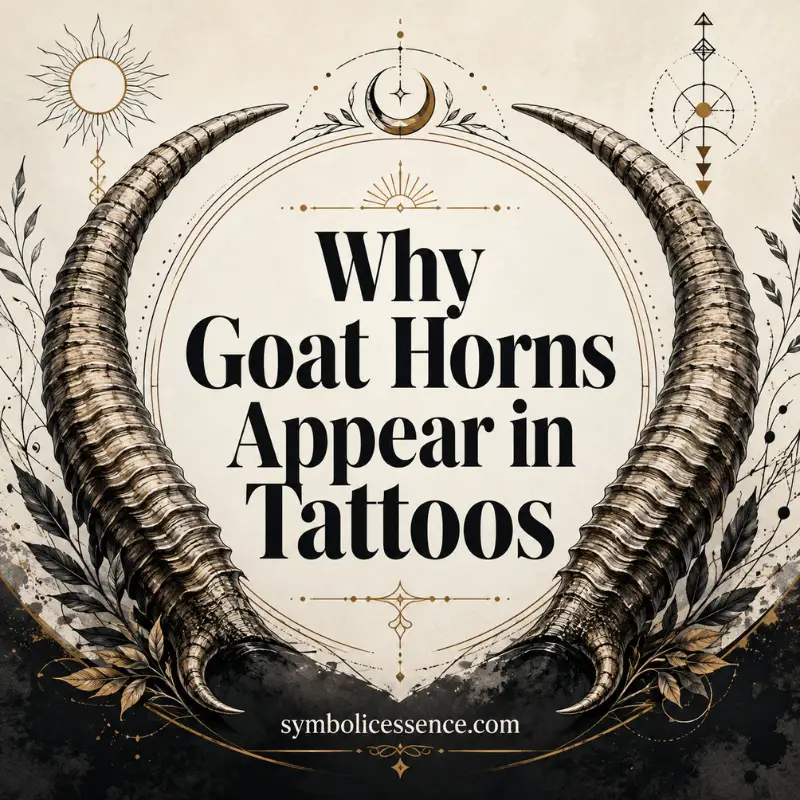
Goat horns work especially well in tattoo design because their curves create a bold, symmetrical silhouette.
Some people choose them as symbols of resilience. A mountain goat or ibex can represent surviving difficult conditions, maintaining balance, or continuing upward despite obstacles.
Others prefer the meaning of independence. In that context, the goat becomes an animal that follows its own path rather than accepting easy control.
A goat skull may communicate something different. It can represent mortality, acceptance of death, wilderness, transformation, or attraction to macabre art.
Occult-style goat tattoos can deliberately express religious dissent, individualism, anti-authoritarian identity, or an interest in esoteric traditions. Yet visual similarity does not prove a person’s beliefs.
A horned goat tattoo should therefore be interpreted from the complete design—and ideally from the wearer’s own explanation.
Jewelry, Decor, Fashion, and Digital Culture
Goat horns have moved far beyond formal religious imagery.
In jewelry, simplified horn shapes can suggest protection, nature, strength, or alternative spirituality. Some pieces draw from historical animal-horn amulets, while others are simply designed for their curved form.
Interior decor uses goat skulls and horns in several overlapping aesthetics. Rustic spaces may treat them as natural-history or pastoral objects. Gothic and dark-academia-inspired interiors can use the same forms because of their association with mortality and the uncanny.
Fashion and album artwork often push the imagery further toward rebellion. Horned silhouettes work naturally with heavy metal, horror, fantasy, and occult-influenced design.
On social media, context can become even less stable. The same goat-horn graphic may be used for a fantasy character, Capricorn-inspired design, Halloween artwork, band logo, tattoo concept, gaming avatar, or joke.
Modern digital culture has therefore made goat-horn imagery more visible while making its meaning less predictable.
Emotional and Psychological Meaning
Symbols work partly because their physical features create emotional impressions before viewers consciously interpret them.
Upward-pointing horns can communicate confidence or confrontation. Large symmetrical horns make a figure appear imposing. Curved horns suggest controlled strength rather than random shape, while sharp tips introduce an element of danger.
For someone choosing the image personally, these features may communicate:
- refusal to be intimidated
- self-reliance
- survival after hardship
- confidence in being unconventional
- closeness to wild landscapes
- resistance to social expectations
The same qualities can become negative when viewed from another perspective. Determination may look like stubbornness. Independence may become defiance. Wildness can become disorder.
This ambiguity is one reason the image remains useful. Goat horns can express an identity that is deliberately difficult to reduce to “good” or “bad.”
How the Meaning Changed Over Time
There is no single historical progression in which goat horns began with one meaning and gradually acquired another.
Instead, several traditions developed alongside one another.
Early farming communities lived closely with goats as valuable livestock. Ancient West Asian artists used goats and ibexes in contexts involving fertility, landscape, ritual, and identity. Horned crowns could signal divinity. Greek traditions connected goat imagery with pastoral nature while the horn of Amalthea contributed to the language of abundance.
Christian Europe later gave horned animal features an increasingly demonic visual role. Nineteenth-century occultism added Baphomet’s influential goat-headed form. Modern entertainment, tattoo culture, alternative fashion, and digital media then mixed those traditions together.
This history explains why modern interpretations can clash.
Someone may see perseverance where another person sees paganism. One viewer may see abundance, while another immediately thinks of the Devil.
Neither response proves that horns have one universal definition. Symbols acquire meaning from historical tradition, cultural setting, surrounding imagery, and personal intention.
FAQs
Are goat horns a positive or negative symbol?
They can be either, but strength, determination, resilience, independence, and abundance are all established positive interpretations. Negative readings usually emerge when goat horns appear with demonic, threatening, or explicitly occult imagery.
What do goat horns mean in a tattoo?
A goat-horn tattoo often represents toughness, persistence, independence, wilderness, or rebellion. A goat skull, mountain goat, Baphomet figure, and realistic farm goat can carry very different meanings even though all include horns.
Do goat horns always represent Satan?
No. Horn symbolism existed thousands of years before the familiar Western image of a horned Devil developed. Ancient horn imagery could signify divinity, fertility, power, landscape identity, or abundance.
What do goat horns symbolize spiritually?
Depending on the tradition, they may suggest natural strength, fertility, untamed nature, divine authority, or esoteric ideas. There is no universal spiritual interpretation shared by all religions or cultures.
Why are goat horns associated with strength?
The association partly reflects real goat behavior. Horns are used during competitive encounters, and prominent horns can contribute to social dominance, making them a natural visual metaphor for physical confidence and defensive power.
What is the connection between goat horns and abundance?
Greek mythology connected the horn of the goat associated with Amalthea to inexhaustible provision. That tradition helped produce the cornucopia, or “horn of plenty,” which remains an American symbol of harvest and abundance.
Are goat horns and ram horns symbolically the same?
Not exactly. Their meanings overlap because both animals have prominent horns, but rams have their own traditions involving Aries, male sheep, sacrifice, and head-to-head combat. Identifying the animal correctly produces a more accurate interpretation.
Conclusion
The symbolism of goat horns grew from thousands of years of human observation, farming, art, mythology, and religious reinterpretation. Their most durable meanings—strength, determination, independence, fertility, abundance, and wild nature—reflect both the physical characteristics of horned goats and the cultural roles humans gave them.
Later European and American imagery added associations with the Devil, Baphomet, rebellion, Gothic aesthetics, and occult identity. Those meanings are culturally important, but they should not erase the much older history of the symbol.
Ultimately, goat horns symbolism is best understood through context. The horns may communicate resilience on a mountain goat, prosperity through the horn of plenty, mortality on a skull, or deliberate defiance in occult-inspired art. The surrounding image tells us which part of that long symbolic history is being used.


