Last Updated: September 29, 2026
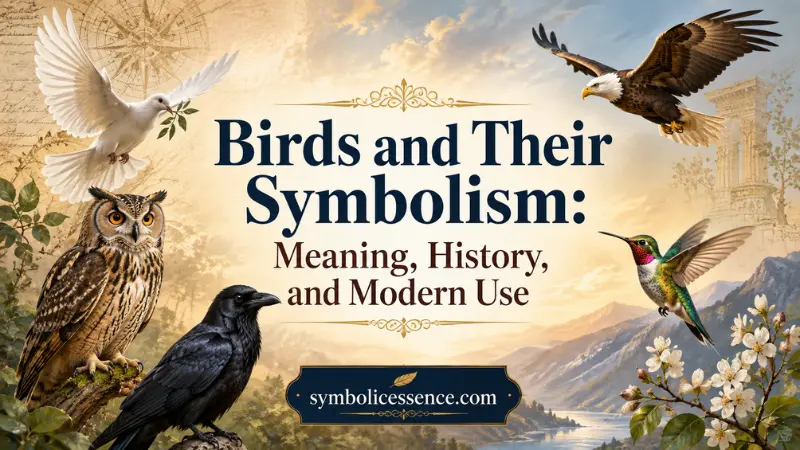
Birds occupy an unusual place in human imagination. We see them on national seals, religious art, tattoos, memorial cards, sports logos, jewelry, and holiday decorations. Because they fly above ordinary human reach, migrate across great distances, sing, build nests, and appear with the changing seasons, people have repeatedly connected birds with ideas larger than the animals themselves.
In modern American culture, birds and their symbolism can represent freedom, hope, peace, wisdom, independence, remembrance, communication, protection, or change. The exact meaning depends heavily on the species. A bald eagle sends a very different message from a dove, raven, owl, cardinal, or hummingbird.
Those differences matter. There is no single universal interpretation of a bird, and meanings that seem familiar in the United States may come from European art, Indigenous traditions, ancient religions, literature, popular folklore, or relatively recent cultural habits.
Quick Answer
Birds and their symbolism most commonly represent freedom, perspective, hope, and movement in modern American culture, largely because flight suggests release from physical limits. Historically, particular birds have also represented divinity, wisdom, peace, death, kingship, renewal, communication, and the passage between different realms of experience.
TL;DR
- Flight makes birds natural symbols of freedom and expanded perspective.
- Different species carry sharply different meanings.
- Ancient religions connected birds with gods, rulers, and the heavens.
- Americans strongly associate the bald eagle with national identity.
- Birds often appear in remembrance, tattoos, art, and personal symbolism.
- Cultural context matters more than any universal bird dictionary.
Why Birds Became Symbols in the First Place
Bird symbolism begins with characteristics people can actually observe.
Birds live on the ground but can suddenly rise into the air. To early societies, that ability naturally distinguished them from most familiar animals. The sky was also associated in many religions with gods, weather, celestial forces, or worlds beyond ordinary human life. Birds therefore became convenient images for communication between earth and sky.
Their behavior added other associations. Migratory species disappear and return, encouraging connections with seasons, absence, return, and renewal. Nesting birds suggest home, protection, and family. Songbirds can represent communication or joy, while predatory birds may suggest power, vigilance, or authority.
Humans also notice birds from a distance. A soaring hawk seems to view a landscape from a perspective unavailable to people on the ground. That physical reality helps explain why birds are often associated with vision, awareness, independence, and seeing beyond immediate problems.
The Core Meanings Birds Commonly Carry Today
Several broad ideas appear repeatedly in contemporary American bird imagery.
Freedom is probably the most familiar. An open-winged bird can imply escape, independence, unrestricted movement, or choosing one’s own direction.
Hope and renewal often come from birds associated with spring, sunrise, migration, or returning after winter.
Perspective develops from flight and height. Bird imagery may suggest looking at circumstances from a wider point of view.
Communication comes from bird calls, songs, messenger traditions, and the old idea of birds carrying information across distances.
Spirituality or transcendence appears when birds are used to represent the soul, heaven, prayer, divine presence, or experiences that seem to rise above ordinary life.
These meanings are broad frameworks rather than fixed definitions. Species usually provide the more precise interpretation.
Common Birds and What They Symbolize
| Bird | Common U.S. Meaning | Other Associations | Important Context |
|---|---|---|---|
| Bald eagle | Freedom and national identity | Strength, independence, authority | Central American civic symbol |
| Dove | Peace | Love, hope, faith, reconciliation | Strong religious and ceremonial associations |
| Owl | Wisdom | Knowledge, watchfulness, night | Can carry darker meanings elsewhere |
| Raven | Mystery and intelligence | Death, memory, prophecy | Strong literary and mythological history |
| Cardinal | Remembrance and affection | Vitality, winter, family | Memorial meaning is largely popular folklore |
| Hummingbird | Joy and resilience | Energy, adaptability, beauty | Common in jewelry and personal art |
These associations should not be treated as permanent rules. A raven in one cultural tradition may represent wisdom, while another tradition emphasizes death or prophecy. Even the same bird can hold opposite meanings at different times.
Ancient Roots of Bird Symbolism
Some of the oldest surviving religious art shows that birds were already connected with authority and divinity thousands of years ago.
In ancient Egypt, the falcon was strongly linked with Horus, a deity associated with kingship and the sky. Egyptian rulers used the imagery of Horus to reinforce ideas of legitimate and divinely protected rule. The ibis was associated with Thoth, who was connected with wisdom, writing, and learning.
Greek culture developed another association still familiar today: the owl with Athena. Athena was connected with wisdom and reason, and the owl appeared as one of her attributes, including on Athenian coinage. The relationship helped establish the owl as a recognizable emblem of learning in later Western culture.
These ancient examples reveal an important pattern. Bird symbolism was rarely based on appearance alone. Meaning developed through mythology, religious practice, political authority, observed behavior, and repeated artistic use.
Birds in Religious Symbolism
Birds appear frequently in religious stories and art because flight provides an intuitive visual language for heaven, divine communication, spirit, and transformation.
Within Christianity, the dove became particularly important. It is associated with the Holy Spirit and, more broadly in Western culture, with peace, purity, reconciliation, and hope. Dove imagery now extends far beyond explicitly religious settings and appears in memorials, peace campaigns, weddings, and visual art.
Early Christian art also used birds in ways that may surprise modern viewers. The peacock, for example, was associated with immortality, influenced partly by an ancient belief that its flesh did not decay. At the same time, the bird’s elaborate display could support an opposing association with pride or vanity.
This illustrates why religious bird imagery requires context. A bird does not automatically have one biblical or Christian meaning simply because someone encounters it in nature.
Birds in Native American Traditions
Discussions of Indigenous bird symbolism need particular care because hundreds of Native nations have distinct languages, histories, ceremonies, and beliefs. There is no single “Native American meaning” for an eagle, raven, owl, or any other bird.
Eagles do hold major ceremonial and religious importance within many tribal traditions. Eagle feathers may be connected with honor, prayer, ceremony, leadership, healing, or relationships with the sacred, depending on the specific nation and practice.
Their significance remains active rather than merely historical. U.S. federal law recognizes the religious and cultural importance of bald and golden eagle feathers to members of federally recognized tribes, while also regulating possession to protect eagle populations.
Because these traditions belong to living communities, reducing them to simplified claims such as “the eagle always means courage in Native culture” erases important differences. Tribal-specific information should be identified as such whenever possible.
What Birds Symbolize in the United States
The most important American example is the bald eagle.
The eagle has appeared on the Great Seal of the United States since 1782 and became closely identified with independence, sovereignty, national strength, and freedom. A notable recent development made that familiar symbolism legally explicit: on December 23, 2024, Public Law 118-206 formally designated the bald eagle as the national bird of the United States.
Bird imagery also operates at state and local levels. Cardinals, mockingbirds, bluebirds, robins, meadowlarks, and other species appear as state symbols, school mascots, community emblems, and regional identity markers.
Sports provide another highly visible example. Eagles, Falcons, Ravens, Hawks, Seahawks, Cardinals, and Orioles all appear in American team identities. Their meanings depend on the species: raptors communicate speed or strength, while ravens can imply intelligence and menace. The Baltimore Ravens, for example, also connect directly with Edgar Allan Poe and the city’s literary identity.
Birds as Symbols of Freedom and Independence
Few animal images communicate freedom as immediately as a bird in flight.
The meaning comes partly from the absence of visible boundaries. A flying bird can cross rivers, fences, roads, and other barriers that restrict people and terrestrial animals. For that reason, open wings frequently appear in tattoos and illustrations dealing with personal independence.
A bird leaving a cage intensifies the message. It can represent release from limitation, the end of a difficult period, emotional independence, or a decision to live differently.
However, freedom is not automatically the meaning of every bird image. A perched owl in a library logo is much more likely to represent learning. A pair of nesting birds may suggest partnership or home. The pose matters nearly as much as the species.
What Does a Flock of Birds Symbolize?
A flock of birds can symbolize community, cooperation, shared direction, freedom, and collective movement. Unlike a single bird, a group immediately shifts attention from individual independence toward relationships and belonging.
The direction and behavior of the flock can change the interpretation. Birds flying together may suggest a shared journey, common purpose, or moving through a major life transition with others. A flock resting together can emphasize safety, connection, or community.
Flocks can also represent change because many bird species travel together during migration. In symbolic art, this makes a group of birds a natural image for leaving one stage of life and entering another.
The number of birds may add personal meaning, too. Someone might choose three birds to represent family members, several birds to honor loved ones, or a large flock to represent a community or group. These interpretations are personal rather than universal symbolic rules.
A flock can therefore express an idea that a single flying bird cannot: freedom does not always mean being alone. It can also mean moving forward with people who share your path.
Birds as Symbols of Love, Partnership, and Home
Birds also carry domestic meanings because people regularly observe courtship, nesting, feeding, and pair behavior.
Two birds positioned together commonly represent partnership, affection, or marriage in contemporary design. Doves are especially popular for weddings because peace and devotion can combine naturally with romantic symbolism.
Swans are often used for romantic partnership, partly because of their paired visual appearance and the long cultural tendency to associate them with elegance and love. Cranes can carry marriage associations in East Asian art alongside their better-known connections with longevity and good fortune.
Nests add another layer. A nest with eggs or young birds usually emphasizes home, parenthood, protection, belonging, and a place where new life can develop.
Birds, Death, Grief, and Remembrance
Bird symbolism becomes especially personal around bereavement.
Doves may appear at funerals or memorial events because peace, release, and spiritual hope fit the emotional setting. Flying birds in memorial art can suggest departure while avoiding a literal image of death.
Ravens and crows occupy a darker part of the symbolic landscape. Their black plumage, scavenging behavior, intelligence, mythology, and appearance in literature have contributed to associations with death, warning, mystery, and the unknown. Edgar Allan Poe’s The Raven reinforced those associations strongly in American literary culture.
Cardinals have developed a different memorial role. Many Americans repeat the popular idea that seeing a cardinal represents a deceased loved one visiting or remaining nearby. That belief can provide comfort, but it is better understood as contemporary folk symbolism than as a scientifically verifiable event or a universal teaching of a specific religion.
Birds as Omens, Signs, and Messages
Bird encounters have often been interpreted as omens, messages, warnings, or signs of change. These interpretations appear in folklore, religious traditions, literature, and modern personal spirituality.
The idea partly comes from the way birds move through human surroundings. A bird can suddenly appear at a window, circle overhead, call from a nearby tree, or arrive during an emotionally important moment. Because the encounter feels unusual or well-timed, people may connect it with something happening in their lives.
Different traditions have assigned different meanings to particular birds. Ravens and crows can appear in stories about mystery, death, intelligence, or prophecy. Doves can suggest peace or hope. Eagles can represent authority, freedom, or spiritual significance. These meanings come from cultural traditions rather than from a universal system of bird messages.
Modern interpretations often become personal. Someone grieving may view a cardinal as a meaningful reminder of a loved one. Another person may see a bird appearing during a major transition as a symbol of moving forward.
It is useful to distinguish symbolic interpretation from factual evidence. A bird’s appearance does not scientifically prove that a supernatural message has been delivered. People can still find emotional or cultural meaning in the experience without treating the interpretation as an established fact.
The most useful questions are simple: What bird appeared? What was happening at the time? What does that bird represent in the relevant culture? And what meaning does the experience hold for the person involved?
What Do Birds Symbolize in Dreams?
Birds in dreams are often interpreted through themes such as freedom, ambition, change, communication, hope, or emotional release. However, dream symbolism does not have one universal dictionary, and the same bird can mean different things to different people.
A bird flying freely may suggest independence, movement, or the desire to escape a restriction. A bird inside a cage can create an opposite image, emphasizing limitation, frustration, or a situation that feels difficult to leave.
A flock may represent community, relationships, or a shared direction. A solitary bird may focus attention on independence, isolation, or an individual journey.
The species also matters. Dreaming about an eagle may evoke power or perspective, while an owl may bring associations with knowledge or mystery. A dove may suggest peace or reconciliation. These interpretations come from established cultural associations rather than from a universal psychological rule.
The dreamer’s emotions provide another important clue. A peaceful bird encounter may feel very different from a dream involving an attacking, injured, trapped, or dead bird.
For that reason, the most useful approach is to combine the bird, its behavior, the dream setting, and the emotions experienced during the dream rather than assigning one automatic meaning.
How Color Changes Bird Symbolism
Color can significantly change the emotional effect of bird imagery.
A white bird often suggests peace, innocence, purity, mourning, or spiritual release, particularly when the species is a dove.
A red bird, especially a male northern cardinal, can suggest vitality, warmth, love, courage, or remembrance. Its intense red plumage also makes it visually striking against winter landscapes.
A black bird may suggest mystery, intelligence, death, rebellion, or the unknown. Yet black coloration does not inherently make a bird negative. Ravens and crows are highly intelligent animals, and modern symbolism increasingly acknowledges cleverness and adaptability alongside darker associations.
Bright tropical birds can communicate beauty, abundance, confidence, or display, while subdued birds may suggest modesty or quietness. These meanings come from human color associations layered onto the species itself.
Bird Symbolism by Behavior and Appearance
Bird symbolism can change even when the species stays the same. What the bird is doing often matters as much as which bird appears.
A bird in flight commonly suggests freedom, movement, independence, or transition. A perched bird may create a calmer impression and can represent observation, patience, rest, or waiting.
Singing birds often connect with communication, happiness, celebration, or self-expression. Because birds use calls to communicate with one another, their songs have long provided a natural metaphor for speaking, sharing news, and expressing emotion.
Nesting birds usually emphasize home, family, protection, and belonging. Eggs can add themes of possibility, growth, or new beginnings, while young birds may suggest parenthood or development.
Migration creates another powerful symbolic image. A migrating bird can represent travel, seasonal change, returning home, adaptation, or moving from one stage of life to another.
Even an injured or grounded bird can change the emotional message. Instead of freedom, it may symbolize vulnerability, limitation, recovery, or the temporary loss of independence.
This is why a useful interpretation looks beyond the bird’s name. Species + behavior + setting + cultural context usually produces a more accurate reading than species alone.
Why Owls, Ravens, Eagles, and Doves Mean Different Things
The strongest bird symbols usually develop from a combination of real behavior and cultural storytelling.
Owls are active at night and have large forward-facing eyes. Their long association with Athena helped reinforce wisdom, making them familiar symbols for schools, books, libraries, and learning.
Ravens are intelligent, vocal, dark-colored birds with long mythological and literary histories. They therefore occupy an ambiguous symbolic position between wisdom and danger.
Eagles soar high, possess formidable hunting abilities, and have been repeatedly adopted by rulers and states. Those characteristics support associations with authority, power, vision, and independence.
Doves have a gentler appearance and extensive religious and artistic history. Their modern identity centers on peace, faith, reconciliation, and love.
The lesson is simple: “bird symbolism” becomes much more meaningful when the actual species is identified.
Birds in Tattoos and Jewelry
Bird tattoos allow people to combine traditional symbolism with personal biography.
A small flying bird may mark independence or a major transition. Multiple birds can represent relatives, children, friendships, or stages of life. Eagles may express patriotism or strength, while ravens can represent intelligence, grief, outsider identity, or an interest in mythology.
Hummingbirds are popular when the desired message is energetic and optimistic. Their rapid movement and ability to hover make them natural images for persistence, adaptability, and enjoying brief moments of beauty.
Feather jewelry has similarly broad meanings, but cultural context is important. A decorative feather inspired by general bird imagery is not the same thing as an eagle feather used within a specific Indigenous religious tradition.
What Does a Bird Feather Symbolize?
A bird feather commonly symbolizes freedom, protection, identity, communication, remembrance, and connection with nature. Its meaning depends on the bird, the cultural setting, and how the feather appears.
A feather separated from the bird can emphasize freedom or release. In jewelry and tattoos, it may represent independence, a new beginning, travel, or a personal connection with birds and the natural world.
Feathers can also carry memorial meanings. Someone may choose a feather design after losing a loved one because it can suggest remembrance without directly depicting death. In this setting, the symbol often expresses memory, comfort, or the feeling of carrying someone’s influence forward.
The bird species matters. An eagle feather, for example, can have profound ceremonial and cultural significance in specific Indigenous communities. That meaning should not be treated as interchangeable with a generic decorative feather.
Color can also change the message. A white feather may suggest peace or purity, while a dark feather may create associations with mystery, protection, or the unknown. These are common artistic interpretations rather than fixed meanings.
When interpreting a feather symbol, consider which bird it comes from, where the image appears, and what the person using it wants to communicate.
Birds in Decor, Fashion, and Digital Culture
Bird imagery works well in modern design because it can be recognizable without being literal.
Home decor often uses songbirds, cranes, swallows, or waterfowl to create associations with nature and calm. Eagle imagery tends to appear in patriotic, military, governmental, or traditional Americana settings.
Fashion uses birds differently. Peacocks and other elaborate species can communicate display, individuality, beauty, or luxury. Ravens and crows fit darker aesthetics associated with Gothic fashion and literary imagery.
On social media, bird meanings are even more flexible. A user may post a cardinal in memory of someone, a soaring eagle during a national holiday, or migrating geese to express travel and change. Digital culture often takes older symbolism and turns it into highly personal shorthand.
Cross-Cultural Bird Meanings
Bird symbolism changes dramatically outside the United States.
In East Asian traditions, cranes have long been associated with longevity, good fortune, and auspicious occasions. Their association with long life appears throughout Japanese and Chinese art, while paired cranes may also support themes of marriage or enduring partnership.
Ancient Egyptian culture associated particular birds with particular gods rather than treating all birds alike. Falcons could evoke Horus and kingship, while the ibis was sacred to Thoth and therefore connected with learning and scribal knowledge.
Norse stories connect ravens with Odin, while Persian literary traditions gave birds complex roles as messengers and participants in spiritual narratives.
These differences are useful reminders that a familiar American interpretation should not be projected onto every culture.
Common Misunderstandings About Bird Symbolism
One common mistake is assuming that every encounter with a bird has an established symbolic message. Cultural symbolism describes meanings humans have assigned to images and experiences; it does not prove that an individual bird appeared in order to deliver a message.
Another problem is treating internet symbolism lists as universal tradition. Statements such as “an owl always means wisdom” or “a raven means death” ignore cultures in which the same bird carries different or more complicated meanings.
Cultural appropriation can also become an issue when sacred imagery is separated from the community that gives it meaning. Eagle feathers are a particularly important American example because their significance within many Native communities is ceremonial, cultural, religious, and legally recognized rather than simply decorative.
The most reliable approach is to ask three questions: Which bird? Which culture? Which historical period?
How Bird Symbolism Has Changed Over Time
Bird meanings rarely disappear completely; they accumulate.
The owl’s classical association with Athena helped shape later Western ideas about wisdom. Christian traditions added particular meanings to doves, peacocks, and other birds. European literature gave ravens and crows stronger associations with darkness and mortality. American political culture transformed the bald eagle into one of the country’s most recognizable civic images.
Modern culture adds personal meanings on top of those older layers. A cardinal can become a memorial symbol. A flock tattoo can represent leaving home. An eagle can signify either national pride or personal independence. A raven can move from ominous folklore into an emblem of intelligence and unconventional identity.
Symbolism survives because people keep adapting it rather than preserving one unchanging definition.
FAQs
What do birds symbolize spiritually?
Birds are often used to represent transcendence, prayer, freedom, the soul, or communication between earthly and spiritual realms because they move between the ground and sky. The interpretation varies greatly between religions and cultures, so no single spiritual meaning applies to every bird.
Which bird most strongly symbolizes freedom?
In the United States, the bald eagle is the strongest established bird symbol of freedom, independence, and national identity. More generally, almost any bird shown flying freely can represent personal liberation.
What bird symbolizes love?
Doves are widely associated with love, peace, and partnership, especially in weddings and romantic design. Swans and paired cranes can also represent devotion or enduring partnership in particular artistic and cultural traditions.
What bird symbolizes death?
Ravens, crows, and sometimes vultures have been associated with death because of their appearance, feeding behavior, mythology, and literary history. That does not make them universally negative; ravens can also symbolize intelligence, memory, or wisdom.
What does a flying bird tattoo mean?
A flying bird tattoo commonly represents freedom, transition, independence, or moving forward. Species, number, direction of flight, accompanying objects, and the wearer’s personal story can substantially change the meaning.
Does seeing a cardinal mean a loved one is visiting?
Some Americans interpret cardinals as comforting signs associated with deceased loved ones. This is a popular memorial belief rather than a scientifically demonstrated phenomenon or a universal religious doctrine.
Are bird symbols always positive?
No. Birds can represent hope, freedom, peace, and wisdom, but they may also represent death, war, pride, danger, isolation, or ominous change. The species and cultural context determine whether the meaning feels positive, negative, or deliberately ambiguous.
What does a flock of birds flying together mean spiritually?
In spiritual interpretations, a flock may represent unity, guidance, shared movement, connection, or a transition. The meaning depends on the person’s religious or spiritual tradition rather than a universal rule.
What does a bird symbolize in art?
Birds in art can represent freedom, peace, love, wisdom, power, mortality, transformation, or communication. The species, pose, color, surrounding objects, and cultural setting determine the strongest interpretation.
Conclusion
Birds have become such enduring symbols because their real behavior gives people an unusually flexible visual language. Flight can suggest freedom, migration can suggest change, nesting can suggest home, predatory vision can suggest authority, and birdsong can suggest communication.
At the same time, birds and their symbolism cannot be reduced to one definition. Bald eagles, doves, owls, ravens, cardinals, hummingbirds, cranes, and other species carry meanings shaped by different histories, religions, communities, behaviors, and artistic traditions.
Understanding the bird, the cultural setting, and the way it is depicted usually reveals far more than searching for a single universal meaning.


