
Crow feather symbolism in modern American culture most often centers on intelligence, adaptability, awareness, memory, and change. The feather’s black color and its connection to a highly observant bird also give it darker associations with mortality, warning, secrecy, and the unknown.
There is no single historical code that defines what a crow feather means. Its symbolism grew from several sources: observation of real crow behavior, older European stories about black birds, specific Indigenous traditions, classical mythology, and modern Gothic and popular culture.
That mix explains why one person may view a crow feather as a sign of cleverness and survival while another sees it as an image of grief, transition, or caution.
Quick Answer
Crow feather symbolism commonly represents intelligence, adaptability, vigilance, and personal change in modern American culture. Historically, crow and related corvid imagery has also been associated with omens, mortality, guidance, social bonds, and communication in different cultural traditions.
TL;DR
- Crow feathers commonly represent intelligence, adaptability, and sharp awareness.
- Black coloring contributes associations with mortality, mystery, and the unknown.
- Crow behavior supports symbolism involving memory, caution, and cooperation.
- Indigenous meanings vary greatly and should never be treated as universal.
- Modern tattoos often emphasize resilience, independence, transformation, or remembrance.
- Crow and raven symbolism frequently overlap but are not identical.
What a Crow Feather Looks Like and Why It Stands Out
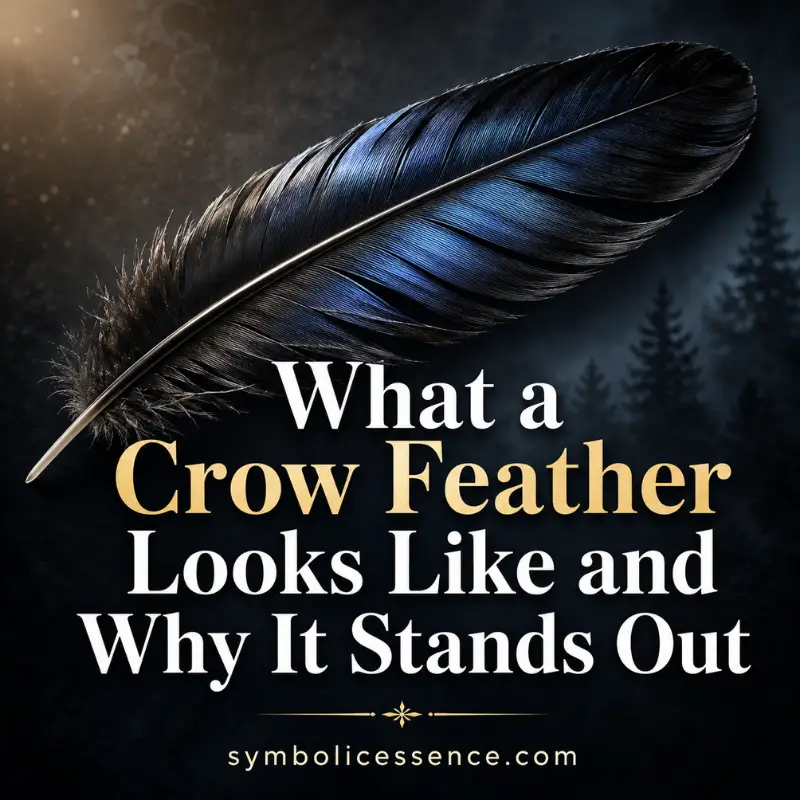
A typical American crow is almost entirely black, from its bill to its plumage. Its feathers can appear simply black from a distance but often look glossy when sunlight hits them. American crows are widespread across much of North America and live in environments ranging from farmland and woodland edges to suburbs and city centers.
That physical appearance matters symbolically.
Black objects are visually striking, particularly when found against grass, snow, pavement, or pale soil. A loose black feather can therefore feel more deliberate or noticeable than an ordinary object encountered outdoors.
The feather also combines two symbolic ideas. A feather suggests movement, flight, lightness, or connection with a bird that has departed. The crow adds associations shaped by the animal itself: observation, intelligence, survival, communal behavior, and its long cultural connection with death imagery.
These meanings are interpretations, not fixed messages. A feather found on a sidewalk does not come with an objective symbolic definition.
What It Commonly Means in the United States
Modern American interpretations of crow feathers are unusually flexible. Positive and darker meanings exist side by side.
| Context | Common U.S. Meaning | Typical Association | Important Note |
|---|---|---|---|
| Personal symbolism | Intelligence | Learning, strategy, observation | Often inspired by real crow behavior |
| Life transitions | Adaptability | Reinvention, surviving change | Usually a modern personal interpretation |
| Warning imagery | Vigilance | Paying attention, recognizing danger | Fits the crow’s alert reputation |
| Memorial symbolism | Mortality | Grief, remembrance, impermanence | Does not automatically predict death |
| Group symbolism | Community | Family, loyalty, cooperation | Reflects the social nature of crows |
| Gothic design | Mystery | Night, shadows, the unknown | Strongly shaped by modern visual culture |
The most useful way to understand the symbol is therefore to ask about context. A crow feather on a memorial tattoo communicates something different from the same image on a Gothic necklace or nature-inspired wall print.
Why Intelligence Became One of Its Strongest Meanings
The association between crows and intelligence is not simply folklore.
American crows cooperate, solve problems, remember useful information, and respond flexibly to unfamiliar situations. Research has also shown that they can recognize familiar human faces and connect those faces with previous experiences.
That makes intelligence one of the most grounded symbolic readings of a crow feather.
Someone choosing the image for a tattoo or piece of jewelry may use it to represent being observant rather than impulsive. It can suggest solving problems with whatever resources are available, noticing what others overlook, or learning from difficult experiences.
This meaning differs slightly from wisdom. An owl is often portrayed as calm, scholarly wisdom. Crow imagery tends to suggest a more practical intelligence: watching, remembering, improvising, and surviving.
That distinction helps explain why the crow appeals to people who identify with cleverness outside conventional systems.
Vigilance, Memory, and Learning From Danger
Crows do not merely notice threats and immediately forget them.
Research on American crows has shown that they can learn to recognize people associated with danger. Knowledge about threatening individuals can also spread socially among birds.
This behavior gives modern crow imagery an especially fitting association with memory and vigilance.
A crow feather can therefore represent the idea that past experience should inform present choices. In personal symbolism, it may mean:
- remember what happened;
- notice recurring patterns;
- learn without becoming trapped in the past;
- recognize danger before repeating a mistake.
That interpretation is psychological rather than supernatural. The crow becomes a visual metaphor for attentive memory.
For someone who has moved through a difficult relationship, career setback, dangerous situation, or major personal change, that symbolism can feel more specific than a generic idea of “strength.”
Why Crow Feathers Are Connected With Death
Crow imagery has a long-standing relationship with death, but the connection is easy to exaggerate.
Crows eat many different foods, including insects, seeds, fruits, discarded human food, small animals, and carrion. Their black plumage and willingness to feed around dead animals helped make crows and other black corvids natural figures in stories involving battlefields, graveyards, danger, and mortality.
American crows also respond noticeably to dead members of their own species. Experiments found that wild crows gather, call, and investigate circumstances associated with a dead crow, apparently using the situation to learn about potential threats. Scientists caution against simply describing this behavior as a human-style funeral or proof of mourning.
Symbolically, this produces a more interesting meaning than “crow feather equals death.”
The feather may instead represent awareness of mortality—the recognition that life changes, losses matter, and danger leaves information behind.
In memorial art, that can make the crow feather an appropriate symbol of remembrance without implying that it predicts another death.
Change, Transition, and Reinvention
Transformation is one of the most popular modern meanings attached to crow feathers, although it is better understood as a contemporary interpretation than as a universal ancient belief.
The connection makes sense because crows themselves are adaptable. They thrive around farms, forests, roadsides, suburbs, beaches, and dense human settlements. Their ability to exploit changing conditions has made them a familiar presence across much of the United States.
In personal symbolism, that adaptability becomes a metaphor.
A crow feather may mark:
- leaving an old identity behind;
- rebuilding after loss;
- changing direction;
- becoming more self-reliant;
- accepting uncertainty.
Here the black feather does not necessarily represent something negative. Darkness can function visually as the unknown—the period between what has ended and what has not yet taken shape.
For this reason, crow feather tattoos are sometimes chosen after a breakup, move, recovery period, career change, or other personal turning point.
Community, Loyalty, and Social Bonds
The lone black crow is a familiar artistic image, but real crows are highly social birds.
American crows can form family groups, cooperate in defending territory, gather in large communal roosts, and join together to mob predators.
That behavior supports a less obvious symbolic interpretation: community and collective protection.
A feather may represent remembering where you belong, protecting people close to you, or understanding that independence does not require isolation.
This meaning works particularly well in family tattoos or designs involving several feathers or several crows. Multiple birds can emphasize cooperation, shared memory, ancestry, or a group that has survived hardship together.
It also complicates the stereotype of the crow as purely solitary or sinister. Much of the bird’s success comes from paying attention to others.
Crow Imagery in American Culture
American crow imagery draws from nature, European folklore, horror aesthetics, literature, tattoos, Halloween imagery, music, film, and contemporary spiritual subcultures.
This cultural mixture has produced two broad versions of the crow.
One is the ominous crow: black, watchful, associated with abandoned landscapes, cemeteries, autumn, death, or approaching trouble.
The other is the clever survivor: urban, adaptable, intelligent, difficult to fool, and comfortable living beside humans.
Modern designs often deliberately combine both. A person may choose a black crow feather precisely because it communicates darkness without helplessness. The symbol can acknowledge hardship while emphasizing the intelligence needed to continue afterward.
This balance between mortality and survival is one reason crow imagery remains useful in contemporary American visual culture.
Indigenous Traditions Require Cultural Specificity
Statements such as “Native Americans believed the crow feather meant…” should be treated cautiously.
There is no single Native American religion or symbolic system. Hundreds of distinct Indigenous nations have their own histories, languages, ceremonial traditions, artistic practices, and relationships with birds.
Even crow and raven terminology can vary. Among the Tlingit, for example, Raven and Eagle are important social divisions, while in one northeastern regional tradition the paired terms are Crow and Wolf. Such identities belong to specific cultural systems rather than a generic dictionary of animal meanings.
Bird feathers themselves can also carry sacred or culturally restricted significance in particular Indigenous communities. Educational guidance from the National Museum of the American Indian specifically warns against casually treating tribal feather imagery as interchangeable decoration.
For a general American audience, the respectful conclusion is simple: do not assign one invented “Native American crow feather meaning” to all Indigenous peoples.
When discussing a specific tradition, identify the nation and rely on information from that community whenever possible.
Ancient and Cross-Cultural Crow Meanings
Crow symbolism extends far beyond the United States, but different cultures use the bird in very different ways.
In Greco-Roman sky lore, Corvus—the constellation whose Latin name means crow—became connected with Apollo through a story involving a crow, a cup, and a water snake. This placed the crow within traditions involving divine communication, consequences, and storytelling in the heavens.
Japanese tradition provides a very different example. Yatagarasu, the mythical three-legged crow, appears as a divinely sent guide in the legendary journey of Emperor Jimmu. It remains associated with guidance in Japanese cultural memory.
These examples show why “crow means bad luck” is far too narrow.
Depending on the tradition, crow imagery can suggest guidance, divine involvement, warning, intelligence, consequence, ancestry, social identity, or death.
A crow feather does not inherit all of these meanings automatically. Cultural context determines which association is relevant.
Crow Versus Raven Symbolism
Crows and ravens are regularly confused in symbolism.
The confusion is understandable. Both belong to the corvid family, both can have black plumage, and their mythology and visual imagery have repeatedly overlapped.
They are not, however, interchangeable birds.
In the United States and Canada, commonly encountered species include the American Crow, Fish Crow, Common Raven, and Chihuahuan Raven. Voice, body size, tail shape, flight style, and other features help distinguish them.
This matters because some famous “crow meanings” circulating online actually come from raven traditions. Norse stories about Odin’s birds, for example, concern ravens. Many Indigenous stories from Alaska and the Northwest Coast likewise specifically center Raven rather than an unspecified crow.
Modern Gothic culture often blurs the distinction because viewers primarily notice the black corvid silhouette.
For historically grounded interpretation, identify the bird first whenever the original tradition does.
Tattoos, Jewelry, Fashion, and Decor
Crow feathers work well in modern design because they can carry several meanings without becoming visually complicated.
In tattoos, a single feather may symbolize independence, survival, memory, or a turning point. Adding other elements changes the message.
A crow feather with a skull emphasizes mortality. One with flowers can contrast loss and renewal. A feather paired with an eye may suggest observation or awareness. Several feathers can shift attention toward family, community, or a shared experience.
Jewelry tends to make the symbolism less narrative. A black feather pendant may simply communicate an affinity for nature, Gothic style, corvids, or unconventional beauty.
Home decor uses crow imagery most heavily during fall and Halloween, where black birds fit established visual themes of shadow, decay, old houses, harvest landscapes, and eerie atmosphere.
None of these uses requires a supernatural belief. Symbols can function as personal shorthand without being treated as literal signs.
What Finding a Crow Feather Can Mean Personally
People often search for a meaning after unexpectedly noticing a black feather.
A spiritual interpretation might describe the discovery as a message to pay attention, trust one’s intelligence, prepare for change, or acknowledge something that has ended. Those interpretations can be meaningful as personal reflection, but they cannot be verified as universal messages sent by the bird or by an outside force.
A grounded approach is to ask what the encounter brought to mind.
Were you already making an important decision? Remembering someone? Leaving something behind? Feeling especially alert or uncertain?
The symbolic value may come from the relationship between the object and your current experience rather than from a fixed supernatural code.
Sometimes, of course, a feather is simply evidence that a bird recently passed through the area.
Legal and Ethical Considerations in the United States
Finding a feather does not automatically mean you are free to take it home.
The American Crow is included on the federal list of birds protected under the Migratory Bird Treaty Act. Federal guidance explains that possession of feathers from protected native migratory birds generally requires legal authorization, and the rule can apply even to naturally molted feathers that someone simply finds outdoors.
There are regulated exceptions and special legal circumstances, including rules involving authorized hunting, permits, scientific or educational activities, and certain religious uses. State regulations can add further requirements.
For an ordinary nature encounter, the simplest practice is to photograph the feather and leave it where it is rather than assuming that finding it makes possession legal.
That approach also keeps symbolic appreciation separate from unnecessary wildlife collection.
How the Meaning Has Changed Over Time
Crow symbolism did not move neatly from one ancient meaning to one modern meaning.
Instead, different layers accumulated.
Older traditions connected crows and related corvids with divine communication, omens, death, guidance, or social identity. European and American visual culture strengthened the black bird’s connection with eerie landscapes and mortality. Modern science, meanwhile, has made the crow’s intelligence, memory, adaptability, and social learning far more widely understood.
As a result, contemporary symbolism is less purely ominous.
The modern crow can still represent death, but it can just as easily represent the mind that notices danger, remembers experience, adjusts to change, and survives.
That shift helps explain why crow feathers now appear in designs centered on resilience and personal growth as often as they appear in explicitly dark imagery.
FAQs
Is a crow feather a good or bad symbol?
It can be either, depending on the context. Positive interpretations emphasize intelligence, adaptability, memory, and survival, while darker interpretations focus on mortality, warning, grief, or uncertainty.
Does finding a crow feather mean death is coming?
There is no evidence that finding a crow feather predicts a death. Its connection with mortality comes from cultural symbolism and the crow’s historical association with black plumage, carrion, and death imagery rather than a reliable omen.
What does a crow feather tattoo symbolize?
A crow feather tattoo commonly represents intelligence, survival, independence, vigilance, personal change, or remembrance. Elements placed around the feather can make the intended meaning much more specific.
Can a crow feather represent protection?
Yes, particularly in modern personal symbolism. The interpretation can draw from the crow’s vigilance and collective defense behavior, making the feather a useful image for watchfulness, boundaries, or protecting one’s community.
What does a black crow feather mean spiritually?
In contemporary spiritual interpretation, it may represent awareness, transition, intuition, caution, or confronting the unknown. These meanings are personal or tradition-dependent rather than universal facts.
Is crow symbolism the same as raven symbolism?
No. Crows and ravens are related corvids and share considerable modern imagery, but many historical traditions specifically refer to one bird rather than the other. Treating every raven story as crow mythology can distort the original cultural context.
Is it legal to keep a crow feather I find?
In the United States, American Crows are federally protected migratory birds, and possession of their feathers is generally restricted without legal authorization. Finding a naturally shed feather does not automatically create an exception.
Conclusion
Crow feather symbolism has become broader than the old stereotype of a black bird bringing bad news. In modern American culture, the feather can represent intelligence, adaptability, watchfulness, memory, community, mortality, or the ability to change course after difficult experiences.
Its darker associations still matter, but they are only part of the picture. Real crow behavior—social cooperation, remarkable memory, alertness, and adaptability—has helped create a modern symbol that is as much about surviving and learning as it is about death or mystery.
A crow feather therefore works best not as a fixed prophecy, but as a reminder to observe carefully, remember what experience has taught you, and respond intelligently to what comes next.


