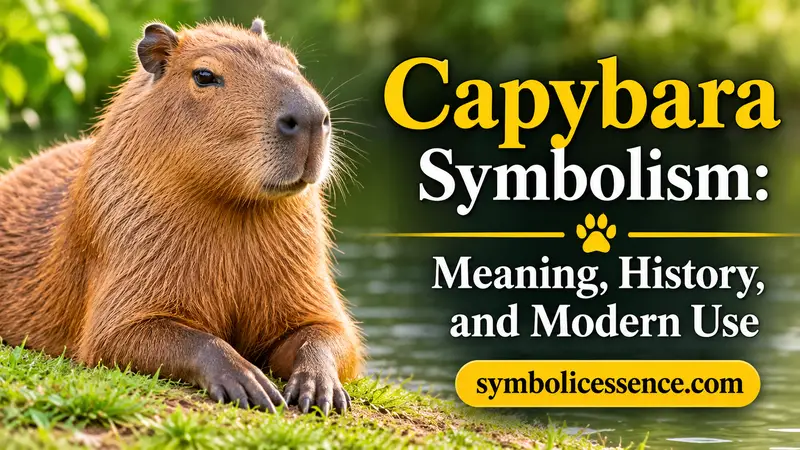
A capybara can sit quietly beside a pond while birds rest on its back or other animals gather nearby. This large, gentle-looking rodent is known for its relaxed behavior, social nature, and ability to live comfortably around different species. Those traits have helped make it a familiar image of calmness and friendship.
Capybara symbolism often centers on peace, patience, cooperation, and acceptance. People who look up its meaning may have seen a capybara in a video, encountered one in a dream, considered it for a tattoo, or simply wondered why this animal has become such a popular image online.
In the United States, the capybara has developed a recognizable place in internet humor, animal-themed fashion, children’s products, and personal expression. Its meaning is not based on one fixed ancient tradition. Much of its current popularity comes from its real behavior and the way modern audiences interpret its relaxed appearance.
Quick Answer
Capybara symbolism most commonly represents calmness, friendship, adaptability, patience, and peaceful coexistence in modern American culture. These associations grow mainly from the animal’s social behavior, semiaquatic lifestyle, and South American history rather than from one established religious or spiritual tradition.
TL;DR
- Calmness: Represents staying relaxed in stressful situations.
- Friendship: Reflects social bonds and peaceful companionship.
- Adaptability: Connects with comfort in different environments.
- Cooperation: Suggests living alongside others without conflict.
- Patience: Represents an unhurried approach to everyday life.
- Modern culture: Appears in American memes, gifts, art, and fashion.
What Does a Capybara Look Like?
The capybara (Hydrochoerus hydrochaeris) is the largest living rodent in the world. It is native to much of South America, where it lives near rivers, lakes, marshes, ponds, and other freshwater habitats.
Its appearance is quite different from that of smaller rodents. A capybara has a large, barrel-shaped body, short legs, coarse reddish-brown fur, small rounded ears, and a broad head. Its feet are partly webbed, making swimming easier.
Several physical features contribute to the meanings people associate with it:
- Relaxed expression: Its small eyes and calm facial appearance suggest comfort and ease.
- Large body: Its size can represent steadiness and physical security.
- Webbed feet: Its ability to move through water and land suggests flexibility.
- Social behavior: Its tendency to live in groups connects it with friendship and cooperation.
- Brown coloring: Its natural coat can suggest earthiness, simplicity, and connection with nature.
Capybaras are often seen resting in water, grazing on grass, or sitting near other animals. These ordinary behaviors have become an important part of their modern image.
Why Is the Capybara Associated With Calmness?
Calmness is probably the most recognizable modern meaning associated with this animal.
Capybaras often appear relaxed even when other animals are moving around them. They can rest near birds, monkeys, turtles, and other wildlife without constantly reacting to every movement.
Their behavior has helped create an image of an animal that does not need to compete for attention.
In American popular culture, this image connects with the idea of staying composed when life becomes stressful. Someone might share a picture of a capybara sitting in a hot spring with a caption about ignoring unnecessary drama.
The message is usually humorous, but it also reflects a familiar personal goal: remaining comfortable with yourself instead of reacting to everything around you.
However, calmness should not be confused with a lack of awareness. Capybaras are prey animals. They stay alert to danger and can quickly enter the water when threatened.
Their relaxed appearance represents an interpretation of their behavior, not proof that they never experience fear or stress.
How Do Friendship and Cooperation Shape Its Meaning?
Capybaras are social animals that usually live in groups. Their communities often include adult males, females, and young animals.
Group living helps them watch for predators, protect their young, and maintain social relationships. Members communicate through sounds, scent marking, physical contact, and grooming.
This behavior gives the animal a natural connection with friendship and cooperation.
There is also a familiar visual detail that strengthens this association: birds sometimes sit on capybaras and feed on insects around them. Photographs of these interactions often show different species sharing the same space.
People interpret these scenes in several ways:
- Friendship without requiring people to be alike.
- Cooperation between individuals with different needs.
- Acceptance of others without unnecessary conflict.
- Comfort in shared spaces.
- Building relationships through patience.
For someone choosing an animal to represent friendship, the capybara offers an interesting alternative to more traditional choices such as dogs, elephants, or dolphins.
It suggests that companionship does not always need constant activity. Sometimes, simply being comfortable around another individual is enough.
Where Did Capybara Symbolism Begin?
Unlike the symbolism of the eagle, lion, or snake, the capybara does not have one widely documented symbolic tradition that explains its meaning across centuries.
Its earliest cultural associations are closely connected with Indigenous South American communities, local languages, food, and the natural environment.
The English name comes through Portuguese and Spanish forms connected to Indigenous Tupi and Guarani languages. One commonly cited Tupi explanation connects the word with grass eating. The animal’s diet makes this interpretation understandable.
Historical records from the sixteenth century describe the capybara as an unusual animal living both on land and in water. European explorers compared it with familiar animals such as pigs because they did not have a close European equivalent.
These descriptions were mainly about its appearance, habitat, and practical use rather than a universal spiritual meaning.
This distinction matters. Modern interpretations of calmness and friendship should not be presented as established beliefs held by all Indigenous South American communities.
The animal’s documented history is more specific: it was known through local names, valued as a source of food in some regions, and recognized as part of the river and wetland environment.
What Role Did the Capybara Play in South American History?
The capybara has long been part of everyday life in several South American countries, including Brazil, Venezuela, Colombia, Paraguay, and Argentina.
For communities living near rivers and wetlands, it was not simply an unusual animal to observe. It was also a source of meat and hide.
Its relationship with people therefore included practical and economic importance.
One particularly interesting historical detail involves Catholic food practices in parts of South America.
During the sixteenth century, the capybara was treated as a fish for certain religious dietary purposes because of its close relationship with water. This classification allowed its meat to be eaten on days when eating ordinary meat was restricted, including Fridays and Lent.
The decision reflected the dietary rules and classifications of the period. It did not mean that naturalists believed the capybara was biologically a fish.
This episode is a useful example of how human culture can interpret an animal according to practical needs and local circumstances.
It also shows why its historical meaning cannot be reduced to modern ideas about relaxation or friendship.
What Does the Capybara Represent in American Culture?
In the United States, the animal is commonly associated with a relaxed personality, friendliness, humor, and acceptance.
Its growing popularity has been especially noticeable in online culture. Images of capybaras sitting peacefully beside other animals offer a welcome contrast to the busy, noisy, and competitive situations that appear in everyday internet content.
Several American cultural associations have developed around this image.
A break from everyday pressure: A capybara resting in warm water can represent the desire to slow down after work, school, or a demanding week.
Being comfortable with yourself: Its unbothered appearance can suggest confidence without the need to impress other people.
Welcoming different personalities: Images of different animals gathering around one capybara often communicate acceptance and peaceful relationships.
Enjoying simple experiences: Grazing, resting, swimming, and spending time with companions connect with a less complicated approach to life.
Gentle humor: The animal’s unusual size and relaxed expression make it suitable for jokes, reaction images, and playful merchandise.
For example, an American college student might use a capybara sticker on a laptop to represent a relaxed attitude toward exams. Someone else might share a capybara meme after a difficult day to make friends laugh.
These interpretations are modern cultural associations, not formal meanings shared by every American.
Why Do Capybara Memes Represent Being Unbothered?
The internet played a major role in turning the capybara into a recognizable image of calmness.
Capybara photographs began attracting online attention before the animal became a major meme subject. Japanese photographer Katsuhito Watanabe launched a capybara photography blog in 2007, helping introduce the animal to a wider online audience.
In 2013, the Tumblr account Animals Sitting on Capybaras helped spread photographs of other animals sitting on these large rodents.
Another memorable image came from Japanese hot springs, where capybaras were photographed relaxing in warm water, sometimes with yuzu citrus fruits placed on their heads.
The trend became especially recognizable internationally during the early 2020s.
In 2020, videos featuring a capybara riding in a car became associated with Don Toliver’s song “After Party.” The accompanying “OK I Pull Up” meme helped turn the animal into a humorous internet personality.
The popularity continued into 2022 and 2023, when the Russian-language Capybara Song became widely used in short-form videos.
These trends helped establish a few recognizable interpretations:
- Staying relaxed when everyone else seems busy.
- Arriving somewhere without making a big effort.
- Being friendly without trying too hard.
- Finding humor in ordinary situations.
- Enjoying life without constantly seeking attention.
The capybara meme is not simply about an animal looking cute. It often uses the contrast between a large wild rodent and an extremely relaxed situation to make people laugh.
What Does a Capybara Mean Emotionally and Psychologically?
People often connect animals with qualities they admire or want to express. A capybara can represent several emotional preferences, particularly when someone feels overwhelmed by daily responsibilities.
Its image may communicate a wish for a more balanced lifestyle.
The desire for peace: Someone who feels surrounded by arguments, deadlines, or constant notifications may connect with an animal that appears comfortable doing very little.
The need for companionship: Its social behavior can appeal to people who value friendship and supportive relationships.
Acceptance of differences: Its association with different species sharing space can reflect an interest in open-minded relationships.
Emotional patience: Its relaxed image can remind someone not to respond immediately to every frustrating situation.
Personal independence: The capybara is not usually portrayed as seeking approval. Its modern internet image suggests being comfortable without needing attention.
These associations can be useful ways to understand personal expression. They are not psychological diagnoses or scientific claims about what a person’s favorite animal reveals about their personality.
Someone may simply like capybaras because they are funny-looking animals.
How Is the Capybara Used in Tattoos and Personal Style?
Capybara tattoos offer a playful way to represent calmness, friendship, and individuality.
Unlike traditional animal tattoos that often emphasize strength or danger, capybara designs usually focus on gentle behavior and an approachable appearance.
Popular design ideas include:
- Relaxing capybara: A small animal sitting peacefully can represent a preference for a slower lifestyle.
- Capybara with birds: This design can suggest friendship, cooperation, and acceptance.
- Hot spring capybara: A capybara relaxing in water can represent comfort and self-care.
- Capybara with fruit: An orange or yuzu balanced on its head creates a playful design connected with internet culture.
- Minimalist capybara: Simple outlines can express a personal interest in animals without an elaborate design.
In American fashion, the animal also appears on T-shirts, sweatshirts, socks, tote bags, phone cases, and accessories.
These items often use cartoon-style illustrations, round bodies, small ears, and relaxed facial expressions.
A person wearing a capybara shirt might be communicating a love of wildlife, a sense of humor, or an appreciation for a calm lifestyle.
Not every design carries a personal message. Sometimes the appeal is simply that the animal looks amusing.
What Does a Capybara Mean in Dreams?
There is no scientifically established meaning for seeing a capybara in a dream. Dream interpretations are personal and often depend on the emotions and circumstances surrounding the experience.
Still, some people use the animal’s familiar characteristics as a starting point for reflection.
| Context | Meaning in USA | Common Associations | Notes |
| A capybara resting | Desire for relaxation | Rest, comfort, balance | May reflect a need for a break |
| A group of capybaras | Interest in stronger relationships | Friendship, community | Can connect with social belonging |
| A swimming capybara | Adjusting to changing circumstances | Flexibility, transition | Water may have a personal meaning |
| A capybara with birds | Appreciation for different personalities | Acceptance, cooperation | Often inspired by real animal interactions |
| A baby capybara | Interest in care and new beginnings | Innocence, responsibility | Interpretation depends on personal feelings |
For example, dreaming about a capybara resting beside a river might remind someone of a peaceful place they visited during childhood.
Another person might dream about a group of capybaras after spending time with friends.
Rather than treating these experiences as predictions, it is more useful to consider what the animal brings to mind and how the dream felt.
How Do Artists and Designers Use Capybara Imagery?
Artists often choose animals because their appearance communicates an idea before viewers read any explanation.
The capybara is especially suitable for illustrations that focus on friendliness and everyday humor.
Its rounded body creates an approachable shape. Its short legs and small ears make it easy to recognize in simple cartoon drawings.
Designers also use familiar settings to give the animal a particular meaning.
For example, a capybara sitting beneath a tree may communicate rest and a connection with nature. One surrounded by flowers may suggest gentleness, while a capybara wearing sunglasses can create a humorous image of confidence.
In American children’s books, stationery, and educational materials, the animal can also introduce lessons about wildlife and group behavior.
Its appearance makes it attractive to younger audiences, while its real habitat provides opportunities to teach children about wetlands, biodiversity, and animal conservation.
In branding, a cartoon capybara can work for products that want to appear approachable, playful, and friendly.
However, the animal does not have one official commercial meaning. A designer’s message depends on the product, illustration, colors, and surrounding text.
Does the Capybara Have Religious or Spiritual Meaning?
The capybara is not widely recognized as a central sacred animal in a major world religion.
There are no universal religious rules that assign it one fixed spiritual meaning.
Its historical connection with Catholic food practices in South America is a documented cultural detail, but it should not be confused with worship or a formal religious symbol.
Some contemporary spiritual and nature-focused communities may interpret the animal as a reminder to practice patience, appreciate companionship, or respect the natural world.
These are personal interpretations rather than established religious teachings.
It is also important to avoid assigning one belief to all Indigenous South American communities. Different communities have their own languages, histories, and relationships with local wildlife.
A respectful interpretation begins with the animal’s actual place in nature and separates documented traditions from modern personal beliefs.
What Are Common Misunderstandings About Capybara Symbolism?
The popularity of the capybara has created a few misconceptions about its behavior and meaning.
Misunderstanding 1: Capybaras are always friendly with every animal.
Online photographs often show them resting near other species. However, this does not mean they are naturally friendly with every animal in every situation. Their behavior depends on safety, surroundings, and individual circumstances.
Misunderstanding 2: Capybaras never experience stress.
Their relaxed appearance can be misleading. They are prey animals and can become frightened by predators, unfamiliar situations, or other threats.
Misunderstanding 3: The capybara is an ancient universal symbol of peace.
There is no strong historical basis for describing it as a universal symbol across ancient civilizations. Its modern associations largely developed through observation and popular culture.
Misunderstanding 4: A capybara is a suitable pet for everyone.
Its gentle appearance does not make it an easy household animal. Capybaras need water, outdoor space, appropriate food, social companionship, and specialized care. Laws governing private ownership also vary by location.
Misunderstanding 5: All capybara images have a spiritual message.
Many images are simply entertainment. A cartoon capybara on a coffee mug does not automatically represent a personal belief or spiritual practice.
Understanding these differences helps people enjoy the animal without confusing internet humor with biological facts or documented history.
How Has Capybara Symbolism Changed Between Generations?
The capybara’s public image has changed considerably as more people have encountered it through photography, zoos, and online media.
Its earlier associations were closely connected with South American wildlife, local food traditions, and wetland habitats.
During the twentieth century, international zoo exhibits helped introduce the animal to people who had never seen one in the wild. Photographs and television programs also made it easier to recognize.
The internet then changed how audiences understood it.
A few generational differences help explain this shift:
- Older generations: May recognize it mainly as an unusual South American rodent or zoo animal.
- Millennials: May remember its early internet photography and animal-sharing memes.
- Generation Z: Often associates it with TikTok videos, funny sounds, and the unbothered personality of online capybara characters.
- Generation Alpha: May encounter it through plush toys, cartoons, games, and short-form videos.
The 2020–2023 meme wave was particularly important because it introduced the animal to audiences who might not otherwise have searched for information about South American wildlife.
By 2026, its online popularity has also created a more serious conversation about animal welfare.
Wildlife organizations have raised concerns that viral attention can encourage unsuitable pet ownership and irresponsible interactions with wild animals.
This adds another layer to its modern image: enjoying an animal online should also involve respecting its needs in the real world.
What Can the Capybara Teach Us About Living With Nature?
The capybara’s real life offers more than an appealing internet personality.
Its survival depends on healthy wetlands, access to freshwater, suitable vegetation, and relationships with other animals.
It also plays a role in its ecosystem as a grazing herbivore. Its feeding behavior connects it with the plants and habitats that support many other species.
For American audiences, the animal can serve as a reminder that wildlife conservation is not only about rare or visually dramatic creatures.
Wetlands are important natural environments. They support wildlife, help manage floodwater, and provide valuable habitat for many species.
Capybaras are also affected by habitat destruction, hunting pressure, and changes to their natural surroundings.
A photograph of a capybara relaxing in a pond can therefore lead to a more practical question: what conditions allow this animal to live comfortably?
That question moves beyond personal interpretation and toward understanding the natural world.
FAQs
Is the capybara a positive or negative symbol?
The capybara is generally viewed positively in modern American culture. It is commonly connected with friendship, calmness, acceptance, and humor, although its meaning can change depending on the artwork or situation.
Does a capybara symbolize good luck?
There is no widely established historical tradition that identifies the capybara as a universal good-luck animal. However, someone may personally use its image as a reminder to welcome positive experiences and maintain a relaxed outlook.
Why are capybaras associated with other animals?
Capybaras often tolerate the presence of other species, and photographs sometimes show birds or smaller animals resting near them. These scenes have helped create their modern reputation as welcoming and sociable animals.
Does the capybara represent introverts?
It can be used as a humorous representation of introverted behavior, especially when shown resting quietly or avoiding unnecessary attention. However, capybaras are naturally social animals, so the comparison is more about their relaxed public image than their actual social needs.
What does a capybara with an orange on its head mean?
It usually refers to photographs of capybaras relaxing in Japanese hot springs with yuzu citrus fruits placed on their heads. Online, this image is associated with relaxation, humor, and the animal’s recognizable internet personality.
Why is the capybara associated with friendship?
Its group-based social behavior and ability to share space with other species inspire this interpretation. The image of different animals resting together has become a familiar representation of peaceful companionship.
Is the capybara connected with Indigenous South American culture?
Yes. Its name has roots in Indigenous South American languages, including Tupi and Guarani, and the animal has long been part of life in the region. However, specific spiritual meanings should not be attributed to Indigenous communities without evidence of the particular tradition.
Conclusion
Capybara symbolism is most commonly associated with calmness, friendship, patience, adaptability, and peaceful coexistence. These meanings come mainly from the animal’s social behavior, natural habitat, and modern appearance in photography and internet culture.
Its historical background is closely connected with South American communities, Indigenous languages, food traditions, and wetland environments. Its modern American image, meanwhile, has grown through memes, tattoos, fashion, toys, and popular illustrations.
Ultimately, capybara symbolism offers a simple reminder that being comfortable, maintaining good relationships, and appreciating ordinary moments can be worthwhile. Even a picture of a capybara resting beside a pond can encourage someone to slow down and enjoy a quieter part of the day.