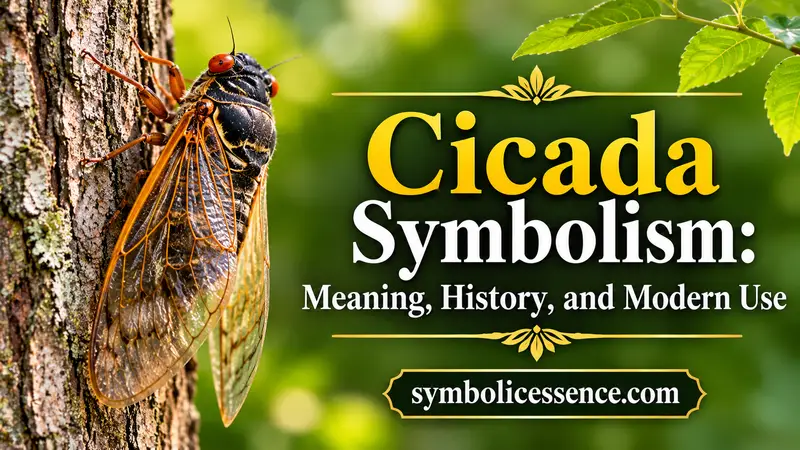
A cicada can spend 13 or 17 years underground before emerging in large numbers, shedding its old skin and taking to the trees. Its short time above ground makes it an unusual insect, especially when its loud summer calls fill neighborhoods, parks, and forests. This natural cycle helps explain why cicada symbolism is often connected with renewal, change, patience, and the passage of time.
People often look up the meaning of a cicada after seeing one on a tree, finding its empty shell, hearing its sound, or considering it for a tattoo. For some, the insect represents a fresh start after a difficult period. For others, it suggests that personal growth can happen quietly before anyone else notices.
In the United States, cicadas have also become part of seasonal life. Their mass appearances, particularly during major periodical emergences, attract public attention and inspire photographs, artwork, jewelry, and online conversations. Their meaning comes from both their unusual biology and the stories different cultures have attached to them.
Quick Answer
Cicada symbolism most commonly represents rebirth, personal transformation, patience, renewal, and the return of new opportunities. These meanings developed partly from the insect’s life cycle, especially its long underground development and its emergence into adult life, while ancient Chinese traditions also connected cicadas with immortality and life after death.
TL;DR
- Cicadas commonly represent renewal, transformation, and new beginnings.
- Their long underground life suggests patience and preparation.
- Shedding their exoskeleton represents leaving an old identity behind.
- Ancient Chinese traditions connected jade cicadas with life after death.
- Japanese culture often associates their summer songs with life’s passing nature.
- American periodical emergences represent natural cycles and seasonal change.
What Does a Cicada Look Like, and Why Is It Recognizable?
A cicada is an insect with a broad body, transparent wings, large eyes, and short antennae. Depending on the species, its body may appear green, brown, black, or a combination of these colors. Some North American periodical cicadas have striking red eyes and orange markings, making them easy to recognize.
Their appearance is unusual enough to attract attention, but their behavior makes them even more memorable.
Male cicadas produce loud sounds using special structures called tymbals on their abdomens. These sounds can be heard across neighborhoods and wooded areas during warm weather. The calls help males attract females and are an important part of their mating behavior.
Another recognizable feature is the empty shell left behind when a young cicada becomes an adult. The insect climbs onto a tree, fence, or other surface, splits its outer covering, and slowly pulls itself free.
The empty shell remains attached to the surface.
This visible change is one reason people associate the insect with personal growth. The old covering stays behind while the living insect moves into a different stage of life.
Cicadas also have an unusual life cycle. Some species emerge every year, while others spend 13 or 17 years underground. Periodical cicadas are especially well known in the eastern United States.
What Does a Cicada Symbolize Today?
The most common modern interpretations focus on change, renewal, and the ability to move forward after a long period of preparation.
However, different people connect with the insect for different reasons.
Rebirth and new beginnings
The emergence of an adult cicada provides a natural example of a fresh beginning. It leaves its underground stage, sheds its outer covering, and enters a new phase of life.
People may use this meaning when starting a new career, recovering from a difficult experience, moving to another city, or beginning a different chapter in life.
Personal transformation
The discarded shell represents an earlier stage that is no longer needed. It can serve as a reminder that people are allowed to change their habits, beliefs, goals, and relationships.
For someone who has outgrown an old version of themselves, the cicada offers a fitting visual comparison.
Patience and preparation
Periodical cicadas spend most of their lives underground. Their emergence reminds people that not every stage of progress is visible.
A person studying for years, building a business, or working toward a personal goal may connect with this idea.
Freedom and self-expression
Once adult cicadas emerge, their calls become one of the defining sounds of summer. Their loud presence can represent confidence, visibility, and the willingness to express oneself.
The passage of time
An adult cicada’s aboveground life is relatively short compared with its underground development. This contrast can encourage people to think about how they spend their time and which experiences deserve their attention.
How Did Ancient Cultures Interpret Cicadas?
Cicadas have a documented place in several historical traditions, particularly in China, ancient Greece, and Japan.
Their meanings were not identical. Each culture focused on different features of the insect, including its appearance, sound, life cycle, and connection with the seasons.
Ancient China: Immortality and Life After Death
Cicadas held an important place in ancient Chinese burial traditions.
One of the best-known objects associated with them is the jade cicada, a small carving shaped like the insect. Archaeologists have found cicada-shaped jade objects in ancient Chinese tombs, including examples from the Han dynasty (206 BCE–220 CE).
These objects were sometimes placed in or near the mouths of the dead.
The exact meaning of every burial object is not fully settled. However, cicadas became associated with ideas of renewal, immortality, and continued existence after death.
Their natural life cycle offered a useful comparison. A cicada seems to disappear underground before returning in another form. Its ability to shed its outer covering also made it a fitting image of renewal.
Jade added another layer of meaning because it was valued in Chinese culture for its beauty, durability, and associations with virtue.
The combination of jade and insect imagery created an object connected with both physical craftsmanship and beliefs about death and renewal.
Ancient Greece: Music, Summer, and Poetry
In ancient Greece, cicadas were admired for their distinctive songs.
Their calls were associated with summer, outdoor life, and the natural world. Greek writers also connected them with music and poetic inspiration.
One notable example appears in Plato’s dialogue Phaedrus. In the story, cicadas are connected with the Muses, the figures associated with artistic and intellectual inspiration in Greek tradition.
The story describes cicadas as former humans who were so absorbed in music that they forgot to eat and drink. After death, they were transformed into creatures that sing and report on human appreciation of music.
This is a mythological explanation, not a scientific account. It shows how strongly the insect’s sound influenced ancient Greek imagination.
Japan: Summer and the Passing of Life
In Japan, cicadas are closely connected with summer.
Their calls are familiar features of the season, appearing in gardens, parks, schoolyards, and wooded areas. Different species become active at different times, and their sounds help mark the changing stages of summer.
Japanese poetry, literature, and seasonal art often use cicadas to suggest the temporary nature of life.
Their short adult stage makes them suitable images of impermanence. A loud summer afternoon may feel full of life, yet the sound eventually fades as the season changes.
This connection is particularly familiar in Japanese haiku and other seasonal writing, where natural sounds can express feelings about time, memory, and change.
Why Does a Cicada Represent Rebirth and Transformation?
The connection between cicadas and transformation comes directly from their development.
A young cicada does not simply grow into an adult while keeping the same outer appearance. It must shed its exoskeleton to complete its final transition.
The process is visible and surprisingly dramatic.
First, the mature nymph climbs out of the soil and finds a suitable surface. It attaches itself to a tree trunk, branch, or other structure. Its outer covering splits, and the adult insect gradually pulls itself free.
Its new body and wings are initially soft. Over time, they harden, and the insect becomes ready for adult life.
This process creates several understandable comparisons with human experiences.
- Leaving the past behind: The discarded shell resembles habits or identities a person no longer needs.
- Accepting change: The insect cannot become an adult without going through a physical transition.
- Starting again: Its new stage brings different abilities and responsibilities.
- Growing through discomfort: The process takes time and requires the insect to remain vulnerable while its body hardens.
The comparison is useful, but it should not be taken literally. Human development is not the same as insect metamorphosis. Cicadas undergo incomplete metamorphosis, which means their immature stages resemble smaller versions of the adults rather than completely different forms.
Still, their visible change gives people a clear image of personal development.
What Does a Cicada Shell Symbolize?
An empty cicada shell often carries a different meaning from the living insect.
The shell is the outer covering left behind after the adult emerges. It remains attached to a tree or another surface, looking almost like a complete insect.
Because it is an actual remnant of an earlier stage, people often interpret it as a sign of release and personal change.
Letting go of the past: The empty covering can represent an experience, relationship, or habit that once served a purpose but no longer belongs in someone’s life.
Growth that becomes visible: A person may spend years working on themselves before other people notice the difference. The shell offers a comparison with that hidden development.
A new identity: The insect does not return to its old covering. It moves forward into another stage.
Memory and reflection: An empty shell can also remind someone of an earlier period in life, especially when found in a familiar childhood place.
For example, someone who discovers a cicada shell in their childhood backyard may associate it with growing up, family memories, and the passage of time.
The shell does not have one fixed cultural meaning. Its interpretation depends on the person and the circumstances in which it is found.
What Does a Cicada Mean in American Culture?
In the United States, cicadas are closely connected with summer, outdoor activity, and the unusual spectacle of mass insect emergence.
They are especially noticeable in eastern and central states where periodical cicadas appear in large groups.
When a brood emerges, thousands or even millions of insects can appear across a region. Trees become covered with them, their calls fill the air, and empty shells collect around homes and parks.
These events create several cultural associations.
A Sign That Summer Has Arrived
For many Americans, cicada sounds are part of the summer experience.
Their calls are commonly heard in backyards, wooded neighborhoods, public parks, and along roadsides. The sound can become so familiar that people associate it with hot afternoons and outdoor gatherings.
A Reminder of Natural Cycles
Periodical cicadas provide a clear example of nature following a long schedule.
The appearance of Brood X in 2021 attracted widespread attention across parts of the eastern United States. Another major emergence in 2024 brought two different periodical cicada groups into public discussion because their emergence schedules overlapped in parts of the country.
These events encouraged people to learn about insect life cycles, environmental patterns, and local ecosystems.
A Subject for Photography and Art
Cicadas appear in nature photography, educational illustrations, posters, and seasonal artwork.
Their red eyes, transparent wings, and detailed bodies offer distinctive visual features. Artists may use them to represent summer, natural change, or the relationship between humans and the environment.
A Symbol of Personal Change
In personal expression, Americans may choose cicada imagery to mark a major transition.
Someone recovering from a difficult period might choose a design featuring an emerging insect. Another person might prefer an empty shell because it represents leaving an earlier stage behind.
These meanings are personal interpretations rather than universally accepted American traditions.
What Do Different Cicada Colors Represent?
Cicadas are not traditionally associated with a fixed color-symbolism system. Their colors are mainly biological features, and their cultural interpretations depend on the artwork or personal context.
However, artists and jewelry designers sometimes use color to add meaning to cicada imagery.
| Context | Meaning in USA | Common Associations | Notes |
| Green cicada | Growth and renewal | Nature, fresh starts, summer | Often inspired by green-bodied species |
| Brown cicada | Grounding and patience | Earth, preparation, endurance | Connects visually with the insect’s underground stage |
| Black cicada | Change and reflection | Mystery, memory, transition | A modern artistic interpretation, not a traditional rule |
| Red-eyed cicada | Individuality and visibility | Uniqueness, attention, natural beauty | Inspired by the appearance of periodical cicadas |
| Golden cicada | Achievement and renewal | Success, value, transformation | Often influenced by decorative art and Chinese jade-cicada traditions |
A golden cicada design, for example, may suggest personal achievement, but gold does not have one established meaning across all cicada traditions.
The important distinction is between the insect’s natural appearance and the meaning an artist or individual adds to it.
Why Do People Choose Cicada Tattoos?
Cicada tattoos appeal to people who want an image connected with change, endurance, and personal growth.
Unlike more familiar tattoo designs, a cicada can communicate a specific experience without requiring words.
Some people choose the insect after completing a difficult period in their lives. Others use it to remember a major achievement or recognize how much they have changed.
Common design choices include:
A cicada with open wings: This design can represent freedom, confidence, and entering a new stage of life.
A cicada emerging from its shell: This is one of the clearest designs for transformation and personal development.
An empty exoskeleton: This can represent release, closure, and moving beyond an earlier identity.
A realistic periodical cicada: Its red eyes and orange details create a recognizable natural design.
A cicada with flowers or branches: These combinations can connect the insect with summer, growth, and the natural environment.
Placement also affects how people use the design. A small cicada on the wrist may serve as a personal reminder, while a larger back or shoulder design may emphasize its detailed wings and body.
There is no official meaning attached to a cicada tattoo. The story behind the design usually matters more than the image itself.
What Does Hearing a Cicada Mean?
Hearing a cicada can bring different emotional associations depending on the person’s memories and surroundings.
For someone who grew up in a region with large cicada populations, the sound may bring back memories of summer vacations, childhood games, and afternoons spent outdoors.
For another person, the same sound may feel unfamiliar or overwhelming.
The loud calls are produced mainly by males seeking mates. They are not warnings, messages, or predictions of future events.
Nevertheless, people sometimes give the sound personal meaning.
- A seasonal reminder: The calls can signal the arrival of warmer weather.
- A memory of childhood: The sound may bring back familiar places and earlier experiences.
- A reminder to pay attention: The sudden increase in noise can make people notice seasonal changes.
- A connection with nature: The calls show how much activity can happen outside ordinary human routines.
In Japanese cultural interpretation, cicada sounds can also remind listeners that summer and life itself are temporary.
In the United States, the emotional meaning is often connected with personal memories rather than a formal tradition.
How Do Cicadas Appear in Fashion, Jewelry, and Home Decor?
Cicada designs appear in several areas of modern decorative culture.
Their unusual shape makes them suitable for both detailed natural artwork and simplified decorative patterns.
Jewelry
Cicada pendants, brooches, earrings, and necklaces can represent personal change or appreciation for nature.
Some designs use gold-colored metal, while others feature silver, enamel, or gemstone details. Jade cicada carvings also have a historical connection with Chinese decorative and burial traditions.
Clothing and Accessories
Cicada illustrations sometimes appear on printed shirts, scarves, bags, and accessories.
A realistic insect design may appeal to nature enthusiasts, while a stylized version can create a more artistic or unusual appearance.
Home Decor
Wall art, ceramic decorations, framed illustrations, and small sculptures provide ways to bring insect imagery into a living space.
A cicada artwork may suit someone interested in gardens, wildlife, seasonal decoration, or natural history.
Social Media
During major American emergences, photographs and videos of cicadas often become popular online.
People share pictures of insects on trees, empty shells, and the unusual density of emerging populations. Some posts focus on scientific information, while others use humor to describe the sudden arrival of thousands of noisy insects.
This online attention has helped introduce more people to the insect’s unusual life cycle.
Are Cicadas Considered Good or Bad Omens?
Cicadas do not have one universal reputation as good or bad omens.
In some historical traditions, they were connected with renewal, longevity, or life after death. In other situations, their sudden appearance and loud sounds could be uncomfortable or alarming.
In modern American culture, most people view them as seasonal insects rather than signs of future events.
Their appearance is determined by biological factors, including species, climate, soil temperature, and life-cycle timing.
A cicada appearing near someone’s home does not predict a marriage, financial success, illness, or major life event.
However, people may choose to interpret an unexpected encounter as a personal reminder.
For example, someone beginning a new career might see an emerging cicada and connect it with the idea of starting a different chapter. That interpretation can be meaningful without requiring a supernatural explanation.
It is helpful to separate personal symbolism from claims about what an insect can predict.
Common Misunderstandings About Cicada Symbolism
Several misunderstandings arise because cicadas look unusual and have life cycles that differ from those of many familiar insects.
Misunderstanding 1: All cicadas spend 17 years underground.
Not all cicadas follow this schedule. Some periodical species emerge every 13 or 17 years, while annual cicadas have different life cycles. Even annual species generally spend considerable time developing underground.
Misunderstanding 2: Cicadas represent death rather than renewal.
Their connection with death and the afterlife appears in certain historical traditions, particularly ancient Chinese burial practices. However, modern interpretations also emphasize new beginnings, development, and the return of life.
Misunderstanding 3: The empty shell is a dead cicada.
The shell is the discarded exoskeleton of a nymph. The adult insect has already emerged from it.
Misunderstanding 4: Cicadas are dangerous to people.
Cicadas do not sting and are not known for biting people. They are generally harmless to humans, although large populations can cause problems for young trees and plants.
Misunderstanding 5: Every cicada appearance has a spiritual message.
There is no scientific evidence that cicadas predict personal events. Their biological behavior can explain when and why they appear.
Misunderstanding 6: Every culture gives cicadas the same meaning.
Chinese jade burial traditions, Greek stories about music, and Japanese seasonal poetry developed different associations. These traditions should not be combined into one universal belief.
How Has Cicada Symbolism Changed Over Time?
The meaning attached to cicadas has developed through several cultural stages.
In ancient China, the insect became connected with ideas about death, renewal, and continued existence. Jade carvings helped preserve this association through burial objects and decorative traditions.
In ancient Greece, attention focused more heavily on the insect’s singing. Cicadas appeared in stories and writing connected with music, poetry, and the natural world.
Japanese cultural traditions later developed their own seasonal associations. Their loud calls and short adult lives became familiar images of summer and the temporary nature of life.
In modern America, scientific knowledge has added another layer. People now understand the insect’s underground development, emergence schedules, and role in the environment.
Several major events have also shaped public awareness:
- 2004: Brood X emerged across parts of the eastern United States, attracting attention from scientists and local communities.
- 2021: Another Brood X emergence brought millions of cicadas into public view.
- 2024: Broods XIII and XIX emerged during the same year, creating an unusual opportunity for public interest in periodical cicada biology.
These events helped make cicadas recognizable beyond regions where they regularly appear.
Younger generations also encounter the insect through online videos, nature photography, educational content, and seasonal jokes.
As a result, its modern meaning combines older cultural associations with contemporary ideas about environmental awareness, personal development, and natural cycles.
Why Do People Feel Connected to the Cicada?
The appeal of the cicada often comes from the contrast between its hidden development and its visible adult life.
For years, a periodical cicada may remain below the surface. Most people never notice it. Then, during the correct season, large numbers emerge almost at once.
This pattern offers an understandable comparison with human experiences.
People often work toward goals without receiving immediate recognition. A student may spend years preparing for a career. Someone recovering from a difficult experience may make gradual changes that others cannot see. A person building a business may work quietly before seeing results.
The cicada provides an image for these experiences.
Its discarded shell can also encourage reflection. People sometimes hold on to identities, habits, or expectations long after they have stopped being useful.
The insect’s emergence offers a visual reminder that growth may require leaving something behind.
There is another reason people connect with it: its life above ground is limited.
The adult stage is focused on reproduction, and the insect’s remaining time is relatively short. This contrast can encourage people to appreciate ordinary experiences, including spending time outside, visiting family, or enjoying a summer afternoon.
The insect does not need to represent a grand personal event. Sometimes its appearance simply makes an ordinary season more memorable.
FAQs
Is seeing a cicada a sign of good luck?
Some people interpret seeing a cicada as a positive reminder of new opportunities, growth, and change. However, no universal cultural rule says that encountering one brings good luck. Its meaning depends on personal beliefs and cultural background.
Does a cicada have a biblical meaning?
Cicadas do not have a widely established, specific symbolic role in mainstream biblical interpretation. Biblical references to locusts and other insects should not automatically be treated as references to cicadas. People may still use cicada imagery in personal Christian artwork, but that is different from an established biblical teaching.
What does it mean when a cicada lands on you?
A cicada landing on someone usually happens by accident, particularly when many insects are active. It may simply be attracted to a nearby surface or become confused while flying. Some people interpret the encounter as a personal reminder of change, but there is no established prediction associated with it.
What does finding a dead cicada mean?
A dead cicada may remind someone of life’s temporary nature, the end of a stage, or the completion of a cycle. Biologically, adult cicadas die after completing their reproductive stage. The personal meaning depends on the circumstances in which the insect is found.
Why are cicadas associated with immortality in Chinese culture?
Ancient Chinese burial traditions included jade cicadas placed in or near the mouths of the dead. Their emergence from underground and shedding of an outer covering helped make them suitable images of renewal and continued existence. The exact meaning and use of individual burial objects varied across periods and archaeological contexts.
Do cicadas symbolize patience?
Yes, patience is a common modern interpretation, especially because periodical cicadas spend 13 or 17 years underground before emerging. Their life cycle offers a comparison with goals that require long periods of preparation before visible results appear.
What is the difference between a cicada and a locust in symbolism?
Cicadas and locusts are different insects, although people sometimes confuse them because both can appear in large numbers. Cicadas are commonly associated with renewal, summer, and transformation, while locusts have a stronger historical association with agricultural destruction and biblical plagues. Their meanings come from different biological behaviors and cultural histories.
Conclusion
Cicada symbolism brings together several ideas: renewal, transformation, patience, seasonal change, and the passage of time. Its associations come from the insect’s unusual life cycle, historical traditions in China, Greece, and Japan, and modern experiences with seasonal emergences in the United States.
For some people, the insect represents leaving an old identity behind. For others, it recalls childhood summers, encourages patience, or offers a reminder to appreciate the present. Its meaning can change depending on whether someone sees a living insect, hears its calls, or discovers an empty shell attached to a tree.
Perhaps the most recognizable lesson comes from the cicada’s own life. Years of unseen development can lead to a brief but noticeable appearance. Sometimes the changes that matter most happen long before anyone else can see them.