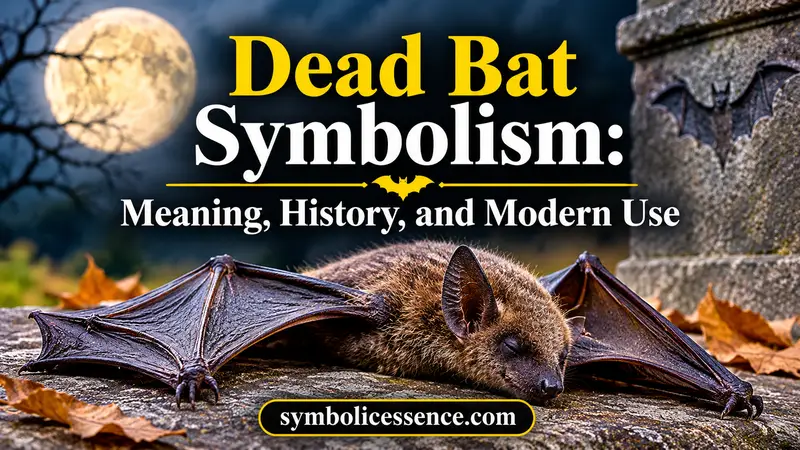
A dead bat can be an unsettling sight, especially when it appears near a home, hangs beneath a roof, or lies along a walking path. Bats are active at night, move quietly through the air, and are often linked with darkness and Halloween imagery. Seeing one dead can bring up questions about endings, fear, change, and the natural cycle of life.
Dead bat symbolism does not have one universally accepted meaning. In modern American interpretations, it is often connected with the end of a difficult period, the loss of something familiar, hidden fears coming into view, or the need to change direction. These are personal and cultural interpretations rather than established facts about what a dead bat predicts.
The meaning also depends on context. A dead bat in a dream, a tattoo, a piece of artwork, and an actual outdoor encounter can each carry a different message. Understanding the animal’s history and its place in American culture helps explain why people attach these ideas to it.
Quick Answer
Dead bat symbolism commonly represents endings, personal change, confronting fear, and leaving old habits behind in modern American interpretations. These associations developed from the bat’s long connection with nighttime, Halloween, folklore, and popular images of death and transformation, rather than from one established historical tradition.
TL;DR
- A dead bat often represents endings and personal change.
- Its nighttime habits helped connect bats with darkness and uncertainty.
- Halloween and vampire stories shaped American attitudes toward bats.
- Some people interpret it as a reminder to face hidden fears.
- Conservation concerns give dead bats a real-world environmental meaning.
- Its meaning in dreams and artwork depends on personal context.
What Does a Dead Bat Look Like?
Bats are small mammals with fur-covered bodies, pointed faces, and wings made from thin skin stretched across elongated finger bones. Their wings are very different from those of birds. They use flexible membranes to make quick turns and control their movement while flying.
In the United States, common species include the little brown bat, big brown bat, Mexican free-tailed bat, and evening bat. Their appearance varies by species, but most have brown, gray, or reddish-brown fur.
A dead bat may be found beneath a tree, near a building, inside an attic, or on the ground near a roosting area. Its wings may be folded against its body, making it look smaller than it does in flight.
These physical details help explain some of its symbolic associations:
- Folded wings: The end of movement or freedom.
- Stillness: A pause after a period of activity.
- Nighttime association: Uncertainty, secrets, and the unknown.
- Small body: Vulnerability and the fragility of life.
These interpretations come from how people view the animal. They are not fixed meanings carried by its physical features.
What Does a Dead Bat Symbolize Today?
The most common modern interpretations center on endings, fear, and change. People often connect the image with something that has reached its natural conclusion or a situation that can no longer continue in the same way.
The end of a difficult chapter
A dead bat can represent the closing of a difficult period. Someone who has recently left a stressful job, ended an unhealthy relationship, or moved away from a harmful situation might see the image as a reminder that one stage of life is over.
This interpretation focuses on closure rather than punishment or bad luck.
Facing hidden fears
Bats are associated with darkness because many species are active after sunset. Their connection with caves, abandoned buildings, and nighttime stories has also made them familiar images of the unknown.
A dead bat may therefore represent a fear that has finally become visible or something that a person no longer wants to avoid.
Losing freedom or independence
A flying bat can suggest movement and independence. When it is dead, the contrast may represent restricted choices, lost opportunities, or the end of a period when someone felt free.
This meaning is especially common in personal artwork and tattoo interpretations.
Change after loss
Death naturally brings associations with endings. However, an ending can also create room for a different beginning.
For some people, the image represents accepting a loss and adjusting to life afterward. It does not necessarily suggest that something bad is about to happen.
Where Did the Bat’s Association With Darkness Begin?
The bat’s association with darkness developed partly from its natural behavior. Many species rest during the day and become active at night. People who rarely saw bats in daylight could easily associate them with caves, shadows, and unfamiliar places.
In European folklore, bats sometimes appeared in stories involving witches, demons, and supernatural creatures. Their unusual wings and nighttime habits made them suitable characters in frightening tales.
However, there was no single European belief about bats. Their meaning varied across regions, periods, and local traditions.
The distinction between a living bat and a dead bat is important. Historical folklore often focused on the animal itself, not on a standardized interpretation of finding its body. There is no strong evidence for one widely shared historical tradition that assigned a specific meaning to a dead bat.
Over time, these older associations helped shape the modern habit of treating a dead bat as an image of fear, loss, or an ending.
How Halloween and Vampire Stories Changed Bat Symbolism in America
Halloween played a major role in making bats recognizable symbols in American popular culture.
During the late 19th and early 20th centuries, Halloween celebrations in the United States increasingly included costumes, decorations, parties, and frightening images. Black cats, ghosts, witches, skeletons, and bats became familiar parts of the holiday’s visual language.
Vampire fiction added another layer. Bram Stoker’s 1897 novel Dracula helped popularize the association between vampires and bats in English-language popular culture. Later films, comic books, and television programs repeated the connection.
By the 20th century, bats were common decorations on Halloween cards, paper cutouts, costumes, and haunted-house displays.
This history helps explain why Americans may interpret a dead bat as a sign of fear, danger, or something unsettling. However, Halloween imagery is entertainment. It does not establish that bats are naturally evil or that finding one predicts misfortune.
What Does a Dead Bat Mean in American Culture?
American interpretations are strongly influenced by popular entertainment, environmental awareness, and personal experience.
Halloween and seasonal decorations
During October, bats appear on front porches, store windows, party invitations, and costumes. A dead bat in a Halloween illustration can make a scene look more disturbing or suggest that something frightening has ended.
The meaning is usually connected with horror entertainment rather than a traditional American belief.
Environmental awareness
Bats also have an important place in American wildlife conservation. They eat insects, support agricultural ecosystems, and help maintain ecological balance.
The deaths of large numbers of bats can be a sign of an environmental problem. White-nose syndrome, a fungal disease affecting hibernating bats, has caused severe population declines in several North American species.
For wildlife supporters, a dead bat may represent habitat loss, disease, or the need to protect local ecosystems.
Personal identity and self-expression
Some Americans use bat imagery to express an interest in gothic fashion, horror art, alternative music, or wildlife conservation.
A dead bat in this setting may communicate a personal relationship with mortality, independence, or the darker side of nature. Its meaning depends on the person using the image.
Art and storytelling
In paintings, photography, films, and illustrations, a dead bat can help establish a mood. An artist might use it to suggest the end of a frightening period, the consequences of neglect, or the vulnerability of living things.
The surrounding details often matter more than the animal alone.
Does Finding a Dead Bat Mean Bad Luck?
Some people associate finding a dead bat with bad luck because bats appear in frightening stories and Halloween decorations. However, there is no reliable historical evidence that a dead bat predicts an accident, illness, financial loss, or another unfortunate event.
The idea of bad luck often comes from the way people respond to unexpected encounters with dead animals. A bat may seem unusual because most people rarely see one up close.
There are several ways people interpret the experience:
- A warning: A reminder to pay attention to a situation that feels unsafe.
- An ending: A sign that something familiar has come to a close.
- A personal reminder: An opportunity to think about changes that have been delayed.
- A natural event: A reminder that wildlife, like all living things, has a life cycle.
None of these interpretations should be treated as a prediction. A dead bat is not proof that something negative will happen.
What Does a Dead Bat Mean in Dreams?
Dreams involving dead animals can feel uncomfortable, especially when the animal has a connection with fear or darkness. A dead bat in a dream may reflect personal worries, recent experiences, or thoughts about something ending.
There is no scientifically established dream dictionary that gives every dead bat dream the same meaning. Personal circumstances are more useful than a fixed interpretation.
Dreaming of finding a dead bat
Finding one in a dream may reflect the discovery of something you have avoided thinking about. For example, a person who has recently recognized problems in a friendship might connect the image with that realization.
Dreaming of a dead bat inside your house
A house often represents personal life, privacy, or family in common dream interpretations. A dead bat inside it may reflect concerns about something uncomfortable entering your private life.
The interpretation depends on the dreamer’s feelings and current circumstances.
Dreaming of several dead bats
Several dead bats may reflect feeling overwhelmed by multiple changes or losses. Someone dealing with several responsibilities might connect the dream with exhaustion or the feeling that too many things are ending at once.
Dreaming of a dead bat coming back to life
This image can suggest reconsidering something previously considered finished. It might relate to an old friendship, a forgotten goal, or an opportunity that appears again.
Dreams are not reliable forecasts. They can be useful starting points for personal reflection, but they should not replace real-world judgment.
The Emotional Meaning: Fear, Loss, and Acceptance
A dead bat can create a stronger emotional response than its small size might suggest. Its unusual appearance and association with nighttime make it an image that can bring together several feelings.
Fear of the unknown: People may feel uncomfortable around animals they rarely encounter. A dead bat can represent the discomfort of facing something unfamiliar.
Grief and loss: The image may remind someone of a recent death, a relationship ending, or an important opportunity that has passed.
Relief after difficulty: For someone leaving a stressful situation, the image may represent the end of a problem rather than the beginning of another one.
Acceptance of change: Seeing a dead animal can remind people that life includes endings they cannot control. This may encourage a more realistic attitude toward change.
The emotional meaning also depends on the person’s relationship with bats. A wildlife enthusiast may feel sadness about the animal’s death, while someone who fears bats may experience anxiety or discomfort.
Neither reaction is unusual. Personal experience plays an important role in how people interpret the same image.
What Does a Dead Bat Represent in Tattoos and Jewelry?
Bat tattoos are common in gothic, alternative, horror-inspired, and nature-themed artwork. A dead bat design is less common, but it can communicate a more specific idea than a regular flying bat.
Dead bat tattoos
A person might choose this design to represent:
- Moving beyond a frightening experience.
- Accepting the end of an important chapter.
- Remembering a personal loss.
- Challenging traditional ideas about death.
- Expressing an interest in gothic art and horror culture.
Design details can change the interpretation. A bat with folded wings may suggest stillness, while a bat beneath a fading moon may communicate an ending or a period of reflection.
Jewelry and personal accessories
Bat-shaped necklaces, earrings, and rings are more commonly decorative than symbolic. They often appear in gothic fashion and Halloween collections.
A piece featuring a fallen or skeletal bat may appeal to someone who likes darker artistic themes. It can also represent an interest in mortality or the natural world.
There is no standard American tradition requiring these designs to represent grief, danger, or bad luck. The wearer’s intention matters most.
How Artists and Writers Use Dead Bats
Artists often use animals to communicate ideas without explaining them directly. A dead bat can serve as a visual detail that changes the mood of an entire scene.
In gothic fiction, it may suggest an abandoned place, a frightening discovery, or the decline of something once active.
In environmental artwork, the same animal can represent the effects of pollution, habitat destruction, disease, or human interference.
Consider two examples:
- A dead bat beneath a broken window in a horror illustration may suggest neglect and danger.
- A dead bat beside a damaged forest habitat in a conservation poster may draw attention to wildlife loss.
These images use the same animal but communicate different concerns. The setting, surrounding objects, and purpose of the artwork determine how viewers understand it.
In literature, a dead bat can also work as a contrast. Its former ability to fly may represent freedom, while its still body suggests that freedom has been interrupted.
Cross-Cultural Interpretations: Why the Meaning Is Not Universal
Bat imagery has different meanings across cultural traditions. However, these meanings should not automatically be transferred to a dead bat.
For example, bats are traditionally associated with good fortune in Chinese visual culture. The Chinese word for bat, fu, sounds like the word for good fortune. Bat designs therefore appear in decorative arts, textiles, and traditional objects as signs of happiness and good luck.
That association concerns the bat as a symbol, not a universal belief about finding a dead one.
European folklore and later Western horror traditions often gave bats a more frightening appearance. These associations helped shape the imagery used in American Halloween celebrations.
The contrast is important. A living bat may appear in one tradition as a sign of good fortune and in another as a frightening creature. Its death does not automatically reverse either meaning.
There is no single worldwide interpretation of a dead bat. It is more accurate to consider the particular cultural setting than to claim that every tradition assigns it the same message.
Common Misunderstandings
Several misunderstandings influence how people interpret these animals.
Misunderstanding 1: A dead bat always represents evil.
This idea is largely influenced by horror stories and popular entertainment. Bats are ordinary mammals with important ecological roles.
Misunderstanding 2: Finding one predicts death.
There is no established evidence that encountering a dead bat predicts the death of a person or another animal.
Misunderstanding 3: All bats are dangerous.
Bats generally avoid people. Although rabies is a genuine concern, most bats do not have the disease. People should still avoid handling them.
Misunderstanding 4: Every dead bat is a sign of disease.
A bat can die for several reasons, including injury, predation, harsh weather, and illness. One observation alone cannot establish the cause.
Misunderstanding 5: A dead bat has one traditional spiritual meaning.
No single documented tradition explains the meaning of every dead bat encounter. Many interpretations found online are modern personal beliefs rather than established historical teachings.
It is useful to separate cultural interpretation from biological facts. A symbol can inspire reflection without becoming evidence of a supernatural event.
The Environmental Meaning: White-Nose Syndrome and Wildlife Loss
There is another important way Americans understand dead bats: as a sign of possible wildlife problems.
White-nose syndrome is a fungal disease that affects bats, especially during hibernation. It was first identified in North America in 2006 and has caused major declines in several bat populations.
The disease affects bats in winter roosts, including caves and mines. Infected animals may use up their stored energy too quickly, making survival difficult.
For wildlife researchers and conservation groups, dead bats can provide important information about the health of local populations.
Their deaths may also draw attention to broader environmental concerns:
- Loss of natural roosting places.
- Disturbance of caves and hibernation sites.
- Changes in local ecosystems.
- Disease affecting vulnerable wildlife populations.
- The importance of protecting native bat species.
This meaning is different from a personal or spiritual interpretation. It is based on real ecological concerns.
A single dead bat does not prove that white-nose syndrome is present. However, multiple dead or dying bats should be reported to the appropriate state wildlife agency or local wildlife authority.
Important safety note: If you find an actual dead bat, do not touch it with bare hands. Keep children and pets away, and contact local animal control or your health department for guidance. If anyone may have touched or been bitten or scratched by the bat, seek medical advice promptly because rabies exposure needs to be assessed.
How the Meaning Has Changed Over Generations
The public image of bats has changed considerably over time, and different generations may respond to them differently.
| Context | Meaning in USA | Common Associations | Notes |
| Traditional folklore | Fear and uncertainty | Night, caves, supernatural stories | Regional beliefs varied considerably. |
| Early 20th-century Halloween | Frightening imagery | Ghosts, vampires, haunted houses | Bats became familiar seasonal decorations. |
| Gothic fashion | Individual expression | Mortality, alternative identity, darkness | The meaning depends on the design and wearer. |
| Wildlife conservation | Environmental concern | Habitat loss, disease, biodiversity | A dead bat may draw attention to ecological problems. |
| Modern personal artwork | Closure and transformation | Loss, acceptance, new beginnings | These are individual interpretations, not established predictions. |
Older popular images often presented bats as creatures to fear or avoid. Movies, comic books, and Halloween decorations helped maintain that image throughout the 20th century.
More recently, wildlife education and conservation campaigns have encouraged Americans to recognize the benefits of bats. Their role in controlling insect populations has become a more visible part of public discussion.
Social media has also made it easier for people to share personal interpretations of unusual animal encounters. Some describe a dead bat as a reminder of change, while others focus on its connection with mortality or gothic art.
As a result, the modern meaning is less tied to one frightening image. It can express personal feelings, artistic interests, or environmental concerns.
FAQs
Is seeing a dead bat a good or bad sign?
It is neither automatically good nor bad. Some people view it as a reminder of change or closure, while others simply see it as an unexpected encounter with wildlife.
Does a dead bat have a spiritual meaning?
Some modern spiritual interpretations connect it with releasing old habits, accepting loss, and moving forward. These ideas are personal beliefs rather than meanings established by one recognized spiritual tradition.
What does a dead black bat symbolize?
A black bat may emphasize themes of uncertainty, fear, mystery, or the unknown. Its color can strengthen the gothic appearance of an image, but it does not create a universal symbolic meaning.
Does a dead bat outside your house mean anything?
Symbolically, some people connect it with changes in family life, personal boundaries, or the closing of an old chapter. In practical terms, bats may die near buildings because of injuries, disease, or environmental conditions.
What does a dead bat symbolize in literature?
Writers may use it to represent interrupted freedom, mortality, decay, or the end of a frightening situation. Its meaning becomes clearer when readers consider the setting and the events surrounding its appearance.
Should I be worried if I find a dead bat?
You should take sensible safety precautions, not assume that it predicts something bad. Avoid touching it, keep pets and children away, and contact local animal control or public health officials for advice.
Does a dead bat represent transformation?
It can represent transformation in modern personal interpretations, especially when someone associates death with the end of an old stage of life. However, transformation is an interpretive meaning, not a documented universal belief about dead bats.
Conclusion
Dead bat symbolism is commonly connected with endings, fear, loss, and personal change. Its modern American meaning has been shaped by European folklore, Halloween traditions, vampire stories, gothic art, and growing awareness of wildlife conservation.
The image does not automatically represent bad luck or predict future events. For some people, it represents leaving an old chapter behind. For others, it brings attention to mortality, environmental problems, or the natural cycle of life.
Ultimately, dead bat symbolism depends on the setting and the person interpreting it. A bat in a gothic illustration, a personal dream, and a real wildlife encounter are three different experiences. Sometimes the most meaningful response is simply to recognize what the image brings to mind while respecting the animal as part of the natural world.