Last Updated: September 29, 2026
Color is one of the most immediate ways writers communicate ideas without directly explaining them. A single color can suggest a character’s emotions, reveal hidden conflicts, represent social values, or create a certain atmosphere within a story. Color symbolism in literature refers to the way authors use colors to represent deeper meanings beyond their physical appearance.
Readers often notice colors in novels, poems, plays, and films because colors connect with human experiences. Red may suggest passion or danger, white may represent innocence or emptiness, and black may suggest mystery, grief, or power. However, meanings are not fixed. A color’s symbolism depends on the culture, historical period, genre, and context of the story.
Understanding color symbolism helps readers look beyond the surface of a text and recognize how authors build themes, characters, and emotional experiences through visual language.
Quick Answer
Color symbolism in literature commonly represents emotions, ideas, character traits, and themes through the use of specific colors. In modern American literature, colors are often used to suggest feelings like love, fear, hope, identity, or conflict, while historical traditions have connected colors with religion, social status, and cultural beliefs.
TL;DR
- Colors reveal hidden themes and emotions.
- Meanings change across cultures and time periods.
- Writers use colors to develop characters.
- American literature uses colors in many genres.
- Context determines each color’s meaning.
What Is Color Symbolism in Literature?
Color symbolism is the practice of using colors as symbols that communicate ideas, feelings, or messages. Instead of simply describing an object’s appearance, an author may choose a color because it adds another layer of meaning.
For example, a writer could describe a character wearing a red dress. The color may represent confidence, desire, danger, rebellion, or something completely different depending on the story.
Colors work as literary tools because humans naturally connect visual experiences with emotions and memories. Writers use this connection to create stronger impressions without explaining every idea directly.
Why Writers Use Colors as Symbols
Authors use colors because symbolism allows them to communicate complex ideas quickly. A carefully chosen color can influence how readers understand a scene or character.
Common reasons writers use colors include:
- Creating mood and atmosphere
- Showing character development
- Representing internal emotions
- Highlighting conflicts
- Connecting objects with larger themes
- Creating contrasts between characters or ideas
For example, a dark setting may create feelings of uncertainty, while bright colors may suggest optimism or celebration. These choices help guide the reader’s emotional response.
Common Color Meanings in Literature
| Color | Meaning in Literature | Common Associations | Notes |
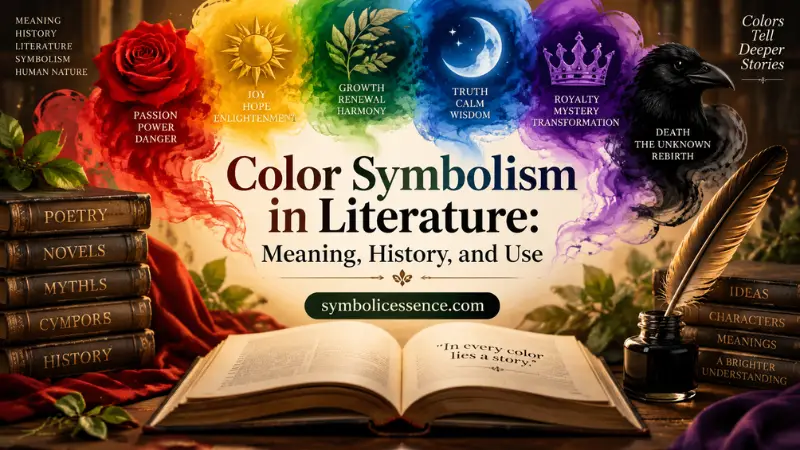
| Red | Passion, danger, love, anger | Desire, violence, energy | Meaning changes based on context |
| White | Purity, innocence, emptiness | Peace, cleanliness, loss | Can also represent isolation |
| Black | Mystery, grief, power | Death, authority, darkness | Not always negative |
| Blue | Calmness, sadness, loyalty | Stability, distance, reflection | Often linked with emotion |
| Green | Growth, nature, jealousy | Renewal, ambition, envy | Frequently appears in symbolic settings |
What Do Different Colors Symbolize in Literature?
Different colors can suggest different ideas in literature, but no color has one universal definition. Writers often build meaning by combining a color with a character, setting, object, event, or recurring theme.
Here are some common literary associations:
Red often suggests love, passion, anger, violence, danger, sacrifice, or strong desire. Its meaning can shift dramatically depending on the scene.
White may suggest innocence, purity, peace, cleanliness, emptiness, surrender, or death. A writer may also use white to create a sense of distance or emotional absence.
Black commonly connects with darkness, grief, mystery, authority, fear, or the unknown. However, it can also suggest elegance, formality, or strength.
Blue may represent calmness, sadness, loyalty, distance, isolation, or reflection. Its meaning often depends on whether the surrounding scene feels peaceful or emotionally cold.
Green can suggest nature, growth, renewal, youth, jealousy, ambition, or inexperience. Writers may use green to contrast natural life with human desires.
Yellow can represent happiness, energy, warmth, caution, sickness, decay, or uneasiness. Its meaning depends heavily on context.
Purple often carries associations with royalty, luxury, spirituality, status, or mystery. Historical access to purple dyes also influenced its association with wealth and power.
Gold can suggest wealth, success, value, achievement, beauty, or excess. A writer may use gold positively or critically to explore material ambition.
Gray often represents uncertainty, neutrality, sadness, age, emotional distance, or a lack of clear identity. It can also create a setting that feels bleak or restrained.
Orange may suggest warmth, excitement, creativity, energy, or danger. Because it combines qualities associated with red and yellow, it can create a vivid or restless atmosphere.
The strongest interpretation comes from examining how the author uses the color rather than relying on a dictionary of symbolic meanings.
Ancient Roots of Color Symbolism
Color symbolism has existed for thousands of years. Ancient societies connected colors with religious beliefs, social roles, nature, and human experiences.
In many early cultures, colors were not simply decorative. They often represented important ideas:
- Gold was associated with wealth, divinity, and achievement.
- Purple was connected with royalty because the dye was historically rare.
- White was often linked with sacredness and purity.
- Red represented life because of its connection with blood.
Religious traditions also shaped many color associations. Different communities developed their own interpretations based on rituals, clothing, art, and ceremonies.
As literature developed, writers borrowed these cultural meanings and adapted them to create new symbolic possibilities.
Color Symbolism in American Literature
In the United States, writers have used colors to explore identity, history, social issues, and personal experiences.
American literature often uses colors to represent:
- Freedom and restriction
- Wealth and inequality
- Nature and survival
- Cultural identity
- Dreams and disappointment
For example, in many American novels, green is connected with ambition and hope. It can represent someone reaching toward a future goal, even when that goal may be unrealistic.
Colors can also reflect American experiences with race, class, politics, and cultural change. Authors frequently use color imagery to explore how individuals see themselves and how society views them.
Examples of Color Symbolism in Famous Literature
Many well-known literary works use color as part of their imagery, characterization, and themes. These examples show why readers should examine a color within the full context of a story.
In F. Scott Fitzgerald’s The Great Gatsby, green is strongly associated with Gatsby’s hopes and his desire for a future connected to Daisy. The green light across the water becomes more than a physical object because it connects to longing, distance, and an uncertain dream.
In Nathaniel Hawthorne’s The Scarlet Letter, the color red plays an important role because of the scarlet letter placed on Hester Prynne. Red connects to shame and punishment within the story, but it also becomes associated with passion, identity, and the complicated consequences of social judgment.
In Herman Melville’s Moby-Dick, white receives unusual attention. Instead of presenting white only as a symbol of purity, Melville explores its connection with fear, mystery, power, and the unknown. The novel demonstrates how an author can challenge familiar color associations.
In Toni Morrison’s The Bluest Eye, color becomes closely connected with beauty, identity, race, and social expectations. The novel examines how cultural standards can shape the way characters see themselves and others.
These works demonstrate an important principle: literary color symbolism does not come from color alone. Meaning develops through repetition, character relationships, imagery, historical context, and the larger themes of the work.
Emotional and Psychological Meaning of Colors
Colors influence how readers emotionally experience a story. Writers use this psychological connection to create stronger scenes.
A character surrounded by warm colors may appear energetic or passionate, while cold colors may create feelings of loneliness or distance.
However, literary color meanings should not be treated as universal psychological rules. A color’s effect depends on the situation.
For example:
- Red may represent love in a romantic scene.
- Red may represent danger during a violent moment.
- Red may symbolize sacrifice in a historical story.
The surrounding details determine the meaning.
Color Symbolism in Character Development
Authors often use colors to reveal personality traits or changes in characters.
A character’s clothing, home, possessions, or environment may contain symbolic colors that reflect their identity.
For example:
- A character wearing white may appear innocent but may later reveal hidden flaws.
- A character surrounded by gold objects may represent ambition or materialism.
- A character associated with gray imagery may symbolize uncertainty or emotional conflict.
These details allow readers to understand characters through suggestion rather than direct explanation.
How to Tell When a Color Is Symbolic
Not every color mentioned in a story functions as a symbol. Sometimes an author uses color simply to describe what a person, place, or object looks like.
A color is more likely to carry symbolic meaning when it connects to a larger pattern in the text.
Look for these clues:
- Repetition: The same color appears several times.
- Emphasis: The author gives unusual attention to the color.
- Character connection: A color repeatedly appears with a particular character.
- Thematic connection: The color relates to a major idea in the story.
- Change: The color appears differently as the character or situation changes.
- Contrast: One color is deliberately placed against another.
- Important moments: The color appears during major turning points or emotional scenes.
For example, one mention of a blue shirt may simply describe clothing. If blue repeatedly appears whenever a character feels isolated, the repeated pattern may support a symbolic interpretation.
Readers should also avoid assuming that repetition automatically proves symbolism. The surrounding language and the work’s broader themes provide stronger evidence than frequency alone.
Color Symbolism vs. Color Imagery: What Is the Difference?
Color imagery and color symbolism are closely related, but they are not exactly the same.
Color imagery uses visual descriptions to help readers picture a scene. A writer might describe a sunset as orange and red to make the setting vivid and memorable.
Color symbolism occurs when a color also points toward a larger idea, emotion, character trait, or theme.
For example, describing a room as gray creates visual imagery. If gray repeatedly appears around a character who feels emotionally detached, the color may also support a symbolic meaning.
The two techniques often work together. Imagery gives readers a visual experience, while symbolism can encourage them to connect that image with a broader meaning.
This distinction helps prevent overinterpretation. Readers should first identify what a color literally describes and then consider whether the text provides evidence for a symbolic layer.
Color Symbolism in Poetry and Fiction
Poets and fiction writers frequently rely on color imagery because it creates strong visual experiences.
Poetry especially uses colors to connect physical images with abstract emotions. A sunset, flower, or piece of clothing may represent ideas such as memory, love, change, or loss.
Fiction writers often repeat certain colors throughout a story to create patterns. When a color appears multiple times, readers may begin to recognize it as connected to a major theme.
Religious and Cultural Interpretations of Colors
Colors can have different meanings depending on cultural background.
For example:
- White may symbolize purity in some Western traditions but may have different associations in other cultures.
- Red may represent celebration in some societies while representing warning or danger in others.
- Black may symbolize mourning in some places while representing elegance and sophistication elsewhere.
Because of these differences, readers should consider the cultural setting of a literary work before deciding what a color means.
How Context Changes Color Symbolism in Literature
Context can completely change the meaning of a color in literature. The same color may communicate opposite ideas depending on the scene, character, culture, or historical period.
Consider red. In a romantic scene, it may support ideas of love or desire. In a violent scene, it may emphasize blood, danger, or conflict. In another story, red may connect with political identity, celebration, sacrifice, or rebellion.
Historical context matters as well. Readers may misunderstand a color if they apply modern associations to a work created in a very different period.
Cultural context also matters. A writer may draw on traditions surrounding clothing, ceremonies, religion, nature, or social status. Those associations can influence how readers understand a color.
The best approach is therefore to ask:
- What is happening when the color appears?
- Which character or object is connected to it?
- Does the color repeat?
- Does another color create a contrast?
- What themes surround the color?
- What cultural or historical associations may matter?
Rather than asking, “What does this color always mean?” literary analysis asks, “What does this color mean here, and what evidence supports that interpretation?”
Color Symbolism in Modern Media and Pop Culture
Today, color symbolism extends beyond books into movies, television, advertising, fashion, and digital culture.
Modern creators use colors to quickly communicate messages:
- Dark colors may create suspense in films.
- Bright colors may create a playful atmosphere.
- Specific color palettes may become connected with certain characters or brands.
Social media and visual storytelling have increased the importance of color choices. Images often communicate emotions before people read any words.
Color Symbolism in Tattoos, Art, and Personal Expression
People also use colors symbolically in personal forms of expression, including tattoos and artwork.
A person may choose a color because it represents:
- A personal memory
- A relationship
- A belief
- A life experience
- An emotional state
For example, someone may choose blue to represent peace or stability, while another person may choose red to represent strength or passion.
The meaning comes from personal experience as much as traditional symbolism.
Common Misunderstandings About Color Symbolism
One common mistake is assuming that every color has one fixed meaning.
A color does not automatically represent one idea in every story. Writers use colors creatively, and meanings can change.
Another misunderstanding is believing that symbolism is always intentional. Sometimes readers create interpretations that are possible but were not necessarily planned by the author.
Strong literary analysis considers:
- The historical period
- The author’s choices
- The story’s themes
- The surrounding details
How to Analyze Color Symbolism in Literature
When analyzing colors in a literary work, ask these questions:
- What color appears repeatedly?
- Where does the color appear?
- Who or what is connected with it?
- How does the color affect the mood?
- Does the meaning change throughout the story?
A color becomes symbolic when it connects to a larger idea. A single mention may only be description, but repeated or meaningful use often suggests symbolism.
FAQs
What does color symbolism mean in literature?
Color symbolism means using colors to represent ideas, emotions, themes, or character traits beyond their literal appearance. Writers use colors to communicate messages indirectly.
Is color symbolism the same in every culture?
No. Color meanings vary across cultures, religions, and historical periods. A color that represents one idea in one society may represent something different elsewhere.
Why do authors use colors instead of directly explaining ideas?
Colors allow writers to create deeper meaning and emotional impact. They encourage readers to interpret themes through imagery rather than simple statements.
What colors are most commonly symbolic in literature?
Red, white, black, blue, and green are among the most frequently used symbolic colors. However, their meanings depend on the context of the work.
Can a color have multiple meanings in the same story?
Yes. A single color can represent different ideas depending on the character, scene, or theme where it appears.
Does color symbolism only appear in classic literature?
No. Modern novels, movies, advertisements, video games, and digital media all use color symbolism.
Can one color symbolize a character?
Yes. Writers may repeatedly associate a character with a particular color through clothing, surroundings, objects, or imagery. This pattern can reinforce the character’s identity or development.
Is color symbolism always intentional?
Not necessarily. Some color choices may serve descriptive or stylistic purposes. Readers should look for textual patterns and supporting evidence before treating a color as deliberate symbolism.
Conclusion
Colors in literature are more than descriptions of appearance. They help writers express emotions, develop characters, and communicate themes that words alone may not fully capture. Color symbolism in literature changes across cultures and time periods, but its purpose remains the same: helping readers discover deeper meanings within stories.
By paying attention to repeated colors, their context, and their connection to characters or themes, readers can better understand the creative choices behind a literary work. Colors are not just visual details—they are part of the language authors use to tell powerful stories.


