Scarlet is a vivid red with a warm, slightly orange cast. Scarlet symbolism is unusually complex because the color can signal passion and confidence in one setting, danger or moral transgression in another, and sacrifice or sacred devotion in a religious setting.
In the United States, scarlet is familiar in fashion, school colors, literature, holiday design, sports branding, religious imagery, and phrases such as “scarlet letter.” Those uses give the color a stronger connection with visibility, intensity, and public identity than softer shades of red.
Its meaning is not fixed, however. Scarlet often inherits the broader associations of red, while history, religion, literature, and social customs add more specific layers.
Quick Answer
Scarlet symbolism most commonly represents passion, confidence, courage, vitality, danger, and intense emotion in modern American culture. Historically, scarlet has also been linked with wealth, sacrifice, religious devotion, sin, public shame, and social status because brilliant red dyes were valuable and the color developed strong biblical and literary associations.
TL;DR
- Scarlet commonly signals passion, confidence, vitality, and boldness.
- Its brightness also makes it effective for danger and warning.
- Costly red dyes once connected scarlet with wealth and status.
- Christian traditions give scarlet meanings of sacrifice, sin, and redemption.
- American literature strengthened its association with public shame.
- Modern fashion often uses scarlet to communicate confidence and visibility.
What the Color Scarlet Actually Looks Like
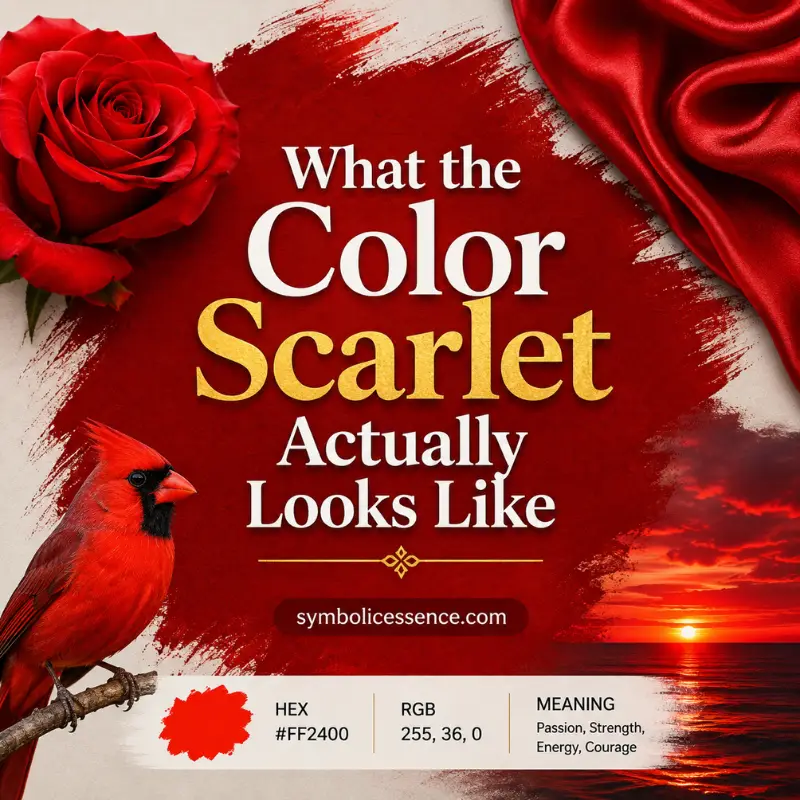
Scarlet belongs to the red family, but it is usually brighter and warmer than crimson or burgundy. It often appears as a vivid red leaning slightly toward orange rather than purple.
That distinction matters symbolically. Dark burgundy can feel restrained, formal, or mature, while bright scarlet tends to appear immediate and energetic. It attracts attention quickly, which helps explain its long association with ceremony, authority, warning, performance, and dramatic clothing.
The word itself has an interesting history. “Scarlet” did not begin simply as the name of a color. In medieval English, related forms referred to an expensive type of cloth, with the word ultimately tracing through French and Latin forms to a Persian term associated with fine fabric. Over time, the name of the valuable material became closely associated with its brilliant red coloring.
What Scarlet Commonly Means in the United States
For many Americans today, scarlet communicates intensity.
That intensity can be positive. A scarlet dress can suggest confidence, romance, glamour, or independence. Scarlet used in a logo, uniform, or sports setting can convey energy, competitiveness, and determination.
The same visual force also supports negative meanings. Scarlet can imply danger, anger, temptation, aggression, or behavior that attracts unwanted attention.
These meanings are not contradictions. They come from the same basic feature: scarlet is difficult to ignore.
Because it is a bright form of red, scarlet largely shares red’s established emotional associations. Research on red-color perception has connected red with both positive and negative high-arousal emotions, including love, passion, anger, excitement, and power. That research generally examines red broadly rather than scarlet as a separate psychological category, so claims about a unique “scarlet psychology” should be treated cautiously.
Scarlet Symbolism at a Glance
| Context | Common U.S. Meaning | Typical Associations | Important Note |
|---|---|---|---|
| Fashion | Confidence and attraction | Glamour, passion, boldness | Meaning depends heavily on styling |
| Religion | Sacrifice and devotion | Blood, martyrdom, sin, redemption | Different biblical passages use red differently |
| Literature | Shame and social judgment | Guilt, adultery, stigma | Strongly influenced by The Scarlet Letter |
| Design | Energy and urgency | Action, heat, attention | Often inherits broader red symbolism |
| Personal symbolism | Courage and intensity | Love, strength, transformation | Individual interpretation can override tradition |
Why Scarlet Became a Color of Wealth and Status
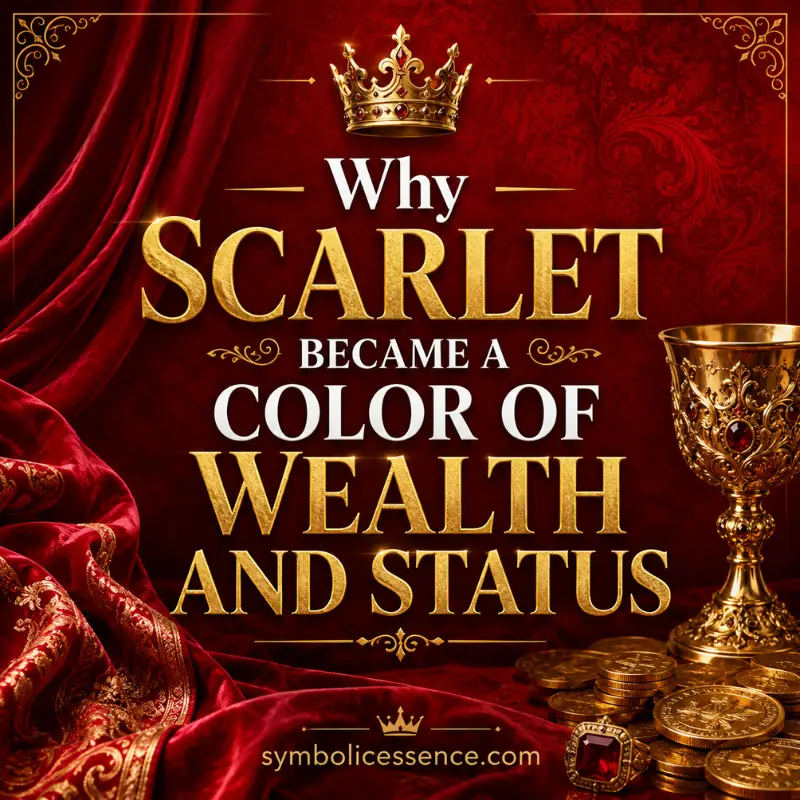
Before modern synthetic dyes, producing vivid, lasting reds could be costly and labor-intensive.
Kermes insects were historically used to produce valued red dyes in Europe and the Mediterranean world. Later, cochineal from the Americas created exceptionally strong reds and became an important international commodity after Spanish colonization brought large quantities of the dye into European markets. Cochineal could produce colors ranging from pinks to brilliant scarlets and dark reds.
When a color is expensive to produce, it naturally becomes easier for wealthy people, political leaders, military officers, and religious institutions to display it prominently.
Scarlet therefore acquired meanings that went beyond beauty. It could communicate money, rank, access, ceremony, and authority.
Modern dyes have made scarlet inexpensive, but the old visual language remains. A scarlet velvet garment, ceremonial robe, or richly decorated room can still feel more luxurious than an ordinary everyday red object.
Scarlet in Biblical and Christian Symbolism
Christian symbolism gives scarlet some of its most contrasting meanings.
In Isaiah, scarlet appears in a comparison between deeply stained sin and cleansing: sins described as scarlet are contrasted with becoming white like snow. That image helped connect scarlet with wrongdoing, guilt, and a stain that seems difficult to remove.
Revelation also uses scarlet in imagery involving luxury, corruption, and moral excess. Those passages contributed to later expressions connecting scarlet with sexual transgression and public disgrace.
Yet it would be inaccurate to say that scarlet simply means “sin” in the Bible.
Scarlet-colored material also appears in sacred and ritual contexts, and later Christian traditions connected red with Christ’s blood, sacrifice, apostles, and martyrs. In contemporary Catholic worship, red is used for occasions including Palm Sunday, Good Friday, Pentecost, and celebrations of martyrs.
Scarlet therefore carries a religious paradox: it can represent human wrongdoing while also recalling blood, sacrifice, faith, and redemption.
How The Scarlet Letter Changed the Color’s Meaning in America
Few works shaped the American understanding of scarlet as strongly as Nathaniel Hawthorne’s 1850 novel The Scarlet Letter.
In the story, Hester Prynne is forced to wear a scarlet “A” after being condemned for adultery in Puritan New England. The visible mark turns private behavior into public judgment.
That image became so culturally familiar that “scarlet letter” developed a broader figurative use. Americans can now describe a reputation, record, label, or past mistake as a “scarlet letter” when it creates lasting stigma or social disgrace. Modern dictionary examples show the expression being used well beyond its original literary context.
This literary influence explains why scarlet has a stronger connection with public shame than many other red shades.
It also illustrates an important point: the color itself did not naturally mean adultery. Literature, religion, and social history taught audiences to make that connection.
Passion, Romance, and Desire
Scarlet also belongs to the romantic side of red symbolism.
In American fashion and visual culture, a bright red dress, lipstick, rose, heart, or evening accessory can communicate attraction, desire, confidence, or romantic intensity. Scarlet works especially well when designers want romance to feel dramatic rather than gentle.
This differs from pink, which is often used for affection, sweetness, or softer romance. Scarlet usually raises the emotional temperature.
Because red has been associated with attraction and sexuality in psychological and cultural research, scarlet may carry similar impressions. These associations are context-dependent, however, and should not be treated as a universal judgment about someone who wears the color.
A person choosing scarlet clothing may simply like bright colors. Symbolism should never be used as evidence of personality, morality, or sexual intent.
Courage, Strength, and Vitality
Blood is one reason humans have long connected red shades with life and physical intensity.
Scarlet can therefore symbolize courage, endurance, vitality, and a willingness to act. Its visual force makes it useful for characters, brands, teams, and organizations that want to appear energetic rather than passive.
Historically, vivid red also appeared in military and ceremonial clothing, strengthening associations with authority, bravery, conflict, and public duty.
In modern American design, these ideas often appear without any direct historical reference. Scarlet used in athletic uniforms, banners, or performance costumes may simply communicate competitive energy and confidence.
For personal use, the color can work as a statement of determination: visible, active, and unwilling to disappear into the background.
Danger, Anger, and Warning
Scarlet’s intensity also gives it a natural place in warning imagery.
Americans are trained from childhood to pay attention to red through traffic lights, stop signs, hazard labels, fire equipment, emergency symbols, and digital alerts. Scarlet is not always the exact shade used in those systems, but it benefits from the same learned relationship between red and urgency.
Psychological studies likewise show that red can draw attention strongly in emotional settings and can carry negative associations involving threat or danger.
Symbolically, scarlet may therefore suggest:
- immediate danger
- anger
- conflict
- heat
- urgency
- forbidden behavior
Context determines whether that intensity feels exciting or threatening.
A scarlet sports car can look energetic. A scarlet warning graphic can feel alarming. The hue is similar, but the surrounding message changes the interpretation.
Shame, Transgression, and Social Judgment
Scarlet’s association with shame deserves special care because it has often been applied unevenly.
Terms such as “scarlet woman” historically connected the color with sexual immorality, especially female sexual behavior. Modern dictionaries still record the expression, although it is old-fashioned and carries a strongly judgmental tone.
Such language reflects cultural attitudes rather than an objective property of the color.
In American literature and older moral language, scarlet could mark someone as visibly outside accepted social rules. The emphasis was not merely on guilt; it was on being seen and judged.
That distinction remains useful when interpreting scarlet in fiction, costume design, or visual art. A character dressed in scarlet may represent rebellion against social expectations just as easily as shame imposed by them.
Modern readers should also recognize the gendered history behind some of these associations instead of repeating them as neutral truths.
Scarlet as a Symbol of Rebellion and Defiance
A color associated with visibility can easily become a color of resistance.
Scarlet clothing can communicate refusal to remain unnoticed. In stories or visual design, it may distinguish someone from a restrained environment dominated by gray, black, beige, or white.
That contrast can make scarlet symbolize independence, rebellion, forbidden desire, or emotional honesty.
The meaning becomes especially strong when social rules encourage modesty or conformity. A scarlet object placed in that environment visually challenges the surrounding order.
This does not mean scarlet universally represents rebellion. Rather, designers and storytellers often use its contrast and historical associations to create that impression.
Emotional and Psychological Meaning
Scarlet tends to communicate high emotional intensity rather than emotional calm.
Someone may experience the color as exciting, energizing, romantic, aggressive, festive, or overwhelming depending on the setting. Research on color-emotion relationships generally places red among colors associated with high-arousal states, including both positive emotions such as love and negative emotions such as anger.
That helps explain why scarlet rarely feels neutral.
In a quiet room, a scarlet chair becomes a focal point. In an outfit, scarlet shoes can become the feature people remember. In digital graphics, a scarlet button can suggest urgency or importance.
Psychological symbolism should still be treated as association rather than biological destiny. Personal experience, culture, lighting, neighboring colors, and context all influence how someone responds.
Scarlet in Fashion, Beauty, and Personal Style
Scarlet is often chosen when subtlety is not the goal.
A scarlet evening dress can appear theatrical or glamorous. Scarlet lipstick can evoke classic Hollywood styling, while scarlet shoes or handbags can give a neutral outfit a strong focal point.
Because the color carries both romantic and authoritative associations, it can communicate several identities at once: elegant, assertive, sensual, rebellious, or celebratory.
The surrounding materials also matter.
Scarlet velvet may suggest luxury. Scarlet leather can appear bold or rebellious. Scarlet satin often feels formal or romantic. A simple scarlet cotton shirt can instead seem sporty or casual.
Color meaning never operates alone. Fabric, silhouette, occasion, and cultural expectations shape the final message.
Scarlet in Tattoos and Personal Symbols

Scarlet works especially well in tattoo imagery involving blood, flowers, fire, hearts, birds, religious symbols, or transformation.
In that setting, common interpretations include:
- passionate love
- courage after hardship
- emotional intensity
- sacrifice
- survival
- vitality
- rebellion
A scarlet rose, for example, may emphasize romantic passion. Scarlet flames may represent anger or renewal. A scarlet religious motif may refer to sacrifice or martyrdom.
Tattoo symbolism is highly personal, so no color meaning should be assigned without considering the entire design. The same scarlet pigment can communicate romance in one tattoo and grief, danger, or resilience in another.
Scarlet in American Holidays, Decor, and Public Culture
Scarlet appears frequently in American seasonal design because it is visually strong and pairs easily with familiar holiday palettes.
During Christmas, bright reds work with green, white, silver, and gold to create a festive look. Around Valentine’s Day, scarlet joins red and pink in designs centered on hearts, flowers, romance, and affection.
Outside holidays, scarlet is common in school colors, sports uniforms, banners, theater costumes, restaurant branding, packaging, and promotional graphics.
In these settings, its meaning is usually practical as well as symbolic. Scarlet is chosen because it stands out.
That visibility can become part of group identity. When an institution repeatedly uses scarlet on uniforms, signs, merchandise, and ceremonial objects, the color comes to represent belonging, loyalty, pride, and shared history for members of that community.
Cross-Cultural Meanings of Scarlet and Red
Scarlet should not be given one worldwide definition.
Across many cultures, red has carried meanings involving life, blood, status, protection, celebration, danger, fertility, political authority, or sacred ritual. The exact meaning changes substantially from one place and period to another.
Cochineal-based reds, for example, had important uses in Indigenous cultures of Mexico and Central America before European colonization. The dye later became globally valuable after being exported to Europe, where brilliant red textiles gained strong associations with wealth and prestige.
In some East Asian contexts, red broadly carries festive or auspicious associations. However, it is safer to speak of red traditions rather than claiming every specific shade called scarlet has an identical cultural meaning.
This distinction prevents a common mistake: treating modern English color labels as though every culture historically divided colors into exactly the same categories.
Common Misunderstandings About Scarlet
The first misunderstanding is that scarlet always means sin.
That interpretation is important in certain biblical, literary, and historical contexts, but scarlet can just as legitimately symbolize sacrifice, courage, celebration, luxury, or romantic passion.
The second mistake is treating scarlet and red as completely different symbolic systems. Scarlet usually inherits much of red’s symbolism. Its brightness and specific cultural history simply add extra associations.
A third mistake is assuming color symbolism can reveal a person’s character. Wearing scarlet does not prove that someone is confident, rebellious, romantic, angry, or sexually expressive.
Finally, scarlet should not automatically be assigned a political meaning simply because modern American political graphics use red. Political “red” and traditional scarlet symbolism overlap visually, but they are separate systems of association.
How Scarlet’s Meaning Has Changed Over Time
Scarlet’s history can be understood as a shift from material value to cultural meaning.
Early associations came partly from the difficulty of making brilliant, lasting reds. Expensive cloth and dye connected scarlet with wealth, rank, ceremony, and institutional authority.
Religious texts and traditions added ideas of blood, sacrifice, transgression, purification, and martyrdom.
Literature later strengthened the connection between scarlet and social judgment, particularly in the United States through The Scarlet Letter.
Industrial dyes eventually removed much of the color’s economic exclusivity. Anyone could wear a bright scarlet garment.
Yet its older associations survived.
Today, scarlet can simultaneously feel luxurious, romantic, dangerous, sacred, rebellious, festive, or shameful. Modern symbolism did not replace the older meanings; it layered new ones over them.
FAQs
Is scarlet a positive or negative symbol?
Scarlet can be either. Positive meanings include passion, courage, vitality, celebration, confidence, and sacrifice, while negative meanings include danger, anger, temptation, shame, and social judgment.
What does scarlet symbolize in the Bible?
Scarlet can represent sin or moral stain in passages such as Isaiah, while other biblical uses involve valuable textiles and sacred ritual. Christian traditions also connect red shades with Christ’s blood, sacrifice, apostles, and martyrs.
What does scarlet mean spiritually?
In Christian settings, scarlet may suggest sacrifice, blood, martyrdom, repentance, or redemption. Outside a specific tradition, claims that scarlet has one universal “spiritual vibration” are cultural interpretations rather than established facts.
What does a scarlet tattoo symbolize?
A scarlet tattoo may represent passion, courage, love, sacrifice, rebellion, survival, or emotional intensity. The image itself matters more than the pigment alone, so a scarlet rose and a scarlet flame can communicate very different ideas.
Why is scarlet associated with shame?
Biblical language contributed to associations between scarlet and wrongdoing, while Nathaniel Hawthorne’s The Scarlet Letter made public shame especially important in American culture. The modern phrase “scarlet letter” can describe a lasting mark of stigma even when adultery is not involved.
What is the difference between scarlet and crimson symbolism?
Scarlet is generally brighter and warmer, so it often feels energetic, visible, passionate, or urgent. Crimson is darker and can appear more solemn, formal, dramatic, or ceremonial, although the symbolic meanings of the two colors overlap heavily.
Conclusion
Scarlet symbolism centers on visibility and intensity. In modern American culture, the color most often suggests passion, courage, attraction, confidence, vitality, danger, or urgency, while older religious and literary traditions add meanings of sacrifice, moral transgression, public shame, and redemption.
Its history also explains why scarlet can still feel luxurious or authoritative. Brilliant red dyes once required valuable materials and specialized production, giving the color associations with wealth and status long before synthetic dyes made it widely accessible.
Scarlet has no single message that applies everywhere. Its meaning comes from the interaction between an attention-grabbing color and the cultural setting in which people choose to use it.


