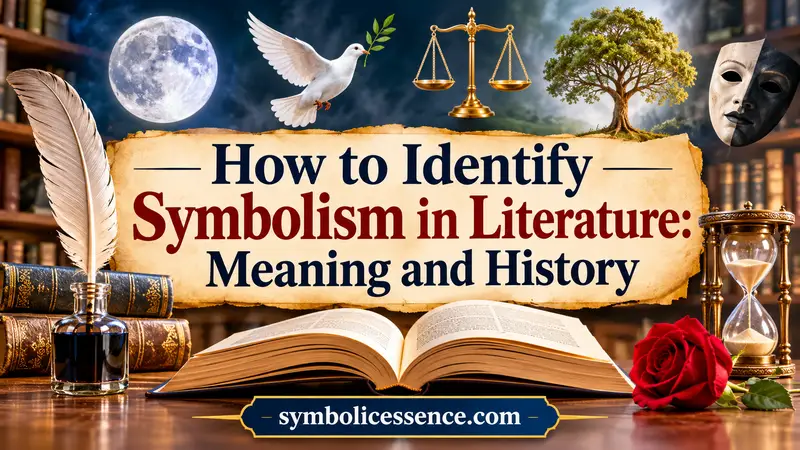
A red rose in a love story may represent romance, while a locked door in a mystery may suggest secrets, fear, or something a character cannot face. These details do more than describe what happens in a story. They can communicate ideas that the writer never states directly.
Learning how to identify symbolism in literature helps readers recognize these hidden layers of meaning. A character’s clothing, a changing season, a repeated object, or even the weather can suggest something beyond its ordinary purpose.
In American classrooms, book clubs, and literary discussions, readers often study these details to understand characters, themes, and the writer’s message. However, not every object represents something else. The key is learning how to recognize meaningful patterns without assigning a meaning that the text does not support.
Quick Answer
To identify symbolism in literature, look for objects, characters, colors, settings, or events that carry meaning beyond their literal purpose. Pay attention to repeated details, unusual descriptions, important moments, and connections to the story’s main themes. A symbol’s meaning should be supported by its context, not simply by a reader’s personal guess.
TL;DR
- Symbols communicate ideas beyond their ordinary, literal meaning.
- Repeated objects and images deserve closer attention.
- Colors, weather, and settings can suggest emotional or thematic ideas.
- Historical and cultural context can change a symbol’s meaning.
- A strong interpretation needs evidence from the actual text.
- Symbols can have several related meanings within one story.
What Does Symbolism Look Like in a Literary Work?
Symbolism occurs when a writer uses something recognizable to represent an additional idea. The object, action, or image still has its ordinary meaning, but it also suggests something more.
For example, a character might carry an old photograph throughout a novel. Literally, it is a picture of someone. However, if the character looks at it whenever they feel lonely, the photograph may represent memory, family connections, or an inability to move on from the past.
Writers use different forms of symbolic details, including:
- Objects: A key may suggest access, freedom, or a secret.
- Colors: White may suggest innocence, while red can suggest love or danger.
- Animals: A bird may represent freedom or the desire to escape.
- Settings: An empty house may suggest loneliness or a broken family.
- Weather: A storm may accompany conflict or emotional confusion.
- Actions: Breaking a chain may represent independence or release.
These meanings are not fixed rules. A bird in one story might represent freedom, while in another it could suggest confinement if it lives inside a cage.
The surrounding story determines which interpretation makes sense.
Start by Looking Beyond the Literal Meaning
The first step is to separate what happens in a story from what that event might suggest.
Imagine reading a novel in which a young woman receives a key from her grandmother. At first, the key appears to be an ordinary household object. Later, the reader discovers that it opens a room containing family letters.
The literal meaning is simple: the key opens a door.
Its possible symbolic meaning is more complicated. It may represent access to family history, the discovery of secrets, or a connection between generations.
Ask yourself three questions:
- What is this object or event doing in the story?
- Why might the writer have included it?
- Does it connect to a larger idea or conflict?
Do not immediately decide that every detail has a hidden message. Writers include ordinary objects to make fictional settings believable. Symbolic interpretation becomes more convincing when a detail receives unusual attention or contributes to the story’s larger meaning.
Notice Which Objects and Images Keep Appearing
Repetition is one of the most useful clues when examining a literary work.
When a writer mentions the same object, image, or description several times, it may connect separate moments or reinforce an important theme.
Consider a fictional story about a family that keeps an old clock in its living room. The clock appears during childhood memories, family arguments, and the final chapter.
Its repeated presence could suggest the passage of time, family traditions, or the way past experiences affect the present.
Look for:
- Objects mentioned in several chapters.
- Images that appear during important decisions.
- Similar descriptions used for different characters.
- Repeated references to particular sounds or colors.
- Details that become more important near the ending.
However, repetition alone does not prove symbolism. A clock might appear frequently because the story takes place in a clock shop.
The stronger clue is a meaningful connection between the repeated detail and the story’s central concerns.
Pay Attention to Colors and Their Changing Meanings
Colors often help writers communicate mood, character development, and contrasting ideas.
American readers commonly associate red with love, anger, danger, or passion. White may suggest innocence or cleanliness, while black can suggest grief, fear, or authority.
But these associations depend on the situation.
For example, a character wearing white at the beginning of a story might appear innocent. If that same character wears white after making a difficult decision, the color could suggest a fresh start instead.
Look at these common literary associations:
| Color | Possible Meaning | Common Literary Associations | Important Consideration |
| Red | Passion, danger, anger | Love, violence, strong emotions | The character’s actions help establish its meaning. |
| White | Innocence, peace, renewal | Weddings, beginnings, purity | It can also suggest emptiness or isolation. |
| Black | Grief, fear, authority | Death, mystery, social power | Clothing and setting affect interpretation. |
| Green | Growth, envy, renewal | Nature, ambition, jealousy | It may carry positive or negative meanings. |
| Blue | Calm, sadness, stability | Water, emotional distance, peace | The surrounding descriptions matter. |
A good interpretation does not depend on memorizing color meanings. Instead, examine how the writer uses a color in a particular scene and whether its meaning changes as the story develops.
Study the Setting, Weather, and Natural World
The physical environment can communicate ideas about a character’s situation.
A writer might place a character in a crowded city to emphasize pressure, competition, or loneliness. Another might use an isolated countryside setting to suggest independence, separation, or a desire for peace.
Weather can also contribute to the meaning of a scene.
Consider these examples:
- Heavy rain: May accompany sadness, danger, or emotional conflict.
- Sunrise: Can suggest a new beginning or a change in direction.
- Winter: May represent hardship, loneliness, or a period of waiting.
- Spring: Often suggests growth, renewal, or new opportunities.
- A dry landscape: Can suggest hardship, scarcity, or emotional emptiness.
One well-known example appears in F. Scott Fitzgerald’s The Great Gatsby. The green light across the water represents Gatsby’s longing for Daisy and the future he imagines with her.
Its meaning connects to the story’s larger concerns about desire, wealth, and the American Dream.
This example also shows why context matters. Green does not automatically mean hope in every novel. Its meaning comes from how the writer connects the image to a character and the events surrounding it.
Examine Characters and Their Actions for Symbolic Clues
Sometimes a character represents an idea that extends beyond their individual personality.
A fictional character who repeatedly refuses unfair treatment might represent independence or resistance. Another who sacrifices personal goals to protect family members might represent loyalty or responsibility.
Writers can communicate these ideas through:
- A character’s repeated decisions.
- Their relationships with other people.
- Changes in their behavior.
- Clothing and personal belongings.
- Their reactions to important events.
A useful example is Atticus Finch in Harper Lee’s To Kill a Mockingbird. His commitment to defending Tom Robinson connects his character to questions of justice, fairness, and moral responsibility.
The character is still an individual within the story, but his choices also help readers consider larger social ideas.
When examining a character, avoid reducing them to a single symbolic label. A person in a novel can represent several ideas while remaining a complicated fictional individual.
Understand How Historical Events Shape Literary Symbols
Symbolism did not begin with modern novels. Writers and storytellers have used objects, animals, colors, and natural images to communicate additional meanings across many periods.
In ancient Greek literature, for example, animals and objects could connect characters to particular gods, virtues, or dangers. Medieval European literature frequently used religious images and moral allegories to communicate ideas about good and evil.
During the Renaissance, writers increasingly explored classical references, human experience, and complex poetic imagery.
Later literary movements brought different approaches.
Romanticism: Writers such as William Wordsworth used nature to express emotional experience, imagination, and the relationship between people and the natural world.
Realism: Nineteenth-century writers often used everyday objects and settings to reveal social conditions, class differences, and personal struggles.
Modernism: Writers experimented with recurring images and fragmented storytelling. T. S. Eliot’s The Waste Land, published in 1922, uses images of dryness, water, and seasonal change to explore cultural and personal disconnection.
These developments show that literary symbols reflect the concerns of their periods. A symbol may retain an older association while gaining new meanings as society changes.
Consider Cultural and Religious Backgrounds Before Choosing a Meaning
A symbol does not communicate exactly the same thing to every reader.
Cultural background, religious traditions, historical experiences, and social customs can influence how people understand particular images.
For example, a dove is commonly associated with peace in American culture. It also has specific meanings in Christian traditions, where it can represent the Holy Spirit.
Similarly, an apple can suggest knowledge, temptation, health, or ordinary daily life depending on the story.
Consider the difference between:
- A wedding ring representing commitment in a family novel.
- A broken ring suggesting separation in a tragedy.
- A ring associated with authority or power in a fantasy story.
The object stays recognizable, but its meaning changes with the cultural and narrative setting.
When reading literature from another country or historical period, do not assume that a familiar American interpretation applies. Ask what the object meant to the people and communities connected to the story.
Use the Story’s Main Theme to Test Your Interpretation
A theme is a larger idea that a literary work explores. Common themes include freedom, family, ambition, identity, justice, love, and loss.
Symbols often help communicate these themes without stating them directly.
For example, in The Great Gatsby, the green light connects to Gatsby’s hopes and his desire to recover an imagined future. This interpretation becomes more convincing because it supports the novel’s broader exploration of ambition, longing, and the American Dream.
Try this simple method:
- Identify the main conflict.
- Determine what the writer seems to be examining.
- Find an object or image connected to that conflict.
- Explain how the detail supports the larger idea.
Suppose a story focuses on a teenager trying to leave a controlling household. A locked bedroom door might represent privacy, independence, or separation from family expectations.
The interpretation becomes stronger if the door appears during important moments in the character’s struggle.
A symbol should contribute to the story rather than exist as an unrelated guess.
Distinguish Symbolism From Metaphors, Similes, and Motifs
These literary devices are related, but they do different jobs. Understanding the differences makes interpretation more accurate.
Symbolism happens when an object, person, place, or action represents an additional idea. A broken mirror might suggest a damaged identity.
Metaphor directly compares two different things without using words such as “like” or “as.” For example, saying “Time is a thief” compares time to someone who steals.
Simile makes a comparison using words such as “like” or “as.” For example, “Her voice was as soft as rain.”
Motif is a recurring element, such as an image, phrase, or situation, that helps develop a theme. Repeated references to doors throughout a novel might form a motif connected to choices and opportunities.
These devices can overlap. A recurring image can become a motif, while its repeated use can also contribute to the work’s symbolism.
Recognizing the difference helps readers explain not only what a writer uses but also how that detail functions.
Read Important Scenes Carefully Instead of Guessing
Some of the best symbolic clues appear during moments of change.
A character may receive an object before making a major decision. A familiar place may look different after a loss. A natural image may appear just before or after a turning point.
These moments deserve attention because writers often use descriptive details to connect events with emotional or thematic changes.
For example, imagine a novel in which a character plants a tree after losing a family member.
The action could represent remembrance, hope, continuity, or the desire to create something lasting.
To understand its possible meaning, read the surrounding paragraphs. What happened before the tree was planted? What does the character say? Does the tree appear again later?
A single sentence may not provide enough evidence. Reading the complete scene often reveals connections that are easy to miss when focusing on an isolated phrase.
Use a Simple Method to Write About Symbolism in an Essay
Recognizing a symbol is only part of the task. Students often need to explain their interpretation in a classroom assignment or literary essay.
A useful approach is to follow three steps: identify, support, and explain.
Step 1: Identify the detail.
Name the object, image, character, or event that you believe carries additional meaning.
Step 2: Support your interpretation.
Use a specific moment from the text. Explain where the detail appears and what happens around it.
Step 3: Connect it to a larger idea.
Describe how the detail contributes to the character’s development, the main conflict, or the story’s theme.
For example:
“In the novel, the locked door represents the main character’s desire for independence. It appears whenever the character struggles against family expectations. Its repeated presence connects to the larger theme of personal freedom.”
This explanation works because it identifies the object, provides a reason for the interpretation, and connects it to a larger idea.
Avoid writing that an object “means freedom” without explaining why. A good literary argument shows the reader how the interpretation develops from the text.
Common Mistakes Readers Make When Interpreting Symbols
Symbolic interpretation requires attention, but it does not need to become complicated. Several common mistakes can lead readers away from what a writer actually communicates.
Assuming every object is symbolic: A cup, chair, or window may simply describe a scene. Look for meaningful emphasis or connections before assigning an additional meaning.
Using one universal meaning: A snake can suggest danger in one story and transformation or wisdom in another. The context matters more than a memorized definition.
Ignoring the historical period: A reference that made sense to nineteenth-century readers may require additional background for a modern audience.
Confusing personal feelings with textual evidence: A reader may associate rain with happiness, but the writer may use it to create tension. Personal reactions are useful starting points, not final proof.
Ignoring the ending: A recurring object may gain a different meaning after the final events. Consider the entire work before settling on an interpretation.
Overlooking irony: A symbol may communicate something different from what a character believes it represents. Writers sometimes use this contrast to create criticism or humor.
The goal is not to discover a secret meaning behind every sentence. It is to make a reasonable interpretation supported by the writer’s choices.
How Modern American Readers Use Symbolism
Symbolic interpretation remains part of American reading culture, particularly in schools, universities, book clubs, and online literary discussions.
Teachers often ask students to examine recurring objects, colors, and settings because these details help explain themes and character development.
For example, students studying The Great Gatsby may discuss the green light and its connection to the American Dream. Readers of To Kill a Mockingbird may examine the mockingbird as an image associated with innocence and the harm caused by injustice.
Modern readers also encounter symbolism outside traditional novels.
- Movies: Directors use lighting, clothing, and repeated objects to communicate ideas visually.
- Poetry: Writers use natural images and everyday objects to express emotions indirectly.
- Graphic novels: Color, visual patterns, and character design can carry symbolic meaning.
- Social media: Readers share interpretations of famous literary images and passages.
- Book clubs: Members compare different interpretations of the same character or object.
The internet has made literary discussions easier to share, but popular interpretations still need evidence. A widely repeated explanation is not automatically the correct one.
Reading closely and considering different viewpoints remain useful skills, especially when a story includes cultural references that modern audiences may interpret differently.
FAQs
What is the easiest way to recognize symbolism in a book?
Start by looking for repeated objects, unusual descriptions, and images connected to important events. Then consider whether these details support a larger theme or character development. A possible interpretation becomes stronger when several parts of the story support it.
Can one object represent more than one idea?
Yes. An object can carry several related meanings, especially when its significance changes during a story. For example, a family photograph might initially represent love but later suggest grief, memory, or unresolved conflict.
Is symbolism always intentional?
Not every possible interpretation reflects a meaning the writer deliberately planned. Some meanings develop through cultural associations or connections readers notice after publication. The strongest explanations remain grounded in the text rather than assumptions about the writer’s private intentions.
Can symbolism appear in short stories and poems?
Absolutely. A short story might use one recurring object to connect its beginning and ending, while a poem may build its entire meaning around a single image. Symbolism does not depend on the length of a literary work.
What is the difference between a symbol and a theme?
A symbol is a detail that represents an additional idea, while a theme is a larger subject or message developed throughout a work. For example, a locked door may symbolize limited freedom, while freedom itself may be one of the story’s main themes.
Do writers always explain what their symbols mean?
No. Many writers leave symbolic meanings open to interpretation rather than explaining them directly. This allows readers to examine the story’s details and develop interpretations supported by its language and events.
Can a reader interpret a symbol differently from the writer?
Yes, readers can bring different cultural backgrounds and experiences to a story. However, a convincing interpretation should still fit the text, its historical setting, and the events within the work. Personal interpretation does not mean every explanation is equally supported.
Conclusion
Learning how to identify symbolism in literature means paying attention to the relationship between ordinary details and larger ideas. Objects, colors, characters, settings, and repeated images can communicate themes that a writer does not express directly.
The most reliable approach is to examine the context, notice patterns, consider historical and cultural background, and support each interpretation with evidence from the text. A red rose might suggest love, but its meaning becomes clearer when readers understand who gives it, why it appears, and what happens afterward.
The next time a familiar object appears several times in a novel, pause before turning the page. Its changing role may reveal something important about the character, the conflict, or the story’s final message.