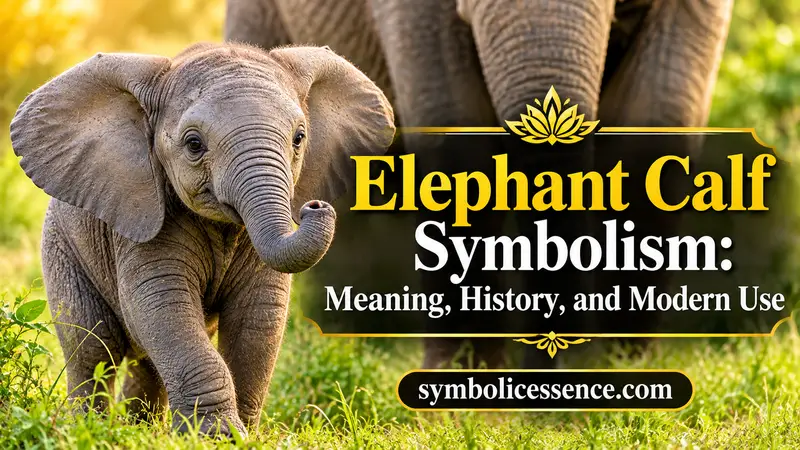
An elephant calf is a young elephant, usually seen walking close to its mother or exploring the world under the watchful eyes of its herd. Its small size, playful behavior, and close family relationships make it a recognizable image of childhood and care. Even as a newborn, an elephant calf is a large animal, but beside the adults, it looks small and dependent.
People often search for elephant calf symbolism when they see one in a dream, encounter its image in artwork, consider an elephant tattoo, or want to understand what a baby elephant represents as a gift. The meaning often connects to family, innocence, protection, patience, and the early stages of personal growth.
In American culture, baby elephants appear in children’s stories, wildlife photography, conservation campaigns, nursery decorations, jewelry, and personal artwork. Their meaning is not limited to one belief system. It often comes from the real behavior of elephants and the emotional reactions people have to their young.
Quick Answer
Elephant calf symbolism commonly represents innocence, family bonds, protection, new beginnings, and learning through experience. These associations come largely from the close relationships between young elephants and their mothers and herd members, while older cultural traditions have also connected elephants with wisdom, good fortune, and strength.
TL;DR
- Innocence: Represents childhood, curiosity, and a fresh outlook.
- Family: Reflects close relationships and support from loved ones.
- Protection: Connects to maternal care and the safety of a herd.
- Growth: Represents learning, development, and gradual independence.
- Good fortune: Draws on older cultural associations with elephants.
- Conservation: Reminds people of wildlife protection and endangered species.
What Does an Elephant Calf Look Like?
An elephant calf has many features of an adult elephant, but its proportions give it a noticeably younger appearance. It has a rounded body, relatively short legs, large ears, a small trunk, and soft-looking skin with folds and wrinkles.
A newborn African elephant calf generally weighs around 200 pounds, although its size varies. Asian elephant calves are often somewhat smaller. Both species depend heavily on their mothers during their early development.
One of the most recognizable features is the calf’s trunk. Young elephants do not immediately have the same control over it as adults. They may swing it around, step on it, or struggle to coordinate its movements while learning how to use it.
These physical details help explain why people associate baby elephants with:
- Childhood and innocence.
- Curiosity about the world.
- Learning through mistakes.
- Dependence on family.
- Physical and emotional development.
Photographs often show calves touching their mothers with their trunks, standing beneath their bodies, or playing with other young elephants.
These scenes provide the visual foundation for many modern interpretations of the animal.
The Main Meanings Associated With Baby Elephants
The meaning of a young elephant depends on its setting, the surrounding artwork, and the person interpreting it. However, several associations appear frequently.
Innocence and childhood
A young elephant represents the early stages of life. Its playful movements and curiosity remind people of children discovering their surroundings. This association makes it a natural choice for nursery decorations, baby gifts, and children’s illustrations.
Family and belonging
Elephant calves grow up within close family groups. Their relationships with mothers, older sisters, and other females make them recognizable symbols of family support.
Protection and safety
A calf surrounded by adult elephants suggests security. The adults help guide and protect younger members, making the image suitable for expressing care and responsibility.
Learning and development
A young elephant needs time to develop its physical abilities and social skills. This makes it an image of patience, education, and gradual improvement.
New beginnings
A newborn animal can represent a new chapter in someone’s life. People may connect a baby elephant with a new family member, a personal goal, or the beginning of a different stage of life.
These meanings are related, but they are not identical. A baby elephant standing beside its mother emphasizes family, while one exploring alone may suggest curiosity and independence.
Why Elephant Calves Represent Family and Protection
One of the strongest reasons people connect young elephants with family is their actual social behavior.
Female elephants usually live in family groups that include mothers, daughters, sisters, and their offspring. These groups often have an experienced older female, known as a matriarch, who helps guide the family.
A calf receives care from more than its mother. Other females may stay nearby, help protect it, and guide its movements. Researchers call this behavior allomothering, which means that an animal other than the biological mother provides care.
This behavior gives the image of a baby elephant surrounded by adults a real foundation.
Consider a familiar scene: a young calf walks through grass while several adult females remain close. The calf may stop to investigate something, but the adults maintain their position around it.
For people, this scene can represent:
- Parents looking after their children.
- Grandparents helping younger family members.
- Older siblings supporting younger ones.
- Communities sharing responsibility.
- The importance of having a reliable support system.
A family elephant illustration can therefore communicate something more specific than general affection. It can represent the idea that raising and protecting young members is a shared responsibility.
Where Did the Symbolism of Young Elephants Begin?
There is no single documented historical origin for the specific symbolism of elephant calves. Their modern meaning developed through a combination of real animal behavior, older cultural views of elephants, religious traditions, and popular storytelling.
Elephants have appeared in human art and cultural traditions for thousands of years. In South Asia, they were associated with royalty, warfare, ceremonial life, and religious imagery. In parts of Africa, elephants have held important cultural and practical roles in communities living near them.
However, it is important to distinguish the symbolism of elephants generally from the symbolism of their young.
Historical artwork often emphasized adult elephants because of their size, strength, and importance in royal processions, military life, and ceremonial settings. Baby elephants did not always have a separate, clearly defined symbolic meaning.
Over time, illustrations and stories began presenting young elephants as recognizable characters with their own personalities.
In the United States, children’s literature, animated films, zoo displays, and wildlife photography helped establish the baby elephant as an image of childhood, family affection, and vulnerability.
Its modern interpretation is therefore not the result of one ancient tradition. It reflects several different influences that developed over time.
How Different Cultures Interpret Elephants and Their Young
Elephants have important cultural associations in several parts of the world. Their young may share some of these associations, although not every tradition gives elephant calves a separate meaning.
South Asian traditions
In Hindu traditions, elephants are associated with Ganesha, the elephant-headed deity widely connected with wisdom, learning, and the removal of obstacles.
Ganesha is not an elephant calf, and his symbolism should not be confused with the meaning of a baby elephant. However, his widespread cultural presence has helped make elephants familiar images of good fortune and new beginnings.
In parts of South Asia, elephants have also been associated with royal ceremonies, festivals, and traditional artwork.
Buddhist communities
Elephants appear in several Buddhist traditions and stories. White elephants, in particular, have a recognized place in Buddhist accounts concerning the life of the Buddha.
Some Buddhist communities in Asia also have traditions surrounding the birth of elephant calves. These practices can reflect the belief that a new animal life deserves recognition and care.
The exact practices differ by community, and they should not be treated as universal Buddhist customs.
African cultural traditions
Elephants have long been part of the cultural and practical lives of communities across Africa. Their presence in stories, artwork, oral traditions, and local knowledge varies considerably by region.
In some communities, elephants may represent strength, leadership, memory, or the importance of family relationships. These meanings do not automatically apply to every elephant calf.
Modern Western culture
In the United States and other Western countries, young elephants are commonly presented as affectionate, curious, and playful animals.
Children’s books, wildlife documentaries, toys, and conservation campaigns have helped shape this interpretation.
The important distinction is that cultural meanings depend on specific traditions. There is no single worldwide interpretation of a baby elephant.
What Does an Elephant Calf Mean in American Culture?
In the United States, a baby elephant is often associated with family life, childhood, and affection.
Its appearance in children’s products is especially common. Parents may choose elephant-themed blankets, stuffed animals, wall art, and clothing because the animal has a friendly appearance and recognizable shape.
Baby elephants also appear in baby showers and newborn celebrations. A small elephant decoration can communicate wishes for a child’s healthy development and a loving family environment.
There are several familiar American contexts where this image appears.
Baby showers and newborn gifts
An elephant-themed gift may represent a wish for the baby to grow up surrounded by care and support. Neutral gray elephant designs are also popular because they work well in different nursery color schemes.
Children’s bedrooms
Illustrations of elephants holding balloons, walking with their mothers, or playing with other animals can create a welcoming atmosphere.
Wildlife education
American zoos and conservation organizations use photographs of young elephants to help visitors understand animal development, family behavior, and the need to protect wild populations.
Art and personal identity
Some Americans choose young elephant imagery to represent parenthood, a new beginning, or a close family relationship.
Unlike the adult elephant, which can also represent authority and strength, a calf usually places greater emphasis on care and development.
The Emotional and Psychological Meaning of a Baby Elephant
People often respond emotionally to images of young animals. Baby elephants have several visual features that encourage this response: rounded bodies, relatively large heads, small trunks, and playful movements.
These features can make an animal appear approachable and vulnerable.
Psychologists sometimes discuss this response through the concept of baby schema. It describes how certain infant-like physical features can encourage attention and caregiving responses in humans.
A young elephant can therefore remind someone of a child or another vulnerable family member.
Its emotional meaning may depend on personal experience.
For a new parent, it might represent the responsibility of caring for a child. For someone who has recently started a new job, it might represent learning and becoming more confident. For another person, it may simply bring back happy memories of visiting a zoo as a child.
A baby elephant can also communicate a balance between vulnerability and future strength.
It is not yet fully developed, but it belongs to a species known for its size and physical abilities. This contrast makes it a useful image for people who are still learning, growing, or adjusting to change.
What Does a Baby Elephant Represent in Dreams?
Dream interpretations are personal and are not scientifically established predictions. Still, people often use animal imagery to reflect on their emotions, relationships, and current experiences.
A baby elephant in a dream may bring up several common themes.
Seeing a healthy baby elephant
This image may reflect happiness about a new opportunity, family development, or something you are working to build.
Seeing a baby elephant with its mother
This may connect with feelings of safety, family support, or a desire to spend more time with loved ones.
Watching a playful elephant calf
A playful calf may remind you to make room for curiosity, relaxation, and enjoyment rather than treating every responsibility as serious work.
Helping an injured or lost calf
This scene may reflect concern for someone who depends on you. It could also connect with feelings of responsibility or a wish to protect something important.
Seeing a calf walking away from the herd
This image may bring up questions about independence, growing up, or adjusting to life without familiar support.
There is no universal interpretation for these dreams. The emotions you experienced during the dream and your personal circumstances matter more than a fixed dictionary meaning.
How Baby Elephant Tattoos Express Personal Values
Elephant tattoos are popular because the animal has a recognizable shape and several established cultural associations. A smaller version can create a different impression from a large adult elephant design.
A baby elephant tattoo often communicates personal feelings rather than a claim about a particular religious or cultural tradition.
Common design choices include:
- Mother and calf: Represents parenthood, family love, and protection.
- Small walking calf: Suggests personal development and moving forward.
- Calf with a flower: Connects childhood, gentleness, and natural beauty.
- Watercolor baby elephant: Creates a playful design associated with creativity and individuality.
- Baby elephant with a heart: Expresses affection and emotional attachment.
- Calf with its trunk raised: Can suggest optimism, celebration, or good fortune.
Some people get matching elephant tattoos with their children, parents, or siblings. Others choose them to remember a family member or mark the birth of a child.
The personal story behind the design usually matters more than the specific tattoo style.
Baby Elephant Jewelry, Gifts, and Home Decorations
A baby elephant is a common decorative subject because its shape is easy to recognize and works in both playful and simple designs.
In American homes, elephant-themed items often appear in nurseries, children’s rooms, and family spaces.
The meaning can change slightly depending on the object.
A small elephant pendant may serve as a reminder of a child or loved one. A mother-and-calf figurine may represent family unity. An elephant blanket can simply be a cheerful newborn gift.
Here is how different settings can change the interpretation:
| Context | Meaning in USA | Common Associations | Notes |
| Nursery decoration | Childhood and safety | Comfort, care, happy beginnings | Often uses soft gray, cream, and pastel colors |
| Mother-and-calf figurine | Family relationships | Parenthood, support, belonging | Highlights shared caregiving |
| Elephant pendant | Personal affection | Family memories, love, protection | May be chosen as a meaningful keepsake |
| Baby shower gift | Welcoming a new child | Celebration, healthy growth | Common in gender-neutral gift themes |
| Wildlife artwork | Respect for nature | Conservation, animal welfare | Often emphasizes natural habitats |
| Matching family accessories | Connection and identity | Togetherness, shared memories | May represent a parent and child |
These items do not have fixed meanings. A person may choose an elephant design simply because they enjoy the animal.
What Does a Baby Elephant With Its Trunk Raised Symbolize?
An elephant with its trunk raised is a familiar decorative image. In modern American gift shops and home decor, this pose is often associated with good luck, celebration, and positive wishes.
When the elephant is young, the interpretation may include additional themes of hope and a promising beginning.
However, the raised trunk does not have one universal meaning in elephant behavior or across all cultural traditions.
In real life, elephants use their trunks for many purposes, including smelling, touching, communicating, drinking, and exploring their surroundings. A raised trunk can occur in different situations and should not automatically be interpreted as a sign of happiness or good fortune.
In decorative art, the meaning comes mainly from human convention.
For example, a small elephant with its trunk raised may be used as a housewarming present to express wishes for a happy home. A similar design on a newborn gift may communicate hopes for a joyful childhood.
Misunderstandings
Some popular interpretations are based on familiar images rather than established cultural or historical evidence.
It helps to separate common decorative beliefs from documented traditions.
Misunderstanding 1: Every elephant represents good luck
Elephants are associated with good fortune in certain cultural and decorative traditions. However, not every culture or individual gives them this meaning.
Misunderstanding 2: A baby elephant has the same meaning as Ganesha
Ganesha is a specific religious figure with an elephant head. A baby elephant is an ordinary young animal. The two should not be treated as interchangeable.
Misunderstanding 3: Baby elephants always symbolize motherhood
Motherhood is one common association, especially in mother-and-calf artwork. However, a single calf can also represent learning, childhood, curiosity, and independence.
Misunderstanding 4: A raised trunk guarantees good luck
This is a common decorative belief, not a scientifically established fact or a universal historical rule.
Misunderstanding 5: Elephant calves are naturally independent
Young elephants rely on their mothers and family groups for care and protection. Their development takes years, and social learning plays an important role.
Understanding these distinctions makes it easier to appreciate the image without assigning meanings that lack clear support.
The Relationship Between Baby Elephants and Wildlife Conservation
A baby elephant can also represent the need to protect wildlife.
Both African and Asian elephants face threats from habitat loss, human-wildlife conflict, and illegal wildlife trade. Their young are especially dependent on the safety and stability of their family groups.
In the United States, wildlife organizations, zoos, documentaries, and educational campaigns often use photographs of elephant calves to help people understand these challenges.
The image of a young elephant beside its mother can make conservation issues easier to understand. Instead of presenting an abstract discussion about population numbers, it shows what can be lost when elephant families are disrupted.
For example, the death of a mother can have serious consequences for a young calf. Research on African elephants has documented the importance of close mother-calf relationships during early development.
This gives the image another meaning: protecting young animals also means protecting their families, habitats, and social groups.
It is worth remembering that conservation imagery should represent the animal’s real needs rather than treating a calf as a decorative object. Responsible wildlife tourism and ethical photography are part of that distinction.
How the Meaning Has Changed Over Time
The modern interpretation of young elephants has developed through changes in art, entertainment, science, and public attitudes toward wildlife.
Before the modern entertainment era
Older traditions often emphasized adult elephants as animals connected with royal life, warfare, ceremonial practices, and religious imagery. Young elephants were generally understood as members of the species rather than as a separate symbolic category.
The 18th and 19th centuries
Elephants became increasingly familiar to Western audiences through traveling exhibitions, zoos, and circuses. In the United States, the arrival of an elephant from Calcutta in 1796 marked an early chapter in the country’s public relationship with these animals.
Large elephants attracted attention because of their unusual appearance and size. The public image of elephants gradually expanded beyond royal and exotic associations.
The 20th century
Children’s entertainment helped change how Americans viewed young elephants.
Disney’s Dumbo, released in 1941, presented a young elephant as a character whose physical differences and separation from his mother became central to the story. The film helped connect baby elephant imagery with childhood vulnerability, acceptance, and family attachment.
Other children’s stories and animated works also helped make elephants familiar characters in American households.
The late 20th century
Growing public attention to endangered wildlife and animal welfare introduced new associations. Baby elephants became recognizable images in conservation education, especially when campaigns showed the effects of hunting, habitat loss, and separation from family groups.
2020–2026
Today, social media, wildlife photography, educational videos, and zoo updates allow Americans to see young elephants displaying their natural behaviors.
People increasingly encounter these animals as individuals with social relationships rather than simply as cute characters or circus attractions.
The result is a broader interpretation that includes family, animal welfare, learning, and environmental responsibility.
FAQs
Is elephant calf symbolism positive or negative?
It is generally positive, with associations such as childhood, family care, protection, and new beginnings. However, an image of an injured or separated calf can also represent vulnerability, loss, or the need for support.
Does a baby elephant symbolize good fortune?
It can represent good fortune in modern decorative traditions, particularly when shown with its trunk raised. This association draws partly on broader cultural beliefs about elephants, especially in South Asian traditions, rather than a separate universal belief about elephant calves.
What does a baby elephant symbolize as a gift?
A baby elephant gift can express affection, good wishes, and hopes for a happy future. It is particularly suitable for newborn celebrations, baby showers, birthdays, and family occasions.
Does a baby elephant have a religious meaning?
A baby elephant does not have one universal religious meaning. Elephants appear in Hindu and Buddhist traditions, but specific religious figures and stories should be distinguished from ordinary images of young elephants.
What does a mother elephant with her baby represent?
This image commonly represents parental love, family responsibility, and protection. It can also remind people that raising young members is sometimes a shared responsibility among several family members.
Why are baby elephants popular in nursery designs?
Their rounded features, recognizable trunks, and friendly appearance make them suitable for children’s decorations. Neutral elephant illustrations also fit many nursery styles without relying on traditional pink or blue themes.
Can a baby elephant represent a fresh start?
Yes. People often connect young animals with the beginning of life and the opportunity to grow. A baby elephant can therefore represent a new family chapter, a personal goal, or the early stages of a meaningful change.
Conclusion
Elephant calf symbolism centers on innocence, family relationships, protection, learning, and new beginnings. These meanings have developed from the real social lives of elephants, older cultural associations, and modern representations in American entertainment, art, and conservation work.
A baby elephant is not simply a smaller version of an adult elephant in symbolic terms. Its young age and dependence on family give it a different emotional meaning. While adult elephants often represent strength, leadership, and wisdom, their young are more closely connected with care, curiosity, and development.
Whether it appears on a newborn blanket, in a wildlife photograph, or as a personal tattoo, the image offers a simple reminder: growing up takes time, and having others nearby can make that journey safer.