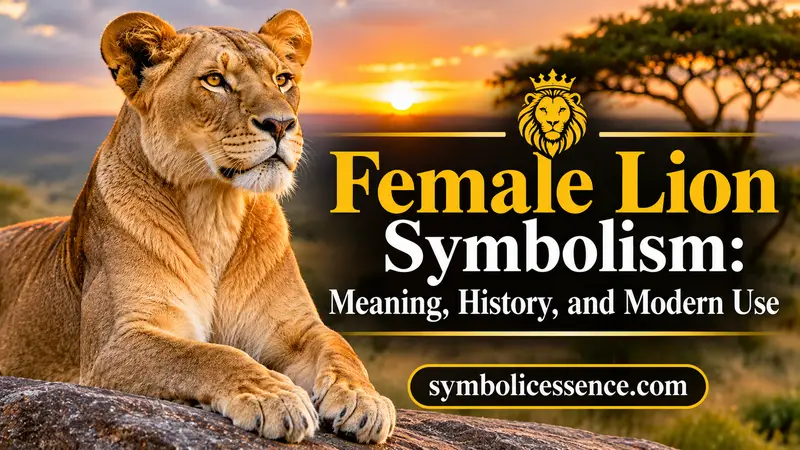
A female lion, commonly called a lioness, is easy to recognize by her muscular body, sandy-gold coat, rounded ears, and lack of a large mane. Unlike male lions, lionesses often work together to hunt, protect their cubs, and support the pride. Their behavior has helped shape their association with courage, cooperation, motherhood, and leadership.
Female lion symbolism attracts people who want to understand what this animal represents in dreams, tattoos, artwork, jewelry, and personal identity. Some see the lioness as a sign of independence, while others connect her with family protection and the ability to face difficult situations.
In American culture, the lioness often represents a woman who can care for others without giving up her own strength. Her image appears in women’s empowerment artwork, sports designs, fashion, and personal tattoos. However, her meaning is not limited to femininity. She can also represent responsibility, teamwork, and confidence.
Quick Answer
Female lion symbolism most commonly represents courage, motherhood, protection, independence, leadership, and loyalty. These associations developed partly from the lioness’s real role in African lion prides and from historical cultures that connected lionesses with goddesses, royal authority, and protection.
TL;DR
- The lioness represents courage, independence, and protective motherhood.
- Her hunting role connects her with teamwork and determination.
- Ancient Egypt associated lioness imagery with divine protection.
- American culture often uses her image for women’s strength.
- Lioness tattoos can represent family loyalty and personal independence.
- Her meaning combines individual confidence with responsibility toward others.
What Does a Female Lion Look Like?
A lioness has a strong, athletic body designed for running, stalking, and catching prey. Her coat is usually golden, tawny, or sandy brown, which helps her blend into the dry grasslands and open woodlands of Africa.
Unlike adult male lions, female lions do not normally develop large manes. Their smaller heads and streamlined appearance give them a different look, but they are still muscular predators with strong jaws, sharp claws, and excellent eyesight.
Lionesses usually live in social groups called prides. A pride may include related adult females, their cubs, and one or more adult males. Females often form lasting relationships with other members of their group.
This physical appearance matters when interpreting the animal in artwork. A lioness standing with her head raised may suggest alertness and confidence. A lioness walking beside her cubs can suggest care and family responsibility. A roaring lioness may communicate warning, courage, or resistance.
Her image appears in wildlife photography, African-inspired artwork, decorative sculptures, clothing, and modern illustrations.
What Does a Lioness Symbolize Today?
The most common modern associations come from the lioness’s behavior and her role within the pride. Several meanings often appear together.
Courage: A lioness is a predator that must face dangerous situations while hunting and defending her territory. People connect this behavior with the willingness to confront difficult circumstances.
Motherhood: Lionesses give birth, nurse their cubs, and help protect young members of the pride. This makes them a recognizable image of maternal care and responsibility.
Independence: Although lionesses live socially, they are capable hunters and active members of their group. Their image can represent someone who makes decisions and takes responsibility for personal goals.
Leadership: A lioness does not need a large mane or an impressive appearance to contribute to the pride. Her actions demonstrate how leadership can come from experience, cooperation, and responsibility.
Loyalty: Female lions often maintain relationships with other females in their pride. This behavior has encouraged associations with family bonds, friendship, and standing beside people during difficult periods.
These meanings are not fixed rules. A person who chooses a lioness as a personal symbol may connect with one association more strongly than another.
How Did Lioness Symbolism Begin in Ancient History?
Lion imagery has appeared in human art for thousands of years. However, the specific meanings attached to female lions developed differently across regions and historical periods.
One important example comes from ancient Egypt, where lioness imagery was connected with divine protection, destruction, royal authority, and the forces of nature.
The Egyptian goddess Sekhmet was usually represented with a human body and the head of a lioness. She was associated with war, disease, healing, and protection. Her fierce appearance reflected the ability to destroy threats, while her divine role also connected her with restoring order.
Sekhmet’s mythology is especially important because it shows that ancient Egyptians did not view lioness imagery as simply an expression of motherhood. It could also represent dangerous force and the protection of the kingdom.
Other Egyptian traditions included feline goddesses such as Bastet. However, Bastet is generally represented as a domestic cat or a woman with a cat’s head, rather than a lioness. Keeping these figures distinct helps avoid mixing different religious traditions.
Lion imagery also appeared in Mesopotamian art. The goddess Inanna, known in Akkadian tradition as Ishtar, was associated with lions. Artists used lion imagery to communicate divine authority, warfare, and royal power.
These examples show that the animal’s historical associations were not limited to one meaning. It could represent protection, authority, danger, and the ability to defend what mattered.
Why Did Ancient Egyptians Associate Lionesses With Protection?
Ancient Egyptian lioness imagery offers one of the clearest historical connections between the animal and protective strength.
Sekhmet was associated with the sun god Ra and was believed to carry out his destructive force against threats. Her fierce nature made her an important figure in stories about maintaining order and punishing wrongdoing.
At the same time, Egyptian religious traditions included rituals intended to calm her anger. This reflects an interesting contrast: the same goddess could be feared for her destructive ability and respected for her protective role.
Lioness imagery also appeared in royal and temple settings. Its presence could communicate that a ruler possessed the strength to defend the land and maintain stability.
The meaning was therefore more complex than simply being brave. It involved the idea that strength should serve a purpose.
Modern interpretations sometimes draw inspiration from Sekhmet when using a lioness image to represent protection, female authority, or the ability to stand against injustice. These are contemporary interpretations of an older religious tradition, not proof that ancient Egyptians understood modern ideas about women’s empowerment in the same way.
What Does a Lioness Represent in American Culture?
In the United States, the lioness is often used as an image of confidence, determination, and female leadership.
Unlike the bald eagle, which has a direct national connection, the lioness is not a native American animal or an official national symbol. Its cultural meaning comes mainly through international wildlife imagery, historical artwork, sports, popular culture, and personal expression.
One common use appears in women’s empowerment designs. A lioness with her head raised or eyes facing forward can represent a woman who is confident in her decisions and unwilling to be defined by other people’s expectations.
The animal also appears in family-centered artwork. A lioness standing beside two or three cubs can communicate the importance of protecting children and supporting family members.
In sports and fitness culture, lioness imagery can represent discipline, competition, and the willingness to work toward a goal. It is especially suitable for team logos and athletic clothing because the animal has a recognizable appearance.
American artists also use the lioness in paintings and digital illustrations that explore leadership, identity, and family relationships.
The important distinction is that American interpretations are not all inherited from one historical tradition. Some come from ancient imagery, while others developed through contemporary discussions about women’s independence and representation.
Why Is the Lioness Associated With Motherhood?
One of the most recognizable meanings comes from the lioness’s relationship with her cubs.
Female lions give birth after a gestation period of approximately 110 days. A litter commonly contains two to four cubs, although litter sizes vary. During their early months, cubs depend heavily on their mothers for milk, warmth, protection, and care.
In some prides, related females also nurse and help care for one another’s young. This cooperative behavior is an important part of lion social life.
This behavior explains why people often associate the animal with:
- Maternal responsibility.
- Protecting children and family.
- Patience during difficult periods.
- Caring for others without abandoning personal needs.
- Standing against threats to loved ones.
In American family artwork, a lioness with cubs can represent a mother’s commitment to her children. Some parents also choose this design for necklaces, framed prints, and tattoos.
However, motherhood is only one part of the animal’s identity. A lioness can also represent an independent woman, a team leader, or someone who has overcome a personal challenge.
How Does a Lioness Represent Female Independence?
The lioness offers an interesting example of female independence because her social life does not prevent her from acting with confidence.
Female lions frequently cooperate with other females, but they are also active hunters. Their hunting abilities contribute to the survival of the pride.
This combination challenges the idea that independence must always mean working alone.
For many American women, the lioness represents the ability to build relationships while maintaining personal goals. She can stand for a person who values family but also wants a career, education, financial stability, or creative freedom.
The animal can communicate several ideas:
- Making personal decisions with confidence.
- Taking responsibility instead of waiting for permission.
- Supporting other women without treating them as competitors.
- Maintaining boundaries in difficult relationships.
- Balancing personal ambition with family commitments.
A lioness does not need to separate herself from her pride to demonstrate capability. Her role shows that cooperation and individual strength can exist together.
This interpretation is particularly common in contemporary illustrations, motivational artwork, and women’s fitness communities.
What Does a Lioness Mean in Tattoos and Jewelry?
The lioness is a popular choice for tattoos because her appearance allows artists to create designs with different emotional meanings.
The details of the design often influence its interpretation.
| Context | Meaning in USA | Common Associations | Notes |
| Lioness with cubs tattoo | Family protection | Motherhood, loyalty, care | Often chosen by parents |
| Realistic lioness portrait | Personal confidence | Courage, independence | Facial expression affects the message |
| Matching lioness jewelry | Family or friendship bonds | Loyalty, connection | May be shared between relatives |
| Roaring lioness artwork | Standing up for oneself | Resistance, determination | Often used in motivational designs |
| Minimalist lioness pendant | Quiet confidence | Self-respect, individuality | Suitable for everyday wear |
A realistic lioness tattoo with focused eyes may represent determination after a difficult period. A design showing a mother and cubs can honor children or remember a family relationship.
Some people choose the animal after experiencing a major life change, such as becoming a parent, completing an education, leaving a difficult relationship, or building a new career.
Jewelry offers a more subtle way to express the same associations. A small lioness pendant or engraved bracelet may serve as a personal reminder of responsibility and confidence.
There is no universal meaning behind these designs. The person wearing them gives the symbol its personal context.
What Does a Lioness Mean in Dreams?
Seeing a lioness in a dream can bring up feelings related to confidence, fear, responsibility, or protection. However, dream images do not have one scientifically established meaning.
The surrounding situation and the dreamer’s personal experiences matter more than a fixed interpretation.
Some common ways people interpret these dreams include:
A calm lioness: This may reflect a feeling of confidence, personal stability, or comfort with one’s responsibilities.
A protective lioness: A dream showing a lioness guarding cubs may bring attention to family concerns or the desire to protect someone.
A chasing lioness: This image may reflect stress, avoidance, or a situation that feels difficult to manage.
A roaring lioness: Some people interpret this as a representation of anger, assertiveness, or the need to speak up.
A wounded lioness: This may connect with feelings of exhaustion, vulnerability, or concern for someone who usually appears strong.
These are reflective interpretations rather than predictions. Dreaming about a lioness does not mean that a specific event will happen.
A useful way to understand the dream is to consider what was happening, how the animal behaved, and how you felt when you woke up.
What Is the Emotional and Psychological Meaning of a Lioness?
People often connect with the lioness because she combines qualities that are sometimes treated as opposites.
She can be protective without being passive. She can cooperate with others while remaining capable of acting independently. She can care for her young while participating in activities that support the entire pride.
For some people, this combination represents emotional maturity.
A mother may see the lioness as an image of the responsibility she accepts for her children. Someone rebuilding their confidence may connect with her ability to face challenges. A team leader may appreciate the way female lions work together.
There is also a personal identity aspect.
Choosing a lioness as a personal emblem can communicate that someone values:
- Confidence without arrogance.
- Responsibility without losing individuality.
- Loyalty without accepting disrespect.
- Courage without unnecessary aggression.
- Cooperation without depending entirely on others.
These qualities explain why the animal appears in personal artwork and inspirational designs.
However, people should not feel that they must always be strong because they identify with a lioness. Asking for support, resting, and admitting uncertainty are also normal parts of human life.
How Do Lionesses Differ From Male Lions in Symbolic Meaning?
Male and female lions belong to the same species, but their physical appearance and common social roles have influenced how people interpret them.
Male lions usually have large manes, which make them visually prominent in traditional royal portraits, coats of arms, and popular illustrations. Their image is often connected with kingship, authority, and public leadership.
Lionesses have a different visual identity. Their lack of a mane and their frequent role in group hunting have encouraged associations with cooperation, practical ability, motherhood, and protection.
These are cultural interpretations, not strict biological divisions. Male lions also participate in pride protection, while females can demonstrate leadership and aggression.
| Feature | Common Male Lion Association | Common Lioness Association |
| Appearance | Mane, imposing presence | Athletic build, focused expression |
| Cultural image | Kingship and authority | Protection and cooperation |
| Common artwork | Crown, throne, royal portrait | Cubs, family, hunting |
| Modern interpretation | Public confidence and status | Independence and responsibility |
In modern designs, both animals can represent courage and leadership. The difference usually comes from the message the artist or individual wants to communicate.
What Are the Misunderstandings About Lioness Symbolism?
Several common misunderstandings can make the animal’s meaning seem narrower than it really is.
Misunderstanding 1: A lioness only represents motherhood.
Motherhood is an important association, but lionesses also represent hunting, teamwork, independence, and protection. A person does not need to be a parent to connect with the animal.
Misunderstanding 2: Lionesses are always gentle toward their families.
Lionesses care for their cubs, but they are wild predators. They can be aggressive, compete for resources, and face serious conflicts within their environment.
Misunderstanding 3: Female lions do all the hunting.
Lionesses perform much of the cooperative hunting in many prides, but males can also hunt. The hunting roles vary depending on the circumstances.
Misunderstanding 4: The lioness has the same historical meaning everywhere.
Ancient Egyptian religious imagery, Mesopotamian art, and modern American designs come from different cultural settings. Their meanings should not be treated as identical.
Misunderstanding 5: Every lioness tattoo represents female empowerment.
A tattoo may honor a mother, celebrate family, remember a personal experience, or simply express admiration for wildlife. Its meaning depends on the person who chooses it.
Recognizing these differences makes it easier to appreciate the animal without assigning one meaning to every image.
How Has the Meaning Changed Across Generations?
The lioness has acquired different associations as societies have changed.
In ancient Egypt, she could represent a goddess connected with warfare, protection, and royal authority. In other historical settings, lion imagery appeared in religious artwork, royal symbols, and decorative objects.
During the nineteenth and twentieth centuries, European and American wildlife illustrations, museum collections, zoological parks, and natural history photography helped bring greater public attention to African lions.
The animal also became more familiar through documentaries and wildlife television. As viewers saw lionesses hunting, raising cubs, and cooperating within prides, their image became increasingly connected with social behavior and family responsibility.
By the late twentieth century and early twenty-first century, lioness imagery was increasingly used in women’s empowerment artwork, sports branding, and personal fashion.
Social media has added another layer. In the 2020s, lioness illustrations, motivational graphics, and tattoos often present the animal as a representation of confidence, independence, and family commitment.
Younger audiences may interpret her image through personal identity and self-expression, while older generations may associate it more closely with motherhood, family protection, or traditional animal imagery.
These differences are not absolute. People of different ages can share the same interpretation.
Where Can You See Lioness Imagery in Modern Life?
The animal appears in several areas of American culture, often with slightly different meanings.
Fashion and accessories: Lioness pendants, printed shirts, handbags, and decorative accessories use the animal to communicate confidence and individuality.
Home decoration: Wildlife paintings and sculptures featuring a lioness with cubs are common choices for people who appreciate African wildlife or want family-centered artwork.
Sports and fitness: Athletic clothing, gym graphics, and team designs use lioness imagery to communicate competition, discipline, and determination.
Social media: Motivational illustrations often show a lioness standing alone or protecting her cubs. These images are used to express independence, family loyalty, and personal resilience.
Business and branding: Some organizations use lioness imagery to suggest confidence, leadership, and a recognizable female identity. However, not every business using the image is making a statement about women’s rights.
Wildlife conservation: Photographs and documentaries featuring lionesses also draw attention to the importance of protecting African lion populations and their natural habitats.
These uses show how an animal that once appeared in religious and royal imagery can become part of everyday clothing, art, and public communication.
FAQs
Is female lion symbolism positive or negative?
It is generally interpreted positively, especially when associated with courage, motherhood, protection, and confidence. However, its historical connection with warfare and destructive force means it can also represent aggression or the need to confront danger.
Does a lioness have a spiritual meaning?
Some spiritual traditions and modern personal beliefs use the lioness as an image of protection, courage, or feminine strength. There is no single universal spiritual meaning, and interpretations depend on individual beliefs and cultural background.
What does a lioness with two cubs represent?
A lioness with two cubs commonly represents maternal care, family responsibility, and the desire to keep loved ones safe. The number of cubs does not have an established universal meaning, although some people connect it with their own family.
Why is the lioness sometimes called the queen of the jungle?
The expression is a popular cultural description rather than a biological title. Lions mainly live in African grasslands, savannas, and some woodland habitats, not dense jungles, and both male and female lions contribute to pride survival.
Can a man use a lioness as a personal symbol?
Yes. The animal’s associations with courage, cooperation, loyalty, and protection are not limited to women. A man may choose the image to honor his mother, partner, family, or someone whose character he admires.
What does a black lioness tattoo mean?
A black-and-gray lioness tattoo usually emphasizes the animal’s facial expression, shape, and details rather than a separate historical meaning. Some people choose this style to represent remembrance, confidence, personal change, or family loyalty.
Is a lioness associated with any ancient goddess?
Yes. Sekhmet, an important ancient Egyptian goddess, was commonly depicted with a lioness head. She was associated with warfare, disease, healing, and protection, making her one of the clearest historical examples of lioness imagery in religion.
Conclusion
Female lion symbolism brings together courage, motherhood, independence, protection, and cooperation. Its historical associations include ancient Egyptian religious imagery, Mesopotamian lion art, and royal representations of authority. Modern American interpretations often focus on female confidence, family responsibility, and the ability to face difficult situations.
The lioness is especially interesting because her strength is not defined by acting alone. She hunts with others, helps raise young lions, and contributes to the survival of her pride. Her behavior offers a practical reminder that confidence and cooperation can work side by side.
For someone choosing a lioness tattoo, wearing a lioness pendant, or displaying her image at home, the meaning can be personal. It might honor a mother, represent a new beginning, or serve as a reminder to protect what matters without giving up personal independence.