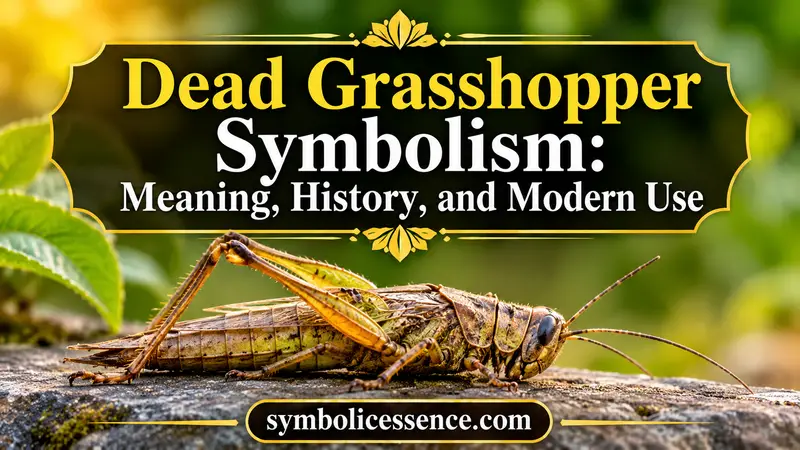
A dead grasshopper is a small but noticeable sight. You might find one on a driveway, near a window, in your garden, or resting in the dry grass. Its folded legs and still body can make an ordinary outdoor moment feel unusual, especially if you stop to consider what it might represent.
People look up dead grasshopper symbolism for different reasons. Some have found one near their front door, while others have noticed one repeatedly in their home or garden. They may wonder whether it represents an ending, a missed opportunity, personal change, or simply the natural cycle of life.
In American culture, a dead grasshopper does not have one established traditional meaning. Its interpretation usually comes from the insect’s familiar associations with movement, freedom, growth, and seasonal change, combined with the natural meaning of death.
Quick Answer
Dead grasshopper symbolism most commonly represents the end of a phase, missed opportunities, vulnerability, and the need to recognize when circumstances have changed. Historically, grasshoppers have been associated with both agricultural abundance and hardship, while modern interpretations of a dead one often focus on life’s temporary nature and personal transitions.
TL;DR
- Endings: A completed phase or the close of an opportunity.
- Missed chances: A reminder to recognize opportunities before they pass.
- Change: The transition from one stage of life to another.
- Vulnerability: A reminder that even active creatures have limits.
- Historical background: Grasshoppers appear in farming traditions, stories, and literature.
- Modern meaning: Americans often interpret the sight through personal experience.
What Does a Dead Grasshopper Look Like?
Grasshoppers are insects with long hind legs, strong bodies, short antennae, and wings in many species. Their bodies are usually green, brown, yellowish, or gray, depending on the species and environment.
When a grasshopper dies, its body becomes still. Its legs may remain folded beneath it or extend outward. Its wings may lie flat against its body, and its natural colors can become dull as the body dries.
In the United States, grasshoppers are commonly seen in lawns, gardens, fields, parks, and roadside vegetation. They are especially noticeable during warmer months.
A dead grasshopper may appear in several places:
- On a windowsill after entering a house.
- Near a garden plant or flower bed.
- On a driveway or sidewalk.
- In dry grass during late summer.
- Near outdoor lights where insects gather.
The location can influence how someone interprets the discovery. Finding one in a garden may bring thoughts of nature and seasonal change, while finding one inside a home may make a person think about boundaries, personal space, or unexpected changes.
However, the insect’s physical condition does not establish a supernatural message. It may simply have reached the end of its natural life.
What Does a Dead Grasshopper Symbolize Today?
Modern interpretations generally connect the sight with several ideas. These meanings are personal rather than universally accepted traditions.
The End of a Life Chapter
A dead grasshopper can represent the completion of a particular stage. This might relate to a relationship, job, personal habit, or long-term goal.
The interpretation comes from the contrast between a living insect’s movement and the stillness of its body.
For example, someone leaving a familiar job might see the insect and connect it with the end of a chapter. The sight becomes a personal reminder that some stages cannot continue forever.
Missed Opportunities
Grasshoppers are known for their ability to jump quickly from one place to another. Their movement can suggest readiness, action, and opportunity.
A dead grasshopper may therefore be interpreted as a reminder of opportunities that were ignored or allowed to pass.
For someone who has delayed an important decision, the sight might encourage a more thoughtful approach to future choices.
Change and Transition
Death in nature often marks a transition rather than a dramatic event. An insect’s life follows a natural cycle, including growth, reproduction, aging, and death.
In personal symbolism, this can represent accepting changes that cannot be reversed.
It may remind someone that moving forward sometimes requires leaving an old routine behind.
Fragility and Limitations
Grasshoppers can leap impressive distances compared with their body size, but they remain vulnerable to predators, weather, disease, and environmental changes.
A dead specimen can represent the limits of physical strength and independence.
This interpretation encourages people to recognize that success and activity do not make anyone immune to life’s difficulties.
Where Did Grasshopper Symbolism Originate?
The historical background of grasshopper symbolism is closely connected to agriculture, storytelling, and the natural environment.
For farming communities, grasshoppers were familiar creatures. Their presence could be harmless, but large populations could damage crops and threaten food supplies.
This gave the insect two contrasting associations: ordinary life in the fields and agricultural destruction.
One important historical connection appears in the biblical account of the plagues of Egypt in the Book of Exodus. Locusts consume crops and vegetation, representing a serious agricultural disaster.
Locusts belong to the grasshopper family, although not every grasshopper is a locust. Their ability to gather in enormous swarms made them a recognizable threat to farming communities.
Another familiar association comes from Aesop’s fable, commonly called The Ant and the Grasshopper.
In this story, the grasshopper spends the warm season singing while the ant gathers food. When winter arrives, the grasshopper discovers the consequences of failing to prepare.
The story became associated with planning, responsibility, work, and the consequences of short-term decisions.
However, these historical examples concern living grasshoppers or locusts. They do not establish a traditional meaning for a dead grasshopper specifically.
Its modern interpretation as an image of endings or missed opportunities is largely a personal extension of these older associations.
How Is a Dead Grasshopper Viewed in American Culture?
In the United States, grasshoppers are familiar parts of outdoor life. Children encounter them in schoolyards, adults see them in gardens, and farmers recognize their importance to crops.
This familiarity shapes how Americans understand the insect.
Connection to Farming and Rural Life
Grasshoppers are common in agricultural areas, particularly across the Great Plains and western states.
During dry periods or population increases, they can become a concern for farmers because some species consume crops and pasture vegetation.
A dead grasshopper found in a field might therefore remind someone of seasonal farming conditions, crop protection, or the natural balance between insects and plants.
Connection to Childhood Memories
Many Americans remember catching grasshoppers during childhood.
The insects may bring back memories of summer vacations, outdoor games, gardens, and time spent exploring nature.
Finding a dead one can create a contrast between childhood curiosity and the reality that living things eventually die.
For some people, this makes the sight a reminder of growing older and remembering earlier stages of life.
Connection to Seasonal Change
Grasshoppers are especially noticeable during warm weather. Their activity changes with temperature, vegetation, and seasonal conditions.
A dead grasshopper appearing in late fall may remind someone that summer has ended and colder weather is approaching.
In this setting, the insect can become a personal representation of seasonal endings and the arrival of a different stage of the year.
Personal Beliefs and Spiritual Interpretation
Some Americans interpret unusual encounters with animals or insects through personal spirituality.
A dead grasshopper might be viewed as a reminder to slow down, reconsider a decision, or accept a change.
Others see it simply as an ordinary natural event.
Both responses are valid personal reactions, but there is no established American religious tradition that assigns one universal spiritual message to a dead grasshopper.
What Does Finding a Dead Grasshopper in Different Places Mean?
The location where someone discovers an insect can shape the personal meaning they attach to it.
These interpretations are modern symbolic associations, not documented rules or predictions.
Near Your Front Door
A front door represents the entrance to a home and the boundary between private and public life.
Finding a dead grasshopper nearby may remind someone of changing circumstances, new decisions, or the end of a familiar routine.
Some people interpret the location as an opportunity to reconsider what they allow into their personal lives.
There is no evidence that the discovery predicts a visitor, financial event, or coming misfortune.
Inside Your House
A dead grasshopper inside a home can feel unusual because people generally expect to find insects outdoors.
As a personal symbol, it may represent something unexpected entering an otherwise familiar environment.
It can also encourage practical questions. Did the insect enter through an open door, window, or small gap?
Before attaching meaning to the discovery, consider ordinary explanations.
In Your Garden
A garden represents growth, care, and the changing seasons.
Finding a dead grasshopper among flowers or vegetables may remind someone that healthy environments contain both growth and loss.
It can also bring attention to the relationship between insects, plants, birds, and other parts of the local ecosystem.
On a Window
Windows are often associated with observation, perspective, and the boundary between indoor and outdoor life.
A dead grasshopper near a window may become a personal reminder to reconsider an old perspective or recognize a change that has already taken place.
The practical explanation may be that the insect was attracted to light or entered through a small opening.
On a Road or Sidewalk
A dead grasshopper on a road or sidewalk may represent vulnerability and the unpredictable nature of everyday life.
It can also prompt thoughts about how human activity affects smaller creatures.
This setting is particularly useful for reflecting on the relationship between people, transportation, and the natural environment.
What Is the Emotional and Psychological Meaning?
The emotional response to a dead insect depends on a person’s memories, beliefs, and current circumstances.
Someone who enjoys gardening may feel sadness when finding one among their plants. Another person may barely notice it.
There are several reasons the sight can become personally meaningful.
Awareness of mortality: A small dead creature can remind people that life is temporary. The experience may encourage appreciation for ordinary moments.
Reflection on missed chances: The grasshopper’s association with jumping and movement can create a mental connection with decisions that were delayed.
Acceptance of change: A dead insect can represent the natural ending of a stage, making it easier to think about changes in relationships, work, or personal goals.
Concern for the environment: People who care about wildlife may wonder whether pesticides, habitat loss, or changing weather conditions affected the insect.
The meaning often comes from the person’s emotional situation rather than the insect itself.
For example, someone who has recently experienced a major life change may interpret the discovery differently from someone who is simply cleaning a garden.
Does a Dead Grasshopper Represent Good Luck or Bad Luck?
There is no widely accepted American tradition that identifies a dead grasshopper as either good luck or bad luck.
The interpretation depends on the context.
Some people associate it with a completed chapter, which can be a positive idea when they are ready to move forward.
Others connect it with missed opportunities or vulnerability, making the experience feel uncomfortable.
It is also important to distinguish between grasshoppers and locusts.
Historically, large locust swarms have been associated with crop destruction, hunger, and economic hardship. These associations developed from real agricultural damage rather than a belief that an individual dead insect predicts future problems.
A dead grasshopper in a backyard is not evidence that something bad will happen.
If the sight encourages you to reconsider your priorities or appreciate the present, that personal response can be useful without treating it as a prediction.
How Do Dead Grasshoppers Differ From Living Grasshoppers Symbolically?
The condition of the insect changes the way people interpret it.
A living grasshopper is usually associated with movement and activity. A dead one creates a different impression because its movement has stopped.
| Context | Meaning in USA | Common Associations | Notes |
| Living grasshopper | Movement and opportunity | Freedom, action, summer | Often connected with outdoor childhood memories |
| Dead grasshopper | Endings and vulnerability | Mortality, change, missed chances | Usually a personal modern interpretation |
| Dead grasshopper in a garden | Natural cycles | Growth, loss, seasonal change | May also prompt ecological concerns |
| Dead grasshopper near a doorway | Personal transitions | Boundaries, decisions, new stages | No established traditional prediction |
| Grasshopper in a children’s story | Planning and responsibility | Work, preparation, consequences | Associated with Aesop’s fable |
| Locust swarm | Agricultural hardship | Crop loss, food insecurity | Based on documented environmental and historical events |
This distinction matters because a dead grasshopper does not carry exactly the same associations as a living one.
The living insect suggests activity, while the dead insect invites reflection on what has ended.
What Does a Dead Grasshopper Mean in Different Cultures?
Grasshoppers and locusts appear in several cultural traditions, but their meanings are not identical.
It is important not to assume that every culture has a separate spiritual interpretation for a dead specimen.
Biblical Traditions
The Book of Exodus describes a locust plague that damages Egypt’s crops. This account became an important historical and religious reference for understanding locusts as symbols of destruction and hardship.
In later Christian discussions, locusts have also appeared in connections with judgment and difficult times.
These associations concern locusts and their destructive effects. They do not establish a specific religious meaning for an individual dead grasshopper.
European Folklore and Literature
European storytelling includes several well-known references to grasshoppers.
Aesop’s fable about the ant and the grasshopper became particularly influential in discussions of preparation and responsibility.
Later versions appeared in children’s books, illustrations, and educational materials.
The grasshopper’s role in these stories often depends on whether it represents carefree behavior or a failure to prepare.
East Asian Cultural References
Grasshoppers and related insects have appeared in traditional art, decorative objects, and literary imagery in parts of East Asia.
Their associations vary by period and artistic context. In some decorative traditions, insects are appreciated for their connection with nature, seasonal life, and the observation of small creatures.
However, these broader references should not be treated as evidence of a universal East Asian belief about dead grasshoppers.
There is no single cross-cultural interpretation that makes the discovery of a dead grasshopper a fixed sign.
Why Do People Connect Dead Grasshoppers With Missed Opportunities?
The connection between grasshoppers and opportunity comes largely from their physical behavior.
A grasshopper can quickly jump away from danger or move to another feeding area. Its movement creates a familiar association with taking action and responding to changing circumstances.
When the insect is dead, that movement is no longer possible.
People may use this contrast to think about situations in which an opportunity was available but was not taken.
For example:
- A person may regret not applying for a job.
- Someone may wish they had repaired a strained friendship.
- A student may recognize the importance of preparing before an examination.
- An entrepreneur may reflect on a business opportunity that has passed.
In these situations, the insect becomes a reminder rather than a warning.
The useful lesson is not to rush into every decision. It is to recognize that some opportunities have limited time and deserve careful attention.
How Is a Dead Grasshopper Used in Tattoos, Art, and Jewelry?
Grasshoppers are recognizable insects with distinctive legs, wings, and body shapes. These features make them suitable subjects for nature-inspired artwork.
However, dead grasshoppers are much less common in mainstream American jewelry and tattoo designs than living insects.
Their use tends to be personal or artistic rather than part of an established fashion tradition.
Tattoo Designs
A tattoo showing a grasshopper can represent movement, independence, adaptability, or a connection with nature.
A dead grasshopper tattoo may communicate a different message.
Possible interpretations include:
- A finished chapter in someone’s life.
- Acceptance of mortality.
- A personal experience involving loss.
- A reminder of opportunities that should not be ignored.
- A connection with the natural cycle of life.
Some designs use a realistic insect with folded legs and delicate wings. Others place the insect beside dried flowers, fallen leaves, or a fading plant.
The surrounding details help establish the intended meaning.
Nature-Inspired Artwork
Artists may use dead insects in illustrations, photography, and natural-history displays.
A dried grasshopper can reveal details that are easily overlooked when the creature is moving.
Its body structure, wings, and legs can become subjects of scientific illustration or still-life photography.
In contemporary art, an insect’s remains may also be used to explore decay, environmental change, and the relationship between life and death.
Jewelry and Decorative Objects
Grasshopper jewelry more commonly features a living-looking insect design.
Brooches, pendants, and decorative metalwork may use the insect’s long legs and wings to create an unusual nature-inspired appearance.
A design featuring a dead grasshopper would be more unusual and would likely carry a personal artistic meaning rather than a standard cultural message.
What Are the Common Misunderstandings About Dead Grasshoppers?
Several assumptions can make people misunderstand the symbolism of this insect.
Mistaking a Grasshopper for a Locust
Grasshoppers and locusts are closely related, but the terms are not interchangeable in every situation.
Locusts are certain grasshopper species that can change their behavior and form large swarms under particular environmental conditions.
Historical accounts of crop destruction often involve locust outbreaks rather than ordinary individual grasshoppers.
Assuming It Always Predicts Bad Luck
A dead insect is not automatically an omen of misfortune.
There is no reliable evidence that finding one predicts illness, financial loss, relationship problems, or other future events.
Treating Every Encounter as a Spiritual Message
Some people enjoy interpreting everyday encounters through personal beliefs. That is different from claiming that every encounter carries an objective message.
A dead grasshopper may simply be the result of aging, predation, weather, disease, or accidental injury.
Assuming Every Culture Shares the Same Meaning
Grasshoppers appear in different stories and traditions, but their associations vary.
The agricultural concerns of farming communities, the moral lesson of Aesop’s fable, and modern personal interpretations are not interchangeable.
Recognizing these differences makes the subject easier to understand without exaggerating its history.
How Has the Meaning Changed Over Time?
Grasshopper symbolism has changed as people’s relationships with agriculture, storytelling, and nature have changed.
In agricultural societies, the insect was often viewed through its practical effects. Ordinary grasshoppers were familiar parts of the landscape, while locust outbreaks could threaten entire harvests.
During later periods, literature and children’s education helped establish the grasshopper as a recognizable character.
Aesop’s fable became especially important in teaching lessons about preparation and responsibility. Its message remained familiar in American schools and children’s literature.
During the twentieth century, nature photography, wildlife education, and environmental awareness brought more attention to insects as parts of larger ecosystems.
People increasingly encountered grasshoppers not only as garden visitors or agricultural pests but also as creatures with a place in local biodiversity.
In the 2020s, online discussions of animal symbolism have made personal interpretations easier to share. Someone finding a dead grasshopper may now connect the experience with personal growth, endings, or missed opportunities.
These modern meanings are not necessarily inherited from an older tradition. Many are individual interpretations shaped by familiar associations with the living insect.
What Should You Consider After Finding a Dead Grasshopper?
If you find a dead grasshopper, you do not need to assume that it carries a warning or prediction.
A few simple questions can help you understand your reaction:
Where did you find it? Consider whether the insect was inside your home, near a garden, or somewhere it would normally live.
What were you thinking about at the time? Your current circumstances may explain why the discovery caught your attention.
Did it remind you of something? Perhaps it brought back a childhood memory, a recent loss, or a decision you have been postponing.
Is there a practical environmental explanation? Consider weather conditions, nearby vegetation, pesticide use, or possible exposure to predators.
If you find several dead grasshoppers in the same area, it may be worth investigating environmental conditions rather than treating the group as a symbolic event.
For example, recent pesticide application, extreme temperatures, or disease may explain an unusual number of dead insects.
A personal interpretation can be meaningful, but it should not replace practical observation.
FAQs
Is finding a dead grasshopper a good or bad sign?
There is no established American belief that finding one is automatically good or bad. Some people connect it with the end of a difficult chapter, while others see it as a reminder to pay attention to opportunities and changing circumstances.
Does a dead grasshopper have a biblical meaning?
The Bible discusses locusts, particularly in the account of the plagues of Egypt in Exodus. However, it does not establish a specific meaning for finding one dead grasshopper in a house or garden.
What does it mean when a dead grasshopper appears repeatedly?
Repeated encounters do not have a documented universal meaning. If you keep finding them in the same place, consider whether local conditions, nearby vegetation, lighting, or pesticide exposure explain the pattern.
Can a dead grasshopper symbolize the end of a relationship?
It can serve as a personal reminder of an ending, including the conclusion of a relationship. However, the insect does not predict a breakup or reveal another person’s feelings.
Does a dead grasshopper represent financial loss?
There is no established historical American tradition connecting an individual dead grasshopper with financial loss. Its association with hardship may come from historical locust outbreaks that damaged crops and affected farmers’ incomes.
Why do people associate grasshoppers with freedom?
Grasshoppers can leap long distances relative to their body size and move quickly through vegetation. These physical qualities make them natural artistic representations of movement, independence, and the ability to move beyond familiar surroundings.
Is a dead grasshopper different from a dead locust symbolically?
The distinction matters because locusts have a documented history of agricultural destruction and food shortages. A dead individual grasshopper is more commonly interpreted through personal ideas about endings, vulnerability, and natural life cycles.
Conclusion
Dead grasshopper symbolism is mainly associated with endings, missed opportunities, vulnerability, and the natural process of change. Its meaning draws on familiar associations with living grasshoppers, agricultural history, literature, and the contrast between movement and stillness.
For Americans, finding one may bring thoughts of childhood memories, seasonal transitions, personal decisions, or the temporary nature of life. However, it does not have one fixed religious, cultural, or spiritual meaning, and it should not be treated as a prediction of future events.
Sometimes, the most useful response to finding a dead grasshopper is simply to notice the moment. A small insect on a garden path can remind us to appreciate what is still growing, recognize when something has ended, and make thoughtful use of the opportunities that remain.