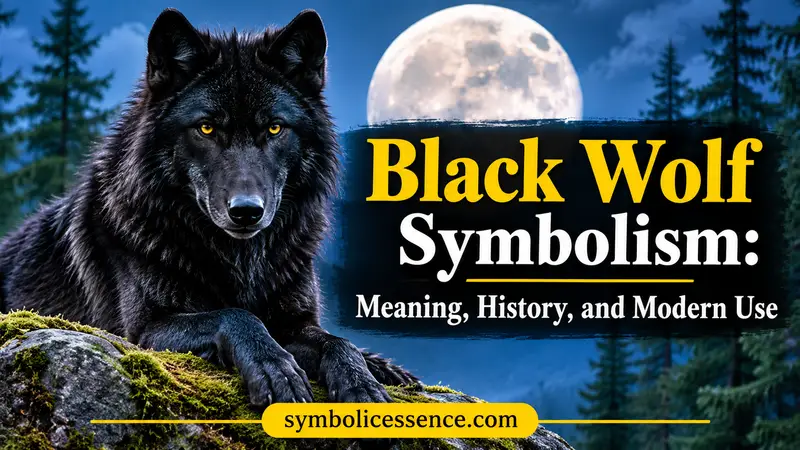
A black wolf stands out because of its dark coat, bright eyes, and familiar wolf-like features. Unlike the gray, brown, or white wolves often shown in wildlife photography, a black-coated wolf can look almost completely different when seen against a snowy forest or moonlit landscape. Its appearance has made it an interesting subject in folklore, wildlife photography, tattoos, literature, and modern art.
People often look up black wolf symbolism when they encounter this animal in a dream, see it in artwork, or consider using its image in a tattoo. Some associate it with independence and protection, while others connect it with mystery, survival, or the ability to face difficult situations.
In the United States, this animal also has a real connection to wildlife conservation. Black wolves live in parts of North America, including Yellowstone National Park, where their unusual coat color adds another layer to public interest in wolf behavior and genetics.
Quick Answer
Black wolf symbolism most commonly represents independence, resilience, protection, instinct, and the courage to face uncertainty. Its modern meaning draws partly from older European associations between wolves, wilderness, danger, and loyalty, while its dark coat adds associations with the unknown and individuality.
TL;DR
- Independence represents the wolf’s ability to survive in challenging environments.
- Protection connects with pack relationships and cooperative hunting.
- Resilience reflects the animal’s ability to adapt to changing conditions.
- Darkness adds associations with uncertainty, privacy, and the unknown.
- Native American wolf traditions vary widely between individual nations.
- Modern tattoos often represent strength, personal freedom, and self-reliance.
What Does a Black Wolf Actually Look Like?
A black wolf is not a separate species. It is a gray wolf (Canis lupus) with a dark coat caused by a genetic variation known as melanism.
Melanism increases the amount of dark pigment in an animal’s fur. As a result, some wolves have coats that appear nearly black, while others show a mixture of dark brown, charcoal, and gray.
These animals have the same general physical features as other gray wolves:
- A long muzzle and strong jaw.
- Upright ears that help detect sounds.
- Thick fur that provides insulation.
- Long legs built for traveling across large areas.
- A bushy tail and muscular body.
- Sharp teeth suited to hunting and eating meat.
Black-coated wolves are found in North America, particularly in some populations of the Canadian Rockies and Yellowstone region.
Their appearance changes how people perceive them. A dark wolf standing in a forest may look difficult to notice until it moves. Against fresh snow, however, its coat becomes immediately visible.
This contrast between visibility and concealment contributes to many modern interpretations of the animal.
What Does a Black Wolf Symbolize Today?
The meaning usually depends on the situation in which someone encounters the animal. However, several interpretations appear frequently in modern American art, personal expression, and popular culture.
Independence and Self-Reliance
Wolves are often associated with independence because they travel across large territories, make decisions while hunting, and adapt to different environments.
A black wolf can represent someone who prefers making personal choices instead of following expectations simply to fit in.
This interpretation is common in tattoo designs and personal artwork. Someone might choose the animal to represent a decision to build a life on their own terms.
Independence does not necessarily mean avoiding relationships. It can also mean knowing when to trust personal judgment.
Protection and Loyalty
Wolves are social animals. Members of a pack cooperate in raising young, defending their territory, and finding food.
This behavior makes them natural symbols of family protection and loyalty.
A dark wolf standing beside smaller wolves, for example, may represent a parent protecting children or someone who feels responsible for loved ones.
The meaning comes from actual wolf behavior rather than the idea that every wolf is naturally aggressive.
Resilience and Survival
Wolves live in environments where finding food and avoiding danger can require constant effort.
Their ability to adjust to seasonal changes, travel long distances, and survive difficult conditions contributes to their association with resilience.
A person who has experienced a major life change may use this image to represent recovery and persistence.
Mystery and the Unknown
The dark coat creates a visual connection with nighttime, shadows, and hidden places.
For this reason, the animal often appears in fantasy artwork and stories about forests, wilderness, and unexplored territories.
In this setting, it can represent things that are not immediately understood, including private thoughts, uncertain decisions, and unexplored parts of someone’s personality.
Where Did Wolf Symbolism Begin?
Wolves have appeared in human stories, religious traditions, and artwork for thousands of years. Their relationship with people has never been entirely positive or negative.
In some communities, wolves represented hunting skill, family cooperation, and survival. In others, they were feared because they sometimes attacked livestock and competed with humans for food.
European history provides several examples of these mixed attitudes.
Wolves in Ancient Rome
One of the best-known wolf stories comes from Roman tradition.
According to the legend, the twins Romulus and Remus were abandoned as infants and cared for by a she-wolf. Romulus later became the legendary founder of Rome.
The Capitoline Wolf became a recognizable image connected with Roman identity, although the history and dating of the sculpture itself have been debated.
The story helped establish a connection between wolves, protection, survival, and the beginnings of a community.
Importantly, the Roman she-wolf is not specifically described as black. Its connection to modern dark-wolf imagery comes through broader wolf symbolism rather than a documented black-coat tradition.
Wolves in Medieval European Stories
During the medieval period, European stories often portrayed wolves as dangerous animals living outside settled communities.
They appeared in religious art, moral tales, and popular folklore as threats to livestock and travelers.
The wolf in Little Red Riding Hood, for example, represents deception and danger hidden behind an apparently harmless appearance.
These stories helped establish the wolf as a symbol of fear and the unpredictable wilderness.
A dark-colored wolf could naturally fit this visual language, although historical stories did not always distinguish black wolves from other wolves.
The Norse Tradition
Wolves also appear in Norse mythology.
Fenrir is a famous mythological wolf associated with the events leading to Ragnarök, the destruction and renewal of the world.
Fenrir represents a threat that even the gods cannot fully control. His story is connected with fate, conflict, and the limits of power.
He is not consistently identified as a black wolf in the original tradition. Modern fantasy artwork sometimes gives him dark fur, but that is an artistic choice rather than a historical rule.
These older stories helped shape the way wolves appear in modern fantasy and popular culture.
How Is the Black Wolf Viewed in Native American Traditions?
There is no single Native American interpretation of wolves. Different Indigenous nations have their own languages, histories, stories, and relationships with local wildlife.
Some traditions connect wolves with hunting, family relationships, teaching, or relationships between humans and animals. Other stories may present wolves as dangerous, clever, or important figures in cultural narratives.
For example, wolf-related traditions appear in stories from several Indigenous peoples of North America, including some communities in the Great Lakes and Plains regions.
However, it would be inaccurate to claim that all Native American cultures consider a black wolf a symbol of spiritual protection or guidance.
The distinction matters because many modern websites present a single wolf meaning as if it belongs to every Indigenous nation.
There is also a difference between traditional wolf stories and contemporary spiritual interpretations. A modern person may personally view a dark wolf as a guide or protective figure, but that does not automatically make the interpretation an established Indigenous teaching.
When discussing these traditions, it is better to identify the specific nation and documented story rather than treating Indigenous cultures as one group.
What Does the Black Wolf Represent in American Culture?
In the United States, the animal has several different meanings depending on whether it appears in wildlife conservation, popular entertainment, outdoor culture, or personal expression.
Wildlife and Conservation
The return of wolves to Yellowstone National Park is one of the most recognizable wildlife conservation stories in modern American history.
Wolves were reintroduced to Yellowstone in 1995 after being eliminated from the park earlier in the twentieth century.
Black-coated wolves are part of the park’s wolf population. Their presence has helped introduce visitors to the genetic variation found within wild wolf populations.
For conservation supporters, these animals can represent the importance of protecting wildlife and maintaining functioning ecosystems.
Their meaning is not limited to personal strength or folklore. They also remind people that wild animals have a place in the natural environment.
American Outdoor Identity
Wolves appear frequently in American outdoor culture.
Their images are used on camping equipment, clothing, nature posters, hunting-related artwork, and wildlife photography collections.
For some people, the animal represents a connection with remote forests, mountains, and places far from crowded cities.
A dark wolf photographed in a snowy landscape can communicate a sense of wilderness without needing additional words.
Individuality and Personal Identity
The animal also appears in American designs connected with independence and self-expression.
Someone who feels different from their surroundings may choose it as a personal emblem.
The dark coat makes the image visually distinctive, while the wolf itself communicates qualities such as confidence, awareness, and self-reliance.
This interpretation is especially common in graphic art, clothing designs, and tattoo culture.
Why Do People Connect With the Black Wolf Emotionally?
Part of the attraction comes from the contrast between the animal’s appearance and its actual behavior.
A wolf may look intimidating, but it also depends on cooperation, communication, and relationships with other members of its pack.
This combination allows people to connect with different parts of their own personalities.
For example, someone who is quiet but protective may identify with the animal because it represents strength without constant attention.
Another person might connect with its independence because they have recently left a difficult relationship, changed careers, or started living independently.
The image can also help people express emotions that are difficult to communicate directly.
A person who chooses a wolf design does not necessarily believe the animal has supernatural meaning. They may simply appreciate what it represents to them.
Three emotional connections are particularly common:
- Feeling misunderstood: The animal can represent someone who does not always fit into social expectations.
- Protecting loved ones: Its pack relationships can reflect commitment to family and close friends.
- Facing uncertainty: Its association with wilderness can represent the willingness to move forward without knowing every outcome.
These interpretations are personal rather than fixed rules.
Why Do People Choose Black Wolf Tattoos?
Wolf tattoos have been popular in American body art for many years. Dark versions are especially common in realistic, black-and-gray, and fantasy-inspired designs.
People usually choose them because they want an image that combines a recognizable animal with a personal message.
Different tattoo designs can communicate different ideas.
| Context | Meaning in USA | Common Associations | Notes |
| Wolf head tattoo | Personal strength and confidence | Identity, courage, independence | Often uses direct eye contact |
| Howling wolf | Communication and belonging | Family, expression, connection | Frequently includes a moon |
| Lone wolf design | Self-reliance | Individuality, personal freedom | Does not necessarily mean loneliness |
| Wolf and forest | Connection with nature | Wilderness, exploration, survival | Often uses detailed landscape backgrounds |
| Wolf pack tattoo | Family commitment | Loyalty, teamwork, protection | May represent children or close relatives |
A Lone Wolf Design
A single wolf standing or walking alone can represent independence.
Some people choose this design after a major personal transition, such as moving to another state, ending a relationship, or beginning a new stage of life.
However, a lone wolf should not automatically be interpreted as someone who dislikes people. It can simply represent comfort with personal decisions.
A Howling Wolf Design
A howling wolf often represents communication, identity, and connection.
Wolves howl for several reasons, including maintaining contact with other pack members and communicating across distances.
In tattoos, this behavior can represent someone who wants to express their voice or maintain a connection with people they care about.
A Wolf With Blue or Yellow Eyes
Some artists add bright eyes to a dark wolf design.
Blue eyes can create a fantasy-inspired appearance, while yellow or amber eyes can make the animal look closer to wildlife photography.
These colors are artistic choices. They do not have universal historical meanings.
What Does a Black Wolf Mean in Dreams?
Dream interpretations are personal, and there is no scientific evidence that seeing a particular animal in a dream predicts future events.
Still, people often use dream imagery to think about their emotions and experiences.
A dark wolf may be connected with several feelings depending on what happens in the dream.
Seeing a Black Wolf From a Distance
If the animal watches you from far away, the dream may reflect a situation you are observing without fully understanding.
You might be uncertain about someone’s intentions or considering a decision that requires more information.
Being Chased by a Black Wolf
A chasing wolf can reflect feelings of pressure, fear, or avoidance.
For example, someone dealing with a difficult conversation at work might dream about being followed by an animal they cannot escape.
This does not mean something bad will happen. It may simply provide an image for an emotion the person has not addressed.
Seeing a Friendly Black Wolf
A calm or friendly wolf may reflect trust, companionship, or a desire for protection.
The dreamer’s relationship with the animal matters. A wolf that sits nearby creates a different emotional experience from one that growls or attacks.
Seeing a Black Wolf in Snow
Snow creates a strong visual contrast with dark fur.
This setting may bring attention to feelings of isolation, stillness, or facing a difficult situation in an unfamiliar environment.
The most useful question is not whether the dream predicts something, but what feelings the animal brought up and whether those feelings connect with current experiences.
How Does the Dark Coat Change the Symbol’s Meaning?
The coat color is an important part of the image, but it does not give the animal a completely separate biological or historical identity.
Black is commonly associated with night, shadows, privacy, and things that are difficult to see.
When these associations are combined with the wolf’s reputation, the result is an image that can communicate several contrasting ideas.
Darkness and uncertainty: The coat can represent situations where the outcome is unclear.
Individuality: Because black-coated wolves are less familiar to many people than gray wolves, their appearance can suggest standing apart from a group.
Strength without display: A dark wolf can look imposing without needing an aggressive pose.
Adaptability: Its coat provides an opportunity to discuss how genetic differences appear within a species.
Not every interpretation is positive. Some people may associate the dark appearance with danger or fear, particularly when the animal is shown with glowing eyes, exposed teeth, or an aggressive expression.
The artwork and surrounding details often influence the meaning more than the color alone.
What Do Black Wolves Represent in Movies, Books, and Games?
Wolves have a long history in storytelling, and modern entertainment continues to use them as recognizable characters.
Dark wolves are particularly useful in fantasy because their appearance can suggest a character who is difficult to understand or whose motives are uncertain.
In fantasy novels, a dark wolf might appear as a companion, guardian, rival, or supernatural creature.
In video games, its design may communicate stealth, speed, danger, or strength.
In animated entertainment, the animal can represent a character’s loyalty or conflict between personal freedom and responsibility toward others.
These portrayals are not always based on traditional folklore. Modern writers and artists often combine older European stories, wildlife characteristics, and original fantasy ideas.
This is one reason the animal has become familiar even to people who have never seen a wild wolf.
How Are Black Wolves Used in Jewelry, Clothing, and Home Decor?
The image appears in several consumer and decorative settings in the United States.
Its meaning changes slightly depending on how it is presented.
Jewelry
Wolf pendants, necklaces, rings, and bracelets often use the animal as a personal emblem.
A small wolf-head pendant may represent independence, while a wolf-and-pup design can communicate family loyalty.
Some jewelry makers use black stones, dark metal, or engraved wolf outlines to create a more understated look.
Clothing
Wolf images appear on hoodies, T-shirts, jackets, and outdoor-themed accessories.
A realistic design may appeal to wildlife enthusiasts, while a stylized wolf graphic can communicate an interest in fantasy, gaming, or alternative fashion.
The image can also serve as a personal statement without requiring an explanation.
Home Decor
Wolf artwork is used in posters, canvas prints, sculptures, and decorative objects.
A black wolf against a snowy mountain background may suit a nature-themed room, while a detailed forest illustration can create a wilderness-inspired atmosphere.
These products are often chosen by people who enjoy wildlife, outdoor photography, or animal-themed artwork.
Are Black Wolves Dangerous or Misunderstood?
The intimidating appearance of a dark wolf can create misunderstandings about its actual behavior.
A black wolf is not automatically more aggressive, dangerous, or dominant than a gray or white wolf.
Its coat color is related to genetics, not a special personality type.
Wild wolves generally avoid people when they can. However, they remain large predators and should be treated with caution.
People should never approach, feed, or attempt to touch a wild wolf, regardless of its appearance.
There is also a difference between the real animal and its representation in popular entertainment.
Movies sometimes portray wolves as animals that constantly hunt humans or attack without warning. These scenes are designed for storytelling and do not accurately represent ordinary wolf behavior.
Another common misunderstanding involves the phrase lone wolf. Wolves are social animals, and many naturally live in family groups. Some leave their original packs to find mates or establish new territories.
Therefore, being alone is not the defining feature of wolf behavior.
Understanding these differences makes it easier to appreciate the animal without relying on exaggerated stories.
How Has Black Wolf Symbolism Changed Over Time?
The interpretation of wolves has shifted as human relationships with wildlife have changed.
In earlier European communities, wolves were often viewed through the practical concerns of farming, livestock protection, and personal safety.
A wolf near a village could represent a real threat to animals and livelihoods. Folktales and religious stories sometimes strengthened that negative image.
During the nineteenth and early twentieth centuries, wolf populations declined across much of the United States because of hunting, trapping, poisoning, and government predator-control programs.
As wildlife science and conservation movements developed, public attitudes gradually changed.
The 1973 Endangered Species Act became an important part of modern American wildlife protection. Later, the 1995 reintroduction of gray wolves to Yellowstone brought renewed public attention to their ecological role.
The meaning also changed through entertainment and personal expression.
In the late twentieth century and early 2000s, wolf photography, fantasy artwork, nature documentaries, and tattoo culture helped make wolves familiar symbols of individuality and wilderness.
Social media has added another layer. People now share wolf illustrations, tattoo designs, wildlife photographs, and personal interpretations with audiences around the world.
As a result, the dark-coated animal can represent several ideas at once: a real wild predator, a conservation success story, a family protector, or a personal emblem of independence.
What Is the Difference Between a Black Wolf and a Black Dog Symbolically?
Black wolves and black dogs can look similar in artwork, but they often communicate different ideas.
The wolf is generally associated with wilderness, instinct, social cooperation, and survival. The dog is more commonly connected with companionship, domestic life, and relationships between humans and animals.
There is some overlap.
Both animals can represent loyalty, protection, and trust. However, the wolf usually carries a stronger association with untamed nature.
A black dog may also appear in European folklore as an omen or supernatural figure. The British legend of the Black Shuck, for example, describes a large ghostly black dog associated with particular areas of eastern England.
That tradition should not be confused with the history of real black wolves.
Modern artwork sometimes combines the two visual traditions, especially in fantasy illustrations. Recognizing the difference helps readers understand which animal and cultural tradition a particular image is drawing from.
FAQs
Is Black Wolf Symbolism Positive or Negative?
It can be either, depending on the setting and the person’s interpretation. Modern artwork often presents the animal positively through associations with independence, loyalty, and survival, while older European stories sometimes connected wolves with danger and destruction.
Does a Black Wolf Have Religious Meaning?
There is no single religious meaning attached to black-coated wolves across major religious traditions. Wolves appear in different religious stories and cultural teachings, but interpretations vary, and many modern meanings come from folklore or personal beliefs rather than formal religious doctrine.
Does a Black Wolf Represent Loneliness?
Not necessarily. Although a solitary wolf can represent independence, actual wolves are social animals that often live in family groups. A single-wolf image may communicate personal freedom without suggesting that someone wants to avoid relationships.
Why Are Some Wolves Completely Black?
Their dark fur is caused by melanism, a genetic variation affecting pigmentation. In North American gray wolves, the genetic variant associated with black coats has been linked to historical gene flow from domestic dogs into wolf populations.
Are Black Wolves Rare in the United States?
They are less common than gray or mixed-color wolves, but they are not extremely unusual in every population. Black-coated wolves are particularly well known in Yellowstone, where dark coat coloration occurs in a notable portion of the local population.
What Does a Black Wolf With a Pack Represent?
In personal artwork, this image often represents family responsibility, cooperation, and loyalty. It can also reflect the importance of having supportive relationships while maintaining individual identity.
Is a Black Wolf a Spirit Animal?
Some modern spiritual practices use wolves as personal animal symbols or guides. However, the phrase does not have one universal meaning, and it should not be presented as a belief shared by every Indigenous culture or religious tradition.
Conclusion
Black wolf symbolism brings together several ideas, including independence, resilience, protection, instinct, and the unknown. Its modern interpretation comes from a mixture of older wolf stories, wildlife knowledge, American conservation history, and contemporary art.
The dark coat adds visual associations with nighttime and individuality, but it does not make the animal a separate species or give it a fixed meaning. A wolf in a wildlife photograph, a family tattoo, and a fantasy illustration can communicate very different ideas.
Ultimately, the meaning depends on the person and the context. For someone, a black wolf may represent the courage to stand alone. For another, it may represent family loyalty or a lasting appreciation for wild animals. Its image remains relevant because it gives people a recognizable way to express their relationship with independence, nature, and the people they protect.