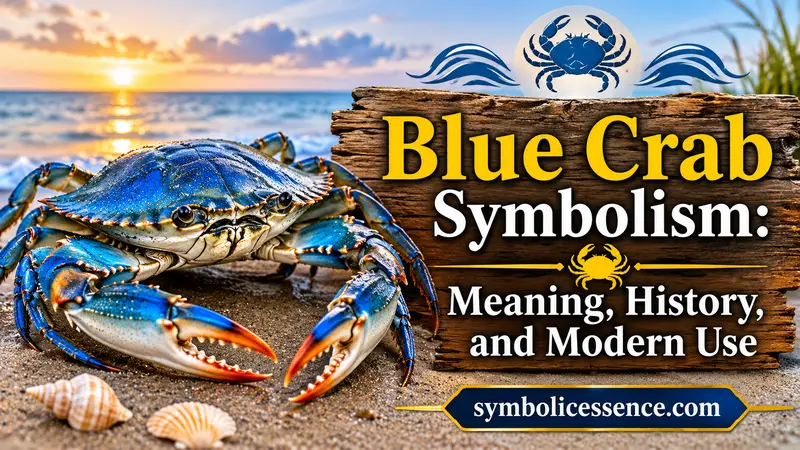
A blue crab has a distinctive appearance: bright blue claws, a hard protective shell, and a body built for moving through shallow coastal waters. Along the Atlantic coast of the United States, especially around the Chesapeake Bay, it is much more than a seafood favorite. It represents local identity, coastal traditions, family gatherings, and a connection to the water.
People often look up blue crab symbolism because they want to understand what this animal represents in tattoos, artwork, dreams, jewelry, or personal designs. Its unusual combination of a protective shell and delicate, moving legs also gives people several ways to interpret its character.
In American culture, the blue crab is closely connected to Maryland, Chesapeake Bay communities, fishing traditions, and summer crab feasts. Its meaning comes largely from these real-life connections rather than from one universal symbolic tradition.
Quick Answer
Blue crab symbolism commonly represents protection, adaptability, resourcefulness, independence, and a strong connection to home. In American culture, these meanings developed alongside coastal fishing communities, particularly around the Chesapeake Bay, where the blue crab became an important part of local history, food traditions, and regional identity.
TL;DR
- Protection comes from the crab’s hard outer shell and defensive claws.
- Adaptability reflects its ability to live in changing coastal environments.
- Resourcefulness connects to its survival skills and feeding habits.
- Maryland communities associate it with regional pride and coastal heritage.
- Crab feasts represent family gatherings, friendship, and shared traditions.
- Modern designs use it to express independence and a love of coastal life.
What Does a Blue Crab Look Like?
The blue crab (Callinectes sapidus) is a swimming crab found along the Atlantic coast and Gulf Coast of the United States. Its scientific name comes from Greek and Latin roots. Callinectes means beautiful swimmer, while sapidus means savory or tasty.
Its appearance makes it easy to recognize.
An adult blue crab usually has an olive-green to brown upper shell, blue legs, and bright blue claws. Mature females may have reddish or orange coloring on the tips of their claws. Its wide, flat body is protected by a hard shell called a carapace.
Unlike many crabs that mainly walk along the ocean floor, blue crabs have specially shaped rear legs that work like paddles. These help them swim through the water.
They are commonly found in:
- Chesapeake Bay and its connected rivers.
- Coastal waters of Maryland and Virginia.
- Estuaries along the Atlantic coast.
- Gulf Coast bays and shallow coastal areas.
- Seagrass beds, muddy bottoms, and other sheltered habitats.
These physical features help explain why people associate the animal with protection, movement, and the ability to adjust to different surroundings.
Its natural appearance also makes it a recognizable subject in coastal paintings, seafood restaurant signs, regional decorations, and souvenirs.
What Does a Blue Crab Symbolize Today?
There is no single official meaning attached to the blue crab. However, several interpretations appear naturally when people consider its appearance, behavior, and place in American coastal culture.
Protection and personal boundaries
The crab’s hard shell protects its softer body. Its claws also help it defend itself when threatened. For this reason, it can represent personal boundaries, caution, and the importance of protecting what matters.
Someone who chooses a crab design may connect with the idea of staying strong without needing to appear aggressive.
Adaptability and survival
Blue crabs live in coastal environments where water conditions can change. They move between different habitats and tolerate a range of environmental conditions.
This makes them a suitable symbol for adjusting to new situations, handling uncertainty, and finding ways forward when circumstances change.
Independence and self-reliance
A crab moves on its own and uses its natural abilities to find food and avoid danger. Its independent behavior can represent confidence and the ability to manage personal challenges.
Home and belonging
For people from Maryland and other Chesapeake Bay communities, the animal can represent familiar places, childhood memories, and a connection to the coast.
This meaning is especially personal for people who grew up attending family crab feasts or spending time near the bay.
Where Did Blue Crab Symbolism Begin?
The story of the blue crab as an American cultural symbol is closely connected to the history of coastal communities.
Long before it appeared on restaurant menus and tourist merchandise, blue crabs were part of the food systems of people living near the Atlantic coast and Chesapeake Bay.
Indigenous communities in the Chesapeake region used local waterways as important sources of food. Crabs and other aquatic animals formed part of the broader coastal environment that supported fishing, gathering, and seasonal food practices.
European colonists later adopted local seafood traditions and developed commercial fishing activities around the bay. As coastal settlements expanded, blue crabs became an increasingly important food resource.
By the nineteenth and twentieth centuries, commercial crab harvesting, seafood markets, and crab-processing businesses had become significant parts of the Chesapeake economy.
The animal gradually became more than something people caught and ate. It became associated with the livelihoods of watermen, local businesses, and families who depended on the bay.
There is no well-established historical record showing that the blue crab originally had one fixed symbolic meaning across these communities. Its modern cultural importance developed through everyday relationships with the animal and the coastal environment.
Why Is the Blue Crab Important in Maryland?
Maryland has one of the strongest cultural connections to the blue crab in the United States.
The Chesapeake Bay is closely associated with the state’s seafood industry, fishing communities, and regional identity. Blue crabs have played an important role in this relationship for generations.
The animal is also officially recognized as Maryland’s state crustacean, a designation adopted in 1989.
This recognition reflects its importance to the state’s economy, food culture, and public identity.
You can see this connection in several places:
- Restaurant culture: Crab houses serve steamed crabs as a familiar regional meal.
- Tourism: Visitors often associate Maryland trips with crab feasts and Chesapeake seafood.
- Local merchandise: Crab illustrations appear on shirts, hats, kitchen items, and souvenirs.
- Public identity: The animal appears in regional artwork, signs, and community events.
- Family traditions: Many Maryland families treat summer crab gatherings as an annual event.
For a Maryland resident, a blue crab can represent far more than an animal. It may remind someone of a grandparent’s crab recipe, a childhood summer near the water, or a family gathering around a newspaper-covered table.
That personal connection is a major reason the crab has become such a recognizable regional emblem.
What Does the Blue Crab Represent in American Coastal Culture?
Across the United States, coastal communities often develop local symbols from the animals, landscapes, and industries that shape their daily lives.
The blue crab is a clear example of this relationship.
Its strongest cultural association is with the Chesapeake Bay, but it is also familiar along parts of the Atlantic and Gulf coasts.
Coastal identity
A crab image can communicate a connection to seaside towns, fishing communities, and life near the water. People who have moved away from their hometowns sometimes use coastal designs to remember where they came from.
Hard work and local livelihoods
Commercial crab fishing requires knowledge of tides, seasons, equipment, and changing water conditions. The animal therefore has a practical connection to the work of watermen and seafood businesses.
Hospitality and shared meals
Steamed crabs are often served in large quantities for groups. People gather around tables, share food, and spend time together.
The animal can consequently represent hospitality, friendship, and the enjoyment of ordinary family moments.
Regional pride
In Maryland, blue crab imagery can function almost like a visual statement of local identity. It tells others that the person has a connection to the state or its coastal traditions.
These associations are based on recognizable community practices, not on a belief that the animal has the same meaning for every American.
How Does the Blue Crab Represent Protection and Personal Boundaries?
One of the easiest meanings to understand comes directly from the crab’s body.
Its shell creates a protective covering around its softer internal parts. Its claws provide another form of defense.
People often connect this physical feature with the idea of having emotional boundaries.
For example, someone who has experienced a difficult period may choose a crab image to represent learning to protect personal time, relationships, and emotional well-being.
The meaning does not have to suggest avoiding other people. It can communicate the difference between being open and allowing others to cross important boundaries.
There is another interesting detail: crabs must periodically shed their old shells to grow. This process is called molting.
After molting, the new shell is soft until it hardens. This biological process can inspire personal interpretations about growth, change, and the uncomfortable stages that sometimes come before a new beginning.
The connection is especially useful in artwork about personal development because it comes from a real part of the animal’s life cycle.
What Does the Blue Crab Mean in Tattoos and Personal Designs?
Crab tattoos are often chosen by people who have a personal connection to coastal life or who like the animal’s unusual appearance.
Unlike a generic ocean tattoo, a blue crab can carry a strong regional meaning.
Here are some common design interpretations:
A traditional blue crab tattoo
A detailed crab with visible blue claws may represent Maryland roots, Chesapeake Bay memories, or pride in coastal heritage.
A crab with raised claws
This design can communicate confidence, self-defense, and the willingness to stand up for personal boundaries.
A small minimalist crab
A simple outline may represent a quiet connection to the beach, summer holidays, or a favorite coastal location.
A crab with waves
Adding ocean waves can emphasize freedom, adaptability, and a love of marine environments.
A crab with a date or name
Some people add a family name, hometown, or important date to turn the design into a personal memorial or reminder.
The emotional meaning depends on the person wearing it. A tattoo that represents childhood summers for one person may represent resilience or independence for another.
How Is the Blue Crab Used in Art, Fashion, and Home Decor?
The animal’s recognizable shape makes it useful in visual design.
Its broad shell, extended claws, and bright coloring create an image that works in both realistic illustrations and simple decorative patterns.
Coastal home decor
Blue crab pictures appear in beach houses, vacation homes, seafood restaurants, and coastal-themed kitchens. They can create a sense of place without requiring a complicated design.
Clothing and accessories
Crab illustrations are commonly used on T-shirts, sweatshirts, caps, tote bags, and beach accessories. In Maryland, these designs often communicate local pride.
Kitchen and dining decorations
Crab-shaped serving dishes, decorative plates, tablecloths, and kitchen signs connect the animal to seafood traditions and shared meals.
Paintings and illustrations
Artists may use the crab to show the natural beauty of estuaries, coastal wildlife, or traditional fishing communities.
A realistic blue crab painting might focus on its colors and body structure, while a cartoon version may create a playful seaside atmosphere.
In each case, the design can carry a different message depending on its setting and the person using it.
What Does a Blue Crab Represent at Family Gatherings?
One of the most recognizable American traditions involving blue crabs is the Chesapeake-style crab feast.
These gatherings are particularly common in Maryland and surrounding areas during the warmer months.
Steamed crabs are usually seasoned, placed in large groups on tables, and shared among family members and friends. Mallets and crab knives help people open the shells and remove the meat.
The process takes time. People talk, laugh, eat slowly, and help one another.
This is different from a meal where everyone receives an individual plate and finishes quickly.
Because the food is shared and the activity brings people together, the crab can represent:
- Family connection and shared memories.
- Friendship and community participation.
- Summer traditions and outdoor celebrations.
- Hospitality and local food heritage.
- Enjoying simple experiences with other people.
For someone who grew up attending these gatherings, a blue crab decoration may bring back memories of relatives, familiar recipes, and warm evenings near the water.
In this setting, its meaning comes less from its physical appearance and more from the experiences connected to it.
Does the Blue Crab Have Religious or Spiritual Meaning?
The blue crab does not have one widely established religious meaning across major American religious traditions.
It is important to separate documented cultural practices from personal spiritual interpretations.
Some people may personally associate a crab with protection, personal growth, or adapting to life’s changes. Others may connect it with a childhood memory or a meaningful experience near the ocean.
These interpretations can be personally important, but they should not be presented as universal religious teachings.
The animal is also not a recognized universal warning sign. Seeing one on a beach, in a picture, or near a home does not establish that something good or bad will happen.
For people who enjoy personal symbolism, the most useful approach is to consider what the animal represents in their own lives.
How Do Different Blue Crab Designs Change Their Meaning?
The surrounding details can change the message of a crab illustration.
A naturalistic design may emphasize wildlife and environmental awareness, while a colorful decorative design may communicate fun, summer, and regional pride.
| Context | Meaning in USA | Common Associations | Notes |
| Blue crab tattoo | Personal identity and protection | Independence, hometown pride | Often connected to Maryland or coastal memories |
| Crab jewelry | Connection to the ocean | Personal style, beach lifestyle | Small charms are usually decorative and personal |
| Crab house artwork | Regional heritage | Seafood, hospitality, community | Especially familiar around Chesapeake Bay |
| Crab with waves | Adaptability and coastal freedom | Ocean life, travel, change | The waves add a sense of movement |
| Crab family illustration | Family and togetherness | Shared meals, friendship | Often suits kitchens and gathering spaces |
The colors also matter.
Bright blue claws can make the animal recognizable, while natural green and brown tones create a more realistic wildlife appearance. Red and orange details can make a design feel warmer and more decorative.
A simple crab outline may feel understated, whereas a large, detailed illustration can become a strong statement of regional identity.
What Are Common Misunderstandings About Blue Crab Symbolism?
Because the animal has several modern interpretations, it is easy to confuse personal meaning with established cultural history.
A few misunderstandings are worth clearing up.
The blue crab does not have one universal meaning.
Protection and adaptability are reasonable modern interpretations, but there is no single historical definition that applies to everyone.
It is not exclusively a Maryland symbol.
Maryland has a particularly strong relationship with the animal, but blue crabs also live in other Atlantic and Gulf Coast regions. People outside Maryland may have their own coastal connections.
Its symbolism is not always spiritual.
A crab image on a shirt or restaurant sign may simply express a love of seafood or local culture. Not every design is intended to communicate a personal belief.
The sideways movement does not prove a lack of progress.
People sometimes interpret a crab’s sideways walking as a sign of moving indirectly through life. This is a creative comparison, not a documented universal tradition.
A hard shell does not mean emotional coldness.
Although the shell can represent protection, it does not have to suggest that someone is unfriendly or unwilling to trust others.
Understanding these differences makes it easier to appreciate the animal without attaching unsupported claims to it.
How Has the Meaning Changed Over Time?
The blue crab’s place in American culture has developed alongside changes in coastal communities.
In earlier periods, its importance was closely connected to food gathering, fishing, and local survival. Coastal residents valued it as a natural resource, and later commercial fishing businesses made it an important part of regional economies.
During the nineteenth and twentieth centuries, seafood markets, crab-processing businesses, and local restaurants helped establish its public identity.
As tourism grew around the Chesapeake Bay, the crab also became a familiar image used to represent Maryland and its coastal attractions.
The official recognition of Maryland’s state crustacean in 1989 strengthened its place in the state’s public identity.
More recently, the animal has become common in clothing, home decorations, souvenirs, and personal artwork.
Its meaning has also expanded beyond seafood and regional pride. Modern designs may use it to communicate environmental awareness, personal independence, or a connection to a coastal hometown.
Younger generations may encounter it through social media, merchandise, and decorative artwork rather than through fishing traditions.
Still, its connection to local food and community gatherings remains one of its most recognizable cultural features.
Why Do People Still Connect With the Blue Crab?
The blue crab has several qualities that make it easy to connect with.
Its shell creates an obvious image of protection. Its ability to move through different coastal environments provides a natural comparison for adaptability. Its role in family meals gives it a social meaning that many people can understand.
There is also something specific about regional symbols: they can remind people of a place even when they are far away from it.
A person who grew up in Maryland may see a crab design and remember a family gathering. Someone who lives near the Gulf Coast may associate it with local seafood restaurants and fishing communities.
Another person might simply appreciate its unusual shape and bright colors.
These connections do not need to be complicated. Sometimes an animal becomes meaningful because it reminds someone of a place, a person, or an experience they do not want to forget.
FAQs
Is blue crab symbolism positive or negative?
It is generally interpreted positively in modern American decorative and personal contexts. Protection, adaptability, independence, and family connection are common associations, although the crab’s defensive claws can also suggest caution.
Does a blue crab symbolize good luck?
There is no widely documented American tradition that establishes the blue crab as a universal good-luck symbol. However, an individual may associate it with a successful fishing season, a happy family memory, or a meaningful experience near the water.
What does a blue crab symbolize in a tattoo?
A blue crab tattoo can represent coastal identity, personal boundaries, independence, or pride in a hometown. Some people also choose it to remember a loved one who enjoyed fishing or spending time near the Chesapeake Bay.
Why is the blue crab associated with Maryland?
Maryland has a long history of blue crab harvesting, seafood businesses, and Chesapeake Bay traditions. The animal became a recognizable part of the state’s identity and was officially designated its state crustacean in 1989.
Does a blue crab symbolize family?
It can represent family because shared crab feasts are an established tradition in Chesapeake Bay communities. The experience of gathering around a table, preparing food together, and sharing a meal gives the animal a connection to family life.
What does a blue crab represent in coastal home decor?
In home decorations, it commonly represents a seaside lifestyle, regional pride, and an appreciation for marine wildlife. It is especially popular in coastal-themed kitchens, vacation homes, and beach-inspired interiors.
Does the blue crab symbolize personal growth?
It can represent personal growth through the process of molting. A crab sheds its old shell to grow, making this natural process a useful comparison for leaving behind an earlier stage of life and adjusting to change.
Conclusion
Blue crab symbolism is closely connected to protection, adaptability, independence, and belonging. Its hard shell provides a natural image of personal boundaries, while its place in American coastal communities gives it a strong connection to regional identity and shared traditions.
Its cultural history is especially visible around the Chesapeake Bay, where generations of fishing communities have made the animal an important part of local food, business, and public identity. Today, it also appears in tattoos, clothing, artwork, and home decorations, often carrying personal meanings that go beyond its role as seafood.
A blue crab on a kitchen wall or a tattoo on someone’s arm may look like a simple coastal design. But for the person who chooses it, that small image might hold memories of home, family gatherings, summer evenings, or the determination to protect what matters most.