
Last Updated: September 10, 2026
Few animals get a reaction as immediate as the skunk. Most people picture the black-and-white stripe, the raised tail, and the smell before they picture anything else. But skunk symbolism goes well beyond that first impression, touching on ideas of self-protection, boundary-setting, quiet confidence, and the surprising power of a creature that never needs to be the biggest or fastest thing in the room. In American culture especially, the skunk has become a low-key stand-in for self-respect and calm assertiveness.
People search out the meaning behind skunk symbolism for a few different reasons. Some have had a personal encounter — a skunk wandering through a backyard at dusk — and want to know if it means anything. Others are drawn to skunk imagery in tattoos, folk art, or nature writing and want context before they commit to it. And some are simply curious why an animal best known for its smell has earned a surprisingly warm reputation in wildlife folklore and pop culture.
This article breaks down where skunk symbolism comes from, how it shows up in American life, and why an animal so easy to underestimate has become a quiet symbol of standing your ground.
Quick Answer
Skunk symbolism in modern American culture centers on self-protection, boundary-setting, and quiet confidence — the idea that you don’t need brute strength to defend yourself, just clear warning signs and follow-through. Historically, several Native American traditions associated the skunk with self-respect, restraint, and the wisdom of avoiding unnecessary conflict.
TL;DR
- Skunk symbolism centers on boundaries, self-respect, and calm confidence.
- Native American folklore often linked skunks to restraint and quiet strength.
- Americans today associate skunks with independence and not sweating small threats.
- Its defense mechanism, not aggression, is the core of its symbolic meaning.
- Skunk imagery appears in tattoos, kids’ media, and backyard wildlife folklore.
- Modern usage leans playful and empowering rather than negative.
What a Skunk Actually Looks Like and Where People Encounter One
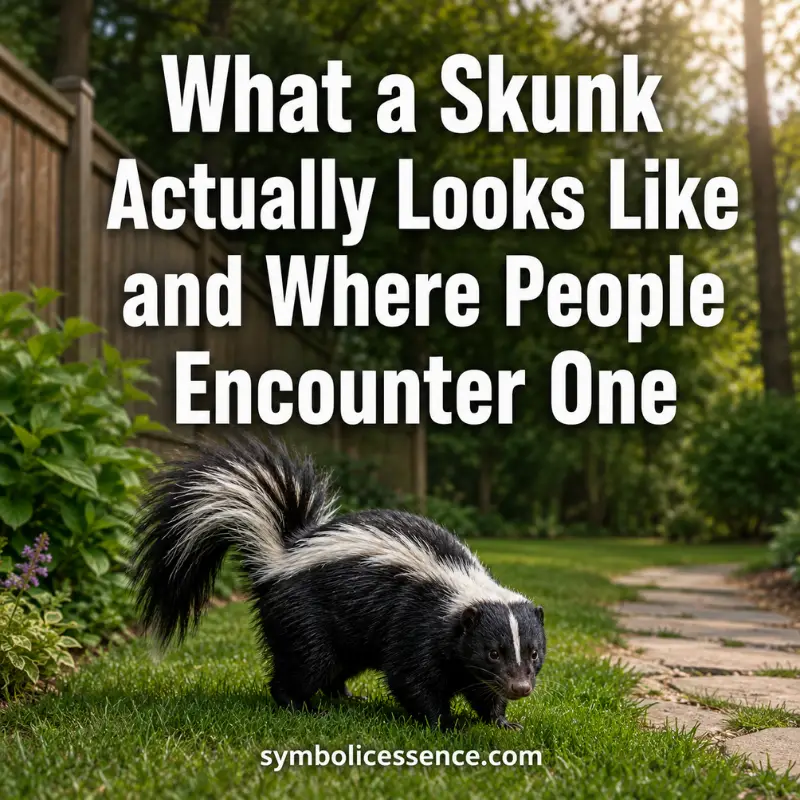
The skunk most Americans know is the striped skunk, recognizable by its stocky black body, white dorsal stripes, and bushy tail. It’s a common sight — sometimes literally in the yard — across most of the continental United States, and it’s mostly active at dusk and overnight. Because it’s more often smelled than seen, people tend to form their sense of the animal from a distance: a warning, a memory, a story told after the fact rather than a long, close look.
That indirect relationship matters for symbolism. Unlike a wolf or an eagle, which people romanticize from wildlife documentaries, the skunk earns its reputation from lived, sometimes comedic, encounters. Its symbolism is built on function — what it does when threatened — rather than on appearance alone.
The Core Meaning Behind Skunk Symbolism
At the center of skunk symbolism is one simple fact: a skunk doesn’t attack, it warns. Before ever using its spray, a skunk stomps its feet, raises its tail, and gives a clear signal to back off. Only when that warning is ignored does it use its strongest defense.
That sequence is the reason skunk symbolism reads as confident rather than aggressive. It represents the idea of setting a boundary clearly, giving fair warning, and only escalating when necessary. People who relate to this symbolism often describe it as a reminder that defending yourself doesn’t require picking a fight first.
Historical Origins of Skunk Symbolism
Long before the skunk became a subject of nature documentaries or children’s cartoons, it held a place in the oral traditions and folklore of numerous Native American nations across North America, where the animal is native. Interpretations varied by nation and region, but a recurring thread was respect for the skunk’s self-sufficiency — the idea that a small, unassuming animal could hold its own against predators many times its size without needing speed, size, or teeth.
In some traditions, the skunk also carried associations with patience and timing, since its defense only works if it waits for the right moment rather than reacting immediately. This idea of controlled, deliberate response — rather than instant aggression — shaped much of the animal’s early symbolic weight and still echoes in how the skunk is talked about today.
Skunk Symbolism in the United States
In broader American culture, the skunk occupies an unusual space: it’s disliked in the moment but admired in hindsight. Homeowners don’t want one under the porch, but almost everyone respects the strategy. That mix of irritation and admiration is where most of the animal’s modern American symbolism lives.
The skunk shows up in regional folklore as a minor trickster figure — not as clever as a fox or coyote, but similarly good at getting exactly what it wants without a fight. In everyday language, “don’t poke the skunk” has become an informal way of saying someone is calm until pushed too far. It’s a distinctly American use of the animal: less mythic, more practical, tied to the idea of not underestimating someone who seems easygoing.
Skunk Spirit Animal Meaning
When people use the phrase “skunk spirit animal,” they usually mean the personal qualities they associate with the animal rather than a single universal spiritual doctrine. The skunk can represent self-respect, boundaries, patience, independence, and confident self-protection.
Its strongest lesson is that strength does not always require confrontation. A skunk can discourage a threat through warning signals before using its defense. As a personal symbol, this can encourage you to communicate your limits clearly and avoid unnecessary arguments.
The skunk can also represent individuality. It does not have the speed of a deer or the physical power associated with animals such as bears and lions. Yet it has an effective defense that makes predators think twice. Symbolically, this creates a useful reminder: you do not have to compete with someone else’s strengths to protect your own space.
For some people, skunk symbolism can also suggest patience. Instead of reacting immediately, the animal’s behavior can be viewed as a metaphor for assessing a situation before deciding whether action is necessary.
If the skunk repeatedly catches your attention in personal reflection, art, dreams, or nature encounters, you can treat it as a prompt to ask simple questions: Where do I need stronger boundaries? Am I reacting too quickly? Have I clearly communicated what I will and will not accept?
These interpretations are reflective rather than fixed spiritual rules. Different cultures and individuals can understand the same animal in very different ways.
Skunk Symbolism in Design, Identity, and Public Life
Beyond folklore, the skunk’s black-and-white pattern has made it a recognizable design element on its own. Its bold, high-contrast coloring is often borrowed in logos, mascots, and branding for products or teams that want to suggest resilience with a bit of personality — something memorable rather than fierce. Sports teams and local mascots occasionally use the skunk specifically because it reads as tough but likable, an underdog with a built-in advantage.
The skunk has also become a small but recognizable identity symbol for people who see themselves as underestimated — physically small, quiet, or easy to overlook, but not to be tested. This is less about official tradition and more about how the animal’s real-world behavior has been adopted informally as a personal metaphor.
Black-and-White Skunk Symbolism
The skunk’s striking black-and-white appearance adds another layer to its symbolic appeal. Black and white are often used in visual symbolism to suggest contrast, balance, clarity, duality, and the meeting of opposites.
That contrast fits the skunk unusually well. The animal can appear harmless and even comical, yet it possesses a powerful defense. Its appearance therefore reinforces the broader symbolic idea that outward impressions do not always reveal inner capability.
The black-and-white pattern can also represent two sides of the same personality: gentleness and firmness, calmness and defense, independence and social connection. Someone drawn to skunk imagery may appreciate that tension because it reflects the ability to remain approachable without becoming easy to take advantage of.
However, color symbolism is culturally variable. Black does not automatically mean something negative, and white does not always represent purity. In the case of the skunk, the strongest symbolic meaning comes from the animal as a whole rather than from assigning a fixed meaning to each color.
Cross-Cultural Meaning Beyond the United States
Because skunks are native to the Americas, most of their symbolic weight comes from North and Central American traditions rather than European, Asian, or African folklore, where the animal historically had little to no presence. In Mesoamerican traditions, animals with strong defensive traits were often respected as symbols of self-sufficiency, and the skunk fits within that broader pattern of admiring creatures that survive on wit and preparation rather than raw power.
Outside the Americas, skunk symbolism is largely a modern import, shaped by nature media, children’s books, and, more recently, internet culture, rather than by deep-rooted local tradition.
Emotional and Psychological Symbolism
Psychologically, skunk symbolism tends to resonate with people who value calm self-protection over confrontation. It appeals to the instinct to avoid unnecessary conflict while still being fully capable of defending yourself if pushed. That combination — patience paired with a firm limit — is why so many people who connect with skunk symbolism describe it as reassuring rather than intimidating.
There’s also an element of quiet self-worth in it. The skunk doesn’t need to be the strongest animal in the forest because it knows exactly what it’s capable of and doesn’t waste that capability on small provocations. For many, that’s the real emotional core: confidence that doesn’t need to prove itself constantly.
Skunk Symbolism in Love and Relationships
In love and relationships, skunk symbolism can represent healthy boundaries, emotional self-respect, independence, and knowing when to step back.
The skunk’s behavior offers an interesting relationship metaphor. It does not need to attack simply because another animal comes close. Instead, it communicates a warning before using its strongest defense. Applied to relationships, that can symbolize expressing discomfort early rather than allowing resentment to build.
A skunk can also represent the importance of personal space. Healthy relationships do not require two people to give up their independence. The symbolism suggests that caring about someone and maintaining clear boundaries can exist at the same time.
For someone recovering from a difficult relationship, the skunk may feel especially meaningful because it represents the right to say “enough.” Its symbolism is not about punishing another person. It is about recognizing your limits and protecting your well-being without unnecessary hostility.
In a positive romantic context, the skunk can also symbolize authenticity. Choosing a skunk instead of a more traditionally glamorous animal may communicate that personality matters more than appearances.
Ultimately, skunk symbolism in love is less about romance itself and more about self-respect within connection: care for others, communicate clearly, and do not ignore your own boundaries.
Skunk Symbolism in Dreams
Dreaming about a skunk often connects with boundaries, self-protection, avoidance, and the need to respond carefully to a difficult situation. The meaning depends heavily on what the skunk was doing and how you felt during the dream.
A calm skunk may represent confidence without confrontation. It can suggest that you already know how to protect yourself and do not need to prove your strength to anyone. A skunk that raises its tail or prepares to spray can point toward a warning: something in your waking life may be getting too close to a personal boundary.
Being sprayed by a skunk can symbolize feeling overwhelmed by conflict, embarrassment, criticism, or an unpleasant situation that you could not avoid. In contrast, watching a skunk walk away may represent choosing distance instead of engaging in an argument.
A friendly skunk can carry a different message. It may symbolize an underestimated part of your personality — quiet, unconventional, independent, or stronger than other people realize. Because skunks often survive without relying on size or aggression, they can appear in dreams when self-confidence needs to replace confrontation.
Dream symbolism is personal rather than universal. A skunk appearing in your dream does not predict a specific event. Instead, consider what happened immediately before the dream and whether its behavior reminded you of a person, conflict, decision, or boundary in your waking life.
Why Skunks Appear in Tattoos and Personal Style
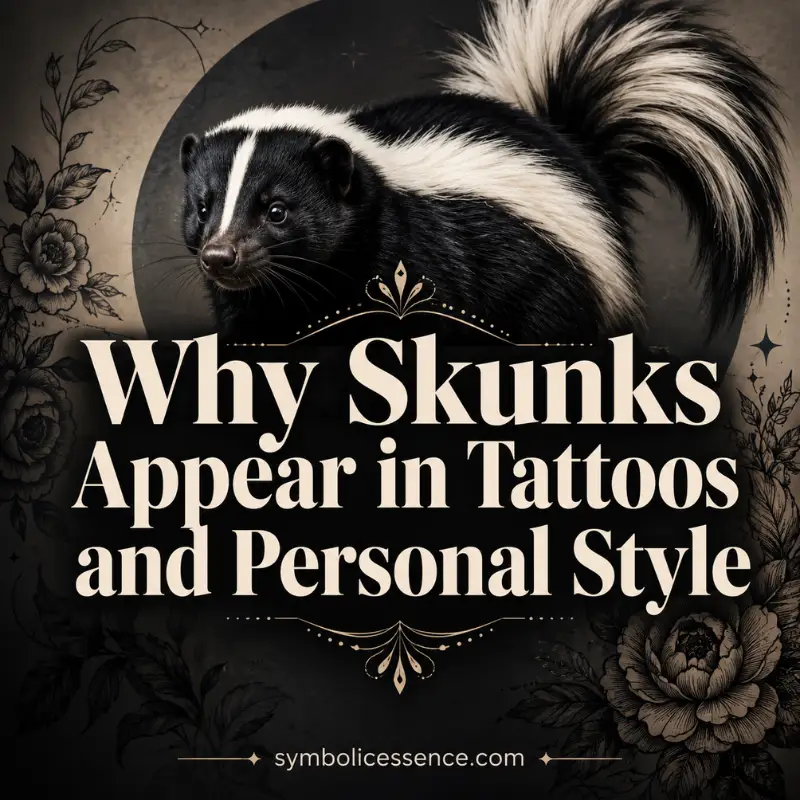
Skunk tattoos are a small but steady niche within animal tattoo culture, often chosen by people who want something distinct from more common choices like wolves or lions. The appeal usually comes down to personality: a skunk tattoo tends to signal humor, self-assurance, and a “don’t test me” attitude without looking aggressive or oversized on the skin.
Because the animal’s design is naturally graphic — bold black, bold white, minimal shading needed — it also works well in simple line-art or minimalist tattoo styles, which has helped it gain traction in contemporary tattoo trends that favor clean, symbolic imagery over highly detailed realism.
Skunk Symbolism in Modern Pop Culture
Pop culture has done a lot to soften the skunk’s reputation. Characters like Pepé Le Pew introduced the skunk as a comedic, if now dated, figure decades ago, while more recent children’s media tends to lean on the skunk as a lovable, misunderstood character whose only real flaw is bad timing. This shift has slowly moved the animal’s public image from “pest” toward “underestimated good guy.”
On social media, skunks get frequent attention as backyard wildlife content — clips of skunk families, close encounters, or rescue stories tend to perform well specifically because the animal’s reputation makes any friendly moment feel like a plot twist.
What Does It Mean When You See a Skunk?
Seeing a skunk does not have one universally accepted spiritual meaning or guaranteed omen. In symbolic interpretation, however, an unexpected skunk encounter can become a useful reminder about boundaries, caution, patience, and self-protection.
If a skunk appears while you are dealing with a difficult person or stressful situation, you might interpret the encounter as a reminder to create more distance rather than escalate the conflict. The symbolism fits the animal’s natural behavior: warn clearly, avoid unnecessary confrontation, and defend yourself when necessary.
A skunk crossing your path can also represent independence. Because skunks rely on an effective defense rather than physical dominance, the encounter may resonate with people who feel underestimated or overlooked.
The setting can influence the personal interpretation. Seeing a skunk near your home may naturally bring the idea of protecting personal space to mind. Seeing one while walking through a natural area may instead encourage awareness, patience, and respect for wildlife.
At the same time, sometimes seeing a skunk simply means that a skunk lives nearby. Symbolism does not need to replace the ordinary explanation. A meaningful interpretation can exist alongside the practical one.
The most useful question is not necessarily “What omen does this skunk bring?” but “What does this encounter make me think about in my own life?” That approach keeps the interpretation personal without treating symbolism as a prediction.
Skunk Symbolism in Decor and Everyday Objects
Skunk imagery shows up in home and garden decor mostly in a lighthearted way — yard signs, kitschy figurines, or nature-themed prints aimed at people who enjoy wildlife humor rather than traditional woodland aesthetics like deer or owls. It rarely appears in formal or elegant decor contexts, largely because the animal’s reputation keeps its use playful rather than decorative in a serious sense.
This differs from animals like foxes or owls, which carry a longer decorative history tied to elegance or wisdom. Skunk decor leans almost entirely on charm and humor instead.
Common Misunderstandings About Skunk Symbolism
The most common misunderstanding is treating the skunk as purely negative — a symbol of unpleasantness or something to avoid. That reading misses the actual behavior the symbolism is based on: the skunk’s spray is a last resort, not a first move. Framing the animal as simply “gross” ignores the more interesting part of its symbolism, which is about restraint before reaction.
Another misunderstanding is conflating skunk symbolism with aggression. In reality, the animal’s whole strategy is built around avoiding conflict when possible. Its symbolism is closer to calm deterrence than hostility.
Skunk Symbolism, Controversies, and Misuse
Skunk symbolism doesn’t carry the kind of heavy historical baggage seen with some other animal symbols, but it has occasionally been used dismissively — as slang for someone considered unpleasant or untrustworthy, distinct from its more respectful folklore meaning. This casual, negative usage exists mostly in slang and pop culture and isn’t connected to the animal’s traditional symbolic meaning, which is far more about self-respect than character judgment.
It’s worth keeping these two meanings separate: the folk and cultural symbolism built around boundary-setting and quiet strength, and the informal slang usage that has little to do with the animal’s actual behavior or traditional significance.
How Skunk Symbolism Has Evolved Over Time
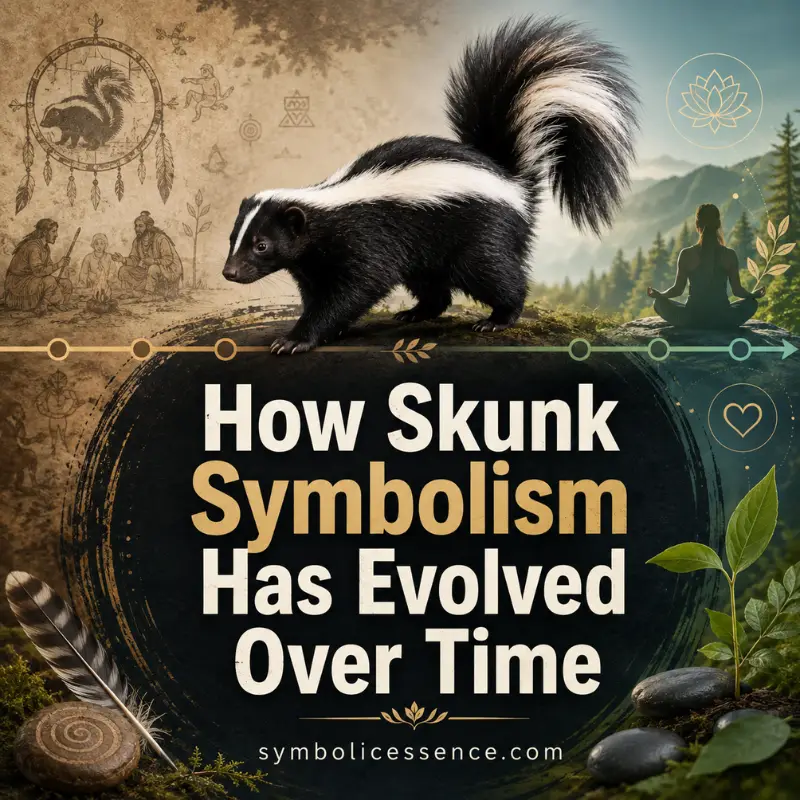
Early interpretations of the skunk centered on respect for its self-sufficiency and its unusual, non-violent form of strength. As European settlers arrived in North America and later as American pop culture developed, the animal’s image shifted toward comedy and nuisance, largely shaped by its smell and its habit of showing up uninvited near homes and farms.
More recently, that pendulum has swung back. Nature-focused social media, a broader cultural interest in “underdog” animals, and a general shift toward appreciating overlooked wildlife have brought the skunk’s original symbolic strengths — patience, boundaries, quiet confidence — back into focus.
Skunk Symbolism at a Glance
| Context | Meaning in the USA | Common Associations | Notes |
|---|---|---|---|
| Folklore | Self-respect, restraint | Patience, timing, quiet strength | Rooted in Native American oral traditions |
| Everyday language | Calm until provoked | Boundaries, fair warning | Reflected in phrases like “don’t poke the skunk” |
| Tattoos | Confidence, individuality | Humor, self-assurance | Popular in minimalist, bold-line styles |
| Pop culture | Misunderstood good guy | Comedy, charm | Softened by children’s media over decades |
| Slang | Untrustworthy person | Negative judgment | Separate from traditional folklore meaning |
FAQs
What does a skunk symbolize spiritually?
In many Native American traditions, the skunk is connected to self-respect and the wisdom of avoiding unnecessary conflict. Spiritually, it’s often read as encouragement to protect your energy and boundaries without needing to be aggressive about it.
What does a skunk tattoo mean?
A skunk tattoo generally signals confidence, individuality, and a calm but firm “don’t test me” attitude. Many people choose it specifically because it stands apart from more common animal tattoo choices while still carrying a clear personal message.
Is skunk symbolism positive or negative?
It’s overwhelmingly positive in traditional and modern cultural contexts, centered on boundaries and quiet strength rather than hostility. The negative reading mostly comes from slang usage or from focusing only on the animal’s smell rather than its behavior.
Does seeing a skunk mean anything?
Encountering a skunk isn’t tied to any single, universally agreed-upon omen, though some people interpret it as a nudge to reassess their boundaries or slow down before reacting to a conflict. Most modern interpretations treat it as a personal, reflective prompt rather than a fixed sign.
How is skunk symbolism different in Native American traditions versus mainstream American culture?
Native American traditions tend to emphasize patience, timing, and self-respect as spiritual or moral lessons drawn from the animal’s behavior. Mainstream American culture has translated that into a more casual, everyday idea — staying calm until you actually need to defend yourself.
Why do skunks have such a mixed reputation?
The mismatch comes from timing: people react to the smell in the moment but tend to respect the strategy once they think about it. That gap between instant reaction and later reflection is exactly why the skunk’s symbolism split into both a nuisance reputation and a respected one.
What does it mean when a skunk crosses your path?
A skunk crossing your path has no universally accepted omen. As a personal symbol, it can serve as a reminder to slow down, respect boundaries, avoid unnecessary conflict, and trust your ability to protect yourself.
What does a skunk symbolize in a dream?
A skunk in a dream can symbolize boundaries, self-protection, caution, or quiet confidence. A threatening skunk may reflect a situation where you feel pressured, while a calm skunk may represent confidence without confrontation.
Conclusion
Skunk symbolism ultimately comes down to a simple, relatable idea: real strength doesn’t need to announce itself constantly, just clearly enough when it counts. The animal’s entire defense strategy — warn first, act only if ignored — has shaped how it’s understood across folklore, tattoos, and everyday language, turning a creature people try to avoid into a quiet symbol of self-respect.
What makes this symbolism stick is how practical it is. It’s not about grand mythology or dramatic transformation; it’s about knowing your limits, communicating them clearly, and trusting that you don’t need to be the loudest or biggest thing around to hold your ground. For an animal best known for one unfortunate smell, that’s a surprisingly grounded lesson.