
Last Updated: September 13, 2026
Moon jellyfish symbolism usually develops from the animal’s translucent body, steady pulsing movement, and ability to live within changing currents. In modern American culture, the moon jelly often represents adaptability, emotional openness, renewal, calmness, and the ability to remain responsive without losing one’s identity.
People encounter moon jellies along coastlines, in public aquariums, in nature photography, and across ocean-inspired art. Their rounded bells can resemble pale moons suspended in water, while their unhurried movement creates an impression of stillness even when they are actively swimming.
Unlike symbols inherited from a single religious text or ancient tradition, the moon jellyfish has no universally established symbolic code. Most meanings attached to it are modern interpretations based on its appearance, behavior, life cycle, and relationship with the marine environment.
Quick Answer
Moon jellyfish symbolism commonly represents adaptability, emotional transparency, calmness, and renewal in modern American culture. Its changing life stages and current-influenced movement also connect it with transformation, acceptance, and navigating uncertainty without becoming completely passive.
TL;DR
- Adaptability is the most common modern interpretation.
- Transparency suggests honesty, sensitivity, and visible emotion.
- Its life cycle supports renewal and identity change.
- Rhythmic movement communicates calm rather than weakness.
- Modern meanings come mainly from observation, not ancient doctrine.
- Environmental interpretations require care because jellyfish blooms have several causes.
What a Moon Jellyfish Looks Like
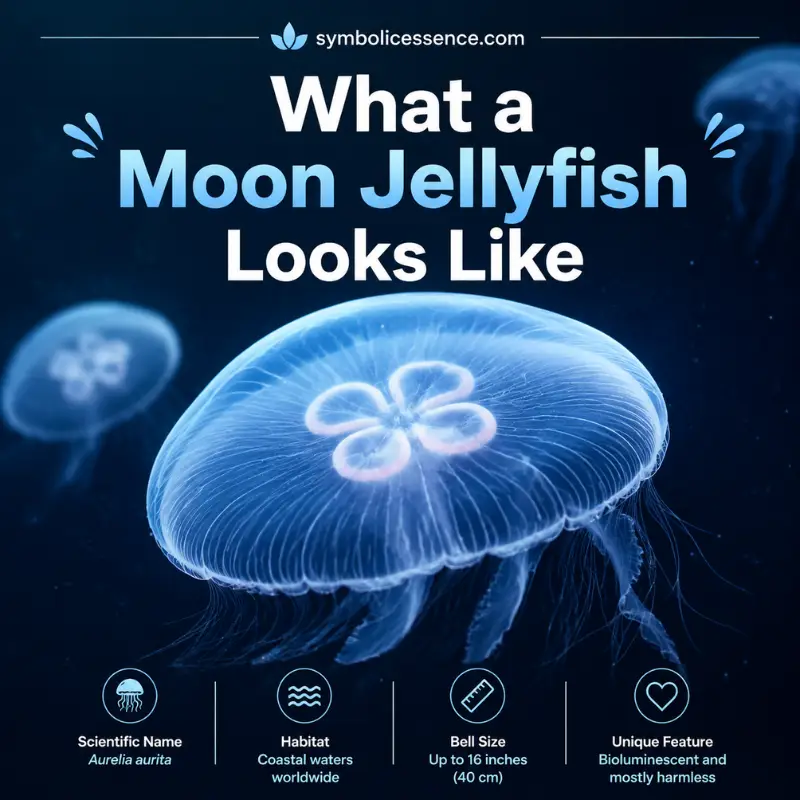
Moon jellies are recognized by their translucent, saucer-shaped bells and the curved reproductive organs often visible near the center. These internal structures commonly appear as four pale horseshoe or crescent shapes, strengthening the visual connection between the animal and the moon.
The name “moon jellyfish” is often used broadly for members of the genus Aurelia. Although many look nearly identical, genetic research has shown that the group contains numerous distinct species that cannot always be separated by appearance alone. For that reason, not every moon jelly seen in an aquarium or coastal bay should automatically be identified as Aurelia aurita.
Their short tentacles, clear bodies, rounded outlines, and regular contractions give them a softer appearance than long-tentacled sea nettles or box jellyfish. Moon jellies possess stinging cells for catching prey, but their sting generally causes little or no reaction in most people. Sensitive individuals may still experience irritation, so “mild” should not be confused with completely incapable of stinging.
These physical traits shape nearly every symbolic interpretation. The transparent bell suggests openness, the circular shape suggests continuity, and the pulsing motion suggests a steady response to surrounding conditions.
Core Meanings at a Glance
| Context | Common Meaning in the United States | Visual or Biological Association | Important Note |
|---|---|---|---|
| Personal growth | Adaptability | Moving through changing currents | Adaptation is not the same as surrender |
| Emotional identity | Openness and sensitivity | Translucent body | Vulnerability can include boundaries |
| Major life changes | Renewal and transformation | Multi-stage life cycle | Change may be gradual rather than dramatic |
| Stress and wellness | Calm, rhythm, and regulation | Repeated bell contractions | Calmness should not imply avoidance |
| Relationships | Gentle connection | Soft form and coordinated movement | Healthy closeness still requires self-protection |
| Environmental art | Ocean awareness | Coastal habitat and visible blooms | Bloom causes should not be oversimplified |
Adaptability Without Losing Direction
The moon jellyfish is frequently interpreted as a symbol of going with the flow. That phrase can be useful, but it can also create a misleading picture of total passivity.
Moon jellies are strongly influenced by water movement, yet they are not simply lifeless objects carried wherever the ocean chooses. They contract their bells rhythmically to move, feed, maintain position, and respond to their surroundings. Their motion combines individual effort with environmental influence.
Symbolically, this creates a more practical meaning than “let life happen.” The moon jelly can represent recognizing conditions that cannot be controlled while continuing to make small, purposeful adjustments.
For Americans dealing with career changes, relocation, family transitions, or uncertain plans, the image may communicate flexibility without complete self-erasure. It encourages responsiveness: notice what is changing, conserve energy where resistance is useless, and act where movement remains possible.
The lesson is not that every current should be followed. It is that effective adaptation begins with understanding the current before deciding how to respond.
Transparency, Sensitivity, and Emotional Honesty
Because much of the moon jelly’s internal structure can be seen through its bell, it is often associated with transparency. In personal symbolism, this may refer to honest communication, emotional availability, or the wish to live without maintaining a false exterior.
Transparency can also represent exposure. A clear body appears delicate because it seems to hide nothing. This makes the moon jelly relevant to people who view sensitivity as both a strength and a source of risk.
A person choosing this symbol may identify with noticing subtle changes in tone, environment, or relationships. The moon jelly does not need to symbolize fragility in the sense of helplessness. Instead, it can represent a responsive nervous system, a perceptive personality, or a preference for gentleness over aggression.
Its symbolism becomes especially meaningful when openness is paired with discernment. Emotional honesty does not require sharing everything with everyone. The animal’s stinging cells provide a useful contrast: a soft and nearly transparent form can still possess defensive mechanisms.
Renewal Through a Changing Life Cycle
The familiar floating jelly is only one stage of the moon jelly’s life. Jellyfish move through several forms, including a free-swimming larval stage, an attached polyp stage, a juvenile ephyra stage, and the adult medusa form most people recognize. Polyps can reproduce asexually, while adult medusae participate in sexual reproduction.
This biological transformation supports symbolic associations with renewal, identity change, and hidden development. A moon jelly does not simply become a larger version of its earliest form. It passes through body plans that look and function differently.
For personal use, that process can represent a period when an old identity no longer fits but a new one has not fully formed. The attached polyp may symbolize preparation, stability, or unseen growth. The juvenile stage can suggest experimentation, while the adult jelly may represent emergence into a more visible phase.
This interpretation differs from the butterfly’s familiar metamorphosis symbolism. Butterfly imagery often emphasizes a dramatic before-and-after transformation. Moon jelly imagery suggests repeated stages, changing environments, and development that may be less visible from the outside.
Moon Jellyfish Symbolism for Personal Growth and Life Transitions
For personal growth, the moon jellyfish can represent a quieter form of transformation. Its life cycle reminds us that development does not always happen through one dramatic breakthrough. Sometimes change occurs through several stages, each with its own purpose.
This makes the moon jellyfish a useful symbol during periods such as starting a new career, moving to a different city, ending a relationship, returning to school, or rebuilding confidence after a difficult experience.
Its connection with currents can represent circumstances that cannot be completely controlled. A person may not choose every condition around them, but they can still decide how to respond. The moon jelly therefore supports a practical interpretation of resilience: adjust when necessary while protecting the values and boundaries that matter most.
The animal’s transparency can also represent becoming more honest with yourself. Personal growth often begins when someone recognizes what they actually feel rather than maintaining an identity that no longer fits.
Its rhythmic movement offers another lesson. Progress can be repetitive and gradual. Small actions repeated consistently may matter more than occasional bursts of effort.
The moon jellyfish can also symbolize leaving behind an outdated definition of strength. Instead of associating resilience only with toughness, confrontation, or control, this symbol allows strength to include sensitivity, flexibility, patience, and careful adaptation.
For someone marking a new chapter, a moon jellyfish image can serve as a reminder that changing form does not necessarily mean losing yourself. Growth can alter how you live, work, relate to others, and understand your identity while still preserving a sense of continuity.
Calmness, Rhythm, and Emotional Regulation
Moon jellies are commonly displayed under carefully arranged aquarium lighting, where their contractions appear slow and meditative. This visual experience has helped connect them with calmness, rest, and controlled breathing.
The symbolism comes from rhythm rather than complete stillness. A moon jelly is almost always moving. Its bell expands and contracts in a repeated pattern, creating forward motion through consistency rather than force.
That distinction makes the animal a useful emblem for emotional regulation. Calmness does not require the absence of fear, pressure, or movement. It can mean returning to a dependable rhythm while circumstances remain unsettled.
In wellness spaces, artwork featuring moon jellies may support an atmosphere of quiet attention. In personal reflection, the pulsing bell can resemble the cycle of inhaling and exhaling: gather, release, gather again.
This meaning should remain metaphorical. Looking at jellyfish may feel relaxing, but the symbol is not a substitute for professional care when anxiety, trauma, or persistent stress affects daily life.
Softness Paired With Boundaries
The moon jelly’s appearance can make it seem defenseless. Its body lacks the hard shell, claws, teeth, or obvious armor associated with many protective animal symbols.
Yet moon jellies are cnidarians, animals equipped with specialized stinging cells. They use these cells primarily to capture small prey rather than to project aggression. Their defense is subtle, built into the body rather than displayed as a warning.
This creates an appealing symbolic contrast: softness does not eliminate the need for limits. Someone can remain compassionate, receptive, and gentle while still rejecting harmful treatment.
In relationship symbolism, the moon jelly may therefore represent quiet boundary-setting. It favors protection without constant confrontation. Its message is not to become threatening but to recognize that sensitivity requires safeguards.
The same idea can apply to creative work and public identity. Artists, writers, and emotionally expressive people may reveal meaningful parts of themselves while keeping private areas protected.
Moon Jellyfish Symbolism in Love and Relationships
In love and relationships, moon jellyfish symbolism can represent emotional openness, gentle connection, adaptability, and closeness without loss of individuality.
Its transparent body can suggest honesty between partners. Rather than presenting a carefully controlled image, the symbol may represent a willingness to show genuine feelings and acknowledge emotional vulnerability.
The moon jelly’s movement offers another relationship meaning: growing together while responding to circumstances. Healthy relationships often require both people to adapt when work, distance, family responsibilities, or personal goals change. The symbolism therefore fits relationships that value flexibility without demanding that either partner abandon personal identity.
Two moon jellyfish can represent companionship and emotional synchronization. Their presence together may symbolize two people moving through life at a similar emotional pace while still remaining separate individuals.
The animal’s subtle defenses add an important layer to romantic symbolism. A gentle relationship still needs boundaries. Being emotionally open does not mean accepting disrespect, controlling behavior, or repeated harm.
A moon jellyfish tattoo shared by partners may therefore represent a relationship built around sensitivity and independence. It can also commemorate a period when two people supported one another through major change.
In a difficult relationship, the same symbol can take on a different meaning. A jellyfish drifting alone may express emotional distance, while a jellyfish surrounded by turbulent water may represent confusion or instability.
The most meaningful relationship symbolism comes from the story behind the image. For one couple, the moon jelly may represent meeting near the ocean. For another, it may symbolize surviving a difficult transition together. Personal experience gives the symbol its strongest emotional meaning.
The Moon Connection
The common name encourages associations with lunar symbolism even though the animal is not biologically governed by a mystical relationship with the moon. Its pale circular bell simply resembles a full moon, especially when viewed from above or illuminated against dark water.
In symbolic design, combining moon and jellyfish imagery can intensify themes of cycles, reflection, intuition, nighttime calm, and changing emotional states. These meanings belong to artistic interpretation rather than established marine science.
The moon connection can also introduce a feminine association because Western art and literature have frequently linked the moon with femininity, fertility, and cyclical time. However, the jellyfish itself does not carry a fixed gender meaning. People of any identity may use it to represent receptiveness, change, or emotional awareness.
A crescent moon placed above a jellyfish often suggests guidance through uncertainty. A full moon enclosed within the bell may communicate inner illumination or self-knowledge. These are contemporary design choices, not inherited rules with one correct interpretation.
Moon Jellyfish Spiritual Meaning
The spiritual meaning of a moon jellyfish is usually interpreted through themes of acceptance, transformation, emotional awareness, and connection with natural rhythms. Unlike symbols tied to a specific religious tradition, the moon jellyfish does not have one universally recognized spiritual meaning.
Its translucent body can represent inner honesty. Spiritually, transparency may suggest becoming more aware of emotions, motives, and personal values instead of hiding difficult feelings behind an outward image.
Its rhythmic movement can also symbolize trust in gradual progress. A moon jellyfish does not need to move with dramatic force to remain active. This can become a useful metaphor for people who are learning that meaningful growth sometimes happens through small, repeated actions.
The jellyfish’s changing life cycle adds another spiritual layer. Its development through different forms can represent periods of release, preparation, emergence, and renewal. A person may use the image when entering a new chapter while recognizing that identity can change without erasing the past.
The moon association may further encourage reflection on cycles. Because the animal’s bell resembles a pale moon, artists and spiritual practitioners may combine the two images to suggest intuition, emotional cycles, nighttime reflection, or acceptance of change.
However, these ideas should remain personal interpretations rather than claims about supernatural messages. Seeing a moon jellyfish does not objectively predict an event or prove that a spiritual force is communicating with you. Its value as a spiritual symbol comes from the meaning a person consciously gives to the encounter.
For some people, the strongest spiritual message is simple: remain receptive without becoming directionless, accept change without abandoning your values, and protect your sensitivity without closing yourself off from the world.
Moon Jellyfish Symbolism in Dreams
Dreams about moon jellyfish can reflect how a person is handling emotions, uncertainty, change, or situations that feel partly outside their control. Because dream symbolism depends heavily on personal experience, there is no single interpretation that applies to everyone.
A calm moon jellyfish moving through clear water may suggest emotional balance, acceptance, or confidence in navigating a changing situation. Its gentle pulsing can represent a return to a steady rhythm after a stressful period.
A moon jellyfish floating away from you may point to emotional distance or a situation you cannot control. The dream may reflect the need to accept change instead of repeatedly trying to hold onto something that is already moving in another direction.
Seeing a jellyfish in dark or cloudy water can create a different emotional tone. It may represent uncertainty, hidden concerns, confusion, or feelings that remain difficult to understand. The water matters because clear water often creates a sense of awareness, while murky water can suggest incomplete information.
A jellyfish touching or stinging you may symbolize a subtle emotional boundary being crossed. The image can be especially relevant when someone appears gentle or harmless but has caused emotional pain. In this context, the dream may encourage greater awareness of personal limits.
A large group of moon jellyfish may represent emotional overwhelm or too many competing demands. By contrast, a single jellyfish can suggest independence, solitude, or a private period of personal change.
A glowing moon jellyfish may carry a more hopeful interpretation. Its light can symbolize insight, emotional clarity, or finding direction during an uncertain period.
Dream symbolism works best as personal reflection rather than prediction. Instead of asking what a moon jellyfish dream “guarantees,” consider what was happening in the dream and what emotion remained after you woke up. That emotional response often provides the most useful clue.
Historical Roots of the Symbol
There is little evidence that ancient societies developed a distinct symbolic system around the moon jellyfish as a species. Historical people certainly encountered jellyfish, but most surviving myths, religious images, and literary traditions do not separate moon jellies from other gelatinous marine animals.
Jellyfish as a biological group are far older than human culture. Fossil evidence suggests that jelly-like animals existed hundreds of millions of years ago, long before dinosaurs. Their evolutionary age can support modern ideas of endurance and biological continuity, but it should not be presented as proof of an ancient symbolic meaning.
The scientific term “medusa” for the free-swimming jellyfish form connects the animal broadly with Medusa of Greek mythology. The name was influenced by the resemblance between trailing tentacles and the Gorgon’s snake-covered hair. This linguistic connection does not mean the moon jelly traditionally symbolized Medusa, petrification, vengeance, or female rage.
Modern interpretations should therefore distinguish three separate things: the actual marine animal, the zoological medusa stage, and the mythological figure Medusa. Combining them may be artistically valid, but they do not share one continuous historical meaning.
How American Aquariums Shaped Its Modern Image
Public aquariums have played a major role in how Americans understand moon jellies. Most people do not observe these animals while diving or sailing. They see them in circular tanks, dark galleries, videos, educational displays, and illuminated exhibits designed to reveal their movement.
The Monterey Bay Aquarium began developing its jellyfish husbandry and displays in the late 1980s, starting with moon jellies received through collaboration with Japanese aquarium professionals. Specialized tanks allowed delicate jellies to remain suspended without being injured by corners, drains, or unsuitable water flow.
These displays changed the jellyfish’s public image. An animal once dismissed as shapeless beach debris or feared as a stinging nuisance could now be viewed as graceful, complex, and visually precise.
Aquarium lighting also affects symbolic perception. Blue, violet, pink, and white illumination can make clear jellies appear luminous even when the animal itself is not producing that colored glow. As a result, contemporary artwork often portrays moon jellies as radiant beings floating through darkness.
This aquarium aesthetic has become central to American tattoos, screensavers, décor, animation, and social media imagery.
Moon Jellyfish Symbolism in the United States
In the United States, the moon jelly is most often used as a personal rather than national or ceremonial symbol. It does not have the established patriotic role of the bald eagle, the memorial associations of the poppy, or the holiday meaning of the turkey.
Its appeal is strongest in coastal culture, marine education, wellness design, tattoo art, and online visual communities. Americans may use it to represent a calm personality, a love of the ocean, recovery from a disruptive period, or comfort with an unconventional life path.
The symbol also suits people who reject aggressive definitions of strength. Rather than displaying dominance, speed, or physical power, the moon jelly survives through responsiveness, efficient movement, and a body adapted to its surroundings.
Younger audiences may encounter the image through aquarium livestreams, animated media, digital illustrations, stationery, phone backgrounds, and ocean-themed fashion. In these settings, its meaning may be partly aesthetic. Not every moon jelly image carries a deliberate spiritual or psychological message.
Cross-Cultural Meaning and Its Limits
Moon jellies live in coastal waters across different regions, and members of the Aurelia genus have long been studied and displayed internationally. However, global biological distribution should not be confused with a shared cross-cultural symbolic tradition.
In Japan and other parts of East Asia, jellyfish appear in aquariums, cuisine, art, entertainment, and seasonal coastal experiences. Meanings can range from beauty and tranquility to inconvenience during large blooms. It would be inaccurate to compress these varied uses into a claim that “Asian culture” gives the jellyfish one fixed meaning.
Western viewers sometimes connect jellyfish with Greek Medusa imagery. Contemporary artists may combine the two to explore fear, protection, anger, beauty, or misunderstood femininity. That combination is a modern creative interpretation rather than a specific ancient teaching about moon jellies.
Cultural context matters whenever the symbol is placed beside religious icons, Indigenous designs, or traditional artistic motifs. The jellyfish itself may be widely available for personal use, but surrounding elements can carry meanings that require greater knowledge and respect.
Moon Jellyfish Symbolism in Art and Literature
Moon jellyfish imagery works especially well in art because its appearance can communicate several ideas without requiring a literal explanation. Its translucent body, circular bell, trailing oral arms, and underwater movement create an image that can feel peaceful, mysterious, vulnerable, or otherworldly.
Artists may use the moon jelly to explore the tension between softness and survival. A nearly transparent creature can appear delicate while still possessing biological defenses and a highly effective way of feeding. This contrast allows the image to represent strength that does not look aggressive.
In literature and poetry, a moon jellyfish can serve as an image of emotional uncertainty. A character moving through unfamiliar circumstances may be compared metaphorically to an animal responding to currents while attempting to maintain its own direction.
The animal can also represent isolation. A single jellyfish suspended in a large expanse of dark water creates a natural image of solitude. When several appear together, the meaning can shift toward community, emotional overwhelm, or a shared environment.
Contemporary visual art often places moon jellyfish outside the ocean. They may appear among stars, above city streets, inside rooms, or alongside human figures. This unusual placement can symbolize imagination, displacement, dreams, or the feeling of existing between familiar worlds.
Moon imagery strengthens the effect. A jellyfish beside a full moon can emphasize cycles and reflection, while a crescent moon can suggest transition or an incomplete stage of personal development.
Color also changes the emotional reading. Pale blue and white can create a peaceful atmosphere, while darker backgrounds can make the same animal appear mysterious or lonely. Bright artificial colors may shift the image toward fantasy or futuristic design.
There is no single literary meaning for the moon jellyfish. Its value comes from the tension it creates between movement and stillness, softness and defense, visibility and concealment, and individuality and environmental influence.
Meaning in Tattoos
A moon jelly tattoo commonly represents adaptability, rebirth, emotional sensitivity, calmness, or trust in gradual progress. Its rounded form works well in circular compositions, while the tentacles allow the design to follow the shape of an arm, shoulder, thigh, or back.
A transparent or fine-line tattoo may emphasize honesty and vulnerability. A darker design with sharper tentacles can shift the meaning toward protection, survival, or hidden danger.
Adding stars or a crescent moon usually strengthens themes of intuition, night, dreams, or personal cycles. Flowers may introduce growth, remembrance, or femininity. Waves can emphasize movement, migration, and acceptance of changing circumstances.
A damaged or partially dissolving jellyfish may represent grief, exhaustion, or the process of releasing an old identity. Two moon jellies can suggest companionship, synchronized growth, or a relationship in which both individuals remain independent.
Because tattoo meanings are personal, the wearer’s explanation matters more than an online symbol list. The same design can represent recovery for one person and ocean conservation for another.
Jewelry, Décor, Fashion, and Digital Art
Moon jellyfish jewelry often uses glass, resin, silver wire, or translucent materials that imitate the animal’s clear bell. The piece may communicate sensitivity, fluidity, or attachment to the sea without carrying an explicitly spiritual message.
In home décor, jellyfish lamps and aquarium-inspired lighting create soft movement and changing color. These objects are commonly associated with relaxation, futuristic design, and underwater atmosphere. Artificial jellyfish lamps should not be mistaken for live-animal exhibits, although both borrow from the same visual appeal.
Fashion designs may use flowing fabric, layered mesh, iridescent surfaces, and trailing details to imitate a jellyfish’s body. In this context, the animal can suggest movement, otherworldliness, or unconventional beauty.
Digital artists often place moon jellies in space, forests, skies, or dreamlike city scenes. Removing the animal from the ocean turns it into a symbol of existing outside expected boundaries. A jellyfish floating through the stars may represent imagination, displacement, loneliness, or freedom from ordinary limitations.
Environmental Meaning and Ocean Change
The moon jelly can represent marine awareness because it is closely associated with coastal ecosystems and public education. Aquarium displays often introduce visitors to planktonic food webs, animal development, water quality, and the diversity hidden within apparently simple organisms.
Large jellyfish gatherings are sometimes used in environmental media as evidence that the oceans are “taking over” or collapsing. That message is usually too simplistic. Jellyfish populations naturally fluctuate, and blooms can be influenced by temperature, food availability, reproduction, currents, oxygen levels, coastal construction, and other local conditions.
Research has suggested that docks, seawalls, aquaculture structures, and other artificial surfaces may provide additional habitat for jellyfish polyps. Murky, nutrient-rich, low-oxygen water can also favor some jellyfish under certain conditions. These relationships vary among species and regions.
As an environmental symbol, the moon jelly is most useful when it encourages curiosity rather than panic. It can represent ecological change, but it should not be treated as automatic proof of pollution or climate damage whenever several appear near shore.
Common Misunderstandings
One common mistake is treating the moon jelly as a symbol of helplessness because it moves with currents. This ignores its active swimming, feeding behavior, reproductive strategies, and ability to respond to changing conditions.
Another misunderstanding is describing every moon jelly as Aurelia aurita. Modern genetic research has revealed substantial hidden diversity within Aurelia, meaning animals that look alike may belong to different species.
It is also misleading to call moon jellies immortal. Some jellyfish species are known for unusual abilities to reverse developmental stages, but that claim does not apply generally to moon jellies. Their symbolism of renewal comes from a multi-stage life cycle, not literal freedom from death.
Moon jellies should not automatically be labeled spiritual messengers, omens, or supernatural signs. Seeing one in the ocean usually reflects habitat, season, currents, and food conditions. A person may assign personal meaning to the encounter, but that interpretation remains subjective.
Finally, their translucent appearance does not mean they are weak or biologically simple in every sense. Their bodies support feeding, reproduction, sensory response, coordinated swimming, and survival without the organs humans usually associate with complex animals.
Positive and Negative Interpretations
Most modern interpretations are positive. The moon jelly can represent flexibility, patience, emotional awareness, transformation, quiet resilience, and confidence that does not rely on aggression.
Its less comfortable meanings arise from the same traits. Drifting may suggest indecision. Transparency may feel like exposure. Softness may be interpreted as vulnerability, while repeated movement without obvious progress can represent feeling trapped in a cycle.
A jellyfish floating alone in dark water may symbolize isolation or emotional distance. A dense group can suggest overwhelm, loss of individuality, or conditions becoming difficult to navigate.
Neither side is inherently correct. Symbolism changes through composition, color, context, and personal experience. A bright moon jelly rising through clear water communicates something different from one tangled in plastic or stranded on a beach.
Choosing the Meaning for Personal Use
Begin with the quality that genuinely connects you to the animal. Someone entering a new phase of life may focus on transformation. A highly sensitive person may choose emotional openness, while someone recovering from burnout may value rhythm and energy conservation.
Next, consider the surrounding imagery. Water currents emphasize adaptation. A visible heart or central light suggests emotional honesty. Protective circles can reinforce boundaries, while broken lines may express instability or transition.
Color also changes the tone. White and pale blue often suggest peace or clarity. Pink can feel tender or affectionate. Purple may create a dreamlike or reflective mood. Black and deep red can emphasize survival, grief, danger, or concealed strength.
The strongest personal symbols usually carry one central meaning supported by one or two secondary ideas. Trying to make a single jellyfish represent every possible concept can weaken the message.
FAQs
Is a moon jellyfish a positive symbol?
It is generally used positively to represent adaptability, renewal, emotional openness, and calmness. In darker artwork, it can also express isolation, uncertainty, exposure, or difficulty maintaining direction.
What does a moon jellyfish tattoo mean?
A moon jellyfish tattoo often represents navigating change while remaining emotionally aware. Depending on the design, it may also symbolize boundaries, recovery, sensitivity, ocean identity, or trust in gradual transformation.
Does a moon jellyfish symbolize going with the flow?
Yes, but the meaning is more useful when it includes active adjustment rather than total passivity. Moon jellies are influenced by currents while continuing to pulse, feed, orient themselves, and respond to their environment.
Does the moon jellyfish have a spiritual meaning?
No major religion assigns the moon jellyfish one official spiritual meaning. Individuals may use it as a metaphor for acceptance, cyclical change, intuition, or feeling connected to the ocean, but those interpretations are personal.
Is the moon jellyfish connected to the Greek Medusa?
The free-swimming form of a jellyfish is called a medusa, a zoological term influenced by the snake-haired figure from Greek mythology. That naming connection does not make the moon jelly an ancient symbol of Medusa or the Gorgons.
What does seeing a moon jellyfish mean?
Biologically, seeing one usually means local water conditions, currents, food, and season have brought it into view. Personally, the encounter may remind someone to remain flexible, notice subtle changes, or approach uncertainty with less force.
What does a pair of moon jellyfish symbolize?
Two moon jellies can represent companionship, emotional synchronization, or two people changing together. They may also symbolize a relationship that allows closeness without requiring either person to lose individuality.
What does a moon jellyfish symbolize for personal growth?
The moon jellyfish can symbolize gradual transformation, resilience, flexibility, and learning to adapt without abandoning your identity. Its changing life cycle makes it especially relevant to major life transitions.
What does a moon jellyfish symbolize in a tattoo?
A moon jellyfish tattoo can represent adaptability, emotional sensitivity, renewal, calmness, protection, or personal transformation. Additional elements such as moons, stars, waves, flowers, and color can give the tattoo a more specific meaning.
Conclusion
The moon jelly’s meaning comes largely from what people can observe: a transparent body, rhythmic movement, understated defenses, and a life cycle involving several dramatically different forms. These traits make it a fitting symbol of adaptability, emotional honesty, renewal, calmness, and strength expressed without aggression.
Moon jellyfish symbolism is most accurate when it reflects both sides of the animal. It moves with forces larger than itself, but it is not entirely passive. It appears delicate, yet it can feed and protect itself. It changes form without losing its biological continuity.
As a modern symbol, the moon jelly offers a grounded reminder that flexibility does not require abandoning direction, and sensitivity does not require living without boundaries.


