
Emerald green symbolism centers on growth, renewal, prosperity, elegance, and confident vitality. The color combines the natural associations of green with the prestige of the emerald gemstone, giving it a more luxurious and deliberate character than softer greens.
Americans encounter emerald green in jewelry, formal clothing, home interiors, holiday displays, wedding palettes, logos, tattoos, and Irish-American celebrations. Depending on the setting, it can suggest anything from springtime renewal to financial success or sophisticated personal style.
Its history is also more complicated than its polished modern image suggests. Emerald gemstones carried legends long before the shade became a fashionable color, while a vivid nineteenth-century pigment called emerald green became notorious because some versions contained arsenic.
Quick Answer
Emerald green symbolism commonly represents growth, renewal, prosperity, elegance, and confidence in modern American culture. Historically, the color also gained associations with spring, valuable emerald gemstones, love, status, and older cultural traditions connected with green.
TL;DR
- Emerald green commonly represents growth, prosperity, renewal, and refined confidence.
- Its gemstone connection adds luxury, rarity, love, and status.
- Americans also associate green with money and Irish heritage.
- Dark saturation makes emerald green feel richer than ordinary green.
- Historic emerald-green pigments could contain dangerous arsenic compounds.
- Context determines whether the color feels natural, formal, festive, or spiritual.
What Emerald Green Looks Like
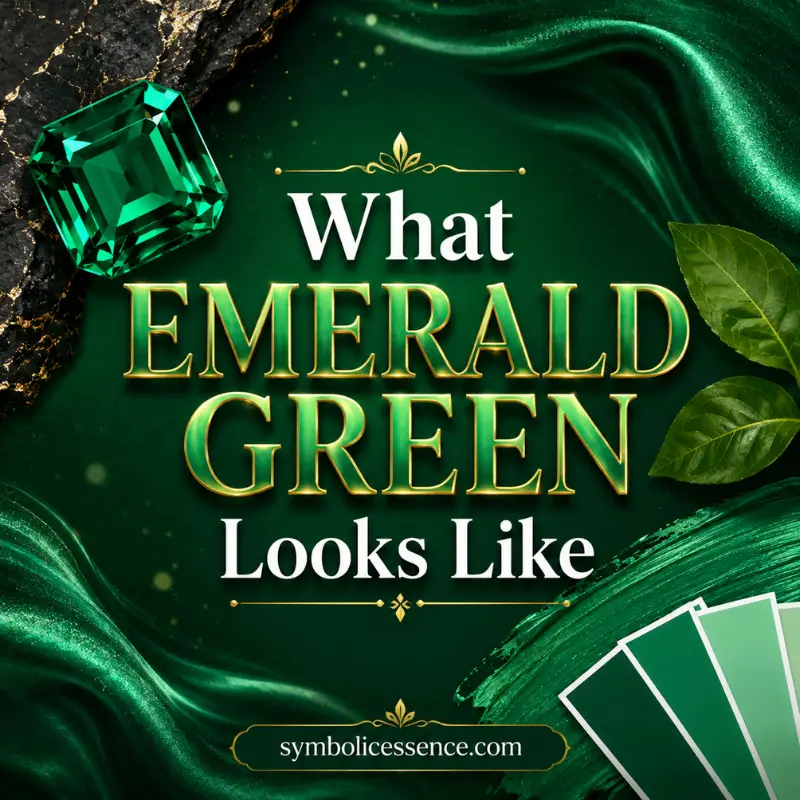
Emerald green is a saturated, jewel-like green modeled on the appearance of fine emeralds. Genuine emerald gemstones range from green to bluish green, so there is no single natural emerald color that every stone must match.
Compared with mint or sage, emerald green looks darker and more intense. Compared with forest green, it often appears brighter and more jewel-like. Those visual qualities help explain its symbolism: it can evoke vegetation and natural growth without appearing rustic or subdued.
That combination matters. A pale green room might communicate softness and freshness, while an emerald green room can feel dramatic, polished, and intentional. The underlying color family is the same, but saturation changes the social message.
What Emerald Green Commonly Symbolizes
In the United States, emerald green most often carries positive associations. Its strongest meanings include:
| Context | Common U.S. Meaning | Typical Association | Notes |
|---|---|---|---|
| Nature | Growth and renewal | Spring, leaves, healthy landscapes | Comes from broader green symbolism |
| Jewelry | Luxury and value | Emerald rings, necklaces, heirlooms | Strongly influenced by the gemstone |
| Money | Prosperity and success | Cash, business, abundance | Especially recognizable in U.S. culture |
| Fashion | Confidence and sophistication | Evening wear, suits, accessories | Richer than casual pastel greens |
| Irish-American culture | Heritage and celebration | St. Patrick’s Day, shamrocks | Green is broader than emerald specifically |
| Personal symbolism | New beginnings | Tattoos, gifts, decor | Meaning depends on individual context |
Green has long been connected with fertile landscapes, growth, prosperity, health, and well-being in visual culture. Emerald green inherits those ideas while adding the visual impression of a precious stone.
Why Emerald Green Represents Growth and Renewal
The growth symbolism begins with something very ordinary: plants are green.
Leaves, grass, young shoots, gardens, and many productive landscapes make green an easy visual shorthand for living vegetation. That connection is so familiar that green often appears in messages about freshness, health, environmental awareness, gardening, and sustainable living.
Emerald green strengthens this association because its intensity resembles lush vegetation rather than faded or dry plant life. It can therefore suggest abundance rather than mere survival.
Spring symbolism reinforces the idea. Emerald gemstones have themselves been associated with spring, rebirth, and new beginnings, and emerald is the traditional May birthstone.
That is why emerald green works naturally for events or designs meant to mark a fresh chapter: weddings, new homes, personal reinvention, business launches, graduations, or other transitions.
The Emerald Gemstone Shaped the Color’s Meaning
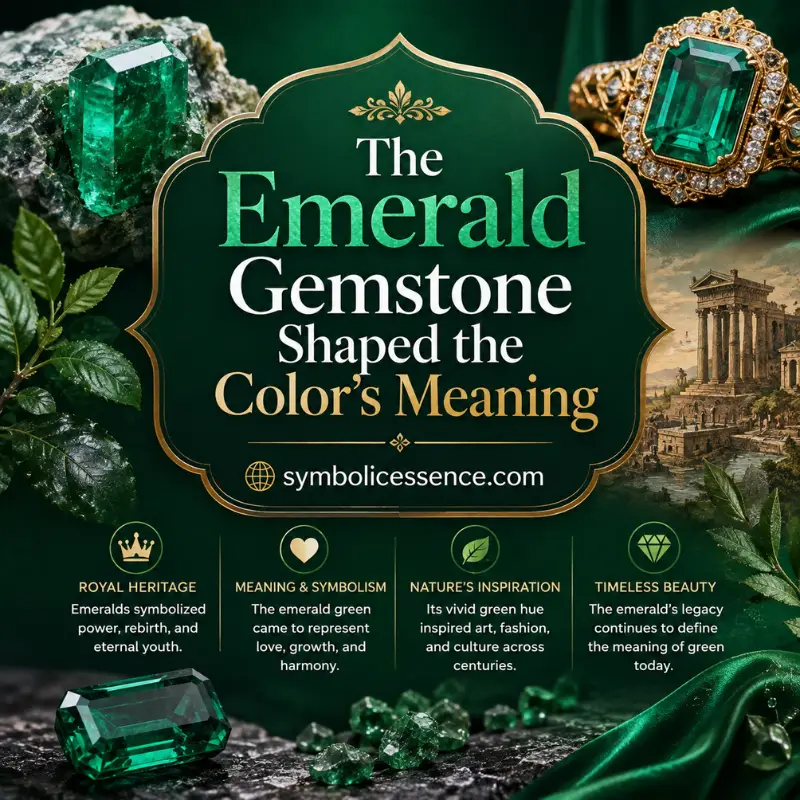
The color cannot be fully understood without the stone that gave it its identity.
Emerald is the green to greenish-blue variety of the mineral beryl. Fine emerald color has been highly valued in jewelry, which helped make the name itself suggest beauty, rarity, expense, and prestige.
Older traditions also surrounded emeralds with beliefs that went far beyond appearance. At different points, people credited the gemstone with improving intelligence, revealing truth in love, aiding eloquence, or providing protection and healing. These should be understood as historical beliefs rather than proven properties.
Modern emerald green symbolism retains the favorable emotional residue of those traditions even when people know nothing about the old legends. A velvet dress or painted wall does not need to contain a gemstone to borrow its associations with rarity and refinement.
Why the Color Suggests Wealth and Luxury
Emerald green often looks expensive because people already understand emeralds as precious objects.
Color symbolism frequently develops through association. Gold suggests wealth partly because gold itself has value. Emerald green works similarly: a color named for a valuable gemstone can inherit some of the gem’s social meaning.
Its depth also helps. Bright neon green can look playful or artificial, while pale green often feels gentle and casual. Emerald green sits in a different visual category. It is saturated enough to make a statement but dark enough to work in formal settings.
As a result, the shade commonly appears in upscale-looking interiors, formal dresses, jewelry packaging, hospitality design, wedding stationery, and branding intended to communicate quality or exclusivity.
Here, emerald green means more than money. It often communicates controlled abundance—prosperity presented with restraint rather than flashy excess.
Money Symbolism Has a Special American Dimension
For Americans, green has an unusually direct connection with money.
U.S. Demand Notes issued beginning in 1861 became known as greenbacks because green ink appeared on their backs. The association between green and paper currency continued afterward and became deeply familiar in American visual culture.
That history helps explain why dark or saturated greens can imply earnings, financial opportunity, investment, business growth, or economic success in U.S. advertising and popular imagery.
Emerald green intensifies the message because it combines two value signals: green money and a precious gemstone.
Still, the association is contextual. An emerald green garden wall is more likely to suggest nature than wealth. The same shade on luxury packaging or a finance graphic may immediately suggest prosperity.
Emerald Green and Irish-American Culture
Green also has a strong place in American celebrations of Irish heritage, especially around St. Patrick’s Day.
The holiday has a long history in the United States, with early celebrations occurring in places such as Boston and New York before expanding alongside Irish immigration. Wearing green, displaying shamrocks, and decorating streets and businesses in green eventually became familiar parts of American St. Patrick’s Day culture.
Emerald green fits comfortably into that tradition because Ireland has long been popularly described through green landscape imagery, and the word emerald itself reinforces the familiar idea of Ireland as exceptionally green.
However, not every use of emerald green represents Irish identity. The association becomes strongest when the color appears beside shamrocks, Celtic-inspired designs, Irish flags, St. Patrick’s Day imagery, or explicit heritage references.
Treating all green imagery as inherently Irish can flatten the many unrelated cultural meanings of the color.
Emotional and Psychological Meaning
Emerald green tends to communicate a mixture of stability and vitality.
Green sits visually between the warmth of yellow and the coolness of blue, and natural green surroundings are widely linked in everyday culture with plants, health, freshness, and restoration. Smithsonian material on green similarly connects the color with fertile landscapes, growth, prosperity, and wellness.
Emerald green adds intensity. Instead of appearing quiet or delicate, it can feel confident and substantial.
That makes several emotional readings especially common:
- Renewal when someone is beginning again.
- Self-assurance when used in clothing or personal style.
- Security when paired with traditional or formal design.
- Ambition when associated with prosperity or achievement.
- Balance when the natural side of green is emphasized.
Color psychology should not be treated as a universal diagnostic system. People react differently according to memory, culture, lighting, fashion, and context. Emerald green can feel calming to one person and dramatic to another.
Love, Marriage, and Relationship Symbolism
Emerald green has a quieter connection with romance than red or pink, but its relationship symbolism is well established through the gemstone.
Emerald is traditionally associated with the twentieth and thirty-fifth wedding anniversaries, strengthening connections with enduring partnership and long-term commitment.
Historical emerald lore also linked the gem with truth and faithfulness between lovers, although such ideas belong to legend rather than science.
In contemporary weddings, emerald green can therefore communicate commitment without relying on conventional romantic colors. It works particularly well when couples want a palette that feels formal, natural, and mature.
Its renewal symbolism also fits marriage: the color can represent two people entering a new stage of life together.
Spiritual and Religious Associations
Emerald green does not have one universal religious meaning.
Green more broadly has important associations in Islamic cultures and appears in numerous religious, artistic, and cultural contexts. Museum interpretations of Islamic and Muslim-related art explicitly identify green as a color associated with Islam in some works.
Green vegetation can also fit religious images of gardens, life, fertility, paradise, renewal, or creation. In other traditions, gemstones may receive devotional or mystical interpretations.
The distinction between green and emerald green matters, however. A broad religious meaning attached to green should not automatically be narrowed to this particular modern shade.
When someone uses emerald green for spiritual reasons today, the color may represent personal renewal, hope, abundance, faith, or a connection with nature. Those interpretations can be meaningful without pretending that every culture assigns the same message to the shade.
Cross-Cultural Meaning Beyond the United States
Green symbolism varies significantly across cultures.
Across works held by the National Museum of Asian Art, green can appear through landscapes, minerals, gemstones, pigments, and decorative materials, with associations that include growth and prosperity.
Different societies, however, developed their own color traditions. A green gemstone, painted surface, religious object, garment, or ceremonial decoration cannot be interpreted accurately from color alone.
This creates an important rule for understanding emerald green: shared color does not guarantee shared symbolism.
An emerald-colored fashion item in New York, a green element in Islamic art, and a green object from an Asian historical collection may look visually related while carrying different cultural meanings.
Context, object type, period, and local tradition should always come before generalized color symbolism.
The Surprisingly Dangerous History of Emerald Green Pigment
One of the most unusual parts of emerald green history has nothing to do with gemstones.
During the nineteenth century, the name emerald green was used for a brilliantly colored synthetic pigment associated with copper and arsenic compounds. Historical conservation research places the development of an emerald-green copper acetoarsenite pigment in the early 1800s.
The vivid pigment appeared in objects such as paints, decorative materials, textiles, wallpapers, and book coverings. Its beauty came with a serious problem: arsenic made the historical material hazardous. Researchers and libraries still identify arsenic-containing green pigments in nineteenth-century objects.
This history creates an unusual contrast. Modern emerald green usually suggests health, life, and luxury, yet a famous historical version of the color was literally toxic.
That does not mean today’s emerald green paint, clothing, or printed materials contain the old arsenic pigment. The danger belongs to specific historical materials, not to the color itself.
Emerald Green in Fashion and Personal Style
In clothing, emerald green commonly signals confidence without demanding the aggressiveness sometimes associated with bright red or neon colors.
Its jewel-tone quality makes it suitable for evening dresses, suits, ties, scarves, handbags, shoes, and formal accessories. It also contrasts strongly with many neutral shades, allowing it to function as either a statement color or a controlled accent.
Symbolically, wearing emerald green can communicate:
Confidence. The saturation makes the wearer visually noticeable.
Elegance. Gemstone associations make the shade feel polished.
Individuality. It is distinctive without being extremely unconventional.
Seasonal flexibility. It can evoke spring growth, rich summer foliage, or formal winter decor depending on surrounding colors.
A person choosing the shade does not necessarily intend any symbolic message, of course. Sometimes emerald green is simply flattering or fashionable. Symbolism describes cultural associations, not a hidden intention behind every outfit.
What Emerald Green Means in Home Decor

In interior design, emerald green often creates a different effect from lighter botanical greens.
Sage can make a room feel muted and relaxed. Mint often feels fresh and airy. Emerald green introduces more visual weight.
On walls, upholstery, cabinets, tile, curtains, or accent pieces, the shade can communicate luxury, closeness to nature, or dramatic comfort. Materials change the message further: emerald velvet emphasizes richness, while glazed green tile may emphasize freshness and craftsmanship.
Natural materials such as wood, stone, linen, or plants strengthen the nature connection. Metallic finishes can push the same color toward glamour and formality.
Because emerald green is intense, even a small amount can establish the visual identity of a space.
Tattoos, Jewelry, and Personal Identity
Emerald green becomes especially personal when people choose it for jewelry or permanent body art.
An emerald or emerald-colored tattoo may represent May birthdays, personal growth, prosperity, renewal, lasting love, or a meaningful turning point. Emerald jewelry can also mark anniversaries or family connections because emerald is recognized as May’s birthstone and as an anniversary gemstone.
Plant tattoos shaded in emerald green may focus more heavily on growth and resilience. A jewel design may emphasize value or self-worth. Irish or Celtic-themed imagery can shift the meaning toward ancestry or heritage.
There is no official tattoo dictionary. The person wearing the design ultimately determines its most important meaning.
Can Emerald Green Have Negative Meanings?
Yes, although its positive associations are more prominent in many modern American contexts.
Green in general can sometimes suggest envy, jealousy, greed, inexperience, sickness, or artificiality. Emerald green may inherit some of those meanings when the surrounding imagery supports them.
For example, a story about extreme wealth could use emerald green to imply greed rather than prosperity. A villain dressed in saturated green might appear calculating or unnatural rather than balanced.
The historical arsenic pigment also gives emerald green an unexpected association with toxicity, although this meaning is mostly relevant to art conservation and Victorian material history rather than everyday symbolism.
Negative meanings therefore depend strongly on context. The shade itself does not automatically signify jealousy, greed, or danger.
How Emerald Green Symbolism Changed Over Time
Emerald green acquired meaning in layers rather than from one single origin.
First came the natural foundation: green vegetation made the broader color family an obvious sign of life and growth.
Precious emerald gemstones added associations with rarity, status, spring, love, and renewal. Historical legends expanded the gem’s reputation into areas such as truth, intelligence, and protection.
The nineteenth century added another layer when brilliant synthetic emerald-green pigments entered art and consumer goods, sometimes with hazardous arsenic compounds.
American culture contributed its own associations. Green currency strengthened the connection between green and money, while Irish-American traditions made green highly visible in St. Patrick’s Day celebrations.
Today, these meanings overlap. Emerald green can simultaneously look natural, luxurious, financially successful, festive, traditional, or boldly modern.
Common Misunderstandings About Emerald Green
The biggest mistake is assuming the shade has one fixed definition.
Emerald green does not automatically mean wealth simply because emeralds are valuable. It does not always represent Ireland because green appears in Irish-American celebrations. It is not universally sacred because green has religious significance in some traditions.
Another misunderstanding comes from the historical pigment. The arsenic-containing emerald green used in some nineteenth-century objects should not be confused with every modern product described as emerald green.
Finally, color meanings are not personality tests. Choosing emerald green does not prove that someone is ambitious, spiritual, wealthy, jealous, or emotionally balanced.
Symbolism works best when it helps interpret an object or situation alongside its broader context.
FAQs
What does emerald green symbolize spiritually?
Emerald green can symbolize renewal, hope, abundance, life, and a connection with nature in modern spiritual use. However, there is no universal spiritual definition shared by all religions or cultures.
Is emerald green a symbol of wealth?
It often can be. The shade inherits luxury associations from valuable emerald gemstones, while Americans also have a long-standing cultural connection between green and paper money.
What does emerald green mean in love?
Emerald green can represent enduring affection, loyalty, renewal, and mature commitment. The connection is reinforced by emerald’s traditional use for twentieth and thirty-fifth wedding anniversaries.
What does an emerald green tattoo symbolize?
An emerald green tattoo may represent growth, prosperity, rebirth, a May birthday, heritage, or a major personal transition. The surrounding image and the wearer’s intention usually matter more than the color alone.
Does emerald green represent Ireland?
Emerald green can evoke Ireland and Irish-American identity, particularly alongside shamrocks or St. Patrick’s Day imagery. Green has become a major visual feature of St. Patrick’s Day celebrations in the United States, but emerald green has many unrelated meanings as well.
Is emerald green positive or negative?
Most modern American uses lean positive, emphasizing growth, prosperity, elegance, renewal, and confidence. In certain settings, however, broader green associations such as envy, greed, sickness, or toxicity can change the interpretation.
Conclusion
Emerald green symbolism is best understood as a combination of nature and value. Green supplies the ideas of growth, life, renewal, and abundance, while the emerald gemstone adds rarity, elegance, love, and prestige.
American culture gives the shade additional layers through its connection with money, formal design, Irish-American celebrations, jewelry, weddings, fashion, and personal expression. Its history even includes a striking contradiction: some brilliant nineteenth-century emerald-green pigments contained toxic arsenic compounds.
No single meaning applies every time. An emerald ring, a St. Patrick’s Day decoration, a dark green living room, and an emerald-colored tattoo may share the same shade while telling entirely different stories. The surrounding object, culture, and purpose are what turn the color into a symbol.


