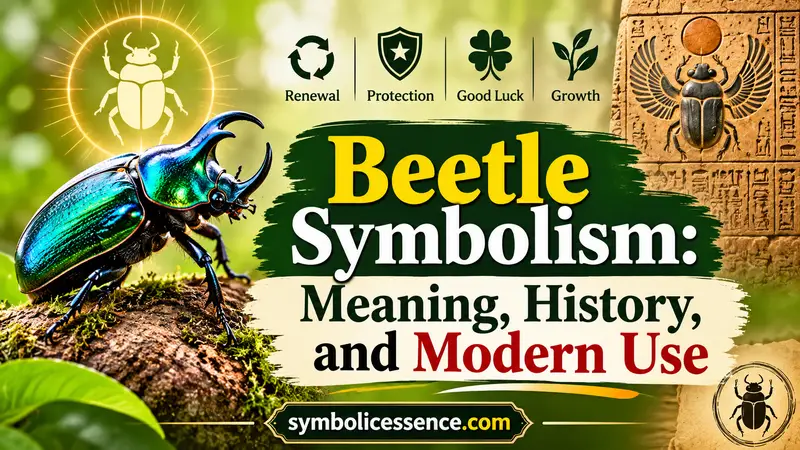
A beetle can appear in an unexpected place: crawling across a garden path, resting on a windowsill, or landing on someone’s clothing. Some have shiny green shells, while others are black, brown, red, or covered in bright spots. Their small size and unusual appearance often make people curious about what they might represent.
Beetle symbolism is commonly connected with transformation, persistence, protection, renewal, and adaptability. These meanings come partly from the insect’s life cycle, its ability to survive in different environments, and the role certain beetles played in historical cultures.
In the United States, beetles appear in tattoos, jewelry, artwork, nature photography, children’s stories, and garden designs. A person might choose a beetle as a reminder to keep going through a difficult period, while another might simply appreciate its unusual shape and natural beauty.
The meaning depends on the species, the setting, and the person interpreting it. A ladybug, scarab, stag beetle, and black ground beetle do not carry exactly the same cultural associations.
Quick Answer
Beetle symbolism most commonly represents transformation, persistence, protection, renewal, and the ability to adapt to life’s challenges. Historically, some of these associations developed from the beetle’s life cycle, while ancient Egyptian scarab imagery connected the insect with the sun, rebirth, and renewal.
TL;DR
- Beetles commonly represent change, persistence, and personal growth.
- Ancient Egyptians associated scarabs with the sun and renewal.
- Their hard outer shells suggest protection and resilience.
- Ladybugs have separate associations with luck and good fortune.
- Modern Americans use beetle designs in tattoos, jewelry, and artwork.
- Different species can carry very different cultural meanings.
What Does a Beetle Look Like?
Beetles belong to the insect order Coleoptera, one of the largest groups of animals on Earth. They have six legs, two antennae, and a hard outer pair of wings called elytra. These protective wing covers give many beetles their recognizable appearance.
Their bodies come in many shapes and sizes. Some are round and smooth, while others have long horns, sharp-looking jaws, or textured shells.
Common examples include:
- Ladybugs: Small, rounded beetles often recognized by their red shells and black spots.
- Scarab beetles: Sturdy insects with oval bodies, sometimes associated with ancient Egyptian artwork.
- Stag beetles: Known for the large, antler-like jaws found in males of certain species.
- Japanese beetles: Metallic green and copper-colored insects often found on garden plants.
- Ground beetles: Usually dark-colored insects that move quickly across soil and garden surfaces.
Beetles live in forests, gardens, grasslands, deserts, wetlands, and even homes. Some feed on plants, others hunt smaller insects, and some help break down dead organic material.
Their physical features help explain why people associate them with protection and survival. A hard shell offers a visible example of a natural defense, while their ability to live in different environments suggests adaptability.
What Does a Beetle Symbolize Today?
The most common modern interpretations come from the beetle’s physical characteristics and natural behavior.
Transformation and personal growth
Many beetles develop through four life stages: egg, larva, pupa, and adult. Their appearance changes considerably as they mature.
This process makes them a natural comparison for personal development. Someone going through a career change, moving to a new city, or rebuilding after a difficult experience might connect with a beetle as a reminder that change takes time.
Unlike a butterfly, a beetle is not always recognized as a transformation symbol. However, its life cycle offers a similar natural example.
Persistence and determination
Some beetles spend much of their lives searching for food, shelter, and suitable places to reproduce. Others dig, climb, burrow, or move through difficult terrain.
These behaviors support associations with patience and determination.
A beetle tattoo, for example, might represent someone who continued working toward a goal despite setbacks.
Protection and boundaries
The beetle’s hard outer wing covers protect its delicate wings and body. This feature makes it an understandable symbol of safety, personal boundaries, and emotional protection.
People may choose the image when they want to represent the importance of protecting their time, values, or personal space.
Renewal and new beginnings
Because beetles develop through distinct stages, they can represent the start of a new chapter.
The connection is especially noticeable in scarab imagery, where ancient Egyptian beliefs linked the insect with the sun’s daily movement and renewal.
Adaptability
Beetles occupy many different habitats and have developed a wide range of feeding and survival strategies.
For modern readers, this can represent the ability to adjust when circumstances change without losing a sense of identity.
Where Did Beetle Symbolism Begin?
One of the oldest documented cultural connections comes from ancient Egypt, where the scarab beetle became an important religious and artistic image.
The sacred scarab was commonly associated with the dung beetle, particularly species that roll balls of dung across the ground.
Ancient Egyptians observed this behavior and connected it with the movement of the sun. The rolling ball became an image of the sun traveling across the sky.
The scarab was also associated with Khepri, an Egyptian deity linked with the rising sun and the appearance of new life.
This connection gave the insect several related meanings:
- Daily renewal and the rising sun.
- Creation and the emergence of life.
- Protection during life and death.
- Rebirth and the continuation of existence.
Scarab-shaped objects were made from materials such as stone, faience, and other decorative substances. They appeared as jewelry, seals, and protective objects.
Some scarabs were placed in Egyptian burials. Heart scarabs, in particular, were associated with funerary beliefs and were intended to serve a protective role in the afterlife.
This is an important distinction: ancient Egyptian scarab symbolism was not simply about working hard or surviving challenges. It was part of a larger religious system involving the sun, creation, death, and rebirth.
Why Did Ancient Egyptians Connect Beetles With Rebirth?
The connection becomes clearer when looking at the behavior of dung beetles.
Certain dung beetles collect animal waste and shape it into balls. They may roll these balls across the ground before burying them or using them as food resources.
Ancient observers connected this activity with the sun’s apparent movement across the sky.
There was also an interesting biological detail. Young dung beetles emerge from buried brood balls, which may have contributed to the association between the insect and the appearance of new life.
The Egyptian deity Khepri represented the rising sun and the process of becoming or coming into existence. Scarab imagery therefore became connected with the idea that life could begin again.
During different periods of ancient Egyptian history, scarab amulets were used in personal adornment, official seals, and burial practices.
Their importance continued across centuries, although the exact design and purpose of scarab objects varied.
It would be inaccurate to assume that every ancient culture gave beetles the same meaning. The Egyptian scarab is a particularly well-documented example, not proof of a universal belief.
What Does a Beetle Mean in American Culture?
In the United States, beetles do not have one fixed national meaning. Their interpretation depends heavily on the species and the situation.
Ladybugs are probably among the most familiar beetles in everyday American culture. Children often recognize them from picture books, classroom activities, gardens, and decorative objects.
They are commonly associated with good luck, pleasant weather, and nature. Gardeners also appreciate many ladybug species because they eat aphids and other plant pests.
Other beetles have different associations.
A stag beetle might appear in nature illustrations because of its unusual jaws. A metallic green beetle may be used in fashion or jewelry because of its reflective appearance.
In American environmental education, beetles can also represent biodiversity. They help introduce children to food webs, pollination, decomposition, and the importance of insects in healthy ecosystems.
Their presence in gardens and parks gives people a direct connection with the natural world.
Beetles in American seasonal traditions
Ladybugs are particularly common in spring and summer decorations. Their red-and-black appearance makes them popular in children’s clothing, garden accessories, stationery, and seasonal crafts.
Some people also use beetle imagery in Halloween decorations. Black beetles and shiny insect designs can create a natural-history or slightly unsettling visual effect.
However, there is no major nationwide American holiday specifically devoted to beetles.
Their cultural presence is mostly found in everyday nature appreciation, gardening, education, and personal design.
How Do Different Beetle Species Change the Meaning?
Not every beetle carries the same associations. Color, shape, behavior, and cultural background can influence how someone interprets a particular species.
| Context | Meaning in USA | Common Associations | Notes |
| Ladybug | Luck and happiness | Good fortune, gardens, childhood | Often used in children’s designs |
| Scarab | Renewal and rebirth | Ancient Egypt, protection, the sun | Has a specific historical background |
| Stag beetle | Strength and individuality | Unusual appearance, determination | Often selected for striking artwork |
| Black beetle | Persistence and protection | Endurance, boundaries, mystery | Meanings vary by species and design |
| Jewel beetle | Beauty and individuality | Color, creativity, nature | Its reflective shell inspires decorative art |
The species matters because a person choosing a ladybug design may want to express optimism, while someone choosing a stag beetle may appreciate its unusual structure.
A scarab design, meanwhile, can communicate an interest in Egyptian history or the idea of starting again.
What Does a Beetle Mean Emotionally and Psychologically?
People often connect with small animals because they recognize something familiar in their appearance or behavior.
A beetle can suggest a particular way of dealing with life’s challenges.
For someone who values independence, the insect’s ability to move through its environment without attracting much attention may be appealing.
For another person, the hard shell might represent emotional boundaries. It can suggest the difference between being open to others and allowing people to cross personal limits.
There are also associations with patience.
Many beetles spend considerable time in stages of development that people rarely see. Their adult appearance is only one part of their lives.
This can serve as a useful comparison for people who feel that progress is happening slowly.
However, these interpretations are personal rather than established psychological facts. Seeing a beetle does not reveal someone’s personality, predict an event, or prove that a particular life change is coming.
The meaning comes from the connection a person makes with the insect.
What Does a Beetle Tattoo Represent?
Beetle tattoos have a distinctive visual appeal. Their symmetrical bodies, patterned shells, curved legs, and unusual shapes work well in both small and detailed designs.
Common tattoo interpretations include:
- Transformation: A reminder of a major life transition.
- Resilience: Recognition of surviving a difficult period.
- Protection: A personal reminder to maintain boundaries.
- Renewal: A new beginning after loss or change.
- Individuality: Appreciation for unusual beauty and natural design.
The design itself can change the message.
A small ladybug tattoo may feel playful and optimistic. A detailed scarab with geometric patterns may communicate an interest in ancient Egyptian art.
Some people choose a beetle because it represents a specific memory, such as childhood summers spent exploring a garden.
Others simply like insects and want body art that looks different from more common floral or animal designs.
There is no requirement to follow a traditional interpretation. Personal meaning is often the main reason behind a tattoo choice.
Why Are Beetles Popular in Jewelry and Fashion?
Beetle shapes have appeared in decorative arts for thousands of years, but their use in modern fashion is not limited to historical references.
Their bodies naturally create interesting design elements.
The curved shell can be represented through metalwork, while the wings and legs offer opportunities for detailed engraving. Bright beetles also inspire the use of colorful stones, enamel, and reflective surfaces.
In American fashion, beetle jewelry can communicate several different ideas:
- An interest in insects and natural science.
- Appreciation for unusual or vintage-inspired accessories.
- Connection with Egyptian-inspired decorative art.
- Personal interest in renewal or change.
Scarab pendants are particularly recognizable because of their long history in jewelry and decorative objects.
Some modern pieces use Egyptian-inspired designs, while others focus on realistic beetle shapes without making any historical claim.
The insect’s appearance can be enough to make it attractive as an accessory.
What Do Beetles Mean in Art, Literature, and Popular Culture?
Beetles have appeared in visual art, children’s literature, scientific illustrations, and popular entertainment.
Their unusual appearance makes them useful for artists who want to explore ideas about nature, beauty, survival, and the relationship between humans and insects.
In scientific illustrations, beetles are often presented with careful attention to their legs, antennae, wing covers, and body patterns. These images can make an ordinary insect look like a piece of natural sculpture.
In children’s stories, ladybugs and other small beetles often appear as friendly characters. Their recognizable shapes make them easy to illustrate and animate.
A notable example of beetles in American popular culture is the 1960s British rock group The Beatles. Although the band’s name is a wordplay on “beetles,” it should not be confused with traditional insect symbolism.
The band’s name became part of a major cultural movement, but that popularity does not establish a historical symbolic meaning for the insect.
Beetles also appear in science fiction and fantasy, where their armored bodies and unusual shapes can inspire fictional creatures, machines, and characters.
How Do Other Cultures Interpret Beetles?
The ancient Egyptian scarab is the clearest example of a beetle with a documented cultural and religious role.
Other traditions have different relationships with particular beetle species.
Ancient Egypt
The scarab was associated with Khepri, the rising sun, renewal, and the emergence of life. Scarab amulets were used in both daily life and funerary settings.
Japanese culture
In Japan, rhinoceros beetles and stag beetles have a notable place in children’s culture. Children often collect, observe, and keep these insects during the summer.
Beetle-keeping is also connected with hobbies involving insect care, competitions, and nature education.
This relationship is more focused on fascination with the insects themselves than on a single religious meaning.
European decorative traditions
In parts of Europe, jewel beetles and other colorful insects have inspired decorative arts and natural-history collections.
Their reflective shells attracted attention from artists and collectors, especially during periods when insect specimens became popular objects of scientific and artistic interest.
These examples show why it is important not to treat every beetle as a scarab. Cultural meanings develop through specific species, practices, and historical settings.
Are Beetles Good or Bad Omens?
A beetle is not automatically considered a good or bad sign.
Some people interpret an unexpected encounter as a reminder of personal change, persistence, or protection. Others see it as an ordinary event caused by weather, food sources, light, or seasonal activity.
In American folk traditions, ladybugs are frequently associated with good luck. Their friendly appearance and usefulness in gardens have helped support that positive reputation.
Black beetles, however, are sometimes interpreted differently in modern spiritual discussions. Their dark color may lead some people to associate them with mystery, uncertainty, or endings.
These interpretations are not universal traditions, and there is no scientific evidence that a beetle predicts good fortune, financial success, illness, or a future event.
It is also important to separate cultural symbolism from practical insect identification. A beetle inside a house may simply be searching for shelter or responding to outdoor lighting.
If large numbers appear indoors, identifying the species is more useful than assigning a spiritual meaning.
What Are Common Misunderstandings About Beetle Symbolism?
Several misconceptions can make the subject confusing.
All beetles symbolize rebirth.
Not exactly. Rebirth is especially associated with the Egyptian scarab. Other beetles may represent completely different ideas or have no established symbolic meaning.
Every beetle is a sign of good luck.
Ladybugs have a familiar positive reputation, but this association does not apply equally to every species.
A beetle entering a home predicts something.
There is no reliable evidence that an insect entering a home forecasts an event. Environmental factors usually explain why insects appear indoors.
Black beetles always represent something negative.
Black is often used in modern art to suggest mystery or seriousness, but a beetle’s color does not establish a universal meaning.
The scarab and ladybug have the same historical background.
They are different beetles with different cultural associations. The scarab’s connection with ancient Egyptian religious imagery should not be transferred automatically to ladybugs.
Understanding these distinctions helps keep cultural history separate from personal interpretation.
How Has Beetle Symbolism Changed Over Time?
The meaning attached to beetles has changed as people have observed them in different settings.
In ancient Egypt, the scarab became connected with the sun, creation, and rebirth. Its religious importance was reflected in amulets, seals, and burial objects.
During later periods, scarab designs continued to attract interest as decorative objects and historical references.
In the nineteenth century, growing interest in natural history brought insects into museums, scientific collections, illustrations, and decorative arts. Beetles were studied not only for their behavior but also for their unusual colors and body structures.
By the twentieth century, ladybugs had become familiar figures in American children’s books, educational materials, garden decorations, and household designs.
During the late twentieth and early twenty-first centuries, tattoo culture and alternative fashion helped make less familiar insects more visible as personal design choices.
Today, digital photography and social media allow people to share close-up images of insects that might otherwise go unnoticed.
A beetle can now be appreciated as a scientific subject, an art form, a fashion accessory, or a personal reminder of change.
The central difference is that modern interpretations are often individual. Ancient Egyptian scarabs had a recognizable religious context, while a modern beetle tattoo may simply express someone’s own experience.
FAQs
Is seeing a beetle considered good luck?
Some people associate beetles with good fortune, particularly ladybugs. However, there is no universal belief that every beetle encounter brings luck, and an ordinary sighting does not predict what will happen next.
Does a beetle have a biblical meaning?
Beetles do not have one widely recognized symbolic role in mainstream Christian interpretation. Some modern religious discussions use insects as examples of creation, endurance, or transformation, but these are personal interpretations rather than a single established biblical teaching.
What does it mean when a beetle lands on you?
Some people treat the encounter as a personal reminder of patience, protection, or change. From a biological perspective, the beetle may simply have landed while moving between plants or searching for a place to rest.
What does a green beetle symbolize?
A green beetle may be associated with nature, growth, renewal, and the natural world. These interpretations often come from the color green rather than a specific historical belief about green beetles.
What does a beetle symbolize in dreams?
A beetle in a dream may represent persistence, discomfort, change, or something that requires attention. Dream meanings are subjective, so the insect’s behavior and the dreamer’s feelings are more useful than treating one interpretation as universal.
Why is the scarab important in Egyptian history?
The scarab was connected with Khepri, a deity associated with the rising sun and renewal. Its image appeared on amulets, seals, and funerary objects, making it an important part of Egyptian religious and decorative traditions.
Can a beetle symbolize strength?
Yes. Its protective outer shell and ability to survive in different environments make it a natural image of endurance and resilience. This is especially common in modern tattoos, illustrations, and personal artwork.
Conclusion
Beetle symbolism brings together several ideas, including transformation, persistence, protection, renewal, and adaptability. Its historical background is especially clear in ancient Egypt, where the scarab represented the rising sun and the continuation of life.
In modern America, beetles have taken on more personal meanings. They appear in tattoos, jewelry, garden decorations, artwork, and nature education. A ladybug might suggest good fortune, while a scarab can represent renewal or an interest in Egyptian history.
What makes the beetle an interesting subject is its ordinary presence. A small insect crossing a garden path can remind someone that growth happens in stages, protection has a purpose, and even the smallest creatures have a place in the natural world.