
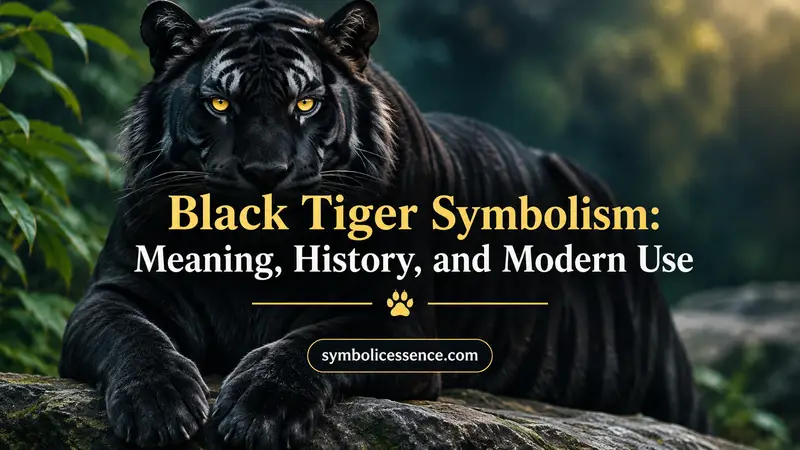
A black tiger is one of the rarest-looking forms of the tiger. Its dark coat and unusually wide black stripes can make it appear almost completely black, especially when seen in photographs or shaded forest environments. Unlike an ordinary tiger, its markings may cover much more of its orange background.
Black tiger symbolism is often connected with individuality, strength, mystery, independence, and the ability to stand apart from others. These associations come partly from the animal’s unusual appearance and partly from the way people have traditionally viewed tigers.
In the United States, people may encounter this image in tattoo designs, wildlife photography, artwork, clothing, and conversations about rare animals. Its meaning is not fixed, however. A person choosing a black tiger tattoo may be expressing personal independence, while a wildlife enthusiast may see the animal as a reminder of genetic diversity and conservation.
Quick Answer
Black tiger symbolism commonly represents individuality, strength, independence, mystery, and the courage to be different. Its modern interpretation comes mainly from the tiger’s traditional association with physical power and the rare dark-striped appearance of pseudo-melanistic tigers, particularly those documented in India.
TL;DR
- Individuality: Represents being different and accepting an unusual identity.
- Strength: Connects with the tiger’s natural power and hunting ability.
- Mystery: Its dark appearance creates associations with the unknown.
- Independence: Reflects self-reliance and personal freedom.
- Rarity: Represents uniqueness and uncommon qualities.
- Conservation: Reminds people of wildlife diversity and habitat protection.
What Does a Black Tiger Actually Look Like?
A black tiger is not a separate tiger species. The name generally refers to a rare color and stripe pattern known as pseudo-melanism.
In these animals, the black stripes are unusually wide and may connect with one another. This leaves less visible orange fur between the markings. Under certain lighting conditions, the animal can look almost entirely black.
Most known examples have been documented in India, especially in the Similipal Tiger Reserve in Odisha.
A few physical features make these tigers particularly recognizable:
- Dark markings: Their black stripes are wider than those of typical Bengal tigers.
- Reduced orange areas: The dark pattern can cover much of the body.
- Distinctive facial markings: Their faces may have unusually dense dark stripes.
- Unusual appearance: Their coats create a striking contrast between dark and lighter areas.
The word pseudo-melanism is important here. True melanism involves an increased amount of dark pigment, while pseudo-melanism in these tigers results from an unusual stripe pattern.
This distinction matters because popular descriptions sometimes suggest that these animals are completely black. In reality, their appearance is more complicated.
Their unusual coloring is the starting point for many modern symbolic interpretations.
What Does a Black Tiger Symbolize Today?
There is no universally accepted symbolic definition for this animal. However, several interpretations appear naturally when people connect its appearance with the qualities traditionally associated with tigers.
Individuality and Uniqueness
The rare coat pattern makes this animal an obvious representation of individuality.
Most tigers have recognizable orange-and-black markings. A pseudo-melanistic tiger looks noticeably different, making it a fitting image for someone who does not want to follow ordinary expectations.
In personal artwork, it can represent accepting the qualities that make someone different.
Strength and Courage
Tigers are large predators with strong bodies, sharp claws, and impressive hunting abilities.
Their natural characteristics have made them familiar symbols of courage and physical strength. The darker appearance adds another visual layer to that association.
Someone may choose this image to communicate confidence, determination, or the ability to face difficult situations.
Mystery and the Unknown
Dark coloring often creates a sense of secrecy in visual art and storytelling.
A tiger that appears almost completely black can look difficult to recognize against a shadowy background. Artists may use this appearance to suggest something hidden, unexpected, or difficult to understand.
This interpretation comes from visual design rather than a documented universal belief.
Independence and Self-Reliance
Tigers generally live solitary lives outside certain social and family situations.
Because they usually hunt and move independently, they are often used to represent self-reliance.
A black tiger can combine that familiar association with the idea of having an identity that does not depend on approval from others.
Where Did Black Tiger Symbolism Come From?
The exact historical origin of black tiger symbolism is not established. There is no single documented ancient tradition that gives this particular coat pattern one fixed meaning.
Instead, its modern associations developed from two separate sources: the cultural history of tigers and the unusual appearance of rare dark-striped individuals.
Tigers have appeared in Asian art, stories, decorative objects, and traditional imagery for centuries.
In several Asian cultures, the animal has been associated with courage, authority, protection, and the ability to confront danger. These associations existed long before pseudo-melanistic tigers became widely discussed through modern wildlife photography.
The black tiger itself has a much narrower documented history.
Reports of unusually dark tigers have circulated for generations, but scientific understanding of their appearance developed through closer wildlife observation. The rare animals documented in Odisha helped bring greater attention to the condition.
In the 20th and 21st centuries, photographs and conservation reporting made the unusual coat pattern more familiar to international audiences.
As a result, the animal gradually became associated with rarity, unusual identity, and the natural variety found within wildlife populations.
It is important not to confuse this modern interpretation with an established historical religious or spiritual tradition.
What Does a Black Tiger Represent in American Culture?
In the United States, the black tiger is better understood as a personal and artistic symbol than as a traditional national symbol.
It does not have a widely recognized place in American holidays, official ceremonies, or national customs. Its meaning is more likely to appear through individual choices and visual representation.
Personal Identity
Americans often use animal images to communicate personality traits.
A tiger may represent confidence, while its unusual dark appearance can suggest that someone values individuality.
For example, an artist might use a dark tiger portrait as a self-representation, showing that being different is something to accept rather than hide.
Sports and Competition
Tiger imagery is common in American sports branding because it communicates speed, athletic ability, aggression, and determination.
A dark tiger illustration can make a team logo look more intimidating or visually distinctive.
However, a team using a black tiger design does not necessarily intend to communicate a specific cultural belief. Often, the choice is simply about creating a memorable visual identity.
Wildlife Appreciation
American wildlife enthusiasts may encounter images of these animals through documentaries, zoo education, photography, and conservation discussions.
In this setting, the animal can represent the importance of protecting genetic variation and natural habitats.
Its unusual appearance also encourages people to learn that wildlife does not always fit familiar visual patterns.
Art and Personal Expression
Dark tiger imagery can appear in posters, digital illustrations, clothing, and decorative designs.
An American artist might combine a black tiger with a forest, moon, or mountain background to create an image of independence and solitude.
The meaning depends on the surrounding artwork and the artist’s intention.
What Do Tigers Mean in Different Asian Cultures?
Although the specific black coat pattern does not have one established cross-cultural meaning, traditional tiger symbolism provides useful historical context.
Chinese Cultural Traditions
In Chinese cultural history, the tiger has been associated with bravery, authority, and protection.
Tiger images have appeared in traditional artwork and decorative objects. In some folk traditions, tiger imagery was also used to protect children from harmful influences.
The White Tiger is one of the Four Symbols in traditional Chinese cosmology. It represents the western direction and is associated with autumn.
However, the White Tiger is not the same as a black tiger. Confusing these two animals creates an inaccurate cultural comparison.
Korean Traditions
Tigers hold an important place in Korean folklore, painting, and traditional storytelling.
They can represent strength and authority, but their portrayal is not always frightening. Korean folk art sometimes depicts tigers with humorous expressions or exaggerated features.
This mixture of respect and humor gives the animal a distinctive cultural role.
A black tiger may borrow some of these familiar associations in modern artwork, but there is no reason to assume that its particular coat pattern carries the same traditional meaning.
Indian Cultural Connections
India is especially relevant because it is home to the best-known population of pseudo-melanistic tigers.
The Bengal tiger has an important place in Indian wildlife identity, conservation, and cultural imagery.
For modern audiences, the unusually dark tigers documented in Odisha can represent the country’s remarkable wildlife diversity.
Their significance in conservation is more clearly documented than any single traditional symbolic meaning attached specifically to their dark coat.
Why Do People Emotionally Connect With This Animal?
The appearance of a black tiger can create an immediate emotional response.
Its familiar tiger shape suggests strength, while its unusual markings make it look different from the animal most people expect to see.
That combination can appeal to people who want an image that communicates more than one personality trait.
The Desire to Be Different
Many people feel pressure to fit into social groups, workplaces, or family expectations.
A rare animal can become a personal reminder that difference does not automatically mean weakness.
For someone who has experienced being misunderstood or excluded, the image may represent confidence in an individual identity.
Confidence Without Attention-Seeking
A tiger does not need bright colors or decorative features to appear recognizable.
Its physical presence does most of the work. The unusually dark pattern can make that presence even more distinctive.
Some people connect this appearance with quiet confidence: being comfortable with oneself without constantly seeking approval.
Attraction to Rare Things
People naturally notice things that are unusual or difficult to encounter.
A rare-looking tiger can therefore appeal to collectors, wildlife photographers, and people interested in uncommon natural patterns.
Its rarity becomes part of its emotional appeal, although rarity alone does not make an animal more important or valuable in nature.
What Does a Black Tiger Tattoo Mean?
A black tiger tattoo can communicate several ideas, depending on its design and the person wearing it.
Unlike traditional tattoo motifs with well-established meanings, this particular design does not have one agreed-upon interpretation.
Common personal meanings include:
- Individuality: Accepting personal qualities that make someone different.
- Courage: Facing difficult situations without giving up.
- Independence: Making personal decisions without depending on outside approval.
- Resilience: Continuing through difficult experiences.
- Self-confidence: Recognizing personal strengths.
The artistic details can also change the message.
| Context | Meaning in USA | Common Associations | Notes |
| Black tiger tattoo | Individuality and personal strength | Courage, resilience, independence | Often chosen for personal rather than traditional reasons |
| Wildlife photography | Natural rarity | Biodiversity, curiosity, conservation | Highlights unusual genetic variation |
| Dark tiger artwork | Confidence and mystery | Solitude, identity, boldness | Meaning depends on the artist’s composition |
| Clothing designs | Distinctive personal style | Strength, athletic identity | Often used as a visual statement |
| Home decoration | Bold personality | Nature, confidence, individuality | Usually an artistic choice rather than a cultural tradition |
A realistic full-body tattoo may emphasize the animal’s natural appearance. A close-up face design may focus more on its eyes and expression.
Some people choose a tiger surrounded by trees to represent independence and connection with nature. Others prefer a geometric design that emphasizes its unusual markings.
Before choosing this tattoo, it is worth remembering that the meaning comes from the wearer’s personal story, not from a universal rule.
How Is the Image Used in Fashion, Art, and Home Decor?
Dark tiger imagery can work in several creative settings because its markings create a strong visual contrast.
Fashion
Clothing designers sometimes use tiger illustrations on T-shirts, jackets, hoodies, and accessories.
A dark tiger graphic may communicate an athletic, rebellious, or unconventional style.
Unlike ordinary tiger-print fabric, which usually imitates the animal’s stripes, a black tiger illustration often focuses on the animal itself.
Digital Art and Illustration
Digital artists may use dark backgrounds, glowing eyes, or dramatic lighting to emphasize the animal’s appearance.
These choices can make the tiger look more secretive or intimidating.
However, glowing eyes and supernatural effects are artistic additions, not natural characteristics of the animal.
Home Decoration
A framed tiger portrait can become a striking feature in a living room, office, or personal workspace.
Some homeowners prefer realistic wildlife photography, while others choose stylized illustrations.
The artwork may reflect an interest in wildlife, an appreciation for unusual animals, or a preference for bold natural imagery.
Jewelry and Accessories
Tiger faces and striped patterns may appear on pendants, rings, bracelets, and decorative accessories.
A black tiger design can make these pieces look more unusual than traditional orange tiger motifs.
For the wearer, it may represent confidence, personal identity, or an interest in wildlife.
Is a Black Tiger a Good or Bad Symbol?
A black tiger is generally interpreted positively in modern personal artwork.
Its most common associations include strength, courage, independence, and uniqueness. These qualities are often viewed as desirable.
However, its dark appearance can also create associations with danger, secrecy, or aggression.
This does not mean the animal is naturally a negative symbol.
The interpretation depends on the context.
For example:
- A peaceful tiger portrait may suggest confidence and self-control.
- A roaring tiger may communicate aggression and determination.
- A tiger walking alone may suggest independence.
- A tiger surrounded by dark shadows may create an atmosphere of secrecy.
In wildlife education, there is no need to assign a moral meaning to the animal’s coloring. A rare coat pattern is a biological characteristic, not evidence that an animal is good, bad, lucky, or unlucky.
Common Misunderstandings About Black Tigers
Several misconceptions can make discussions about these animals confusing.
Are Black Tigers a Separate Species?
No. They are not a separate species or recognized tiger subspecies.
The term generally describes unusually dark-striped tigers, most commonly associated with Bengal tigers.
Are They Completely Black?
Not necessarily.
Many have an orange or lighter-colored background beneath their unusually broad dark stripes. Depending on the lighting and coat pattern, the orange areas may be difficult to see.
Do They Have Special Supernatural Abilities?
There is no scientific evidence that their unusual coat gives them supernatural abilities.
Ideas about extraordinary powers belong to personal storytelling or creative interpretation rather than zoology.
Are They More Dangerous Than Other Tigers?
Their dark coloring does not establish that they are more aggressive or dangerous than normally patterned tigers.
Like other wild tigers, they are large predators that should be observed from a safe distance.
Do All Cultures Give Them the Same Meaning?
No. Even ordinary tiger symbolism varies across cultures.
The specific black tiger pattern has an even narrower documented cultural history, so claims of one universal traditional meaning should be treated cautiously.
How Has Black Tiger Symbolism Changed Over Time?
The way people interpret this animal has developed alongside changes in wildlife knowledge, photography, and popular media.
Before modern wildlife research: Traditional tiger associations focused on the animal’s strength, hunting ability, and place in folklore. The specific meaning of its unusual coat pattern was not clearly established.
During the 20th century: Wildlife observation and photography helped document unusual tiger appearances. Scientific interest gradually separated the biological explanation from imaginative descriptions.
During the early 21st century: Better wildlife photography and online media made rare animals easier for international audiences to recognize. The Similipal population attracted particular attention.
During the 2020s: Greater public awareness of genetic variation and conservation encouraged people to view these animals as examples of natural diversity. Social media also made their unusual appearance more familiar to people who might never encounter one in person.
The shift is important. Earlier interpretations often borrowed general tiger associations, while modern discussions increasingly include genetics, wildlife protection, and the value of biodiversity.
Today, people can appreciate both the animal’s appearance and the scientific explanation behind it without treating those perspectives as contradictory.
What Does a Black Tiger Represent in Dreams?
Some people search for the meaning of seeing a black tiger in a dream.
Dream interpretation is personal, and there is no scientific evidence that a particular animal predicts future events. Still, the image can provide an interesting way to think about emotions and experiences.
A few possible personal interpretations include:
- Seeing a calm black tiger: You may associate the image with confidence, self-control, or independence.
- Being chased by one: The dream may reflect fear, pressure, or a situation you find difficult to face.
- Watching one from a distance: It may reflect curiosity about something unfamiliar or outside your comfort zone.
- Seeing one in a forest: The setting may connect with solitude, uncertainty, or a desire for personal space.
- Protecting a black tiger: The experience may relate to caring for something unusual or important to your identity.
The emotions you experience during the dream are often more useful than the animal’s appearance alone.
For example, a person who feels peaceful while watching the animal may interpret the dream differently from someone who wakes up frightened.
How Does Conservation Change the Way We Understand This Animal?
The unusual appearance of pseudo-melanistic tigers is not just an artistic detail. It also raises important questions about genetics and wildlife conservation.
The best-known population is found in India’s Similipal Tiger Reserve. Research has linked the unusual stripe pattern to a genetic variation involving the Taqpep gene.
This is an example of how inherited traits can affect an animal’s appearance.
However, rarity should not automatically be confused with a conservation success.
A limited population can face risks from habitat loss, isolation, disease, and reduced genetic diversity. A rare appearance may attract attention, but healthy wildlife populations require suitable habitats and enough genetic variation.
For American readers, this creates another way to understand the animal.
Instead of seeing it only as a symbol of strength or individuality, people can also view it as a reminder that protecting wildlife means preserving the natural conditions that allow different populations to survive.
Its unusual appearance is one reason people notice it. Its place in a living ecosystem is a more important reason to protect it.
FAQs
Is a black tiger a symbol of good luck?
There is no widely established American or international tradition that identifies this particular tiger pattern as a good-luck symbol. Some individuals may use it as a personal reminder of confidence, opportunity, or positive change, but those meanings are personal interpretations.
Does a black tiger have religious meaning?
There is no single recognized religious meaning specifically attached to pseudo-melanistic tigers. Traditional tiger imagery appears in several Asian cultural and religious settings, but those associations should not automatically be transferred to the rare dark-striped animal.
What does a black tiger symbolize in a relationship?
In personal artwork, someone might use the animal to represent loyalty, personal boundaries, or the strength to maintain an individual identity within a relationship. These are modern personal interpretations rather than established traditional meanings.
Why is a black tiger considered rare?
Its unusual appearance is linked to a genetic variation that produces unusually broad, connected dark stripes. This pattern has been documented particularly among Bengal tigers in India’s Similipal region.
Is a black tiger the same as a black panther?
No. Black panther is a common name for melanistic leopards or jaguars. A pseudo-melanistic tiger is a tiger with unusually broad dark stripes, not a member of either of those species.
What does a black tiger with blue eyes symbolize?
Blue eyes are sometimes added to black tiger illustrations as an artistic feature. People may associate them with awareness, intelligence, or an unusual personality, but blue eyes are not a defining characteristic of pseudo-melanistic tigers.
Can a black tiger represent personal transformation?
Yes, as a personal interpretation. Its unusual appearance can remind someone of accepting change, developing confidence, or becoming comfortable with an identity that differs from earlier expectations. There is no established historical tradition requiring this interpretation.
Conclusion
Black tiger symbolism is mainly connected with individuality, strength, independence, mystery, and rarity. These interpretations draw from the tiger’s familiar role as a symbol of courage and the unusual appearance of pseudo-melanistic animals.
In modern American culture, the image appears most naturally in tattoos, artwork, clothing, personal expression, and wildlife photography. Its meaning can change depending on the person and the setting. For some, it represents confidence and independence. For others, it reflects an interest in rare wildlife and natural diversity.
The real animal offers something worth remembering: its unusual appearance is not the result of magic or a separate species, but a natural variation that makes each individual worth understanding. Sometimes, the most interesting thing about being different is simply learning what makes that difference real.