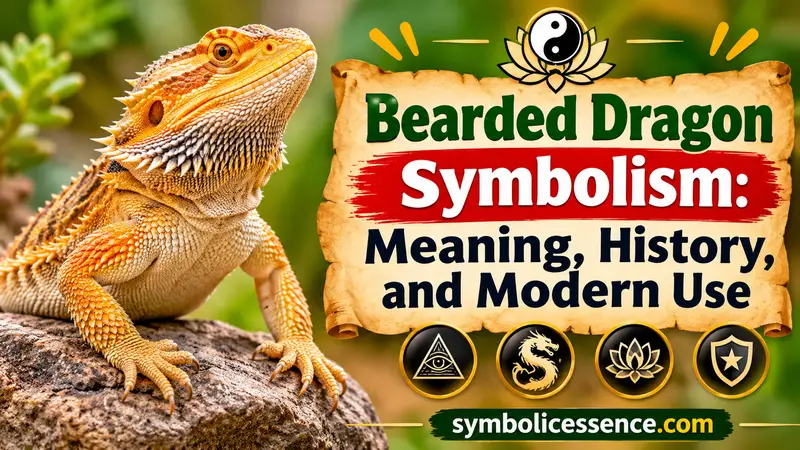
A bearded dragon is a small Australian lizard known for its triangular head, spiny body, and expandable throat pouch. When threatened or displaying dominance, it can darken the skin beneath its chin, creating the appearance of a beard. Its calm behavior, alert expressions, and unusual appearance have made it a popular companion animal in American homes.
People searching for bearded dragon symbolism often want to understand what this reptile represents beyond its physical appearance. Some associate it with patience, adaptability, independence, and the ability to remain calm under pressure. Others connect it with curiosity, self-protection, and personal growth.
In the United States, this animal is familiar through pet ownership, wildlife education, tattoos, illustrations, and reptile communities. Its meaning is largely shaped by its natural behavior and the personal experiences people have with it rather than by one established religious or historical tradition.
Quick Answer
Bearded dragon symbolism commonly represents patience, resilience, adaptability, independence, and quiet confidence. These interpretations come mainly from the reptile’s Australian desert habitat, its ability to regulate its body temperature, and its defensive behavior when facing threats.
TL;DR
- Patience: Represents knowing when to wait instead of rushing.
- Resilience: Reflects survival in Australia’s challenging environments.
- Adaptability: Connects with adjusting to changing circumstances.
- Independence: Represents self-reliance and personal boundaries.
- Protection: Reflects the defensive display of its spiny beard.
- Curiosity: Connects with alertness and awareness of surroundings.
What Does a Bearded Dragon Look Like in Nature?
Bearded dragons belong to the genus Pogona, a group of lizards native to Australia. The central bearded dragon, scientifically known as Pogona vitticeps, is the species most commonly kept as a pet in American households.
Its body has several recognizable features:
- A broad, triangular head.
- Small pointed scales along its sides and throat.
- A thick, flattened body.
- Strong legs with sharp claws.
- A long tail that helps with balance.
- A throat pouch covered with spiny scales.
The throat pouch is especially important to its appearance. When the animal feels threatened, displays dominance, or communicates with another dragon, it may expand this area and darken its color.
Its natural colors include shades of tan, brown, yellow, orange, and gray. Captive breeding has also produced different color varieties, including red, citrus, and translucent forms.
In the wild, bearded dragons live in dry and semi-arid parts of Australia. They spend time on rocks, branches, and other elevated surfaces where they can bask in sunlight and watch their surroundings.
These physical and behavioral characteristics provide the foundation for many modern interpretations of the animal.
What Does a Bearded Dragon Symbolize Today?
The most common modern interpretations are connected to how the reptile behaves and survives.
Patience and Self-Control
Bearded dragons often spend long periods resting in warm locations. They do not constantly move around their environment. Instead, they alternate between basking, exploring, feeding, and resting.
People may interpret this behavior as a reminder to slow down and avoid reacting immediately to every situation.
For someone dealing with a stressful period, the animal can represent the value of waiting, observing, and choosing a response carefully.
Resilience and Survival
These reptiles live in environments where temperatures and water availability can change considerably.
Their ability to survive in dry habitats makes them a natural image of endurance. In personal symbolism, they can represent continuing through difficult circumstances without losing the ability to adjust.
Independence
A bearded dragon can spend time alone and does not require the same kind of social interaction as many traditional companion animals.
This characteristic makes it an appealing symbol of independence and personal space.
It can represent someone who enjoys companionship but also values having time to themselves.
Protection and Boundaries
Its spiny appearance and defensive beard create a noticeable contrast with its generally calm behavior.
This contrast can represent a person who is peaceful but knows when to protect themselves.
The interpretation is especially relevant to people who are learning to establish healthier personal boundaries.
Where Did Bearded Dragon Symbolism Originate?
Unlike the eagle, lion, or snake, the bearded dragon does not have one widely established symbolic tradition shared across different civilizations.
Its modern meaning developed mainly through its natural environment, Australian wildlife associations, and growing popularity as a companion animal.
The reptile’s Australian origins are an important starting point.
Australian Natural History
Bearded dragons evolved in Australia’s varied inland environments. Their ability to bask, climb, change their appearance, and respond to environmental conditions makes them interesting examples of reptile adaptation.
Early European scientific descriptions helped introduce these animals to Western zoology.
The central bearded dragon was scientifically described in the early twentieth century, although its classification and naming have changed over time.
These scientific records did not establish a universal symbolic meaning. Instead, they helped make the animal recognizable to researchers, wildlife enthusiasts, and eventually pet owners.
Growth of the Pet Trade
During the late twentieth century, bearded dragons became increasingly popular in the international reptile trade.
Captive breeding helped make them available to American reptile enthusiasts. Their manageable size, distinctive appearance, and relatively calm temperament contributed to their popularity.
As more people began keeping them as pets, their meaning became connected to everyday experiences such as responsibility, companionship, observation, and care.
This is an important distinction: many modern interpretations come from relationships between people and their pets, not from documented ancient beliefs.
What Does a Bearded Dragon Represent in American Culture?
In the United States, the bearded dragon is best known as an exotic companion animal and an educational reptile.
Its cultural associations are different from those of animals that have long-standing roles in American holidays, national symbols, or religious traditions.
Pet Ownership and Responsibility
Many American families choose bearded dragons because they are interesting to observe and can become familiar with regular handling.
For children, caring for one can introduce practical lessons about responsibility.
A proper enclosure, controlled temperatures, suitable lighting, fresh water, and a balanced diet all require attention.
Consequently, the animal can represent consistency and the responsibility involved in caring for another living creature.
Reptile Education
Zoos, wildlife centers, schools, and reptile education programs sometimes use bearded dragons to introduce people to reptiles.
Their visible behaviors make them useful educational animals.
For example, students can observe basking, feeding, shedding, and communication through body movements.
In this setting, the reptile can represent curiosity, learning, and respect for wildlife.
Individual Identity
Some Americans connect with the animal because they see their own personality reflected in it.
A quiet person may appreciate its relaxed appearance. Someone who values independence may identify with its solitary habits.
Others enjoy its unusual appearance because it stands apart from familiar household pets.
These interpretations are personal rather than nationally established beliefs.
What Does Its Desert Habitat Represent?
The Australian environment provides another source of modern interpretations.
Bearded dragons live in areas where they must respond to heat, sunlight, limited water, and changing weather conditions.
Their natural behavior offers several useful symbolic associations.
Adaptation to Change
Bearded dragons are ectothermic animals, meaning they depend on external heat sources to regulate their body temperature.
They move between warmer and cooler locations as needed.
People may interpret this behavior as a reminder that adapting does not always mean making a dramatic change. Sometimes it means recognizing the conditions around you and adjusting your actions.
Making Use of Available Resources
A bearded dragon uses rocks, branches, sunlight, and sheltered areas to meet its needs.
This can represent resourcefulness: making practical use of what is available instead of waiting for ideal circumstances.
Knowing When to Rest
Basking is a normal part of a bearded dragon’s daily behavior.
Rather than treating rest as wasted time, people can interpret this habit as a reminder that recovery supports continued activity.
The association is especially meaningful in a culture where busy schedules often leave little room for breaks.
What Does a Bearded Dragon’s Beard Symbolize?
The animal’s beard is its most recognizable feature and an important part of its communication.
When threatened or displaying dominance, a bearded dragon may expand its throat pouch and darken the scales underneath its chin.
This behavior gives the animal a larger, more noticeable appearance.
As a symbolic image, the beard can represent:
- Self-protection: Recognizing when personal boundaries need defending.
- Confidence: Showing that a calm appearance does not mean helplessness.
- Courage: Facing uncomfortable situations without immediately backing away.
- Communication: Expressing discomfort through visible behavior.
- Awareness: Recognizing potential threats before responding.
However, the beard is not simply a sign of aggression. Bearded dragons use body language in several situations, and a darkened beard can have different explanations.
For example, stress, temperature, social interactions, and other environmental factors can influence coloration.
The symbolic interpretation should not be confused with a scientific explanation of every color change.
Does a Bearded Dragon Symbolize Good Luck or Protection?
There is no widely documented historical tradition that establishes the bearded dragon as a universal good-luck charm.
However, some modern owners and animal enthusiasts associate it with positive qualities.
Good Luck
Its association with good fortune is generally personal rather than traditional.
Someone might consider a bearded dragon lucky because adopting one introduced companionship, routine, or happiness into their home.
A bearded dragon appearing in a personal illustration or gift can also represent a positive new beginning.
Protection
Protection is a more direct interpretation of its defensive appearance.
Its expanded beard and spiny body provide a natural image of standing one’s ground.
For people who use animal imagery to express personal values, this can represent emotional safety and the importance of setting limits.
Neither interpretation means that the animal can predict future events or prevent misfortune.
What Is the Emotional and Psychological Meaning?
People often connect with animals because their behavior reminds them of familiar human experiences.
A bearded dragon offers an interesting combination of calmness, alertness, independence, and defensive behavior.
Comfort and Companionship
Pet owners may develop strong emotional connections with their reptiles.
A bearded dragon that becomes familiar with its surroundings and regular caretaker can provide a sense of companionship.
Watching it bask, explore, or respond to familiar routines may also become a relaxing part of everyday life.
Confidence Without Constant Attention
The reptile’s appearance is unusual, but it does not need to be constantly active or demanding to attract attention.
Some people identify with this quality.
They may see it as an image of being comfortable with one’s personality without needing constant approval.
Personal Space
Bearded dragons have individual behavior patterns and may react differently to handling and environmental changes.
Their need for suitable space and careful handling can remind owners that healthy relationships involve respecting boundaries.
This association can be particularly meaningful for people learning to balance social relationships with personal independence.
What Does a Bearded Dragon Tattoo Mean?
Bearded dragon tattoos are a relatively personal form of animal-inspired body art.
Unlike traditional tattoo symbols with established meanings, their interpretation depends largely on the wearer.
Common associations include:
Resilience: A dragon tattoo can represent overcoming difficult circumstances and continuing forward.
Individuality: Its unusual shape and recognizable beard make it suitable for someone who prefers less common animal designs.
Protection: The spiny body can represent standing up for oneself.
Companionship: Some people choose the design to remember a pet that has been part of their family.
Connection to Australia: The animal can represent an interest in Australian wildlife, travel, or the natural world.
Design choices can also change the meaning.
A realistic portrait may honor a particular pet, while a geometric design may emphasize independence and personal identity.
An illustration showing the reptile resting on a branch can communicate calmness rather than defense.
How Is the Animal Used in Jewelry, Fashion, and Home Decor?
Bearded dragon imagery appears in niche reptile merchandise, handmade crafts, accessories, and decorative artwork.
Its distinctive head and spiny outline make it easy to recognize even in simplified illustrations.
| Context | Meaning in USA | Common Associations | Notes |
| Pet-themed jewelry | Companionship and affection | Loyalty, memories, personal connection | Often chosen by reptile owners |
| Tattoos | Individual identity | Resilience, independence, protection | Meaning depends on design and wearer |
| Home decor | Interest in wildlife | Curiosity, nature, individuality | Common in reptile-themed rooms |
| Clothing and accessories | Personal interests | Humor, uniqueness, animal appreciation | Often used in casual graphic designs |
| Artwork and illustrations | Creativity and observation | Adaptability, personality, nature | Can feature realistic or cartoon styles |
In home decor, bearded dragon images may appear on posters, stickers, ceramic items, and decorative signs.
Some owners also display photographs of their pets as personal keepsakes.
In fashion, cartoon-style illustrations can give the animal a friendly or humorous appearance. More realistic designs tend to emphasize its unusual physical features.
These uses are generally expressions of personal interest rather than signs of a shared cultural tradition.
Does a Bearded Dragon Have Religious or Spiritual Meaning?
There is no single established religious meaning associated specifically with the modern bearded dragon.
It is not a central symbol in major American religious traditions such as Christianity, Judaism, Islam, or Buddhism.
People may still give the animal personal spiritual interpretations.
For example, someone may view it as a reminder to remain patient during a difficult period or to protect personal boundaries.
Others may associate its ability to adapt to environmental changes with accepting life’s natural transitions.
These are individual interpretations, not universal religious teachings.
It is also important to distinguish general lizard symbolism from the specific cultural meaning of the bearded dragon. A tradition that assigns meaning to a particular lizard or reptile should not automatically be applied to every species.
Are Bearded Dragons Connected to Australian Aboriginal Traditions?
Australia has many Aboriginal cultures, each with distinct histories, languages, stories, and relationships with the natural environment.
Lizards and other reptiles appear in some Indigenous Australian cultural traditions, including stories and visual representations connected with local landscapes and wildlife.
However, it would be inaccurate to claim that all Aboriginal communities assign one shared meaning to the bearded dragon.
A specific, widely established traditional interpretation of the central bearded dragon is not sufficiently documented to support a universal claim.
This distinction matters because cultural symbols should be understood within their actual community and historical setting.
The animal’s Australian origin does not automatically make every modern interpretation an Aboriginal tradition.
Common Misunderstandings
Several assumptions can lead people to misunderstand this animal’s meaning.
They Are Always Aggressive
The beard and spiny appearance can make the reptile look intimidating.
However, bearded dragons are often calm when properly cared for and handled appropriately.
Their defensive displays are natural responses, not proof of an aggressive personality.
They Represent Ancient Spiritual Knowledge
Some modern online interpretations describe the animal as a messenger of ancient wisdom.
There is no strong historical evidence establishing this as a traditional, widely recognized meaning.
It is better understood as a contemporary personal interpretation.
They Are Naturally Lucky Animals
A bearded dragon does not have a universally established reputation as a good-luck animal.
Its association with positive experiences generally comes from individual owners and modern symbolic creativity.
Every Bearded Dragon Has the Same Personality
Individual animals can differ in temperament, behavior, and comfort with handling.
One may be particularly curious, while another prefers spending more time resting.
These differences are important because personal symbolism often develops from direct experiences with a particular animal.
How Has the Meaning Changed Over Time?
The modern interpretation of this reptile developed through several stages.
Before widespread international pet ownership: Bearded dragons were primarily part of Australia’s native wildlife. Their meaning outside their natural environment was limited.
Early twentieth century: Scientific descriptions helped establish their place in reptile classification and natural history.
Late twentieth century: Growing interest in captive reptile keeping introduced them to more American households. Their calm behavior and distinctive appearance became familiar to pet enthusiasts.
Early twenty-first century: Online reptile communities, pet photography, and social media made individual bearded dragons more visible to wider audiences.
2025–2026: The animal continues to appear in pet communities, educational content, handmade merchandise, tattoos, and personal artwork. Its modern associations often focus on independence, responsible care, patience, and adaptability.
The most noticeable change is the shift from viewing the reptile mainly as an unfamiliar Australian animal to recognizing it as a familiar companion and an expression of individual personality.
How to Interpret a Bearded Dragon in Your Own Life
The meaning of an animal symbol often depends on the situation in which someone encounters it.
A bearded dragon in a pet shop, a tattoo, a photograph, and a dream does not necessarily communicate the same idea.
Consider the details before assigning a meaning.
- A calm, resting dragon: You might associate it with patience and the importance of taking a break.
- A dragon displaying its beard: It may represent boundaries, self-defense, or standing up for yourself.
- A dragon exploring its surroundings: You might connect it with curiosity and learning.
- A dragon shedding its skin: It can serve as a personal image of change and renewal.
- A dragon basking in sunlight: You may interpret it as a reminder to make room for rest and recovery.
These interpretations are reflective tools, not predictions.
For example, someone starting a new job might appreciate the animal’s association with adaptation. A person recovering from a difficult experience might connect with its ability to respond to challenging environments.
The most useful interpretation is one that relates naturally to the person’s circumstances.
FAQs
Is a bearded dragon considered a positive or negative symbol?
It is generally interpreted positively in modern personal symbolism. Patience, independence, adaptability, and self-protection are among its most common associations, although its defensive appearance can also represent caution.
Does a bearded dragon symbolize transformation?
It can represent transformation because bearded dragons periodically shed their skin as they grow. This natural process can serve as a personal metaphor for leaving behind an earlier stage of life, although shedding itself is a normal biological process.
What does a black beard on a bearded dragon mean symbolically?
Some people interpret a darkened beard as an image of confidence, protection, or expressing discomfort. In real animals, beard darkening can occur for several reasons, including stress, temperature changes, and social behavior.
Why are bearded dragons associated with patience?
They spend considerable time basking and observing their surroundings rather than moving constantly. People often connect this behavior with taking time to assess a situation before acting.
Does a bearded dragon represent independence?
Yes, independence is a common modern interpretation. Its ability to spend time alone and its relatively solitary natural behavior make it an appealing image for people who value personal space and self-reliance.
What does a bearded dragon symbolize in a home?
A bearded dragon in a home can represent companionship, responsibility, and an interest in wildlife. For families with pet reptiles, it may also represent shared routines and the experience of caring for an animal.
Is a bearded dragon an Australian cultural symbol?
It is an animal native to Australia and can represent Australian wildlife and biodiversity. However, it is not accurate to describe it as a universal Aboriginal spiritual symbol or a nationally recognized Australian emblem.
Conclusion
Bearded dragon symbolism is mainly associated with patience, resilience, adaptability, independence, and protection. These meanings come from the reptile’s natural behavior, its Australian habitat, and the experiences people develop through pet ownership and wildlife education.
In modern American culture, the animal has become more than an unusual-looking lizard. It appears in tattoos, artwork, accessories, and personal expressions of identity. For some people, it represents the ability to remain calm while still knowing when to defend personal boundaries.
Its appeal comes partly from this contrast. A bearded dragon can look tough while behaving calmly, spend time alone without appearing helpless, and adapt to its surroundings without constant movement. That combination gives people a recognizable image of quiet confidence and practical resilience.