
Last Updated: September 10, 2026
Bees hold a strange kind of cultural weight for such small creatures. People plant gardens to attract them, worry when their numbers decline, and still instinctively step back when one buzzes too close. Bee symbolism draws on all of that — the industry, the community, the sting, and increasingly, the concern for their survival — making it one of the more layered animal symbols in everyday American life.
Interest in bee symbolism tends to come from a few directions: people drawn to the idea of hard work and teamwork, those who’ve encountered bee imagery in jewelry or tattoos, and a growing number who associate bees with environmental awareness. Because bees sit at the intersection of nature, industry, and now conservation, their symbolism has kept evolving well past its older, simpler meanings.
This article walks through where bee symbolism began, how it developed across different cultures, and why the same insect can represent both tireless labor and fragile ecological balance in modern America.
Quick Answer
Bee symbolism in modern American culture most commonly represents hard work, community, and productivity, along with a newer meaning tied to environmental fragility and the importance of pollinators. Historically, bees were associated with royalty, immortality, and divine order in ancient Egyptian, Greek, and Christian traditions.
TL;DR
- Bee symbolism centers on hard work, cooperation, and productivity.
- Ancient Egypt linked bees to royalty and organized, divine order.
- Christian tradition connected bees to community and disciplined effort.
- American culture ties bees to industriousness and environmental urgency.
- Modern usage spans tattoos, jewelry, brand logos, and conservation messaging.
- Bee decline has added a newer layer of fragility to older meanings.
What a Bee Looks Like and Where People Encounter One
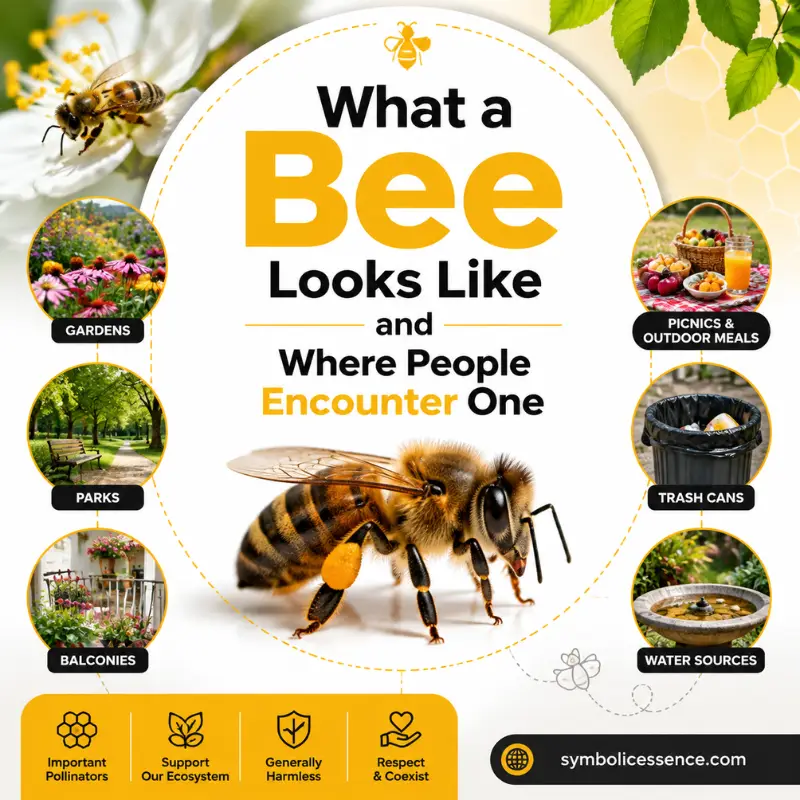
The honeybee is the species most Americans picture when they think of bee symbolism — a small, fuzzy, black-and-yellow-striped insect seen hovering around flowers, gardens, and orchards. Beyond honeybees, the U.S. is also home to thousands of native bee species, many solitary rather than hive-based, though these rarely factor into popular symbolism the way the honeybee does.
Most people encounter bees briefly and outdoors: in a backyard garden, at a farmers market honey stand, or in late-summer stories about swarms. That combination of familiarity and slight caution — welcome around flowers, unwelcome up close — shapes much of how the symbol is understood.
The Core Meaning Behind Bee Symbolism
At its foundation, bee symbolism is about organized effort that benefits something larger than the individual. A single bee produces very little on its own; the value comes from thousands of bees working in coordinated roles inside a hive. That structure is the basis for the bee’s long-standing association with hard work, cooperation, and productivity.
The sting adds a second, smaller layer to the symbolism — a reminder that even a hardworking, cooperative creature can defend itself sharply when necessary. Unlike predator symbolism built around aggression, the bee’s defensive trait is understood as a last resort tied to protecting the group, not the individual.
What Does a Bee Symbolize Spiritually?
A bee can symbolize spiritual purpose, community, diligence, protection, and the value of small actions. Its life revolves around cooperation and a shared purpose, so many spiritual interpretations use the bee as a reminder that individual effort can contribute to something much larger.
The bee can also represent balance between giving and receiving. Bees gather nourishment from flowers while helping plants reproduce through pollination. Symbolically, this creates an image of exchange: taking what is needed while contributing something valuable in return.
For some people, seeing a bee feels like a reminder to stay focused on meaningful work rather than immediate results. The bee does not build its hive through one dramatic act. Instead, it makes countless small contributions. That makes it a useful symbol for patience, consistency, and progress.
The bee’s ability to defend its hive adds another spiritual layer. It can represent healthy boundaries, courage, and protecting the people or values that matter most. In this interpretation, the bee is not primarily a symbol of aggression; it represents knowing when protection becomes necessary.
Spiritual bee symbolism therefore tends to emphasize purposeful action, connection, protection, and perseverance rather than predicting a specific event. The personal meaning often depends on the circumstances in which someone encounters the bee.
Historical Origins of Bee Symbolism
Bee symbolism has some of the oldest continuous roots of any animal symbol, tracing back to ancient Egypt, where the bee was closely tied to kingship and appeared in royal titles as a symbol of Lower Egypt. Bees were seen as orderly, industrious, and connected to the sun god Ra, with an early belief that bees were born from his tears.
In ancient Greece, bees were associated with the oracle at Delphi and were sometimes described as messengers between the human and divine worlds. Greek and Roman writers also praised the hive as a model of ideal social order, a comparison that would echo for centuries in Western thought about community and labor.
Bee Symbolism in Religious and Cultural Tradition
Beyond ancient Egypt and Greece, bee symbolism carried significant weight in Christian tradition, where the hive was frequently used as a metaphor for a well-run, disciplined community — every member contributing to a shared purpose without complaint. Beeswax candles also held a place in religious ceremony, valued for burning cleanly, which added a layer of purity to the bee’s already positive symbolism.
In Hindu tradition, bees appear in association with several deities and are sometimes linked to desire and devotion, occasionally depicted hovering near a deity’s forehead. Across these varied traditions, the recurring theme is order — bees representing a natural world that runs with purpose and structure rather than chaos.
Bee Symbolism in the Bible
Bees have a more limited and less straightforward role in the Bible than some animals, so biblical bee symbolism should not be confused with later Christian folklore. When bees or bee-related imagery appear in biblical passages, the emphasis often connects with danger, abundance, or the natural world rather than a single universal symbolic meaning.
One of the best-known biblical references occurs when enemies are described as surrounding a person like bees. This imagery emphasizes the threatening nature of a large group of attackers. It shows that biblical bee imagery can carry a negative meaning when the context focuses on swarming danger.
At the same time, bees are connected indirectly with the biblical theme of honey and abundance. Honey appears repeatedly in Scripture as an image associated with sweetness and the richness of the promised land. However, readers should distinguish the symbolism of honey from the symbolism of the bee itself.
Later Christian traditions developed additional meanings for bees. The organized hive became a metaphor for disciplined community, while beeswax became associated with purity and religious candle-making. These interpretations influenced Christian art and devotional symbolism over the centuries, even though they do not all come directly from biblical passages.
For this reason, the safest interpretation of bee symbolism in Christianity is contextual. A bee may suggest community, diligence, danger, sweetness, or divine order, depending on the tradition and the specific imagery being used.
Bee Symbolism in the United States
American bee symbolism draws heavily on the older themes of industriousness but reframes them in distinctly American terms tied to labor, self-reliance, and the value of hard work rewarded by tangible results — a message that resonated strongly during the country’s agricultural and early industrial periods. The phrase “busy as a bee” became a common shorthand for productivity long before it became a cliché, reflecting how deeply the association took hold in everyday language.
Beekeeping itself has a long American history, particularly as European colonists brought honeybees to North America, where they weren’t native. That practical, working relationship with the animal helped cement the bee’s American identity as useful and hardworking rather than purely symbolic or decorative.
What Does It Mean When a Bee Lands on You?
When a bee lands on you, it can feel unusually meaningful because bees normally move quickly from flower to flower. Symbolically, people often interpret the experience as a reminder to slow down, pay attention, or notice something they have been overlooking.
A bee landing on you can represent focus and purposeful action. Since bees spend their lives gathering resources and supporting their colony, the encounter may inspire reflection about your own work, responsibilities, or contribution to others.
Some people also interpret the experience as a symbol of community and connection. The bee’s life depends on cooperation, so its appearance can serve as a reminder that personal goals do not always exist separately from family, friendships, work, or community.
The bee’s defensive nature creates another possible meaning: protect your boundaries without becoming unnecessarily aggressive. A bee can be peaceful around flowers but capable of defending itself when threatened.
There is no scientifically established spiritual message attached to a bee landing on someone. Its symbolic meaning depends on personal beliefs and context. From a practical perspective, the safest response is simply to remain calm and allow the bee to move away rather than swatting at it.
Bee Symbolism in American Design, Holidays, and Public Life
Bees show up frequently in American civic and organizational symbolism, most notably as the mascot for spelling bees, a distinctly American tradition where the insect’s association with focused, individual effort gets applied to academic achievement. The name itself likely borrows from an older use of “bee” to describe a community gathering for shared work, like a quilting bee, extending the insect’s cooperative symbolism into human social events.
Bees also appear on state symbols, seals, and agricultural branding across several U.S. states with strong farming or beekeeping traditions, usually chosen specifically to represent productivity and industry rather than any deeper folklore meaning.
Cross-Cultural Meaning Beyond the United States
Outside the U.S., bee symbolism carries similarly strong associations with community and industry, though the emphasis shifts by region. In French history, the bee became strongly tied to Napoleon Bonaparte, who adopted it as a personal emblem to symbolize immortality and resurrection, deliberately linking his rule to ancient symbols of order and continuity.
In parts of Slavic and Eastern European folklore, bees are sometimes treated as messengers connected to the souls of the dead, expected to be informed of major family events like births or deaths — a tradition rooted in the idea that bees maintain a connection between the every day and the sacred.
Bee Symbolism in Literature and Storytelling
In literature, bees often work as compact symbols for industry, social order, community, desire, and the tension between individual freedom and collective responsibility. Writers can use a hive to represent an organized society in which every individual has a role.
The bee’s productivity makes it an especially effective metaphor for human labor. A character described as “busy as a bee” may appear energetic and dependable, but the comparison can also carry criticism. Constant work can suggest dedication, yet it can also hint at exhaustion or a life dominated by obligations.
The hive creates a second literary possibility. Because thousands of bees operate together, authors can use the hive to explore questions about conformity and individuality. The image can praise cooperation while also asking what happens when personal desires conflict with the needs of a larger group.
Bees can also symbolize sweetness and danger at the same time. Honey suggests pleasure and abundance, while the sting introduces pain and defense. This contrast makes bee imagery useful when a story explores relationships, attraction, temptation, or situations that appear harmless but contain hidden risks.
Modern environmental writing adds another layer. The bee can represent the vulnerability of nature and humanity’s dependence on ecosystems that are easy to overlook. As a result, contemporary bee symbolism can move from a metaphor for human productivity to a reminder of ecological responsibility.
Emotional and Psychological Symbolism
Psychologically, bee symbolism tends to appeal to people who value contribution over individual recognition — the idea that consistent, cooperative effort adds up to something meaningful, even if no single contribution stands out on its own. It resonates with a mindset built around teamwork, discipline, and trust in a shared system.
There’s also a protective undercurrent tied to the bee’s willingness to defend the hive even at personal cost, since a honeybee typically dies after stinging. That trait has given the bee a quieter symbolism around sacrifice for the good of the group, distinct from its more visible reputation for productivity.
Bee Symbolism in Dreams
Bee dreams can take several meanings depending on what the bees are doing and how you feel during the dream. Because bees commonly symbolize work, community, productivity, and protection, these themes often provide the most useful starting point for interpretation.
Dreaming of a busy hive may reflect teamwork, responsibilities, or a highly organized period of life. It can suggest that many small tasks are demanding attention at once.
Dreaming of a single bee can place more emphasis on individual effort. It may represent a small responsibility, an opportunity, or a personal contribution that seems minor but still matters.
Being stung by a bee can symbolize conflict, hurt feelings, criticism, or a boundary that has been crossed. The emotional reaction in the dream matters. Fear may point toward anxiety, while anger could suggest resentment or a need to defend yourself.
Seeing a swarm of bees may represent overwhelming activity, social pressure, or a situation that feels difficult to control. In a more positive dream, however, the swarm can symbolize collective energy and coordinated action.
Watching bees pollinate flowers may suggest growth, creativity, or the idea that one effort is helping create future results. It can be especially meaningful when the dream has a peaceful or hopeful emotional tone.
Dream symbolism is personal rather than universal. A bee dream does not automatically predict an event or carry one fixed spiritual message. Your emotions, recent experiences, and the specific behavior of the bees usually provide the strongest clues.
Why Bees Appear in Tattoos and Jewelry
Bee tattoos have become increasingly popular in recent years, often chosen by people who want to signal hard work, resilience, or a connection to community and family. The image also carries personal meaning for many as a tribute to a loved one, since the bee’s short lifespan and self-sacrificing nature lend it naturally to memorial tattoo designs.
In jewelry, bee motifs are common in both fine and costume pieces, frequently tied historically to French design influenced by Napoleon’s use of the symbol, and more recently adopted by fashion brands looking to signal both elegance and quiet strength.
Bee Symbolism in Modern Pop Culture and Digital Life
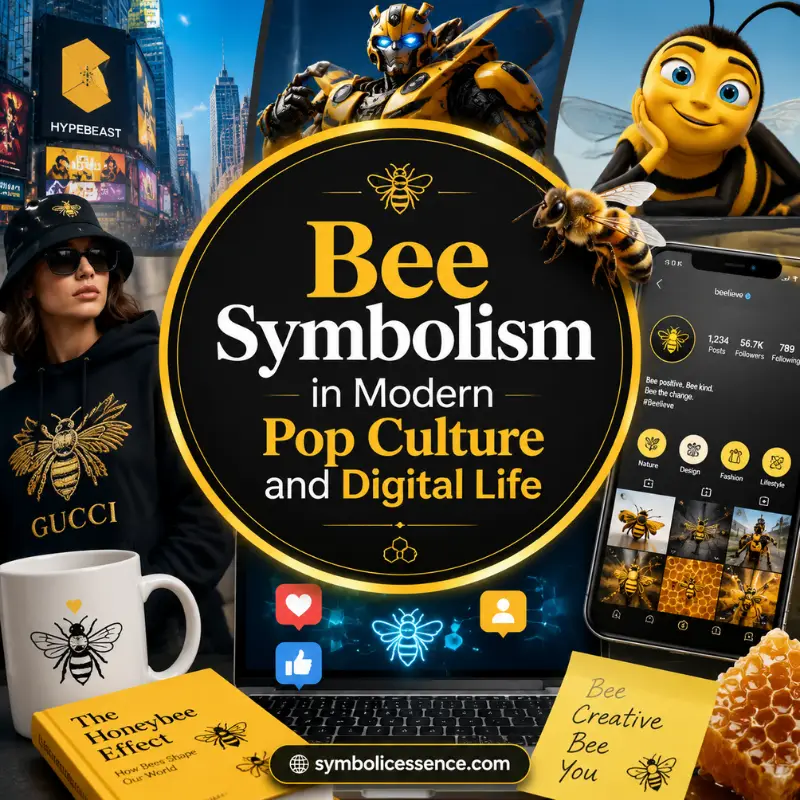
Bee imagery has taken on new visibility through environmental messaging, with “save the bees” becoming a widely recognized cultural phrase tied to concerns about pollinator decline and its impact on food production. This has shifted some of the bee’s modern symbolism away from pure industriousness and toward fragility and ecological responsibility.
On social media, bee content ranges from educational posts about pollinator health to lighter, meme-driven use of the “busy bee” idea to describe someone overcommitted or constantly working. Both uses draw on the same underlying symbolism, just applied to very different tones.
Common Misunderstandings About Bee Symbolism
A common misunderstanding is treating all stinging insects as equally symbolic of the bee’s traditional meaning, when wasps and hornets carry a notably different, more aggressive reputation in folklore and popular culture. The bee’s symbolism specifically depends on its cooperative, non-aggressive behavior, which sets it apart from other stinging insects despite frequent confusion between them.
Another misconception is assuming the bee’s sting defines its symbolism, when historically the far larger association has always been with labor, order, and community rather than danger.
Bee Symbolism, Controversies, and Misuse
Bee symbolism has occasionally been used in branding or messaging in ways that overstate urgency around pollinator decline without full context, since not all bee species face the same level of risk — a nuance often lost in simplified conservation messaging. This doesn’t undermine the real ecological concerns tied to pollinator health, but it does mean the “save the bees” symbolism is sometimes applied more broadly than the underlying science supports.
Historically, the bee’s association with order and hierarchy was also occasionally used to justify rigid social structures, comparing human class systems to a hive with a queen and worker roles. That usage reflects a selective, outdated reading of bee behavior rather than the animal’s actual, more nuanced symbolism.
How Bee Symbolism Has Evolved Over Time
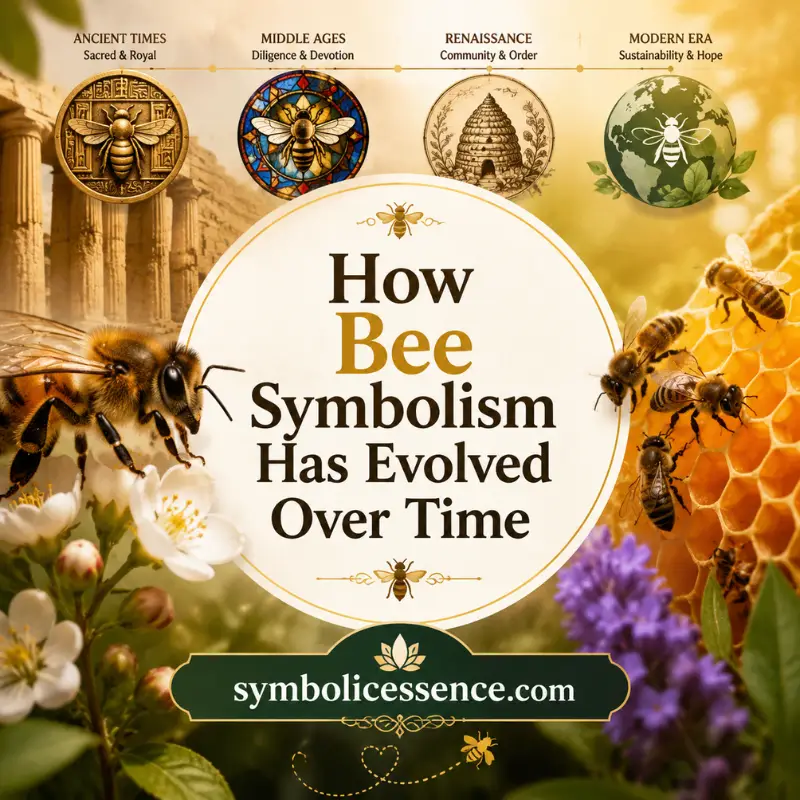
Early bee symbolism centered on divine order, royalty, and disciplined community, reflecting how ancient societies viewed the hive as a model worth imitating. Over the following centuries, meaning shifted toward more everyday associations with hard work and productivity, particularly as beekeeping became a practical, widespread activity rather than a subject of religious reverence.
In recent decades, bee symbolism has added an entirely new dimension tied to environmental concern, transforming an insect once celebrated purely for its productivity into a symbol of ecological fragility as well. That shift hasn’t replaced the older meanings so much as layered a new one on top of them.
Bee Symbolism at a Glance
| Context | Meaning in the USA | Common Associations | Notes |
|---|---|---|---|
| Ancient tradition | Divine order, royalty | Egypt, Greece, Delphi oracle | Rooted in some of the oldest animal symbolism on record |
| Everyday language | Hard work, productivity | “Busy as a bee,” spelling bees | Deeply embedded in American idiom |
| Religious symbolism | Community, discipline | Hive as model of order | Present across Christian and Hindu traditions |
| Tattoos and jewelry | Resilience, tribute | Memorial ink, French-inspired design | Often chosen for personal, sentimental meaning |
| Environmental messaging | Fragility, ecological urgency | Pollinator decline, “save the bees” | A newer layer added to older meanings |
FAQs
What does a bee symbolize spiritually?
Spiritually, bees are often associated with divine order, community, and purposeful effort, drawing on traditions from ancient Egypt, Greece, and Christian symbolism. Some folk traditions also treat bees as messengers between the earthly and spiritual worlds, particularly in parts of Eastern Europe.
What does a bee tattoo mean?
A bee tattoo commonly represents hard work, resilience, and community, though it’s also frequently chosen as a memorial tribute to a loved one. The bee’s short lifespan and self-sacrificing behavior make it a natural symbol for remembrance.
Why is the bee associated with royalty?
The association dates back to ancient Egypt, where the bee appeared in royal titles as a symbol of Lower Egypt and was linked to organized, divine rule. Centuries later, Napoleon Bonaparte revived this connection in France, adopting the bee as a personal emblem of continuity and power.
Is bee symbolism positive or negative?
Bee symbolism is overwhelmingly positive, centered on hard work, cooperation, and community rather than aggression or danger. Any negative association mainly comes from the sting itself, which represents protection of the group rather than hostility.
What does it mean when bee symbolism is used in environmental messaging?
In this context, bees represent the broader health of pollinator populations and their critical role in food production, making the bee a stand-in for ecological balance rather than just individual hard work. This meaning is newer than the bee’s traditional symbolism but has become increasingly common in American culture.
How is modern bee symbolism different from ancient meanings?
Ancient symbolism focused on divine order, royalty, and structured community, while modern American symbolism leans more toward everyday productivity and, increasingly, environmental concern. Both versions share the same underlying respect for the bee’s cooperative, purposeful behavior.
What is the difference between bee and wasp symbolism?
Bee symbolism usually emphasizes community, productivity, cooperation, and protection. Wasp symbolism is more often associated with aggression, conflict, warning, or assertiveness. These meanings come from different cultural perceptions of the insects rather than a universal symbolic rule.
What does a bee symbolize in the Bible?
Biblical bee imagery is contextual rather than tied to one fixed meaning. Bees can appear in imagery involving swarming danger, while honey carries separate associations with sweetness and abundance. Later Christian traditions also connected bees with disciplined community and purity.
Conclusion
Bee symbolism has managed to hold onto its core meaning — organized, purposeful effort — while adding new layers over thousands of years, from ancient royal emblems to a modern shorthand for ecological balance. Few animal symbols have stayed this consistent in meaning while still finding new cultural relevance generation after generation.
What makes bee symbolism particularly resonant today is that both its oldest and newest meanings point toward the same idea: small, coordinated effort adds up to something the individual could never achieve alone. That’s as true in an ancient hive carving as it is in a modern conversation about protecting pollinators.